


Thailand’s tropical monsoon climate creates a distinct annual cycle of heavy rain, river overflow and coastal storm surges that translate into material flood risk for residents and businesses. For individuals and organizations evaluating relocation, understanding how monsoon seasons operate, how flood exposure varies across regions, and how climate change is altering these patterns is essential for long-term planning and risk management.
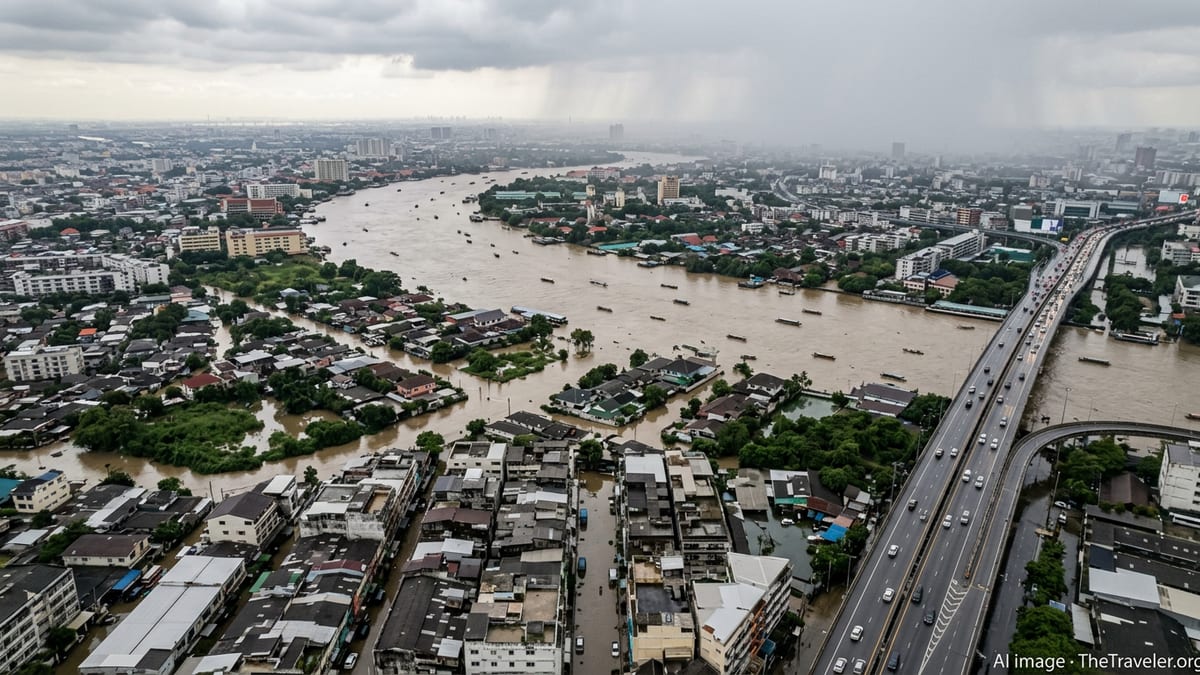
Overview of Thailand’s Monsoon Climate and Flood Profile
Thailand is consistently ranked among the most flood-affected countries globally, with riverine, flash and coastal flooding identified as its primary climate-related hazards. National exposure reflects both natural factors, such as the monsoon systems that dominate rainfall patterns, and human factors, including land subsidence, urbanization on floodplains and changing land use. For prospective relocators, this means that location choice within Thailand can greatly influence day-to-day exposure to heavy rainfall and potential disruption from flooding.
The country experiences two main monsoon systems. The southwest monsoon typically brings widespread rainfall from approximately May to October, affecting most of the country, while the northeast monsoon from around November to February delivers intense rain to the eastern coast of the South and parts of the Gulf of Thailand. Interactions with regional climate phenomena such as El Niño and La Niña can markedly intensify or suppress seasonal rainfall, leading to years of abnormal drought or extreme flooding.
Recent assessments indicate that climate change is increasing the intensity of heavy rainfall events in Southeast Asia, contributing to more frequent and severe floods. Regional climate risk profiles project that the number of people affected annually by riverine flooding in Thailand could roughly double from several hundred thousand in 2010 to well over one million by 2030, while expected urban flood damage is projected to increase by several times over similar time horizons. These trends suggest that flood and monsoon risk should be considered as long-term structural features of the Thai climate, rather than short-term anomalies.
The practical implication for relocation planning is that flood risk in Thailand is not limited to rare disasters. Seasonal inundation, road closures and localized flooding are common in many urban and peri-urban areas during peak monsoon months, and are likely to remain so, even as mitigation infrastructure improves.
Seasonality: How Monsoon Timing Shapes Living Conditions
Thailand’s rainfall distribution is highly seasonal. The southwest monsoon generally begins to build in May, peaks between roughly August and October, and tapers off by late October or early November. During this period, large parts of the North, Northeast and Central regions, including the Chao Phraya River basin, can receive a substantial majority of their annual rainfall. Daily life in these regions during peak months often involves frequent heavy showers or thunderstorms, intermittent flooding in low-lying areas and occasional disruptions to transport and outdoor activity schedules.
The northeast monsoon has a different spatial focus. From about November to February, strong winds from the northeast bring heavy rainfall primarily to the east coast of the southern peninsula bordering the Gulf of Thailand. Provinces such as Surat Thani, Nakhon Si Thammarat, Phatthalung and Songkhla often see their most significant floods in this period, with events sometimes extending into March depending on atmospheric conditions and the passage of tropical storms.
Year-to-year variability is influenced by large-scale climate patterns. La Niña episodes tend to enhance monsoon rainfall and raise the probability of widespread flooding, whereas El Niño often suppresses rainfall, increasing drought risk but not eliminating localized flash floods. Recent years have illustrated how these oscillations can swing conditions from below-average flooding to severe, multi-province inundation within a few seasons. As a result, relocators should view monsoon timing as predictable, but monsoon intensity as increasingly uncertain.
For professional planning, this seasonality translates into distinct annual risk windows. Offices, schools and industrial operations in flood-prone areas are most likely to face disruptions between August and October in the central and northern regions, and between November and January in the flood-vulnerable parts of the South. Relocating households and employers can mitigate disruption by scheduling critical moves, fit-outs and large outdoor works outside of these peak windows whenever possible.
Regional Flood Risk Patterns Across Thailand
Flood risk is not uniform across Thailand and varies meaningfully by region and even within cities. Broadly, the Chao Phraya River basin in Central Thailand, the low-lying coastal zones around the Upper Gulf of Thailand, and parts of the southern peninsula experience some of the highest flood exposure. Rural basins in the North and Northeast also face regular riverine flooding, although the impact profile differs from dense urban centers.
Bangkok and its neighboring provinces, including Samut Prakan and Pathum Thani, sit on a low-lying delta that historically functioned as a natural floodplain. Rapid urbanization has transformed much of this area into dense built-up zones, weakening natural drainage and increasing vulnerability to high river levels, heavy rain and coastal storm surges. Studies that combine projections of sea level rise with observed land subsidence suggest that without substantial adaptation, large portions of this urbanized delta could face frequent tidal or permanent inundation by mid-century.
Central and northern river basins such as those surrounding Ayutthaya, Nakhon Sawan and Sukhothai face recurrent upstream and midstream flooding when heavy monsoon rains combine with high reservoir levels. While these areas have benefitted from expanded flood defenses and better reservoir management since major floods earlier in the decade, they remain exposed to high-flow years and tropical storms that can produce intense, multi-day rainfall.
Southern Thailand, particularly the east coast provinces along the Gulf, has recently experienced some of the country’s deadliest and most disruptive floods. In late 2025, record-breaking rainfall produced catastrophic flooding across multiple southern provinces, with officially recorded fatalities in the hundreds and widespread displacement of households. For relocators considering coastal cities in the South, it is important to recognize that flood risk there is driven not only by monsoon rains but also by interactions with tropical cyclones that can now occasionally form or intensify in the nearby seas.
Urban Flooding, Bangkok’s Exposure and Sea Level Rise
Bangkok is frequently highlighted in international risk assessments as among the world’s most vulnerable major cities to coastal flooding and sea level rise. The city’s elevation in many districts is only a small margin above mean sea level, and decades of groundwater extraction have contributed to land subsidence. When combined with projections of sea level rise in the Upper Gulf of Thailand that may reach several tens of centimeters by around 2050, this creates a structural exposure to both storm surges and high-tide flooding.
Urban flooding in Bangkok arises from multiple interacting drivers. Heavy monsoon downpours can overwhelm drainage systems, leading to short-lived but disruptive street flooding even where no river overflow occurs. High river levels in the Chao Phraya and elevated sea levels at high tide can reduce the capacity of canals and pumping stations to discharge water, prolonging inundation in low-lying districts. In extreme scenarios, such as when upstream releases, local rainfall and high tides coincide, the combination can lead to widespread, multi-day flooding across metropolitan areas.
In response, authorities and private actors have invested in extensive drainage infrastructure, flood barriers and local mitigation measures. Industrial estates and new developments in some flood-prone zones have raised platform heights, installed temporary flood walls and enhanced pumping capacity. While these measures have reduced the frequency of severe urban floods compared with historical extremes, they have not eliminated routine seasonal flooding, and long-term sea level rise continues to erode safety margins.
For expatriates and organizations considering Bangkok, practical exposure will depend heavily on neighborhood selection, building elevation, and building-level protections. Many central business districts and newer residential developments incorporate robust drainage and elevation features, yet commuting routes may still pass through flood-prone corridors. Relocation planning should incorporate mapping of historical flood patterns within the metropolitan area rather than treating the city as a uniform risk zone.
Recent Flood Events and Emerging Climate Trends
Recent flood seasons in Thailand illustrate both the country’s chronic flood exposure and the influence of climate change on event severity. In 2024 and 2025, a sequence of regional floods affected several Southeast Asian countries, with Thailand experiencing extensive flooding in both central river basins and the southern peninsula. Late 2024 floods linked to persistent monsoon rainfall and storms affected more than one hundred thousand households in Thailand, with direct economic losses estimated in the billions of US dollars. The following year, southern Thailand endured record rainfall and its worst flood crisis in decades, with official tallies reporting over one hundred flood-related deaths in a single province and total Thai fatalities in the high hundreds across multiple provinces.
These events were part of a broader pattern of extreme rainfall in the region. Tropical Cyclone Senyar in late 2025, for example, was assessed by meteorologists as an unusually intense system for its low latitude and contributed to severe flooding not only in Indonesia and Malaysia but also in parts of southern Thailand. Rapid attribution studies suggest that ocean warming has made this kind of extreme rainfall significantly more likely compared with preindustrial climates, indicating that similar events could recur within planning horizons relevant to relocation decisions.
In northern Thailand, 2024 saw an intense flooding episode associated with seasonal storms that caused dozens of deaths, disrupted transportation and temporarily closed airports in affected provinces. Such events underline that elevated flood risk is not limited to the coastal delta and southern peninsulas, but extends into inland basins that combine complex river networks with steep terrain susceptible to flash floods and landslides.
Against this backdrop, national and international assessments describe Thailand’s overall climate risk trajectory as one where flood-related impacts on people, infrastructure and economic output are expected to increase without stronger adaptation. Projected increases in heat, changes in rainfall distribution and continued sea level rise all point toward a future in which high-impact flooding could become more frequent, even if year-to-year variability remains substantial.
Risk Management Capacity and Adaptation Considerations
Thailand has substantial experience managing flood disasters and has invested significantly in response capacity, yet adaptation challenges remain pronounced. National agencies responsible for disaster prevention and water resource management deploy early warning systems, reservoir coordination and emergency response mechanisms each rainy season. Satellite monitoring and hydrological modeling are increasingly used to anticipate flood peaks and guide reservoir releases to reduce downstream inundation.
Large-scale infrastructure, including dams, diversion channels, levees and urban drainage networks, provides a degree of protection for major cities and industrial zones. Following earlier catastrophic floods earlier in the decade, substantial upgrades were implemented around key industrial estates near Bangkok, including higher dikes and improved pumping stations. These measures have reduced the likelihood of a repeat of the most damaging scenarios for certain industrial areas, although capacity remains uneven across the country, particularly in smaller towns and rapidly expanding peri-urban belts.
At the same time, multiple assessments highlight governance and land use planning as ongoing challenges. Expansion of settlements and informal housing into low-lying or canal-side areas, coupled with encroachment on wetlands and natural retention areas, continues to increase underlying exposure. Fragmented jurisdiction over water management, drainage and urban planning can delay or dilute mitigation projects, as highlighted by the complex response to the 2025 southern floods.
For relocators, this mixed picture implies that flood risk in Thailand is partially mitigated but far from eliminated. Professional relocation planning should treat monsoon and flood exposure as manageable but non-trivial, especially for critical facilities such as data centers, logistics hubs and healthcare-dependent households. Due diligence should include verification of local drainage and flood defenses, building codes, and continuity arrangements in the specific municipality or industrial estate under consideration.
Practical Implications for Relocating Households and Employers
From a relocation perspective, Thailand’s climate and flood profile necessitates a structured approach to site selection, building choice and contingency planning. Flood and monsoon risk should be evaluated at three levels: national region, metropolitan area and specific property. Each level can materially alter the experience of seasonal rainfall and the likelihood of disruptive flooding.
At regional level, individuals and organizations can reduce exposure by avoiding the most flood-prone low-lying zones of the Chao Phraya delta and the coastal strips of the southern Gulf where severe floods have repeatedly occurred. Higher-elevation districts within the same provinces, or cities located on more elevated terrain in the North and Northeast, may offer reduced flood risk, though still subject to seasonal heavy rain. However, these choices must be weighed against other operational and lifestyle factors that are outside the scope of this analysis.
Within cities, selecting properties with raised ground floors, effective drainage, flood barriers at vehicle entrances and robust waterproofing can significantly reduce vulnerability. In Bangkok and other major urban centers, modern high-rise or mid-rise developments often incorporate these features, while older low-rise structures in canal-side neighborhoods may be more exposed. For corporate facilities, technical assessments of design flood levels, pump capacities and local drainage connectivity are advisable before committing to long leases or capital investments.
Contingency planning remains essential even in mitigated locations. Employers should expect that during peak monsoon weeks, localized flooding can disrupt commuting, deliveries and field operations, and should maintain remote working capabilities or flexible schedules where feasible. Households should plan for short-duration disruptions to surface transport and, in higher-risk areas, temporary outages in power or local services during extreme events. These considerations do not preclude successful long-term residence in Thailand, but they do mean that resilience planning should be integrated into relocation decisions from the outset.
The Takeaway
Thailand offers a predictable seasonal monsoon pattern but an increasingly unpredictable intensity of rainfall and flooding, driven in part by climate change. The combination of low-lying delta geography, dense urbanization in floodplains and rising sea levels around the Upper Gulf of Thailand ensures that flood risk remains a central environmental factor for any medium or long-term relocation decision.
Regional variations are pronounced. Bangkok and its surrounding provinces face elevated risk from both urban flash floods and long-duration riverine and coastal flooding, while the southern peninsula, especially along the Gulf coast, is exposed to intense rainfall from the northeast monsoon and occasional tropical cyclones. Inland basins in the North and Northeast contend with regular riverine flooding and sporadic extreme events, though often with lower population density and different impact patterns.
National and local authorities have strengthened flood defenses and response systems, and some industrial and residential zones are well protected relative to historical conditions. However, recent events in 2024 and 2025 demonstrate that extreme floods remain capable of overwhelming existing systems, causing large-scale displacement and economic disruption. For relocators, the key is not to avoid Thailand entirely on climate grounds, but to integrate climate and flood risk analysis into site selection, asset protection and continuity planning in a systematic way.
In summary, monsoon seasons and flooding in Thailand represent manageable but structural risks. With careful attention to regional patterns, local topography, building characteristics and emergency preparedness, households and employers can substantially reduce their exposure, but cannot eliminate it entirely. Treating flood risk as a central parameter in relocation decisions will yield more resilient outcomes than assuming that major floods are rare anomalies.
FAQ
Q1. How long does the main monsoon season last in most of Thailand?
The southwest monsoon typically runs from about May to October, with the heaviest rainfall commonly occurring between August and October in many regions.
Q2. Which parts of Thailand are considered most exposed to flooding?
The low-lying Chao Phraya delta including Bangkok and neighboring provinces, coastal areas along the Upper Gulf, and the east coast of southern Thailand face particularly high flood exposure.
Q3. Is Bangkok always flooded during the rainy season?
Bangkok experiences regular localized flooding during heavy downpours, but large-scale citywide flooding is less frequent and depends on the interaction of rainfall, river levels and tides, as well as the effectiveness of drainage and flood defenses.
Q4. How is climate change affecting flood risk in Thailand?
Climate change is increasing the likelihood of intense rainfall events and contributing to sea level rise, which in turn raises the probability and potential severity of riverine and coastal flooding over coming decades.
Q5. Are southern provinces more at risk during the northeast monsoon?
Yes. From roughly November to February, the northeast monsoon focuses heavy rainfall on the east coast of the southern peninsula, where severe floods and landslides have become more frequent in recent years.
Q6. Can choosing a higher-floor apartment eliminate flood risk?
A higher-floor unit reduces direct damage to living space, but building access, parking areas, utilities and surrounding roads can still be impacted by flooding, so property-level and neighborhood-level risks must both be considered.
Q7. How often do extreme, multi-province floods occur?
Severe nationwide or multi-region floods are relatively infrequent compared with seasonal local flooding, but historical and recent events show that such large-scale crises can occur within a typical multi-decade planning horizon.
Q8. Are flood defenses in Thailand improving?
Yes. Investments in dams, diversion channels, levees, pump stations and urban drainage have improved protection in many areas, especially around key economic zones, though coverage and maintenance quality vary by location.
Q9. What practical steps can employers take to manage monsoon-related disruption?
Employers can map flood-prone routes, enable remote or flexible work during peak rainfall, protect critical infrastructure, and coordinate with landlords and local authorities on building-level flood preparedness.
Q10. Should flood and monsoon risk deter relocation to Thailand entirely?
For most organizations and households, flood and monsoon risks are factors to manage rather than absolute barriers. With informed site selection, resilient buildings and contingency planning, many relocations can proceed successfully despite these climate risks.