


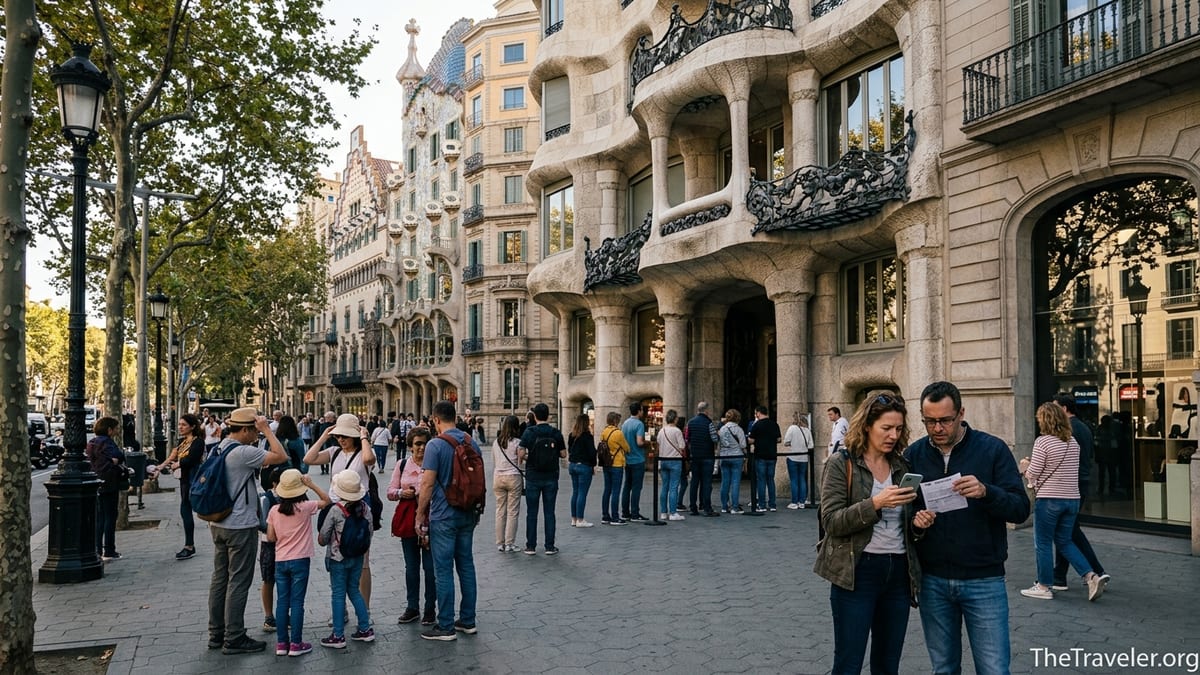
Walk along Barcelona’s Passeig de Gràcia on any given morning and you will see the same scene repeat itself: confused visitors scrolling frantically through their phones outside Casa Batlló, a line curling around the block at La Pedrera, and tired families arriving at Casa Vicens just as the kids hit their afternoon slump. Gaudí’s houses are masterpieces, but they sit in one of Europe’s most crowded city-break destinations. How you plan and behave during your visit matters just as much as the architecture you have come to admire. Here are the most common mistakes travelers make when touring a Gaudí house, and how to avoid them.
Get the latest updates straight to your inbox!
Ignoring Ticket Types and What They Actually Include
One of the easiest ways to walk out disappointed from a Gaudí house is buying the cheapest ticket without reading what it really covers. At Casa Batlló, for example, entry is sold in tiers such as Blue, Silver, Gold, and sometimes Platinum. Since early 2025, rooftop access to the famous Dragon Terrace is no longer included in the basic Blue ticket; you need at least Silver to climb onto the roof and walk among the sculpted chimneys. Many visitors still show up expecting that the standard ticket “of course” includes the rooftop, only to discover at the turnstiles that they would need to upgrade or leave without that iconic view.
Similar confusion happens at La Pedrera (Casa Milà), where there are separate products for a daytime “Essentials”-style visit with audio guide and a “Night Experience” that adds a rooftop light show and a glass of cava. Travelers sometimes book the night ticket assuming it is just a regular visit at a quieter hour, then feel rushed through a more theatrical experience that was never designed as a deep architectural tour. In recent reviews, some visitors complain that the night show feels like a gimmick because they were expecting something else entirely, not because the ticket itself was mis-sold.
Casa Vicens, Gaudí’s earlier and more intimate house, also offers variations: a general visit, occasional guided tours, and sometimes combined products with another attraction. The price difference between a standard timed ticket and a guided visit can seem small compared with the overall cost of a Barcelona trip, yet many travelers default to the cheaper option without considering whether a guided explanation would actually make the house more meaningful for them.
The solution is to slow down during the booking process, preferably on the official site of each house. Look carefully at the table that shows which spaces each ticket level includes, and decide what you truly want to see. If the rooftop is a dream shot for you, confirm that your ticket allows it. If you dislike crowds and performance elements, a simple morning audio‑guided visit may be more satisfying than a premium night spectacle, even if the latter sounds fancier.
Underestimating Crowds, Time Slots, and Walking Fatigue
Another major mistake is assuming you can treat Gaudí houses like minor museums where you just stroll up whenever you feel like it. In high season, midday walk‑up queues at La Pedrera can stretch to 45–90 minutes, and Casa Batlló sometimes sells out entirely for popular time slots. Even Casa Vicens, which is less famous, uses timed tickets and can feel surprisingly busy in late morning when groups arrive. Visitors who try to improvise usually pay twice: once with higher same‑day prices and again with lost sightseeing time standing in line.
Timed entry also catches people out. Most Gaudí houses enforce the rule that you must arrive for the half‑hour window printed on your ticket. Turning up half an hour late because you misjudged how long it would take to cross Eixample, or because you got distracted on La Rambla, can mean a stressful negotiation with staff or being rebooked for a later slot that no longer fits your day. On a short city break, that small slip can snowball into missing another prebooked attraction like the Sagrada Família.
Travelers also underestimate the physical effort required once inside. At La Pedrera’s Night Experience, visitors may be led up several flights of stairs in one go to reach the rooftop for the show, and reviews often mention middle‑aged or older guests gasping for breath because they did not realize how stair‑heavy the visit would be. Casa Batlló and Casa Vicens are more compact but still involve multiple levels, narrow staircases, and long periods standing while listening to audio guides. Arriving already exhausted from a day at Park Güell can turn even the most beautiful building into a slog.
To avoid all this, book timed tickets at least a few days in advance for Casa Batlló and La Pedrera, and consider off‑peak slots such as the first hour of the day or late afternoon. Leave a generous buffer between time‑slotted attractions, and factor in a café break nearby instead of sprinting between sites. If you or someone in your group has mobility issues, research elevator access and seating options in advance and do not hesitate to ask staff for the lift even when the stairs are the default path.
Trying to See Too Many Gaudí Houses in One Day
Gaudí’s houses are intense. The façades are wildly ornamented, the interiors packed with detail, and the stories layered with symbolism. Yet many visitors treat them like a checklist: Casa Batlló at 10:00, La Pedrera at noon, Park Güell at 15:00, and perhaps Casa Vicens squeezed in between tapas. On paper this seems efficient. In reality, by the time you reach the third or fourth Gaudí site, everything starts to blur into “more curves, more tiles, more chimneys,” and the experience loses its emotional impact.
Locals and repeat visitors often recommend choosing two main houses to visit inside, then appreciating the others from the street. For example, you might book Casa Batlló in the morning when your mind is fresh, walk up Passeig de Gràcia to admire La Pedrera’s façade from below, then save a different day for a calmer visit to Casa Vicens in the Gràcia neighborhood. Another combination could be La Pedrera by day, followed by a slow evening stroll to see Casa Batlló lit up from the outside, leaving the interior for another trip.
Trying to “get your money’s worth” by buying a three‑houses‑in‑one‑day tour can backfire. These combinations sometimes allocate as little as forty minutes per building, which barely covers a rooftop and one interior level once you subtract time for security, audio guide setup, and group coordination. You might technically tick off all three, but you will not have the freedom to linger under the parabolic arches in La Pedrera’s attic or to sit quietly in Casa Vicens’s garden, which is where the architecture really starts to speak.
A better approach is to think of Gaudí’s houses as headline experiences, not filler. Allow at least 90 minutes for Casa Batlló and La Pedrera, and a similar amount for Casa Vicens if you enjoy exhibitions. If you only have one full day in Barcelona, choose a single house to visit properly instead of racing through several. You will remember fewer places, but each memory will be clearer and richer.
Focusing Only on Photos and Missing the Story
Stand on the rooftop of Casa Batlló during a busy hour and you will see more phone screens than eyes. Visitors line up in front of the tiled spine of the “dragon” roof, snap the same pose, and quickly move on without listening to their audio guides or reading the panels that explain Gaudí’s ideas. The same thing happens at La Pedrera, where people rush to take panoramic shots over the Eixample grid but never pause to examine the warrior‑like chimneys or the functional ventilation system built into the roofscape.
When you experience a Gaudí house only through your camera, you miss how groundbreaking the architecture was and still is. Casa Vicens, for instance, looks like a collage of green‑and‑white tiles, brick, and cast‑iron leaves, but it also reveals Gaudí’s early experiments with integrating nature motifs into structural elements, not just décor. The Gaudí House Museum in Park Güell appears modest at first glance, yet the furniture inside showcases how he designed chairs, beds, and even coat racks as continuations of the building rather than separate objects.
The technology layered onto some visits can make this worse. Casa Batlló’s immersive rooms and augmented‑reality elements are easy to experience as mere Instagram fodder. Travelers sometimes rush through so they can enjoy the “cool effects” without paying attention to the narration that ties them back to Catalan Modernisme, the Batlló family’s story, or the craftspeople who executed Gaudí’s designs. Walking out, they remember the projections but not the house itself.
To counter this, set yourself a personal rule: for every photograph you take in a given room, spend at least thirty seconds simply standing still and looking. Lean on the balcony railing and notice how the ironwork feels under your hand. Look up at the way light filters through the central lightwell at Casa Batlló or how shadows pool in La Pedrera’s stone folds. Use the audio guide instead of muting it, and resist the temptation to skip ahead. The more you understand the story behind each curve and tile, the more your photos will mean when you scroll back through them months later.
Ignoring Less Famous Houses and Overlooking Context
Many first‑time visitors fixate on Casa Batlló and La Pedrera because they are on every postcard rack in Barcelona. There is nothing wrong with that; both are spectacular and central. But an exclusive focus on these two houses can leave you with an unbalanced picture of Gaudí’s work. Casa Vicens, slightly off the main tourist drag in Gràcia, was his first major house and feels more like a lived‑in home than a monument. It is usually calmer inside, with fewer tour groups and a more museum‑like layout that rewards slow exploration.
Similarly, some travelers skip the Gaudí House Museum inside Park Güell because they assume it is just another ticketed add‑on. In reality, the modest building holds original furniture and objects from multiple Gaudí projects, including pieces from Casa Batlló and Casa Milà. Spending even half an hour here can help you see the continuity between his domestic interiors. Suddenly the wavy doors in La Pedrera or the ergonomic chair backs in Casa Batlló make more sense as part of a larger vision.
There are also other Gaudí houses, such as Palau Güell near La Rambla, that sit slightly outside the standard “three main houses” narrative but offer a different side of his architecture. Visitors who only see the big two on Passeig de Gràcia sometimes leave thinking Gaudí was all about colorful façades and surreal rooftops, when in reality his work ranges from sober stone interiors to experimental brick structures and chapel‑like spaces.
To gain context, spread your Gaudí visits across your stay and mix them with non‑Gaudí sites. Pair Casa Vicens with a slow wander through Gràcia’s plazas and cafés, or visit Palau Güell on a different day from La Pedrera so you can compare their contrasting styles. Even if you ultimately decide you prefer one house over another, you will understand why, rather than feeling like you saw interchangeable “Gaudí stuff.”
Forgetting Practicalities: Weather, Security, and Respect
It is surprisingly easy to forget that Gaudí houses are not just open‑air sculptures but functioning buildings with rules, queues, and weather exposure. Barcelona can be hot and bright from late spring through early autumn, and much of the most photogenic space in these houses is outdoors on rooftops or in small courtyards. Visitors turn up without water or sun protection, then find themselves squinting into harsh midday light on La Pedrera’s exposed roof or queuing outside Casa Batlló’s entrance with no shade.
Security checks also catch some travelers off guard. Large backpacks, trolleys, and bulky camera equipment may not be allowed inside exhibition spaces, and there are often restrictions on tripods. People who arrive directly from the airport or train station dragging luggage sometimes have to scramble for a nearby luggage storage office, losing both time and patience. Others ignore “no flash” signs, irritating guards and fellow visitors in the process.
Respect for the space and for other visitors is another recurring issue. Leaning over fragile railings for the perfect photo, sitting on roped‑off furniture, or pushing past people on narrow staircases can physically damage the houses and diminish the experience for everyone else. At La Pedrera’s night events, groups sometimes chat loudly through the narration, forgetting that for someone next to them this might be a once‑in‑a‑lifetime visit.
Plan for these practicalities as you would for any outdoor monument: carry a small reusable water bottle that you can tuck into a bag, wear comfortable shoes for stairs and uneven surfaces, and bring a light layer even in summer because stone interiors can feel cooler than the streets. Check each house’s rules about bags and photography before you set out, and assume that some spaces will be more fragile than they look. Treat the houses as living heritage sites, not theme‑park sets.
The Takeaway
Visiting a Gaudí house is not just about admiring an iconic façade and snapping a rooftop selfie. It is about understanding how a radical architect reshaped the idea of what a home or apartment block could be, and how those ideas still ripple through Barcelona today. The most common visitor mistakes have less to do with architecture and more to do with rushed planning, mismatched expectations, and a tendency to treat world‑class buildings as background for photos rather than as experiences in their own right.
If you choose your ticket type carefully, respect your time slot, avoid overloading your day, and deliberately slow down once inside, you will experience Gaudí’s houses the way they deserve to be seen: as playful, thoughtful, deeply human spaces. You may not manage to visit every single one, but the ones you do explore will stay with you long after you leave Passeig de Gràcia behind.
FAQ
Q1. Which Gaudí house should I visit if I only have time for one?
If you want the most dramatic, immersive experience, Casa Batlló is usually the top pick. For a more spacious rooftop and a stronger sense of how people actually lived in Gaudí’s buildings, La Pedrera is excellent. If you prefer a quieter, less crowded visit with more museum context, consider Casa Vicens.
Q2. How far in advance should I buy tickets for Gaudí houses?
In peak months such as May to September, it is wise to book at least several days in advance for Casa Batlló and La Pedrera, especially for popular mid‑morning and late‑afternoon slots. For Casa Vicens and the Gaudí House Museum, a few days ahead is usually enough, though weekends can still fill up.
Q3. Is the more expensive ticket tier really worth it?
It depends on what you value. Paying extra at Casa Batlló for a ticket that includes rooftop access is worthwhile if that view matters to you. At La Pedrera, some travelers love the night rooftop show, while others prefer a simpler daytime visit. Read the inclusions carefully and choose based on your interests, not just on price.
Q4. Can I visit Gaudí houses with limited mobility?
Yes, but you should plan ahead. All major Gaudí houses have elevators and accessibility options, though some rooftop areas and narrow staircases may be difficult or inaccessible. Contact the site in advance if you use a wheelchair or have serious mobility issues, and do not hesitate to ask staff for lift access instead of taking stairs.
Q5. Are guided tours better than audio guides for Gaudí houses?
Both can work well. Audio guides give you flexibility to move at your own pace and are usually included in standard tickets. Guided tours cost more but provide the chance to ask questions and get deeper context. If you are very interested in architecture or history, a small‑group guided visit to one house can be especially rewarding.
Q6. Is it worth going inside if I have already seen the façades from the street?
Yes, if your budget and schedule allow it. The façades hint at Gaudí’s creativity, but the interiors, rooftops, and attics reveal how cleverly he handled light, ventilation, and everyday living spaces. Many travelers say that actually entering at least one house changed their perception of his work.
Q7. What is the best time of day to visit a Gaudí house to avoid crowds?
First entry of the day and late afternoon tend to be quieter, especially on weekdays outside of major holidays. Midday slots are usually busiest, particularly in summer. If you dislike crowds, aim for a morning visit to Casa Batlló or La Pedrera and consider Casa Vicens for a more relaxed atmosphere at almost any time.
Q8. Can I visit multiple Gaudí houses in one day without feeling rushed?
Two houses in one day is realistic if you space them several hours apart and include a proper meal or rest in between. Trying to cram three or four Gaudí sites into a single day usually leads to fatigue and blurred impressions. For most visitors, one major Gaudí interior plus street‑level views of others is the sweet spot.
Q9. Are children likely to enjoy visiting Gaudí houses?
Many children enjoy the colorful shapes, rooftop chimneys, and immersive rooms, especially at Casa Batlló. However, long visits with lots of standing and audio narration can be tiring. Choose one house that seems most playful or spacious, bring snacks and water, and avoid scheduling it at the end of an already packed day.
Q10. How should I dress for visiting Gaudí houses?
Wear comfortable walking shoes suitable for stairs and uneven rooftop surfaces, and dress in light layers. In warmer months you will want breathable fabrics and possibly a hat or sunglasses for rooftop areas. In cooler seasons, remember that stone interiors can feel chilly, even when the streets are mild.