


Standing in Antoni Gaudí’s former home in Park Güell, I expected ornate tiles and quirky furniture. I did not expect to recognize my own 21st century life in a house designed more than a hundred years ago. Yet room after room in the Gaudí House Museum felt startlingly current, from flexible living spaces to built-in storage and clever climate control. It was here, far from the crowds at La Sagrada Família, that I finally understood why Gaudí was not just a great architect of his time, but one who was designing for ours.
Get the latest updates straight to your inbox!
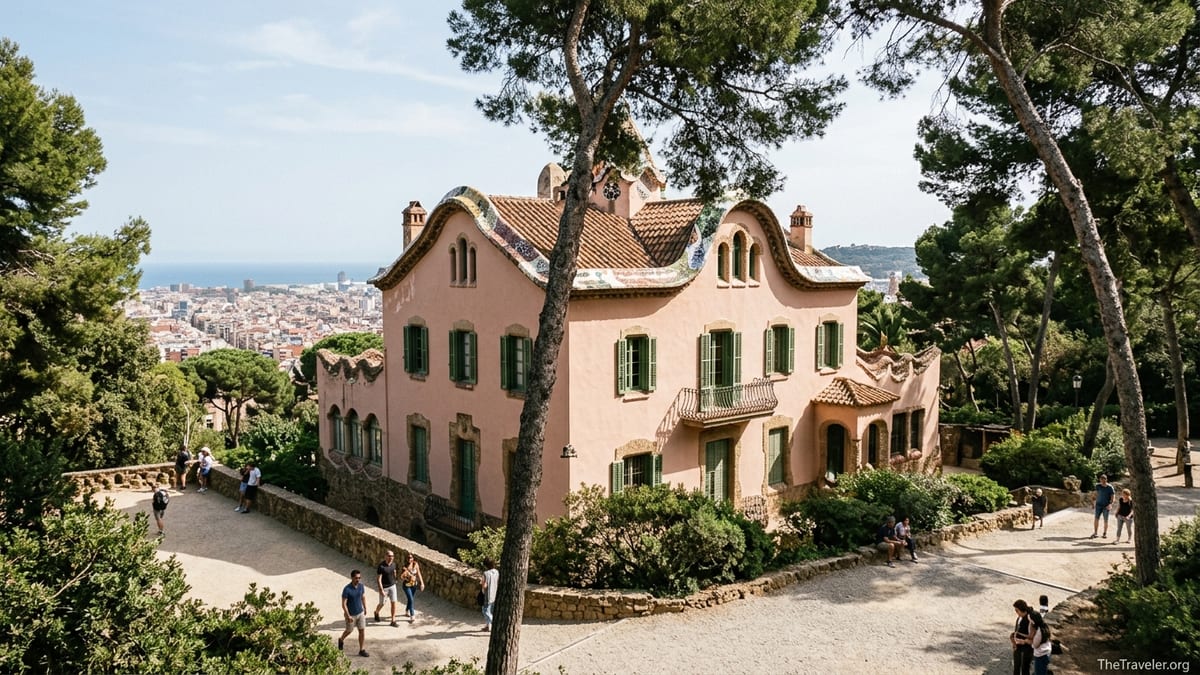
Arriving at the Gaudí House Museum in Park Güell
I reached the Gaudí House Museum by winding uphill through Park Güell’s crunchy gravel paths, past mosaic balustrades and stone viaducts that look like they have grown straight out of the hillside. Today Park Güell is a regulated monument with ticketed access to its central zone, and in 2026 general admission is about 18 euros for adults, with timed entries throughout the day. Inside this larger experiment in garden-city planning sits a quieter story: the modest pink house where Gaudí lived for nearly two decades, now a museum filled with his furniture and everyday objects.
The house is easy to overlook among the park’s grander gestures, yet stepping through its doorway feels more intimate than visiting Casa Batlló or La Pedrera on Passeig de Gràcia. Those other houses are statements commissioned by wealthy industrial families. Here, the rooms are scaled for a single man and his close relatives, rooted in daily routines rather than grand entertaining. That shift in perspective is crucial. It reveals Gaudí less as a stylist and more as an obsessive problem solver who used domestic space as his laboratory.
For travelers, this is one of Barcelona’s most accessible Gaudí experiences. Compared with headline attractions where entry can top 30 euros and premium experiences go far higher, the Gaudí House Museum is typically one of the more affordable Gaudí tickets in the city. It takes less than an hour to explore thoroughly, making it easy to combine with a morning or late afternoon walk through Park Güell’s free or resident zones, depending on your booking. Yet the ideas packed into these few rooms linger much longer than the visit itself.
Inside the House Where Ideas Became Furniture
The first surprise inside is how sparse the rooms feel. Instead of heavy Victorian clutter, there is space to move. Against one wall, a slender wooden chair pinches inward at the back, its curves shaped to follow the spine rather than to impress guests with carving. Nearby, a bench bends in a gentle S, so two people can sit slightly angled toward each other without bumping knees. These pieces are originals or close reconstructions of furniture Gaudí designed for houses like Casa Batlló and Casa Calvet, gathered here as a kind of three-dimensional sketchbook of his thinking.
The ergonomics feel contemporary. You can see the same priorities in modern task chairs sold globally today: lumbar support, weight distribution, the idea that the object should adapt to the body instead of the other way around. Gaudí was exploring this in the early 1900s using simple pine and oak, shaping them by hand and testing with real people. In one corner, several door handles and latches show the same approach. They are slightly twisted, almost melted forms, meant to nestle into the palm. Running a hand over them, you instinctively find the most comfortable grip. It is a small detail, but it embodies a philosophy that would not become mainstream design thinking until the late 20th century.
Even storage is treated experimentally. In the bedrooms, built-in wardrobes are shallow but tall, with doors that open wide so nothing is lost in the back. Today we might call this maximizing vertical storage or minimizing dead space, a familiar concept in compact city apartments from Barcelona to Tokyo. For Gaudí it was simply common sense. He had no interest in pomp; he wanted an efficient, healthy interior that worked for its occupants. In a city now full of micro-studios and co-living spaces, his furniture and fittings feel less like museum pieces and more like prototypes for contemporary urban life.
Light, Air and Natural Comfort Before Technology
On the upper floors of the house, Gaudí’s obsession with light and ventilation becomes clear. The staircase is narrow, but at each landing a window opens to the park or the city below, washing the interior with soft daylight. The exterior walls are thick, yet the rooms never feel cave-like because openings are carefully aligned. Stand in the main bedroom and you can see how opposite windows create a cross-breeze, drawing fresh air through even on a still afternoon. This is passive cooling at work long before air conditioning became standard.
In Barcelona’s increasingly hot summers, these design decisions look prophetic. Rather than sealing the house and relying on mechanical systems, Gaudí shaped the building to cooperate with the climate. At Park Güell and La Pedrera alike, you see the same strategies: ventilated attics, internal courtyards, skylights that bring light deep into the plan while minimizing glare. Contemporary green building certification talks about thermal mass, shading and natural ventilation. Gaudí was already using all three, intuitively and in combination.
For travelers, comparing this house with newer accommodations in the city can be eye opening. Many budget hotels and short term rentals close to La Rambla or the waterfront depend on constant air conditioning to offset poor orientation and thin walls. Meanwhile, guests who book a room in a carefully restored modernista building in Eixample often remark on how cool interiors stay behind thick masonry and wooden shutters. The Gaudí House Museum is a quiet lesson in why: when a building’s envelope is tuned to its environment, machines have less work to do.
Even the color palette is part of this environmental intelligence. Interior walls are mostly light, almost chalky, helping reflect daylight deeper into the space. Yet accent tiles around fireplaces and in the entry use richer greens and terracottas, grounding the rooms without making them dark. This subtle control of reflection and absorption reads like a precursor to modern lighting design, where reflective ceilings and matte surfaces work together to create gentle, glare free brightness.
Nature as Structure, Not Decoration
From the museum windows you catch glimpses of Park Güell’s serpentine benches and colonnaded pathways, all echoing organic forms. Inside the house, however, Gaudí’s use of nature is more stripped back. Floral motifs appear in wrought iron balcony railings and inlaid tiles, but the main way he draws on nature is structural. Arches in the stairwell and chapel-like alcoves are slightly parabolic, their lines recalling tree branches bending under their own weight. It is the same geometric logic that would later appear dramatically in the catenary vaults of the Sagrada Família and the attic of La Pedrera.
What feels forward-looking here is not the imagery but the method. Instead of copying leaves or vines onto flat surfaces, Gaudí studied how natural forms resist loads and then translated those principles into the very bones of the building. Today, engineers model bridges and stadium roofs with sophisticated software, often arriving at shapes that look surprisingly organic because they follow similar rules of efficiency. Gaudí was effectively doing analog parametric design with models, chains and gravity. The result is spaces that feel oddly weightless for their time.
Travelers can see the contrast clearly when they visit other modernista houses in Barcelona. At Casa Amatller, for instance, decorative sculpture can sometimes feel applied, like a beautiful skin on a conventional frame. At Gaudí’s own Casa Batlló, completed a few years after he moved out of the Park Güell house, structure and ornament have become inseparable; the columns on the façade resemble bones not because he carved them that way for effect, but because he shaped their sections to perform structurally while evoking the skeleton of a living creature. The seeds of that integration are visible in his own home in the park, in modest arches and niches that quietly do multiple jobs at once.
This fusion of aesthetics and engineering feels very much in tune with 21st century ambitions, from high speed rail stations that double as public plazas to eco lodges that use their rooflines to collect rainwater. Gaudí’s house suggests he would have understood these ambitions intuitively. For him, a wall was never just a separator, a roof never just a lid. Every element could collect light, guide air, channel loads and frame views, all at once.
Human-Centered Design Long Before UX
One of the museum rooms is devoted to drawings and models of doorways, staircases and handrails. Viewed through modern eyes, they read like early user experience diagrams. Gaudí mapped how people move through a space, where their hands would rest, how their sightlines would open or compress. On some floor plans, you can trace a clear hierarchy: generous circulation where people cross paths, tapered corridors where privacy matters more than space, thresholds marked not with heavy doors but with changes in ceiling height or floor material.
Walking through the house, these decisions translate into a distinct bodily sensation. In the narrow staircase your shoulders brush the walls and your pace slows, making the tiny landings feel more precious, like mini balconies overlooking the park. Entering the small oratory, the ceiling drops and curves, encouraging you to bow your head slightly. Today we talk about “journey mapping” in hotels or airports, planning how guests will arrive, queue, rest and depart. Gaudí was mapping emotional journeys in domestic spaces before those terms existed.
This sensitivity stands out even more when you compare his work with some of the city’s later housing blocks, where tight stairwells and sealed corridors often feel indifferent to the people who use them. In Gaudí’s house, every compression leads to a release, every darkened corner to a patch of light. It is an approach that modern boutique hotels in Barcelona’s Born and Gràcia neighborhoods are rediscovering, carving out small lounges at corridor bends, or placing a single armchair beneath a window at the end of a hall. The idea is the same: give people rhythmic variety, not relentless efficiency.
In practical travel terms, this mindset can change how you choose places to stay. Instead of only looking at square meters or the presence of a rooftop pool, it can be worth paying attention to photos of hallways, staircases and lobbies. Properties housed in older modernista buildings often highlight these transitional spaces because they are part of the experience, not just leftover circulation. Gaudí’s house shows that when designers care about how you move between rooms, your entire stay feels calmer and more coherent.
Gaudí’s Quiet Sustainability and Today’s Overtourism
From the small balcony off the upper floor, I looked out at Park Güell and the steady river of visitors following taped routes through the Monumental Zone. Barcelona has tightened access in recent years, introducing higher ticket prices and strict time slots both to protect the fabric of Gaudí’s work and to manage crowds. In 2026, a family of four can easily spend upwards of 70 euros for Park Güell admission alone, especially if they add audio guides or combo tickets with the Sagrada Família. It is a reminder of how beloved and pressured these sites have become.
Inside Gaudí’s house, however, the scale contracts. Rooms fit only a handful of people at a time, and the museum’s modest footprint naturally limits visitor numbers. In this quieter context, Gaudí’s environmental sensibility comes to the fore. He used local materials, from Catalan brick to regional stone, avoiding long-distance transport long before embodied carbon became a concern. His thick walls and shaded porches reduce energy needs passively. Even the way rainwater is directed off the pitched roof into the garden below hints at a circular mindset, where nothing in the system exists in isolation.
As cities like Barcelona wrestle with the impacts of mass tourism, Gaudí’s example feels unexpectedly current. Sustainable travel is not only about staying in hotels that display green labels or offsetting flights. It is also about supporting places that were designed to consume less from the start. Choosing to spend an hour and a comparatively modest ticket price at the Gaudí House Museum, rather than booking yet another premium time slot elsewhere, means rewarding a smaller scale, lower impact experience that still deepens your understanding of the architect’s work.
On a practical level, this house visit also helps travelers pace their Gaudí itinerary more gently. Instead of rushing from one blockbuster monument to another, you can plan a slower day: a morning ticket for Park Güell’s main area, followed by a shaded picnic under its stone viaducts, then a leisurely circuit through the Gaudí House Museum as the midday sun peaks. Ending with a bus ride back down to the city center avoids the steep downhill walk and saves energy for an evening stroll along Passeig de Gràcia, where the façades of Casa Batlló and La Pedrera glow softly after dark.
The Takeaway
Leaving the Gaudí House Museum, I realized that the most radical thing about Antoni Gaudí was not the colorful mosaics that appear on every postcard stand in Barcelona. It was his insistence that a house could be a finely tuned instrument for living well, built with care for both its occupants and its surroundings. In his modest Park Güell residence, this philosophy is distilled into everyday objects: a chair that supports your spine, a staircase that slows your pace, a window that catches the breeze at exactly the right angle.
For contemporary travelers, the experience offers two intertwined lessons. First, Gaudí was far ahead of his time technically, anticipating ergonomic furniture, passive climate control and nature-informed structures that only later became standard in sustainable architecture and product design. Second, he was ahead of his time culturally, treating comfort, health and environmental harmony as non negotiable, even when fashion pointed elsewhere. In a century marked by rapid urbanization and climate anxiety, his priorities feel less like relics and more like a roadmap.
If you are planning a Gaudí themed visit to Barcelona, it can be tempting to focus on the headline acts with the longest queues and the most dramatic visuals. Make space in your schedule for this quieter house on the hill. It will not overwhelm you with scale or spectacle. Instead, it will reveal the human-sized experiments that made the spectacular buildings possible, and it might just change how you look at the next hotel room, apartment or public space you enter. In seeing how Gaudí designed for his own daily life, you begin to see how deliberately he designed, in many ways, for ours.
FAQ
Q1. Where is the Gaudí House Museum located?
The Gaudí House Museum is inside Park Güell, on a hillside in Barcelona’s Gràcia district, a short bus or taxi ride from the city center.
Q2. How much time should I plan for a visit?
Most visitors spend 30 to 60 minutes inside the house, which makes it easy to combine with a broader visit to Park Güell in the same morning or afternoon.
Q3. Do I need a separate ticket for the Gaudí House Museum?
Yes, entry to the Gaudí House Museum requires a separate ticket from the standard Park Güell admission, and you usually buy it for a specific date and time.
Q4. Is the Gaudí House Museum suitable for children?
Yes, children generally enjoy the compact scale and unusual furniture, though parents should be prepared to supervise closely in narrow staircases and small rooms.
Q5. Can people with reduced mobility visit the house?
Accessibility is limited because the house was built on multiple levels with tight staircases, so visitors with reduced mobility should check current access details before booking.
Q6. What is the best time of day to visit?
Early morning or late afternoon tend to be quieter and provide softer natural light through the windows, which enhances both the interiors and views over Barcelona.
Q7. Are photos allowed inside the Gaudí House Museum?
Photography without flash is generally allowed for personal use, but it is important to follow any posted signs and instructions from staff on the day of your visit.
Q8. Can I visit the house without touring the rest of Park Güell?
In practice, most visitors enter through Park Güell to reach the house, so it is common to combine both; check current ticket conditions when planning.
Q9. How does the Gaudí House Museum differ from Casa Batlló or La Pedrera?
The Gaudí House Museum is smaller and more intimate, focused on Gaudí’s furniture and personal life rather than grand interiors commissioned by wealthy families.
Q10. Is the Gaudí House Museum worth it if I am short on time in Barcelona?
If you are interested in Gaudí’s ideas rather than just his most famous façades, this compact visit offers deep insight in a relatively short, manageable stop.