


Stepping into a Gaudí house is like walking into a living sketchbook. Colors ripple across ceramic tiles, stone bends into waves, and chimneys look like soldiers on a rooftop. Yet amid the crowds and audio guides it is surprisingly easy to rush through, snap a few photos, and leave without really understanding what you saw. This guide focuses on how to visit Gaudí’s main houses in Barcelona so that you do not miss their most impressive details, with concrete examples from Casa Batlló, Casa Milà (La Pedrera) and Casa Vicens.
Get the latest updates straight to your inbox!
Know Your Gaudí Houses Before You Step Inside
Barcelona has several buildings that are commonly called “Gaudí houses,” and understanding the differences before you buy tickets will shape what you notice on site. Casa Batlló on Passeig de Gràcia is the showiest, with a dragon-backed roof and a fully visitable noble floor that lets you walk through dining rooms, galleries and the lightwell at the heart of the building. It is ideal if you want to experience Gaudí as a domestic architect who designed everything from door handles to stained glass. As of mid 2026, standard timed tickets with the multimedia guide typically start in the mid-40 euro range per adult, and more expensive tiers add extra immersive rooms or early access.
Five minutes up the same boulevard, Casa Milà, better known as La Pedrera, feels different. It was conceived as an apartment building, not a single-family residence, and what you visit today is a sequence of key spaces: the undulating stone facade, two large courtyards, a recreated early 20th century apartment, the catenary-arch attic and the famous rooftop with its sculpted chimneys. A general daytime ticket is usually priced a little below Casa Batlló, while the guided Night Experience with rooftop projections costs a bit more per person but reveals details in dramatic light.
Casa Vicens, in the Gràcia neighborhood, is Gaudí’s earlier, more compact house, where he played with Moorish and oriental influences. It feels less multimedia-driven and more like a small museum where you can take your time with the tiles, ceilings and original furniture. Ticket prices are generally lower than at Casa Batlló or La Pedrera, making it a good choice if you want a quieter experience that still showcases Gaudí’s evolution. Knowing in advance what kind of visit each house offers helps you adjust your expectations and focus your eye on the details that matter most in that specific building.
If you have time for only one house, your choice should guide your preparation. For instance, if you book Casa Batlló because of its storybook facade, read briefly about its nickname “House of Bones” and the legend of Saint George and the dragon before your visit. If you pick La Pedrera, spend five minutes learning what a catenary arch is so that the attic’s structural rhythm clicks into place when you see it. A little targeted context before you enter will make small details suddenly feel meaningful rather than decorative.
Master the Facades: Reading Dragons, Waves and Tiles
Most visitors start engaging with a Gaudí house long before they scan their ticket. The facade is your first classroom, and treating those few minutes outside as part of the visit will keep you from missing important symbolic details. At Casa Batlló, look up at the bone-like balconies and the pillar shapes at street level. Their curved forms suggest vertebrae and long bones, which is why locals call it the House of Bones. Above them, the mosaic skin of the facade uses broken ceramic pieces in blues, greens and golds that shimmer differently in morning and late-afternoon light. If you arrive just before your entry slot, stand across Passeig de Gràcia and watch how the surface shifts color as clouds move. It is an easy way to see how Gaudí used texture to animate a flat wall.
Higher up on Casa Batlló, the roof reads like the spine of a dragon, with scaled tiles and a cross-topped turret that recalls the lance of Saint George, the patron saint of Catalonia. When you later climb to the roof, remember this view from the street. Compare the tactile reality of those tiles under your hand with your first impression from below. Many visitors rush straight to the panoramic views of the Eixample grid and miss this narrative connection between street facade and rooftop sculpture. Consciously link those two moments and you will walk away with a clearer sense of how Gaudí wove stories into stone and ceramic.
La Pedrera demands a different eye. Its stone facade on the corner of Passeig de Gràcia and Provença undulates like a quarry face, which is why locals nicknamed it “The Stone Quarry.” Before you go inside, take two minutes to walk the length of the building at street level. Watch how the wrought-iron balconies twist like seaweed or vines and notice that no two are exactly the same. These balconies were not just decoration: Gaudí worked with artisan ironworkers to create a kind of sculpted metal garden on the facade. If you arrive a little early for an evening visit, the side streets often give you quieter vantage points to appreciate the way the curves catch the warm streetlights.
At Casa Vicens, the story is in the tiles and brickwork. The exterior mixes red brick with green-and-white checkerboard ceramic and floral tiles inspired by local plants. When you stand outside, look specifically at the marigold motifs on some of the tiles, which echo flowers that originally grew on the property. On a practical level, arrive with enough time before your slot to circle the small garden and compare the house’s compact scale with the grand boulevard palaces of Passeig de Gràcia. That contrast will help you see Casa Vicens as the experimental starting point for ideas that later bloom in Batlló and La Pedrera.
Move Like an Architect Inside: Lightwells, Floors and Door Handles
Once you enter a Gaudí house, the crowd tends to flow as if the building were a museum with one correct direction. You will get more out of the visit if you move like an architect instead of a tourist, pausing at specific points to look up, down and around. At Casa Batlló, for example, do not treat the central blue-tiled lightwell as just a pretty backdrop for photos. Stand near the middle on one of the stair landings and notice how the tiles get darker as they rise. Gaudí intentionally graded the color so that the light reflecting off them appears even from top to bottom, compensating for the natural dimness of lower levels. If you are using the multimedia guide that comes with most tickets, this is a good moment to stop the narration for thirty seconds and simply observe the way the light hits the tiles.
Pay attention to floors and ceilings, not just eye-level features. In the noble floor of Casa Batlló, parquet patterns echo the movement of water, while the ceilings swirl like shells or spirals of smoke. Instead of walking straight through to the windows overlooking Passeig de Gràcia, pause just inside the main salon, look back at the entrance doors, and then slowly scan up from floor to ceiling. Most visitors cluster at the balcony for the street view and miss how Gaudí has choreographed the room as a flowing space rather than a static box.
At La Pedrera, the recreated apartment offers another chance to look beyond the obvious furniture. Focus on standard elements that Gaudí redesigned, such as door handles and window frames. Many handles in his houses are shaped to fit the curve of a hand, and the doors often sit in slightly curved walls, so that even a corridor feels softer than in a conventional apartment. When you reach the courtyards, walk to a corner and stare upward through the lightwell; notice how the windows get smaller toward the top, a trick that equalizes perceived light levels. A typical daytime ticket allows plenty of time, so build in two or three such “architect’s pauses” where you stop following the audio guide and simply read the space.
Casa Vicens rewards slowness even more. The rooms are smaller, and many surfaces are crowded with pattern, from painted ceilings of palm leaves to ceramic floral reliefs on the walls. Choose one room, often the smoking room with its vivid colors and muqarnas-like ceiling, and spend a full minute looking for repeated motifs. Try to find the same flower on tiles, on carved wood and on painted surfaces. By training yourself to notice how an idea repeats across materials, you will start spotting similar themes when you later visit Gaudí’s bigger works such as the Sagrada Família or Park Güell.
Do Not Rush the Attics and Rooftops
One of the most common mistakes at Gaudí houses is treating the attic and rooftop as simple viewpoints. In fact, these areas often reveal his most innovative structural ideas. At La Pedrera, the attic is formed by a series of shallow brick arches that create a ribcage-like volume. Instead of just walking straight through to the rooftop stairs, pause at the side where a model of the building is usually displayed. Compare the model’s cross section with the live arches around you. This is where that quick pre-visit reading about catenary arches pays off: you can see how a simple hanging-chain curve, flipped, becomes a stable, efficient structure that frees up interior walls.
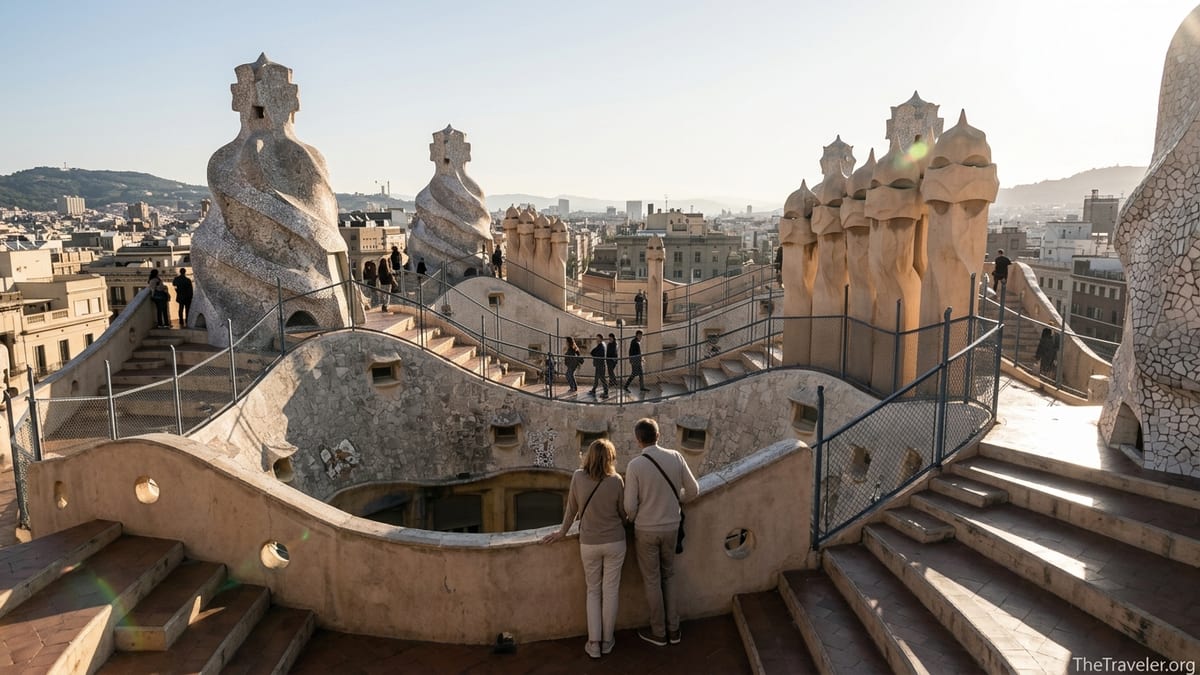
On the rooftop of La Pedrera, you will probably be tempted to aim your camera at the skyline. Before you do, walk up to one of the helmet-like ventilation towers or chimneys. Look closely at the broken marble and stone fragments embedded in the surfaces, and run your fingers lightly along the texture where permitted. These are not just decorative sculptures. They hide the building’s mechanical systems and stairs, turning functional elements into a kind of open-air sculpture garden. If you are doing the paid Night Experience, the projections that play across these forms help you see how the shapes break and catch light, but in daylight the shadows alone tell the story.
Casa Batlló’s rooftop is smaller, but the details are just as rich. Pay particular attention to where the dragon-back roof meets the vertical tower. Tiles here often show subtle color changes and curves that suggest the tension point where the dragon is pierced. Many tickets include access to new immersive spaces under the roof, such as a dome where projected images explore Gaudí’s inspirations in nature. It can be tempting to focus only on the digital spectacle, but take a moment afterward to step back into the real rooftop and look again at the way ceramic, brick and iron come together. Thinking of the immersive room as an introduction rather than the main event keeps the authentic architectural details at the center of your visit.
Casa Vicens has a more modest rooftop, yet here too you should resist the urge to treat it as a simple terrace. Walk the perimeter and notice the small towers and chimneys, then look back toward the neighborhood streets. The scale difference between this early domestic project and the grand urban facades of Gaudí’s later works will help you understand his career visually: from a compact, tile-rich house with clear oriental influences to the sculptural stone waves of La Pedrera and the storybook drama of Casa Batlló.
In all three houses, a practical way to avoid missing rooftop details is to leave a small time buffer at the end of your visit. Many people underestimate how long the audio guides take, especially at Casa Batlló where premium tickets add extra immersive rooms. When you book, assume you will spend roughly 1.5 to 2 hours inside and try not to schedule another timed visit, such as Sagrada Família, within thirty minutes of your exit window. That extra breathing room lets you linger on the roof instead of racing past Gaudí’s most expressive forms.
Use Technology Wisely: Audio Guides, Night Experiences and Ticket Tiers
Modern Gaudí houses lean heavily on technology, from 10D immersive rooms to tablet-based audio guides. These tools can deepen your visit, but they can also distract you from the physical details if you let them lead entirely. At Casa Batlló, for example, the standard ticket typically includes an intelligent audio guide on a smartphone-like device. As you point it at rooms, augmented images show period furniture or imagined underwater scenes. This is entertaining and gives a sense of how the spaces were originally furnished, but it can also pull your eyes away from authentic surfaces. A good strategy is to use the device to get oriented in each major room, then deliberately lower it and spend at least thirty seconds studying the actual woodwork, glass or tile that the animation referenced.
Ticket tiers at Casa Batlló are another place where expectations shape your focus. The more expensive options often add early entry, access to extra immersive rooms or a visit to special spaces. Recently, the house has begun opening an upper-floor apartment with a high degree of original preservation on a private or premium basis, which changes how you might prioritize your budget if seeing untouched Gaudí interiors is important to you. If you opt for a basic tier instead, do not feel you are missing the essence. Almost all the core architectural details, from the flowing noble floor to the rooftop, are included in standard visits and reward careful observation.
La Pedrera offers both daytime visits and a curated Night Experience where groups follow a guide through the main spaces, ending with a rooftop light and sound show and a drink. The evening visit costs more per person than general admission, but the controlled group size and lighting conditions change what you notice. Shadows sliding across the attic arches make the structure more legible, and the illuminated rooftop chimneys stand out against the city. If your budget allows only one premium add-on, consider whether you prefer this kind of guided, atmospheric visit at La Pedrera or a more tech-driven immersion at Casa Batlló. Matching the experience to your learning style will help you absorb more detail.
Casa Vicens, by contrast, is relatively low-tech. Audio guides or downloadable apps are sometimes available, but the house relies more on wall panels and clear circulation to tell its story. Here, your smartphone is best used as a camera and a notebook. Take close-up shots of repeating motifs and jot quick notes in a memo app when something catches your eye. Later, when you walk into another Gaudí building, you can scroll back and compare. Using your own simple digital tools this way often leads to deeper, more personal understanding than relying entirely on curated multimedia shows.
Timing Your Visit to Catch Light, Crowds and Quiet
The same Gaudí house can feel entirely different at 9 a.m. versus 5 p.m., and timing matters if your goal is to notice fine detail. In general, first entry slots in the morning or mid to late afternoon toward last entry tend to be quieter inside, even if the street outside remains busy. At Casa Batlló, early morning visits often mean softer light in the interior courtyard and fewer people crowding the main salon windows, which makes it easier to study the glass and carved wood up close. By contrast, a mid-day slot might give stronger shafts of light in the blue-tiled lightwell but also more reflections on glass surfaces.
La Pedrera’s courtyards and rooftop reward visits when the sun is low. Late afternoon light rakes across the stone waves of the facade and throws long shadows from the rooftop chimneys, emphasizing their sculptural qualities. If you book the Night Experience, you will see the house dressed with carefully designed lighting instead of daylight, which can highlight some surfaces and hide others. For many travelers, this is a second visit after having seen the house by day, but if budget or time push you to choose only one, think about whether you prefer natural light revealing subtle textures or theatrical light dramatizing key forms.
Casa Vicens, set in a narrower street of Gràcia, benefits from planning around both light and crowds. Late morning often offers pleasant natural light in the small garden and decent illumination inside without the harshest midday glare. Because the house tends to draw fewer tour buses than Passeig de Gràcia landmarks, you can often afford to choose a time that suits your personal rhythm rather than just crowd avoidance. Whatever slot you pick, add fifteen extra minutes beforehand so you can arrive unrushed and pay attention to exterior details that hurried visitors miss.
Across all Gaudí houses, buy timed tickets in advance whenever possible, especially in high season from May through October and during holiday periods. Same-day tickets at the door are sometimes limited or unavailable, and having a fixed entry time prevents you from queuing in the sun while your attention drifts. Arrive at least ten to fifteen minutes before your time, not only as an insurance buffer but also to give yourself mental space to start observing the building from the outside rather than sprinting straight to the ticket scanner.
The Takeaway
Visiting a Gaudí house is not just about ticking off a famous attraction. These buildings are dense with ideas about light, structure, nature and narrative. The difference between a forgettable walk-through and a visit that stays with you for years often comes down to how you look and how you pace yourself. By learning the basic story of each house before you arrive, reading the facade slowly, moving through interiors like an architect, giving extra attention to attics and rooftops, using technology thoughtfully and choosing your time of day, you transform the experience.
Concrete habits make this practical. At Casa Batlló, consciously link the dragon-like roof to the street facade and the interior lightwell. At La Pedrera, compare the model in the attic to the arching space around you and then trace that structure up to the rooftop chimneys. At Casa Vicens, treat one small room as a pattern-hunting exercise and carry that way of seeing into the rest of your Gaudí itinerary. Approach every staircase, balcony and door handle as an intentional design rather than background decor.
In the end, Gaudí’s houses reward curiosity more than speed or spending. Whether you choose an immersive premium ticket or a simpler visit, the most impressive details are free and in plain sight: the gradient of blue tiles, the curve of a hand-shaped handle, the way a chimney hides a staircase. Train yourself to look for those elements and you will not just have visited a Gaudí house. You will have started to understand how one architect turned everyday structures into living works of art.
FAQ
Q1. If I can only visit one Gaudí house, which should I choose?
If you want theatrical interiors and multimedia, choose Casa Batlló. If you are more interested in structure and rooftops, pick La Pedrera. For a quieter, earlier work with strong tile design, Casa Vicens is the best option.
Q2. How much time should I plan for a visit to a Gaudí house?
Most travelers should plan about 1.5 to 2 hours for Casa Batlló or La Pedrera and about 60 to 90 minutes for Casa Vicens, not counting time spent photographing the exterior.
Q3. Are premium or night tickets worth the extra cost?
They can be, depending on your interests. Night visits at La Pedrera emphasize atmosphere and guided storytelling, while premium tiers at Casa Batlló add immersive rooms or access to extra spaces. If you mainly care about architecture, a standard daytime visit is usually enough.
Q4. Do I need to book Gaudí house tickets in advance?
In busier months and on weekends you should book in advance to secure your preferred time and avoid long waits. Same-day tickets may be limited or sold out, especially for peak midday slots.
Q5. What time of day is best for photography inside Gaudí houses?
Early morning or late afternoon generally offer softer light and fewer crowds. Casa Batlló’s blue courtyard photographs well when the sun is not directly overhead, and La Pedrera’s rooftop gains depth from long shadows near sunset.
Q6. Can I see important details without taking a guided tour?
Yes. The houses are designed for self-guided visits with audio guides or explanatory panels. If you follow tips like watching the lightwells, ceilings and rooftops carefully, you can appreciate the key details on your own.
Q7. Are Gaudí houses accessible for travelers with reduced mobility?
Accessibility varies by building and by specific route, but in general the main Gaudí houses provide elevators and adapted paths for most key spaces. Check the latest accessibility information when booking and contact the site if you have particular needs.
Q8. Is it necessary to visit both Casa Batlló and La Pedrera?
They complement each other but it is not essential to visit both. Casa Batlló focuses on a single family residence full of symbolic detail, while La Pedrera emphasizes structure, courtyards and a dramatic rooftop. If your budget or schedule is tight, choose the one that best matches your interests.
Q9. Are there ways to save money on Gaudí house visits?
You can often save by choosing basic ticket tiers, visiting in the late afternoon, or purchasing combined passes that include more than one Gaudí site. Paying attention to what each ticket actually includes helps avoid paying for extras you will not use.
Q10. How can I prepare in advance to notice more during my visit?
Spend 15 to 20 minutes reading about each house’s basic history, look up what a catenary arch is, and bring a small list of details to look for, such as lightwells, door handles, rooftop chimneys and repeating natural motifs. Arriving with these in mind makes the architecture much more legible in person.