


St Peter’s Basilica is one of those places that can live up to every expectation, but only if you know how to handle it. With free entry, airport-style security, evolving ticket systems and 10 million annual visitors sharing the same space, a visit can easily slide from awe-inspiring to exhausting. In 2026, with Jubilee crowds adding yet more pressure on Rome and the Vatican, avoiding the most common mistakes matters more than ever. Here is how visitors typically go wrong when exploring St Peter’s, and how you can do better.
Get the latest updates straight to your inbox!
Misunderstanding “Free Entry” and Underestimating the Queue
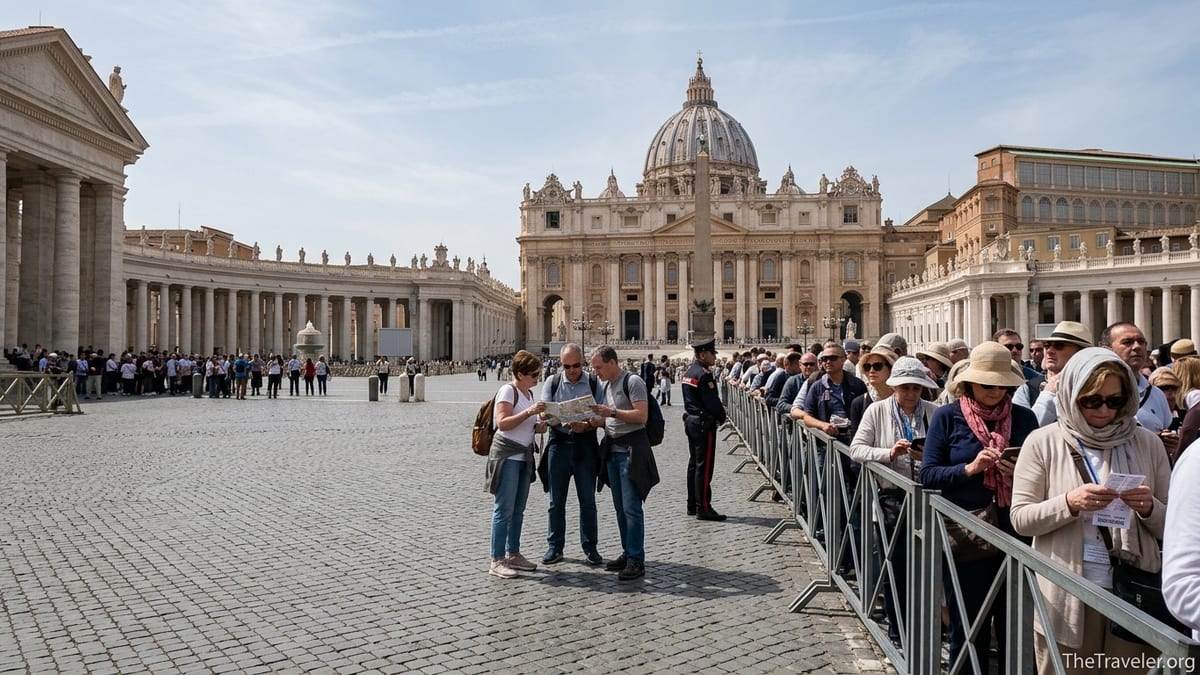
Many visitors arrive in St Peter’s Square assuming that “free entry” means they can stroll straight into the basilica. In reality, everyone must first clear airport-style security: bags on the belt, metal detector, and a single serpentine queue stretching across the square. In peak months like May, June and September, it is common for the line to take 60 to 120 minutes in the late morning. Travellers report arriving around 10:30 a.m. and finding the line looping almost once around the colonnades, effectively wiping out half their day before they even step inside.
A second misconception is that paid options always bypass this wait. Some visitors buy a 7 to 10 euro digital audio guide or a basic “entry ticket” through third-party platforms, assuming it functions as a true skip-the-line pass. In practice, you still join the same security queue as everyone else, and only once inside do you redeem the audio guide or tour. Genuine time savings usually come from a fully guided tour with reserved entry, often bundled with the dome climb or Vatican Museums, which uses a dedicated security lane or a different access point. Prices vary widely, but in 2026 many reputable operators list small-group basilica tours in the 30 to 50 euro range per adult.
The most effective, low-cost way to avoid the queue is simply timing. On an ordinary Tuesday in February or November, arriving at 7:00 a.m. when the basilica opens can mean walking straight through security. Even in July or August, visitors who reach the checkpoints before 8:00 a.m. often report waiting less than 15 minutes, compared with more than an hour by late morning. Late evening close to last admission, generally around 6:00 to 6:30 p.m. depending on the season, can also bring dramatically shorter waits, with some travellers clearing security in under five minutes and enjoying a surprisingly calm interior for the final hour of opening.
Planning your Vatican day around these patterns is crucial. A common error is booking an early Vatican Museums ticket for 8:00 a.m., emerging into the crowds around late morning and only then heading to St Peter’s, just as the line is at its worst. In many cases, reversing the order, or splitting the sites across two days, leads to a far better experience and far less time spent standing in the Roman sun.
Ignoring the Dress Code and Practical Security Rules
Another frequent mistake is assuming that the Vatican’s dress code is a vague guideline rather than an actively enforced rule. St Peter’s Basilica follows the same broad standards as the Vatican Museums: shoulders and knees should be covered for both men and women; low-cut tops, very short shorts, mini skirts and see-through fabrics risk being turned away; and offensive slogans or imagery on clothing are not permitted. The square itself is more relaxed, which confuses some visitors who see people in tank tops outside and assume they will be admitted inside the basilica.
In practice, enforcement happens in the security queue. Vatican staff and Swiss Guards visually scan each person as they approach the metal detectors. If your outfit is borderline, you may be asked to step aside, cover up or leave the line. Real-world examples are easy to find: travellers arriving in athletic running shorts in July, or in sleeveless dresses that ride above the knee, being stopped and told they cannot proceed. Some manage to improvise with a scarf or a light travel wrap kept in their daypack. Others are forced to buy an emergency shawl or long scarf from a nearby souvenir stall at inflated prices, sometimes 10 to 15 euros for something they will never wear again.
An equally overlooked aspect is what you carry through security. While the Vatican publishes lists of prohibited items, visitors continue to show up with large hiking backpacks, tripods, pocketknives or even small picnic bottles. All of these can cause delays. The basilica’s cloakroom, located to the right of the entrance once inside, can store some bulkier items, but it is neither designed nor staffed as a full left-luggage depot. Turning up with only a small daypack, refillable water bottle and essential valuables greatly speeds your passage.
The smartest strategy is to treat St Peter’s like any major cathedral in Europe, with an extra margin of respect. Pack a lightweight scarf or travel shawl even in summer, wear knee-length shorts or skirts and a T-shirt with sleeves, and leave non-essential gear at your hotel. In real terms, this small preparation can be the difference between entering the nave in 10 minutes or losing your place in a long, slow-moving line while you search for a way to comply with the rules.
Poor Timing Around Masses, Papal Events and Wednesdays
St Peter’s is not only a monumental tourist attraction but also a working church, with daily Masses and frequent large liturgies. Many visitors forget this and are caught out by closures or restricted areas. Wednesday mornings are a classic trap. On most Wednesdays when the Pope holds his weekly General Audience, the basilica remains closed to regular visitors until late morning, often around 12:30 or 1:00 p.m. Uninformed travellers turn up at 9:00 a.m., find St Peter’s Square filled with chairs and security barriers, and discover that access to the basilica is blocked until the papal event finishes and the square has cleared.
Papal Masses and special liturgical celebrations, especially around Easter, Christmas and major solemnities, also affect opening hours and crowd levels. During Holy Week or on major feasts, security may be tighter and queues longer, while certain chapels or the main altar area can be cordoned off for preparations. In the 2026 Jubilee Year, the Vatican has scheduled a higher-than-usual number of special events, which translates into more days when regular sightseeing is restricted at short notice. Travellers who only have one morning in Rome and choose that day for St Peter’s are sometimes left staring at a closed entrance and a sea of pilgrims.
Even on ordinary days, timing your visit against Mass schedules inside the basilica can shape your experience. Early morning Masses between 7:00 and 8:00 a.m. are celebrated at side altars, and respectful tourists are usually welcome to observe quietly. Later in the day, large group Masses and confessions take place in several languages. Walking directly in front of an ongoing Mass with a camera in hand is one of the most common faux pas. If you arrive to find a roped-off section or clusters of pews obviously in use, choose an alternate route around the nave and save your photographs for later.
To reduce surprises, check for papal audiences or major liturgies during your dates in Rome and avoid planning your only basilica visit on a busy Wednesday morning or high holy day unless your goal is specifically to attend the event. If your schedule is fixed, aim for early Tuesday or Thursday, when there are typically fewer formal Vatican activities affecting visitor access, and you are more likely to experience the basilica as a place of worship rather than a grand event venue.
Rushing the Interior and Missing Key Highlights
Once past security, many travellers make a different mistake: they rush through the basilica in 20 or 30 minutes as if it were just another stop on a checklist. The sheer scale of St Peter’s can be deceptive. From the nave entrance to the main altar under Bernini’s bronze baldachin, the distance is much longer than it appears, and every side aisle conceals chapels, tombs and artworks that could easily justify a pause.
A common pattern is to follow the crowd straight to Michelangelo’s Pietà on the right as you enter, snap a quick photo through the protective glass and move on. In doing so, visitors often miss the nearby Chapel of the Blessed Sacrament, which usually has limited access for silent prayer, and the monument to Pope Alexander VII, with its striking draped skeleton at the base. Further down the nave, they walk under the gilded ceiling without really seeing the Latin inscriptions and colossal statues of saints that line the piers, many by leading Baroque sculptors.
Another overlooked area is the Vatican Grottoes, the underground level beneath the basilica where many popes are buried. Access is typically free, with a discreet entrance near the high altar area. Inside, you can see tombs ranging from medieval pontiffs to more recent popes, set in a hushed, low-lit corridor that contrasts sharply with the blaze of the main church. Too many visitors skip this section entirely, either because they do not realise it exists or because they failed to leave enough time before a timed entry elsewhere in the city.
The result of rushing is not just a thinner photo album; it is a missed opportunity to understand why St Peter’s matters. Setting aside at least 90 minutes inside the basilica, without including the dome or necropolis, allows you to slow down, sit for a few minutes in one of the side chapels, and absorb both the art and the atmosphere. Even a simple audio guide or a downloaded map that labels the major points of interest can transform the experience from a blur of marble into something coherent and memorable.
Mishandling the Dome Climb and Underestimating the Effort
Climbing the dome of St Peter’s is one of Rome’s most iconic experiences, but it is also where many travellers miscalculate. The dome has its own ticket booth on the basilica’s right-hand side portico and requires a separate fee, typically around 8 euros for the full stair option and about 10 euros for the partial elevator plus stairs. From the elevator landing or lower terrace, visitors still face more than 300 narrow, winding steps up to the lantern. Those choosing the all-stair route tackle over 500 steps in total.
A frequent mistake is to treat the climb as a casual add-on at the end of a long sightseeing day. People queue for the basilica at midday in July, wander inside for an hour in the midday heat, and only then decide to tackle the dome. The result is a congested staircase, stuffy air, and travellers underestimating claustrophobia or the physical challenge. The upper sections of the staircase lean with the curve of the dome, and passages can be so tight that you must walk tilted. There is no easy shortcut down if you change your mind.
Another error is poor timing. The dome usually opens earlier than many visitors realise, often around 7:30 a.m., and closes significantly earlier than the main church, commonly mid to late afternoon. Those who arrive at 4:30 or 5:00 p.m. expecting to climb may find ticket sales finished for the day. Planning the dome first thing in the morning on a weekday, before the worst heat and crowds, gives you cooler temperatures, gentler light on the city from the top and a much more pleasant experience on the terraces.
Health considerations are also critical. Anyone with serious heart, respiratory or mobility issues should think carefully before committing to the climb. Even reasonably fit visitors report shortness of breath and sweaty, crowded conditions in high season. If there is any doubt, consider enjoying the basilica’s ground-level treasures instead, or viewing the dome from St Peter’s Square and nearby viewpoints along the Janiculum Hill. Protecting your health is far more important than ticking off a bucket-list photo.
Combining Too Much in One Day and Poor Route Planning
St Peter’s Basilica is often bundled into an overly ambitious Vatican itinerary. Travellers attempt to see the Vatican Museums, the Sistine Chapel, St Peter’s Basilica, the dome and sometimes the underground necropolis (Scavi) in a single day. On paper it looks efficient; in practice it is usually exhausting and rushed. The museums alone can easily absorb three to four hours, even with a carefully planned route. Adding a full basilica visit and dome climb on top can push a day well beyond eight hours of walking and standing, largely indoors and surrounded by dense crowds.
A specific planning mistake is misunderstanding how the sites connect. Certain guided Vatican Museums tours end in the Sistine Chapel and then lead groups through a special internal passage directly into St Peter’s, bypassing the long external security queue in the square. However, if you tour the museums independently and exit via the standard route, you emerge on Viale Vaticano outside the walls and must walk 15 to 20 minutes around to St Peter’s Square, then join the regular security line with everyone else.
The underground necropolis tours, managed by the Vatican’s Excavations Office, introduce another layer of complexity. These tightly controlled Scavi visits must be reserved well in advance and run at specific times. They end beneath the basilica, in the vicinity of the papal tombs, allowing you to enter the main church without going back through security. Misjudging your timing, or booking a dome slot too close to a Scavi tour, can leave you rushing through both or missing one altogether.
A more realistic approach is to split your Vatican experience. For example, devote one morning to St Peter’s and the dome, starting with the climb at opening time and exploring the basilica afterwards. Then, on a separate day, take an early-entry Vatican Museums tour or timed ticket to see the galleries and Sistine Chapel without feeling pressured to squeeze in the basilica the same day. This spacing not only reduces fatigue but also lets you appreciate each site on its own terms rather than as a box to tick before your next reservation.
Disrespectful Behavior and Photography Missteps
Many of the most jarring mistakes visitors make inside St Peter’s are not logistical but behavioral. For locals and pilgrims, this is first and foremost a place of worship and the burial site traditionally associated with Saint Peter. Yet it is increasingly common to see travellers taking loud phone calls in the nave, filming TikTok dances near the main altar, or raising camera flashes directly into the faces of people kneeling in prayer. These actions may not always be formally prohibited, but they erode the atmosphere and can provoke sharp responses from security staff.
Photography is allowed in most of the basilica, but common sense should guide you. Flash is strongly discouraged, partly out of respect and partly to protect artworks and the experience of others. Tripods and large stabilisers are generally not permitted, and security will often ask you to leave them in the cloakroom. Professional-looking shoots, including wedding-style poses in the aisles or fashion content on the steps, can draw swift intervention from guards who are tasked with preserving the sacred character of the space.
Noise levels are another frequent issue. Tours conducted in multiple languages produce a constant background hum, and some guides use compact radio systems with earpieces to reduce the need to shout. Visitors who wander through with portable speakers, fully audible video calls, or excited children left to run free across the nave add an extra layer of disruption. A better approach is to brief children beforehand about the nature of the place, set clear expectations about walking close to adults and speaking quietly, and choose earlier, calmer hours for family visits.
Simple gestures of respect go a long way. Lower your voice, silence your phone, step aside to a side aisle if you absolutely must check a message, and avoid walking directly in front of someone who is praying. If you want to sit and take in the space, choose a pew and stay a few minutes rather than hovering in the central aisle taking rapid-fire photos. You will leave with better memories and contribute to preserving the basilica’s atmosphere for everyone else.
The Takeaway
Most disappointments at St Peter’s Basilica are avoidable. They stem from treating this complex, living church as if it were a simple museum room with a fixed timetable and predictable flow. Underestimating the security queue, assuming that any paid ticket will skip the line, ignoring the dress code, or trying to compress every Vatican highlight into a single overstretched day almost guarantees frustration.
By contrast, travellers who respect the basilica’s dual identity as sacred space and global attraction tend to have richer experiences. They arrive early or late rather than at midday, dress thoughtfully, travel light, build in time to sit and absorb, and plan their dome climb or necropolis tour with realistic gaps in between. They move quietly around ongoing Masses, accept occasional cordoned areas without argument and focus on what is accessible rather than what is temporarily out of reach.
In 2026, with Jubilee numbers inflating crowd levels across Rome, careful planning matters even more. Yet the reward remains the same as it has for generations: stepping into a space where art, architecture and living faith meet on a scale almost unmatched anywhere in the world. Avoid the common mistakes, and your visit to St Peter’s Basilica can be one of the defining moments of your time in Rome.
FAQ
Q1. Do I need a ticket to enter St Peter’s Basilica?
Entry to the main basilica is free and does not require a ticket, but you must pass through security and may need separate paid tickets for the dome, guided tours or the underground necropolis.
Q2. How long should I allow for a visit to St Peter’s?
Plan at least 90 minutes for the basilica alone, and two to three hours if you also want to climb the dome, visit the grottoes or spend extra time in prayer or quiet observation.
Q3. What is the best time of day to avoid the lines?
The quietest times are usually early morning around opening, roughly 7:00 to 8:00 a.m., or later in the day close to last admission, when many tour groups have already left.
Q4. What exactly is the dress code for St Peter’s?
Shoulders and knees should be covered for all visitors. Avoid very short shorts, mini skirts, low-cut or transparent tops and clothing with offensive prints to reduce the risk of being turned away.
Q5. Can I skip the security line with a paid audio guide or ticket?
Most basic audio guide or “entry” products do not bypass security. Only certain guided tours or reserved-entry options may use separate lanes, and even these are subject to security checks.
Q6. Is the dome climb suitable for everyone?
The dome involves hundreds of narrow, steep steps and can feel very confined, especially near the top. It is not recommended for visitors with serious heart, breathing or mobility issues, or for anyone uncomfortable in tight spaces.
Q7. Are photos allowed inside St Peter’s Basilica?
Yes, non-flash photography is generally allowed in most areas. Flash, tripods, large stabilisers and disruptive or staged photo shoots are discouraged and may be stopped by security staff.
Q8. What happens on Wednesdays with the Papal Audience?
On most Wednesdays when the Pope holds a General Audience, St Peter’s Square is set up with seating and security barriers, and regular access to the basilica is often restricted until late morning or early afternoon.
Q9. Can I visit St Peter’s and the Vatican Museums on the same day?
It is possible but can be very tiring. If you combine them, start early, allow several hours for the museums and Sistine Chapel, and be realistic about how much time and energy you will have left for the basilica and dome.
Q10. How far in advance should I book the Scavi (necropolis) tour?
Necropolis tours are limited and often sell out weeks or months ahead, especially in high season and during the Jubilee. It is wise to request a slot as soon as your Rome dates are confirmed and to plan the rest of your Vatican visit around the confirmed time.