


Most first time visitors to St Peter’s Basilica in Vatican City head straight for Michelangelo’s Pietà, snap a quick photo through the glass, then get swept back into the crowds. Yet this vast church is layered with masterpieces, quiet chapels and hidden spaces that can turn a rushed visit into one of the most memorable experiences in Rome. With a bit of planning, you can see far more than the Pietà and come away with a deeper sense of the basilica’s history, art and living spirituality.
Get the latest updates straight to your inbox!
Understanding the Layout: How to See More Than the Pietà
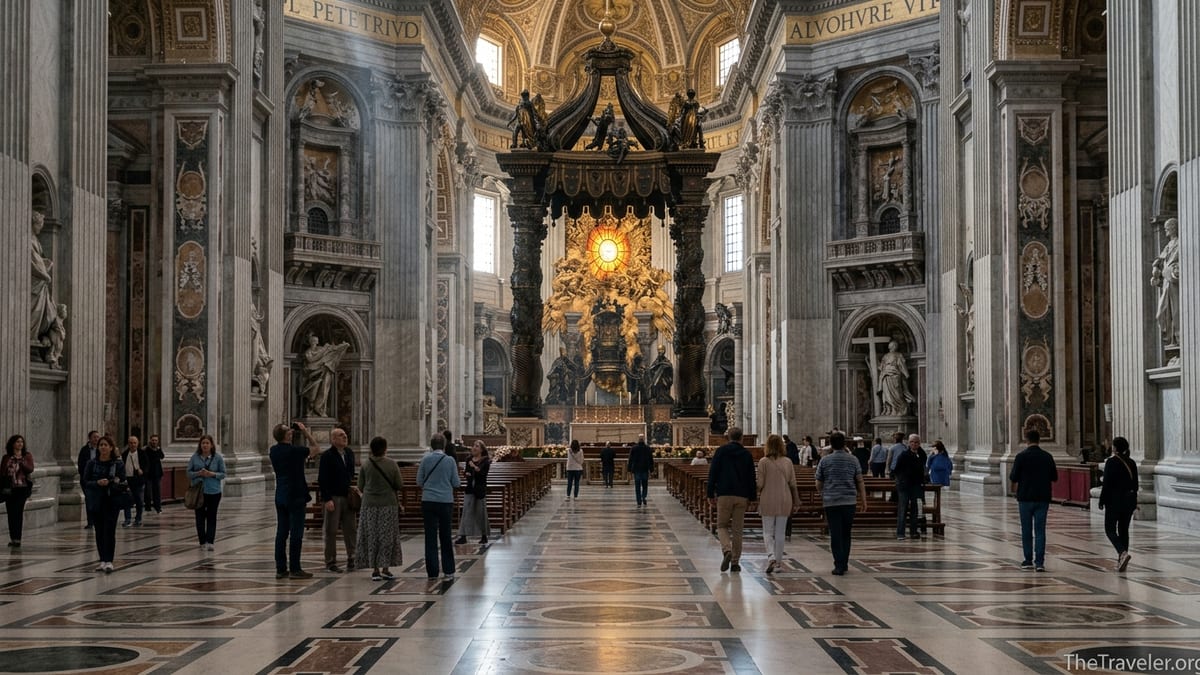
St Peter’s Basilica is one of the largest churches in the world and it feels like it the moment you step inside. The nave alone is longer than two football fields, and the side aisles and chapels branch off in a way that can make the interior disorienting when it is crowded. Before you get lost in the details, pause just past the security and bronze doors to get your bearings. Directly ahead is the long central nave, ending at the high altar and Bernini’s bronze baldacchino. To your immediate right, not far from the entrance, is the chapel housing the Pietà. Most visitors cluster here, but if you walk a little farther in and then work your way slowly around the perimeter, you will discover many areas that casual tour groups barely glance at.
Planning your timing helps you see more. As of mid 2026, the basilica typically opens early in the morning, around 7:00, and closes in the early evening, with slightly longer hours from April to September. Arriving before 9:00, especially on a weekday that is not a major Catholic feast, you are more likely to encounter softer light streaming through the high windows, fewer loud tour groups and shorter lines for the dome, treasury and Vatican Grottoes. Security is through airport style scanners in St Peter’s Square, so factor in 20 to 45 minutes for queues at busy times, more around major papal events or the Wednesday papal audience.
Most areas of the basilica are free to enter, including the main interior and the Vatican Grottoes with papal tombs. Separate tickets apply to optional experiences like climbing the dome, visiting the Treasury Museum and joining a guided tour of the necropolis beneath the grottoes. Prices can change, but in 2026 you can expect to pay around 8 to 10 euros for the dome, about 5 euros for the treasury and roughly 13 euros for the deeply atmospheric Vatican necropolis tour, which must be booked in advance through the Vatican. Knowing where these areas are and what they cost allows you to prioritize what matters most to you beyond the Pietà.
Dress codes are strictly enforced at the entrance. Shoulders and knees must be covered, which means no short shorts or strapless tops, even in the summer heat. Light linen trousers, a midi skirt and a packable scarf are common solutions that keep you comfortable in Rome’s weather while respecting the basilica’s rules. Security can turn people away for inappropriate clothing, so coming prepared ensures you can focus on what you came to see instead of scrambling to buy a scarf from a street vendor at the last minute.
Bernini’s Baldacchino and the Theater of the High Altar
If the Pietà is the most photographed sculpture in St Peter’s, Gian Lorenzo Bernini’s bronze baldacchino is the work that defines the interior space. Rising nearly 30 meters above the papal altar, its twisting columns and vast canopy draw the eye the moment you look down the nave. Commissioned by Pope Urban VIII and completed in the 1630s, the baldacchino marks the place where tradition holds that the tomb of the apostle Peter lies directly below. Rather than a flat canopy, Bernini designed a tent like structure that seems to billow as if caught in a breeze, echoing temporary canopies used to shelter relics during important ceremonies.
From the floor of the nave, take time to circle the baldacchino rather than viewing it only frontally. As you move around, you will notice details that disappear in a quick glance: the bees, suns and laurel motifs that refer to the Barberini family of Urban VIII; the four colossal angels poised at the corners; and the increasing scale of the bronze putti as they climb the columns, a theatrical trick that makes the enormous structure feel even taller. Guides sometimes point out the controversial history of the bronze, said to have been partly sourced from the portico of the ancient Pantheon. Whether that story is exaggerated or not, it hints at how the Counter Reformation church used art and ancient materials to project power and continuity.
Look also at the marble floor under your feet around the altar, marked by large discs of colored stone and an inlaid sunburst indicating the exact center of the church. On the balustrade surrounding the Confessio, you will often see pilgrims kneeling or resting their hands as they look down toward Peter’s tomb, visible through lamps and grilled openings. Even if you are not religious, watching the movement of people around this spot makes it clear that the baldacchino is not just a masterpiece of Baroque sculpture but also the focal point of a living place of worship.
To fully appreciate Bernini’s staging, walk back toward the middle of the nave and then turn around to face the apse. From here you see the baldacchino framed against his later work, the Cathedra Petri, creating a long visual axis from entrance to apse. The contrast between Michelangelo’s heavy masonry and Bernini’s animated bronze and light makes this one of the great indoor vistas in Europe. Photographers often favor a viewpoint near the central nave medallions in the floor, using a wide angle lens to capture the full vertical sweep from marble floor to coffered vaults.
The Cathedra Petri and the Golden Light of the Apse
Walk behind the baldacchino toward the far end of the basilica and you arrive at the apse, where Bernini designed another major ensemble around the so called Chair of St Peter. At first glance, you see a great bronze throne floating on a cloud of angels and golden rays. Encased within this Baroque setting is an earlier wooden chair that medieval tradition associated with the apostle Peter. Modern scholarship suggests the wooden throne is later than the apostolic era, but the symbolism endures, and Bernini’s design treats the object as a relic of papal authority.
Above the chair is an oval alabaster window depicting a dove, the symbol of the Holy Spirit, surrounded by a blaze of golden stucco rays and swirling angels. In the late afternoon, when the sun is low over Rome, this window glows with a deep honey colored light that spreads across the apse and spills into the crossing. If you can time your visit for this moment, usually between about 3:00 and 5:00 depending on the season, you will see why countless visitors describe the scene as one of the most moving in the basilica.
Look closely at the four larger than life bronze figures that support the chair: two Latin Doctors of the Church, Augustine and Ambrose, and two Greek Doctors, Athanasius and John Chrysostom. Their monumental robes and expressive gestures connect the Roman church to both Western and Eastern Christian traditions. A common way to appreciate the scale is to compare the size of a human visitor standing near the marble balustrade with the figures’ sandaled feet, which are taller than a person’s torso. These kinds of visual exaggerations are typical of Bernini, who blended sculpture, architecture and colored light into a total theatrical environment.
Do not rush away after your first photo. Step to the left and right sides of the apse and notice how the composition shifts. From some angles the bronze throne appears almost to float in space; from others you see the depth of its supports and the shadows they cast. Visitors with a modest zoom lens, around 70 to 105 millimeters, can capture tight details of the dove window or the individual saints, while a wider focal length reveals the entire apse framed by massive pilasters and coffered arches.
The Dome and Rooftop: Seeing the Basilica From Above
Climbing the dome is one of the most popular experiences at St Peter’s and it shows you parts of the basilica that are invisible from the floor. Access is from the right side of the basilica near the entrance to the Grottoes. You buy tickets at a small office that, as of 2026, typically charges about 8 euros if you take the full 500 plus steps and around 10 euros if you use the elevator to the roof and then climb the remaining steps inside the dome. Lines for tickets and for the elevator grow long by mid morning, so locals and experienced travelers often aim to be at the dome entrance close to opening time, around 8:00.
The first stop is the interior gallery at the base of the dome, high above the baldacchino. From here you look down into the basilica and see just how tiny the people look around the altar. The mosaics lining the drum and the inside of the dome are visible at arm’s length, revealing that what many assume are frescoes are actually millions of small tesserae designed to withstand humidity and smoke. Take a slow lap around the circular gallery to admire the saints, angels and decorative patterns, and to appreciate Bramante and Michelangelo’s engineering. Those afraid of heights may feel the railing is low, so step back as needed, but even a short look gives you an unforgettable perspective.
The second stage of the climb takes you between the inner and outer shells of the dome via narrow, sloping staircases. The walls curve and tilt as you ascend, which can be disorienting. This is not recommended for visitors with serious claustrophobia or mobility issues; there are no elevators for this part, and you share the space with a stream of other climbers. Bring a small bottle of water and avoid heavy backpacks, because the passages can be extremely tight when busy.
At the top, you emerge on the dome’s outer balcony, with sweeping views over Vatican City and Rome. To one side you see Bernini’s colonnades embracing St Peter’s Square; beyond them, the straight avenue of Via della Conciliazione leading toward the Tiber. On clear days you can pick out Castel Sant’Angelo, the Victor Emmanuel II Monument and even distant hills framing the city. The rooftop level below the dome has a small refreshment kiosk and a gift stand, as well as a chance to walk among the giant statues of Christ and the apostles that line the facade. Up close, their faces and hands are rougher than they appear from the square, another reminder of how much of St Peter’s was designed to be seen from far away.
The Vatican Grottoes and Papal Tombs
Directly beneath the basilica floor lies the Vatican Grottoes, a dimly lit space that feels centuries away from the bright Baroque interior above. Entrance is free and usually found near the crossing, behind or beside the papal altar, depending on current circulation routes. The grottoes contain chapels, fragments of the older Constantinian basilica and the tombs of many popes and European rulers. Because photography is restricted and the atmosphere is hushed, this is a place to slow down, walk quietly and focus on details instead of snapshots.
As you follow the gently sloping passages, you will see simple marble slabs for some modern popes and elaborate sculptural monuments for others. The former resting place of John Paul II became a particular focus of devotion before his remains were moved upstairs after his beatification. Other tombs, such as those of Pius XII or Paul VI, are marked with modest inscriptions and a few fresh flowers. Alongside papal graves are chapels dedicated to national patron saints and remnants of medieval frescoes rescued when the old basilica was demolished in the 16th and 17th centuries.
Near the center of the grottoes, you come close to the area associated with the tomb of St Peter. Access to the actual Roman era necropolis below requires a separate guided Scavi tour, which must be arranged weeks or months ahead through the Vatican’s Excavations Office and costs in the low double digits in euros. Even without that tour, though, the grottoes allow you to sense the layers of history beneath your feet. Many visitors describe this as the moment when the scale of Christian time, from the first centuries to today, becomes tangible.
Because the grottoes are part of an active devotional space, dress codes and behavior expectations are even more important here than in the main church. Voices are kept low, hats should be removed and group leaders often remind participants not to block narrow passages. If you visit in the middle of the day when tour groups are common, consider pausing at a side chapel to let a noisy cluster pass, then enjoy a quieter segment of corridors before returning upstairs to the brightness of the basilica.
Hidden Chapels, Mosaics and the Treasury Museum
Beyond the marquee highlights, some of the most rewarding moments in St Peter’s come from wandering the side aisles and chapels. On the right side of the nave, after the Pietà, you will encounter altars dedicated to saints, former popes and Marian devotions, each with its own artwork. Many paintings that look like canvases are actually mosaics produced in the Vatican’s mosaic studio, created this way so that candle smoke and humidity would not damage them. If you move close to a work and look carefully at the surface, you can see the tiny tesserae that make up faces, drapery and sky, a level of craftsmanship that often surprises visitors expecting brushstrokes.
On the left side of the church, the Blessed Sacrament Chapel is one of the few spaces where a measure of silence is actively enforced so that people can pray. Entry might be restricted to those intending to remain for a time of quiet, which makes it a good refuge from the crowds if you want a moment of stillness. Benches, soft light and the presence of a gilded tabernacle designed by Bernini give this small area an intimate yet richly decorated character that contrasts with the vast public nave.
If you are interested in liturgical art and precious objects, the Treasury Museum is worth considering. Accessed from the left transept through a discreet doorway, it requires a separate ticket of around 5 euros as of 2026. Inside, you will find reliquaries, vestments, chalices, papal tiaras and fragments of early Christian sarcophagi. The museum is not large but it provides context for the ceremonies and history of the basilica, and it is usually significantly less crowded than the main interior. Audio guides or label descriptions, depending on the current set up, explain how particular objects were used in papal liturgies and which historical figures donated them.
As you explore, keep an eye on the floor and lower walls. In several side aisles you can spot inscriptions listing measurements of the world’s great churches, set into the paving to demonstrate just how long St Peter’s nave is compared to others. Along some pillars you will see small medallions showing the level reached by floodwaters from the Tiber in centuries past. These unobtrusive details ground the overwhelming grandeur of the basilica in the practical realities of building, maintaining and using a giant stone structure over hundreds of years.
Planning Your Visit: Practical Tips and Crowd Strategies
Seeing more than the Pietà at St Peter’s is largely a matter of timing and strategy. Mornings before 9:00 and late afternoons after about 16:30 tend to be quieter inside the basilica itself, although seasonal variations and special events can change this. The square may still be lively, but interior noise levels drop as large tour groups head off to the Vatican Museums or wrap up for the day. If you want to combine the dome, the grottoes and an unhurried wander through the chapels, consider arriving early, climbing the dome first, then exploring the interior and finishing in the grottoes when your legs are tired.
Checking the Vatican’s official schedule before you go is wise, especially around major liturgical dates such as Christmas, Easter, Pentecost and canonizations. On days when the pope celebrates Mass in St Peter’s or appears for a papal audience, some sections of the basilica may be cordoned off and security lines can extend well beyond the colonnades. There is no admission ticket for the basilica itself, so you do not need to buy anything from third party vendors who suggest that a paid ticket is required simply to enter the church. What they are usually selling are guided tours, early access packages or combined tickets with the dome or museums. These can be useful for some travelers, but they are optional.
Bag size is another practical consideration. Large backpacks, tripods and bulky camera gear may be restricted or at least inconvenient to carry through dense crowds and narrow stairways. A small daypack with water, a compact camera or smartphone, and a scarf for covering shoulders is generally sufficient. There are limited restroom facilities around the square and on the basilica roof, so it is sensible to plan a restroom break either before entering the security line or once you reach the rooftop level during a dome visit.
Finally, consider how you want to balance photography and presence. The interior of St Peter’s is visually overwhelming and it is tempting to capture every angle of the baldacchino, dome and chapels. Yet some of the most memorable impressions visitors report come from standing still on the central axis, feeling the cool marble underfoot, listening to the murmur of prayers and the distant echo of footsteps, and simply looking. Giving yourself ten or fifteen minutes without a camera raised allows the complexity of the place to sink in, turning a checklist visit into a personal encounter with one of the world’s great sacred spaces.
The Takeaway
St Peter’s Basilica rewards those who move beyond the predictable stop at Michelangelo’s Pietà. From the soaring bronze of Bernini’s baldacchino and the golden glow of the Cathedra Petri to the intimate quiet of the Vatican Grottoes and the sweeping rooftop views from the dome, the church offers a sequence of experiences that layer art, history and devotion. None of them require specialized knowledge; they simply ask for a bit of time, curiosity and willingness to look carefully.
By arriving early or late, dressing appropriately and planning for a few paid extras like the dome or treasury if they match your interests, you can explore the basilica at your own pace. Pause to examine a mosaic up close, listen to the subdued chant of a Mass beginning in a side chapel, or read the inscription on a papal tomb. Each of these concrete encounters deepens your understanding of why this building has drawn pilgrims and travelers for centuries.
When you step back out into the glare of St Peter’s Square, you may find that what stays with you is not just the beauty of the Pietà, but also the vertigo of looking down from the dome, the flicker of votive candles near the apostle’s tomb, or a shaft of afternoon light catching golden dust above the high altar. Those are the moments that turn a famous landmark into a place you remember vividly long after your trip to Rome has ended.
FAQ
Q1. Is entry to St Peter’s Basilica free, and what costs extra?
Entry to the main basilica and the Vatican Grottoes is free, but the dome climb, Treasury Museum and the necropolis (Scavi) tour each require separate paid tickets.
Q2. Do I need to book tickets in advance to climb the dome?
For the basic dome climb ticket you usually buy on site at the basilica, though lines can be long at peak times; the separate necropolis tour beneath the basilica must be requested and confirmed in advance.
Q3. How long should I plan for a visit if I want to see more than the Pietà?
Allow at least two to three hours to explore the main interior, climb the dome or visit the grottoes, and spend unhurried time with highlights like the baldacchino and apse.
Q4. What is the best time of day to avoid crowds inside the basilica?
Early mornings soon after opening and late afternoons tend to be quieter, though major feast days, papal events and peak summer tourism can still bring heavy crowds.
Q5. Is there a dress code, and how strictly is it enforced?
Yes. Shoulders and knees must be covered, and staff at security can turn visitors away for short shorts, low cut tops or sleeveless shirts, especially in summer.
Q6. Can I take photos everywhere inside St Peter’s?
Photography without flash is generally allowed in the main basilica, but it is restricted or discouraged in the Vatican Grottoes, some chapels and during liturgical celebrations; always follow posted signs and staff instructions.
Q7. How physically demanding is the dome climb?
The full climb involves more than 500 steps, some on narrow, steep and sloping staircases; the elevator option reduces the number of steps but still requires a substantial ascent and is not ideal for those with mobility or serious claustrophobia issues.
Q8. Are guided tours necessary to appreciate the basilica’s art and history?
Guided tours and audio guides can provide valuable context for works by Michelangelo and Bernini, but with a good map and some advance reading you can also enjoy a self guided visit at your own pace.
Q9. How do I visit the tomb of St Peter and the ancient necropolis?
To visit the Roman era necropolis and the area immediately around Peter’s tomb, you must book a Scavi tour through the Vatican’s Excavations Office; spaces are limited and often fill weeks in advance.
Q10. Is St Peter’s Basilica suitable for children and non religious visitors?
Yes. Children often enjoy the climb to the dome and exploring the vast interior, and non religious visitors are welcome as long as they respect the quiet atmosphere and ongoing liturgical services.