


The first time I stepped into St Peter’s Basilica in Vatican City, my brain simply could not keep up with my eyes. I had seen the postcards and the drone shots on television, but none of that prepared me for the sheer physical shock of its scale. It was like walking into a building designed for another species, one that measures space in hundreds of meters and tens of thousands of people. Only when I started comparing everything to familiar, real-world sizes did the immensity of St Peter’s truly land.
Get the latest updates straight to your inbox!
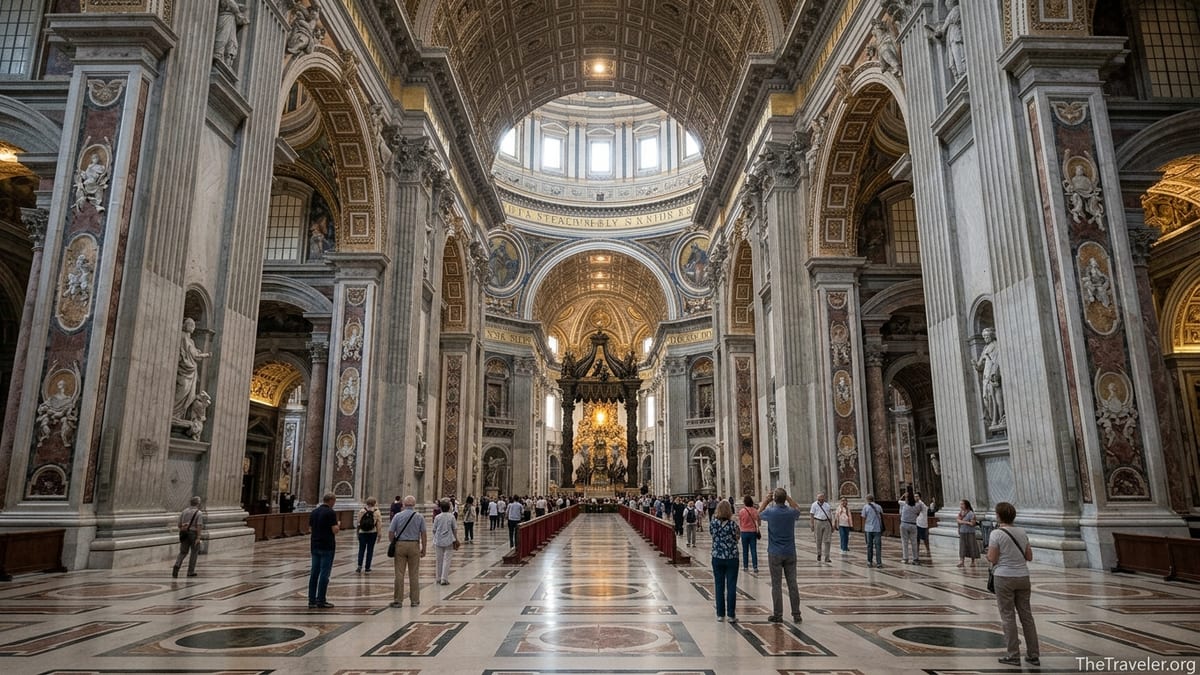
Trying to Grasp a Church the Size of a City Block
The numbers of St Peter’s Basilica are easy enough to look up, but they do not mean much until you are standing under the coffered ceiling yourself. The basilica stretches to about 220 meters in length and around 150 meters at its widest point, with a total interior area large enough to accommodate roughly 60,000 worshippers during major ceremonies. That is the equivalent of filling an entire modern football stadium’s worth of fans, not on the pitch and stands, but inside a single church nave.
To put it in more familiar terms, imagine placing a standard American football field, goalposts and all, directly inside the basilica. You would still have space left over for side aisles, chapels, and Bernini’s enormous bronze Baldachin rising over the papal altar. Even visitors who come from big-city cathedrals like St Patrick’s in New York or Notre-Dame in Paris often report feeling dwarfed here. In person, the marble floor seems to stretch into the middle distance, and the people ahead of you shrink to the size of chess pieces as they approach the high altar.
That sense of scale starts even before you walk inside. The façade towers roughly 45 to 50 meters above St Peter’s Square, while the colonnades of Bernini’s grand piazza wrap around you in a giant stone embrace. Many travelers arrive by metro at Ottaviano or by bus along Via della Conciliazione, and as they step into the square for the first time, their immediate reaction is to stop walking and simply tilt their heads back. The basilica does not just dominate the square. It defines the skyline of an entire microstate.
What surprised me most was how the church keeps revealing its size in stages. The square feels huge until you approach the steps. The steps feel monumental until you stand under the portico. The portico feels cavernous until the bronze doors swing open and you realize you have only just crossed the threshold into a space that could swallow entire city blocks.
Under the Dome: When Architecture Becomes Atmosphere
The true heart of St Peter’s immensity is its dome, Michelangelo’s crowning achievement and still one of the tallest domes in the world. From the basilica floor to the top of the cross outside, the structure reaches roughly 136 meters into the Roman sky. That is higher than many modern skyscrapers in mid-sized cities, and significantly taller than London’s St Paul’s Cathedral, whose dome was directly inspired by this one.
Standing beneath it, just in front of Bernini’s Baldachin, the dome ceases to feel like architecture and starts to feel like atmosphere. The lantern and windows high above appear to hang in mid-air, softened by Rome’s famously diffuse daylight. On bright mornings, shafts of light slice diagonally through the interior, illuminating swirling dust and the gold mosaics that line the dome’s interior. On overcast days, the dome becomes a soaring shadow, an enormous gray void that makes spoken words feel smaller and softer than usual.
For many visitors, the climb to the dome is where the scale becomes personal. As of mid-2026, tickets for the dome are typically just under 10 to 15 euros depending on whether you take the elevator part of the way or climb every step. After a short lift ride or a series of initial stairs, you emerge on the inside base of the dome, at the same level as the ring of saints and Latin inscriptions you originally saw from far below. Suddenly the huge letters, each more than two meters tall, are at eye level, and you realize that what looked like decorative text from the floor is actually the size of a small car.
Continuing upward along the narrow, often tilting staircases, you pass between the inner and outer shells of the dome. The walls curve around you, and at certain points you tilt inward with them like you are walking along the inside of an enormous stone bell. When you finally emerge onto the exterior viewing platform, you are standing above a church that already towered over you, looking down at people in the square who now appear as tiny moving grains of color. The gradual change from feeling dwarfed to looking down on everything is one of the most memorable ways to experience just how massive the basilica really is.
Objects So Large They Distort Your Sense of Distance
Inside St Peter’s, everyday measures fail quickly. The black marble strip inlaid along the nave floor, dotted with inscriptions, compares the lengths of other major churches around the world to St Peter’s. You can see, marked out under your feet, where iconic buildings like St Paul’s in London or Santa Maria del Fiore in Florence would end if they were placed inside this basilica. It is a quietly devastating way of showing size: you are literally walking past the imagined end walls of other world-famous churches while still having plenty of basilica ahead of you.
Even individual works of art play tricks on perspective. Bernini’s Baldachin, the towering bronze canopy over the main altar, looks like an ornate piece of furniture in photographs. In person it rises more than 20 meters high, taller than a typical six-story building. At its base, tour guides often point to the sculpted bees and laurel branches, small details that appear from a distance to be delicate metalwork but up close reveal themselves as massive bronze elements thicker than your hand.
Michelangelo’s Pietà provides another lesson in scale, though of a different sort. This famously delicate sculpture, carved when the artist was in his early twenties, is protected behind glass near the entrance. Visitors usually join a tight cluster of people to get closer. Once again, size plays a role: the Pietà is smaller than many expect, but the space around it is immense, and the contrast between the intimate sorrow of Mary and the monumental architecture around her makes the scene feel almost impossibly human. It is as if a quiet whisper has been placed inside a booming cathedral.
Elsewhere, details that might feel monumental anywhere else become mere accents. The large statues of saints in the niches of the piers look modest from the nave, but stand next to one at close range and you find yourself at knee height. Even the holy water fonts near some entrances, supported by cherubs carved from marble, are the size of small bathtubs. In St Peter’s, the architecture repeatedly undermines your instincts about what “big” means.
How to Visit So the Scale Really Sinks In
The time and manner of your visit can dramatically change how you experience the basilica’s size. As of 2026, entry to St Peter’s Basilica itself remains free, with airport-style security screening in St Peter’s Square. Lines can be long in peak months like May, June, and September, with waits of 45 to 90 minutes not uncommon in the late morning. Some visitors choose to book a paid audio-guide or guided-entry package, which essentially buys you access to a dedicated entrance channel once you clear security, but even then, you share the same scanners as everyone else.
If your priority is feeling the true immensity of the space, consider timing your arrival either very early or near closing. Travelers in recent months have reported walking straight into the basilica with no wait by arriving before 8:00 a.m., when the security line is minimal and the interior is relatively quiet. Another surprisingly effective window is the final hour before closing, when many tour groups have already left and the security queue thins dramatically. In those quieter moments, footsteps echo across the marble, and you can actually hear the faint murmur of priests celebrating Mass at distant side altars, which underlines just how much space separates you from them.
It also pays to move slowly and deliberately once inside. Instead of marching straight to the high altar, pause first just inside the main doors. Let your eyes travel upward along the giant Corinthian pilasters and across the barrel vault of the nave. Then walk to the central medallion on the floor and stand there long enough for your body to register that the dome is not a painted ceiling but a three-dimensional volume of air rising more than 100 meters above you. A few minutes of stillness at these key points can do more to convey scale than any rushed guided commentary.
If you plan to climb the dome, booking ahead is wise, especially in busy months. Recent guidance suggests arriving in the square at least 60 to 90 minutes before your dome time slot to clear security without stress. The climb itself involves more than 300 steps even if you take the elevator, and over 500 if you walk the entire way, so comfortable shoes are essential. For many visitors, the gradual physical strain of the climb matches the psychological realization of the basilica’s bulk: the more your legs work, the more your mind accepts that you are scaling a structure built on a truly monumental scale.
What the Scale Tells You About Faith and Power
Beyond the architecture, the size of St Peter’s is a deliberate statement. When construction began in the early 16th century, the Catholic Church was facing growing challenges to its authority. Building the world’s largest church was not only a devotional project but also a political and cultural message: here was a faith powerful enough to shape stone on a continental scale. When you stand beneath the dome, you are standing inside a centuries-old argument rendered in travertine and bronze.
The lavish spatial generosity of the basilica also reflects the practical needs of the papacy. Major liturgies like Easter Mass or the inauguration of a new pope bring tens of thousands of pilgrims into both the square and the basilica. The building’s vast interior allows processions of cardinals, choirs, and clergy to move through side aisles without disrupting the main altar area. For visitors who usually think of churches as local parish buildings, it can be eye-opening to realize that St Peter’s operates on a scale closer to a national stadium than a neighborhood chapel.
Yet within this monumental setting, the Vatican has curated countless smaller devotional spaces. Side chapels, sometimes separated by simple ropes, host early morning Masses for visiting groups. Confessionals line parts of the nave, each marked with small signs indicating languages spoken by the priests. Pilgrims kneel in front of particular tombs or relics, creating pockets of intimacy within the giant volume. This layering of huge and small, public and private, is part of what makes the basilica so psychologically complex. You are never allowed to forget the building’s size, but you also repeatedly encounter quiet corners that belong to one person at a time.
In a more secular sense, the basilica’s scale also teaches a lesson about human ambition and collaboration. Michelangelo, Bramante, Bernini, and the many other architects and artisans who worked on St Peter’s knew they would never see the finished building exactly as we do today. Yet they designed with centuries in mind. When you stand under the dome or walk along the nave, you are inhabiting the long-term vision of people who built for a future they would not live to enjoy. The size of the space becomes a reminder that some projects are meant to outlast individual lifetimes.
Practical Tips So You Are Not Overwhelmed
The emotional impact of St Peter’s scale can be intense, especially if you arrive tired after a long day of sightseeing. A little planning can make the difference between feeling crushed by the crowds and genuinely awed by the building. First, choose your entrance strategy. If you are traveling in high season and dislike queues, consider joining a small-group or early-access tour that includes basilica entry after the Vatican Museums. These tours do cost more than going independently, but they often route you through a side entrance after the museums and Sistine Chapel, avoiding the longest security line in the square.
Second, respect the dress code, which is strictly enforced at the basilica entrance. Shoulders must be covered, and shorts or skirts should reach at least to the knee for both men and women. In practice, this means packing a lightweight scarf or shawl and avoiding very short shorts or strapless tops. Security staff do occasionally turn people away to cover up before rejoining the line, which in peak sun can be a miserable experience. Sandals are acceptable, but large backpacks may be subject to extra checks or asked to be left outside in designated areas if space is limited.
Third, plan your time inside according to your energy levels. For many travelers, 60 to 90 minutes is enough to walk the nave, see the Pietà, spend time under the dome, and visit a few key chapels without rushing. Add at least another hour if you intend to climb the dome or visit the grottoes and papal tombs below the main floor. Remember that the basilica is both a major tourist attraction and an active place of worship. Photography is generally allowed, but flash is discouraged, and during certain liturgies access to some areas may be restricted or temporarily closed.
Finally, if you tend to feel overwhelmed in large indoor spaces, give yourself small, concrete tasks to focus on. Count how many seconds it takes you to walk from one central marble disk to another along the nave. Compare the size of one statue’s hand to your own. Read a single Latin inscription and track where it appears elsewhere. These simple activities help ground you in the details, turning the basilica from a single, overpowering mass into a collection of fascinating, manageable parts.
The Takeaway
For many visitors, the biggest surprise at St Peter’s Basilica is not its beauty, which they expect, but its scale, which they do not. Photographs compress it. Drone videos glide over it. But to understand what a 136-meter dome and a 220-meter-long church really feel like, you have to stand under the vaults, hear your footsteps echo, and watch other people shrink as they walk away from you across the marble.
In a city filled with extraordinary churches, St Peter’s remains singular because it operates on several levels at once. It is a functioning parish church, a global pilgrimage site, a museum of Renaissance and Baroque art, and an architectural manifesto about the reach of faith and power. Its size is not a gimmick but a language, one that speaks of centuries of ambition, devotion, and labor. When you leave, walking back across St Peter’s Square and glancing over your shoulder at the dome, you carry with you not just images but a new personal measure of what “large” really means.
If you plan carefully, arrive at the right time, and allow yourself both stillness and movement inside, the basilica’s immense dimensions stop being abstract statistics and become something you feel in your body. That is the real gift of visiting St Peter’s: for a short time, you inhabit a space built on a humanly incomprehensible scale, and in doing so, you expand your own sense of what humans can create.
FAQ
Q1. Is entry to St Peter’s Basilica free?
Yes, entry to the basilica itself is free, but you must pass through security screening in St Peter’s Square, and optional extras like dome access or guided tours cost money.
Q2. How long should I plan for a visit to really appreciate its scale?
Allow at least 60 to 90 minutes for the basilica alone, and add another hour if you plan to climb the dome or visit the grottoes and papal tombs.
Q3. What is the dress code for St Peter’s Basilica?
Shoulders must be covered, and shorts or skirts should reach at least to the knee for both men and women. Avoid low-cut tops and very short shorts, or you may be turned away.
Q4. When are the lines shortest?
Lines are usually shortest early in the morning soon after opening and again in the last hour before closing, outside of major religious events or papal ceremonies.
Q5. Do I need a ticket to climb the dome?
Yes, the dome requires a paid ticket, with different prices depending on whether you use the elevator for part of the way or climb all the steps on foot.
Q6. Is the interior really as big as people say?
Yes. At about 220 meters long and with space for tens of thousands of people, St Peter’s is widely considered the largest church by interior area in the world.
Q7. Can I visit St Peter’s Basilica without visiting the Vatican Museums?
Yes, you can visit the basilica directly from St Peter’s Square without a museum ticket, though some guided tours combine both and use a special route between them.
Q8. How physically demanding is the dome climb?
The climb involves more than 300 steps with the elevator option and over 500 if you walk the entire way, including narrow and sloping staircases, so a basic level of fitness is recommended.
Q9. Are photos allowed inside the basilica?
Photography is generally allowed for personal use, but flash and tripods are discouraged, and during certain liturgies or in specific areas, staff may restrict photography.
Q10. What should I focus on if I have limited time?
If you are short on time, prioritize Michelangelo’s Pietà near the entrance, the central nave, Bernini’s Baldachin and high altar, and at least a few minutes standing directly under the dome.