


Stony Man is one of Shenandoah National Park’s most rewarding short hikes: a relatively gentle climb to a cliff-edge summit with sweeping views of the Shenandoah Valley. Whether you are squeezing this hike into a Skyline Drive road trip or planning a dedicated sunrise or sunset outing, understanding the route options, parking, and on-the-ground conditions will help you make the most of your time on the mountain.
Get the latest updates straight to your inbox!
Where Stony Man Is and Why It Is Worth Your Time
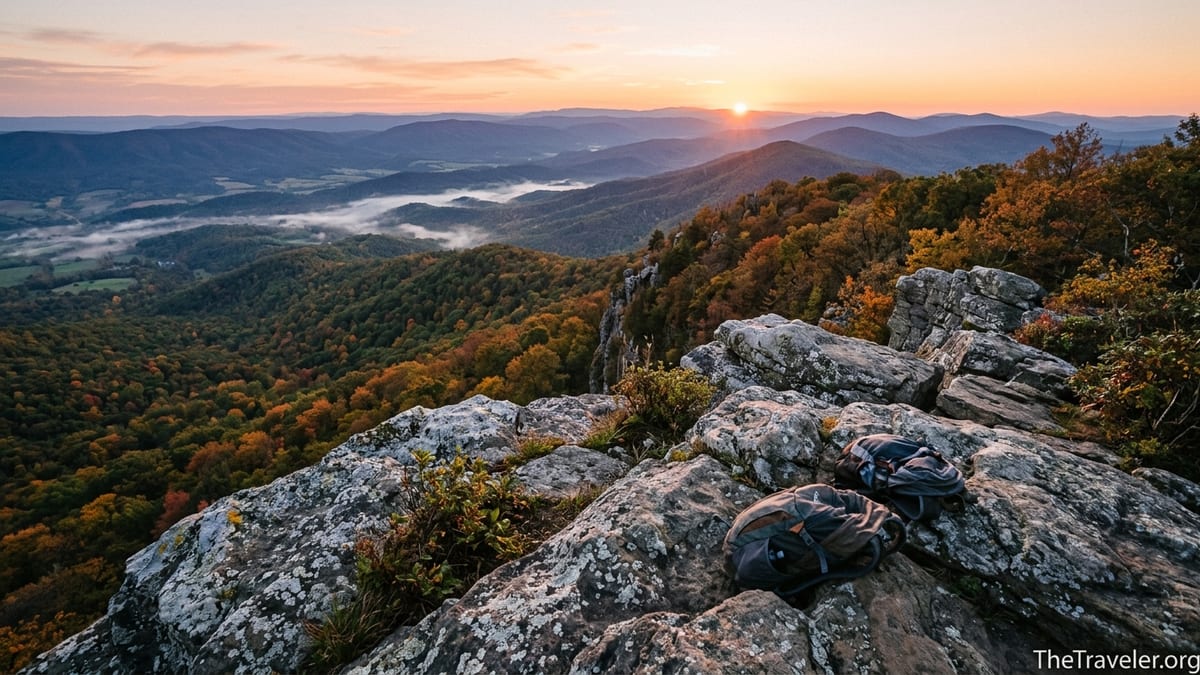
Stony Man rises to about 4,011 feet, making it the second-highest peak in Shenandoah National Park and the northernmost 4,000-foot summit in the Blue Ridge Mountains. The mountain sits in the Central District of the park, just north of Skyland, a historic lodge complex along Skyline Drive. From the summit’s rocky cliffs you look straight out over the Shenandoah Valley and Massanutten Mountain, with the patchwork of farms, small towns like Luray, and the meandering Shenandoah River spread out below.
Part of the appeal of Stony Man is how accessible those big views are. From the main Stony Man trailhead near Skyland, it is roughly a 1.6 mile round-trip hike with about 330 to 340 feet of elevation gain, manageable for many families and newer hikers who are comfortable walking uphill on uneven terrain. For something a bit more strenuous, you can combine Stony Man with Little Stony Man via the Appalachian Trail for a 3 to 3.5 mile outing that feels like a classic Blue Ridge ridge-walk.
Unlike some of Shenandoah’s tougher climbs, such as Old Rag or Hawksbill, the standard Stony Man route does not demand rock scrambles or long, steep grinds. You still get a real mountain summit and exposed cliffs, but the grade and distance are reasonable, which is exactly why this hike is often recommended for first-time visitors to the park who still want a dramatic viewpoint.
The mountain is also deeply tied to the history of the park. Skyland Resort, originally known as Stony Man Camp in the late 1800s, grew up here as an early mountaintop retreat. When you park for the hike today, you are essentially starting from the same high ridgeline area that drew visitors more than a century ago, but with modern trail design and signage that make navigation straightforward.
Mileage Options: Short Loop or Longer Ridge Hike
For most visitors, the primary option is the Stony Man Loop from the dedicated parking area near Skyland. This route is about 1.6 miles round trip. You start on the white-blazed Appalachian Trail, then pick up the blue-blazed Stony Man Trail to reach the summit viewpoint before closing the loop back to the parking lot. Even at a leisurely pace with photo stops, many hikers complete this loop in 60 to 90 minutes.
If you prefer a bit more of a workout and an extra viewpoint, the Little Stony Man approach is a popular alternative. Starting from the Little Stony Man trailhead near milepost 39.1 on Skyline Drive, you can hike a roughly 3 mile out-and-back to Stony Man, gaining around 750 to 800 feet of elevation. Many hikers report that this route feels moderately strenuous but still accessible for fit beginners who are accustomed to walking a few miles.
Another variation is to create a longer loop that links Little Stony Man Cliffs, Stony Man summit, stretches of the Appalachian Trail, and connecting trails like Passamaquoddy and Furnace Spring. Depending on the exact combination, this can add up to around 3.5 to 4.5 miles. Local hiking groups often recommend this configuration to visitors who have half a day and want to sample multiple viewpoints without committing to a full-day backcountry hike.
Whichever version you choose, remember that Shenandoah’s elevations can make distances feel a bit harder than similar mileage at sea level, especially on humid summer days. A 1.6 mile loop may sound short on paper, but if you are bringing young children or older relatives, building in extra time for breaks, snacks, and photos at the overlook will make the outing feel relaxed instead of rushed.
Finding the Trailhead and Understanding Parking
The main Stony Man trailhead is reached from Skyline Drive at approximately mile 41.7, in the Skyland area of Shenandoah National Park. The parking lot is signed as “Stony Man Parking” and is set slightly off the road, with room for a moderate number of vehicles. It serves both the Stony Man loop trail and the Appalachian Trail, so it can fill quickly on pleasant weekends in spring and fall, especially late morning and early afternoon.
The Little Stony Man trailhead, which services the longer option, sits a bit farther north around milepost 39 on Skyline Drive. Here you will find another dedicated parking area on the west side of the drive, near the Little Stony Man Overlook. Because this lot is smaller and also used by people who are just stopping for a quick view from the overlook, it can feel busy even at off-peak times.
In practice, arriving before 9 a.m. on peak-season weekends often means you can drive directly into one of these parking areas without circling. On a sunny Saturday in October, for example, you might find the Stony Man lot nearly full by late morning as leaf-peepers combine hiking with scenic driving. In those cases, it is common to see a few cars waiting for spaces to open or choosing to continue along Skyline Drive to try another trailhead.
Neither trailhead allows overnight parking for backpackers without appropriate permits and planning, and rangers may ticket vehicles left after posted hours. If you are staying at Skyland Resort, a practical strategy is to leave your car at your lodge building or cabin and simply walk to the Stony Man trailhead, adding a few extra minutes to your hike but reducing parking pressure and the need to move your vehicle.
Fees, Passes, and Practical Logistics
To reach any Stony Man trailhead by car you must enter Shenandoah National Park via an entrance station on Skyline Drive. The park charges an entrance fee per vehicle that is valid for seven consecutive days. Recent information from the National Park Service and travelers suggests that the typical private vehicle fee is in the range of a few tens of dollars for that week-long pass, though exact amounts may be adjusted periodically. If you hold an America the Beautiful interagency annual pass, senior pass, or similar national pass, you can usually enter without paying the separate Shenandoah vehicle fee.
As of July 2025, Shenandoah has moved to a fully cashless fee system at entrance stations. That means you should arrive prepared to pay with a credit card, debit card, or mobile payment instead of cash. Many visitors buy their pass online ahead of time to save a few minutes at the gate, particularly on busy holiday weekends when lines can stretch back toward the highway.
From major gateway towns such as Luray to the west or Front Royal to the north, factor in drive time not only to the park entrance but also along Skyline Drive to the Stony Man area. For instance, from the Thornton Gap Entrance near Luray, it typically takes 20 to 30 minutes to reach the Skyland and Stony Man parking areas, depending on traffic and how often you pull off at overlooks.
Cell coverage along Skyline Drive can be patchy, especially for certain carriers, so do not rely on being able to consult online maps or call ride services at the trailhead. Before you set out, download offline maps or a photo of the park’s Skyland area trail map, and confirm your route using printed materials from the national park visitor centers if you are more comfortable navigating with paper.
What the Stony Man Trail Is Really Like
From the main Stony Man parking area, the hike begins on a pleasant forest path under a canopy of hardwoods. You will see white blazes marking the Appalachian Trail for the first stretch. Within a short walk, a signed junction directs you onto the blue-blazed Stony Man Trail that climbs more directly toward the summit. The grade is steady but never extreme, and the surface is a typical Shenandoah mix of packed dirt, embedded rocks, and occasional roots.
As you gain elevation, glimpses of the Shenandoah Valley appear through the trees, especially when leaves are off in late fall or early spring. The air tends to feel a few degrees cooler than down in the valley, and morning hikers often report a fresh, slightly damp forest smell after an overnight dew or light rain. In summer, you may notice mountain laurel and rhododendron along the trail, while in October the surrounding oaks and maples turn shades of orange and red.
Near the top, the trail levels briefly before emerging onto the summit area, which is a broad rock outcrop with dramatic drop-offs to the west. Here the forest opens to reveal a panoramic view that many hikers rank among the best in the park relative to the effort required. On a clear afternoon, you can pick out the lines of farm fields and the blue ridge of Massanutten Mountain beyond the valley. On hazier days, the scene softens into layers of blue and gray ridges receding into the distance.
Because the viewpoint is wide and broken into several rock shelves, hikers tend to spread out. On a typical busy day you might see families picnicking on one section, photographers setting up tripods on another, and day-hikers quietly sitting on the edge listening to the wind. It is easy to spend 20 to 30 minutes here, especially around sunset when the low-angle light turns the rocks a warm color and the valley below begins to glow.
Seasonal Conditions, Weather, and Safety
Stony Man is hikeable year-round, but conditions change significantly by season. In summer, high humidity and afternoon thunderstorms are common. Even though the mileage is short, starting earlier in the day from June through August reduces your exposure to midday heat and avoids typical afternoon storm patterns. A small daypack with water, snacks, a light rain shell, and sun protection is usually sufficient for most visitors.
Autumn is arguably the most popular season, when fall foliage lines Skyline Drive and bursts into color on the surrounding ridges. On a clear Saturday in mid-October, expect heavier traffic on the drive, potential wait times at entrance stations, and crowded parking at Stony Man by late morning. Many travelers find that arriving before 8 or 9 a.m. lets them enjoy cooler temperatures and quieter trails, then they can spend the rest of the day visiting other overlooks or stopping at Skyland for lunch.
Winter and early spring hikes can be spectacular but require more preparation. The trail can be icy or snow-covered, especially in shaded sections, even when the valley below looks clear. Local hikers often bring traction devices that slip over boots, along with insulated layers, hats, and gloves. On cold but sunny days in January or February, you might share the summit with only a handful of other people, enjoying crystal-clear views and a very different mood from the busy summer afternoons.
Regardless of season, the summit cliffs demand caution. There are sheer drop-offs and uneven rock edges, and winds can be gusty. The National Park Service clearly marks areas where you should not climb down or venture too close to the edge. Keep children within arm’s reach in exposed sections, and avoid stepping out onto wet or icy ledges for photos. Pets are not allowed on the Stony Man Trail, which simplifies foot traffic on narrow sections and minimizes the risk of dogs slipping on the rocks.
Gear, Food, and Nearby Services
For most hikers, standard day-hiking gear is appropriate. Closed-toe shoes with good traction, such as light hiking boots or trail running shoes, make it easier to handle rocky spots. Many visitors who try the trail in casual sneakers report that it is doable, but they notice more foot fatigue and less confidence on loose stones. A small backpack with at least one liter of water per person on warm days, a snack, and a lightweight extra layer is typically enough.
If you plan to hike for sunrise or sunset, bring a headlamp or flashlight with fresh batteries. The forested sections can become quite dark even while there is still some light on the horizon, and cell-phone flashlights are easy to drop or drain. In cooler months, adding a warm hat, gloves, and a windproof layer makes waiting for the sun to rise or set at the exposed summit much more comfortable.
Skyland Resort, just south of the Stony Man parking area, offers lodging, a restaurant, and a small gift shop during its operating season. Many hikers build a full day around the area, hiking Stony Man in the morning, then returning to Skyland for a hot meal and perhaps a slice of the popular blackberry ice cream pie. A few miles south, Big Meadows Lodge and the Big Meadows Wayside offer additional dining options, gasoline, and a camp store in season.
Outside the park, nearby towns such as Luray and Front Royal provide full-service grocery stores, outfitters, and restaurants. It is common for weekend visitors to stock up on snacks, sandwiches, and beverages in town before driving up Skyline Drive, since food options on the ridge are limited and seasonal. Keeping a small cooler in your car at a shaded overlook, then enjoying a picnic lunch after your hike, is a simple way to stretch your budget and enjoy more time with the views.
The Takeaway
Stony Man offers one of the best effort-to-reward ratios in Shenandoah National Park. Within a couple of miles of walking, you move from a quiet forest trail to a broad stone summit with sweeping views across the Shenandoah Valley. Whether you choose the short loop from the Skyland-side trailhead or the slightly longer route via Little Stony Man, you will experience classic Blue Ridge scenery without committing to a full-day, highly technical hike.
By understanding the different distance options, knowing where to park, planning for the park entrance fee and cashless payment system, and preparing for seasonal conditions, you set yourself up for a relaxed and memorable outing. The trail is well-marked, the climb is moderate, and services at Skyland and nearby gateway towns fill in the rest of the logistics, from meals to lodging.
If your time in Shenandoah is limited, Stony Man is a strong candidate for a must-do hike. Hike it in the soft light of morning, linger over a picnic lunch at the summit, or time your visit for a golden sunset. In any season, the combination of easy access and big views explains why so many visitors leave saying that Stony Man was a highlight of their Skyline Drive journey.
FAQ
Q1. How long is the Stony Man Trail and how much time should I plan?
The standard Stony Man loop from the main parking area near Skyland is about 1.6 miles round trip, with roughly 330 to 340 feet of elevation gain. Most visitors complete the hike in 60 to 90 minutes, including time at the summit for photos and a short rest.
Q2. Where exactly do I park for the Stony Man hike?
For the classic short loop, park at the signed Stony Man parking area near mile 41.7 on Skyline Drive in the Skyland section of Shenandoah National Park. For the longer option that includes Little Stony Man, use the Little Stony Man trailhead parking area around milepost 39 on Skyline Drive.
Q3. Do I need to pay a fee to hike Stony Man?
Yes. You must pay the Shenandoah National Park entrance fee or present a valid national parks pass at an entrance station to drive Skyline Drive and access the Stony Man trailheads. The entrance fee for a private vehicle covers multiple days, so you can return to hike other trails during the same visit without paying again.
Q4. How difficult is the Stony Man Trail for beginners or families?
The main Stony Man loop is considered one of the easier summit hikes in Shenandoah. The distance is short and the elevation gain is moderate, but the path is rocky and uneven in places. Active children, first-time mountain hikers, and adults with basic fitness usually find it manageable, especially if they take their time and wear sturdy shoes.
Q5. Are dogs allowed on the Stony Man Trail?
No. Pets are not permitted on the Stony Man Trail. This is one of several trails in Shenandoah National Park where dogs are prohibited, in part because of steep cliffs and sensitive habitat. If you are traveling with a dog, consider other pet-friendly hikes in the park and verify current rules before you go.
Q6. What is the best time of day to hike Stony Man?
Early morning and late afternoon are especially rewarding times to hike Stony Man. Morning offers cooler temperatures and fewer crowds, while late afternoon and evening often deliver dramatic sunset colors over the Shenandoah Valley. If you aim for sunrise or sunset, carry a headlamp or flashlight for walking the wooded sections in low light.
Q7. What should I bring for a typical Stony Man hike?
Most hikers are comfortable with closed-toe shoes that have good traction, a small backpack, water, a snack, and a light extra layer. In summer, add sun protection and a lightweight rain shell. In colder months, bring a warm hat, gloves, and traction devices for icy conditions. A printed or downloaded map of the Skyland area is also helpful.
Q8. Is the Stony Man summit safe for children?
The summit offers broad rock ledges with significant drop-offs, so it requires close supervision. Many families hike Stony Man successfully, but adults should keep children close, avoid wet or icy rocks, and respect barriers or warning signs near cliff edges. Sitting a few steps back from the edge still provides excellent views while reducing risk.
Q9. Can I hike Stony Man in winter?
Yes, Stony Man can be a rewarding winter hike with clear views and fewer crowds, but you must be prepared for cold, wind, ice, and snow. Check road and trail conditions before you go, dress in warm layers, and consider traction aids for your boots. Be aware that seasonal closures or temporary restrictions may affect Skyline Drive access after winter storms.
Q10. Are there services or food options near the trailhead?
Skyland Resort, close to the main Stony Man parking area, offers lodging, a restaurant, and a small shop during its operating season. Farther along Skyline Drive, Big Meadows Lodge and the Big Meadows Wayside provide additional dining and basic supplies. Outside the park, nearby towns such as Luray and Front Royal have grocery stores, restaurants, and outfitters where you can stock up before driving into the park.