


More news on this day
Hundreds of passengers were left stranded at Dubai International Airport as a new wave of disruption triggered seven cancellations and 83 delays on major regional routes operated by FlyDubai, Emirates, Air India, IndiGo and Gulf Air, affecting key connections to Bahrain, Karachi and Salalah.
Get the latest news straight to your inbox!
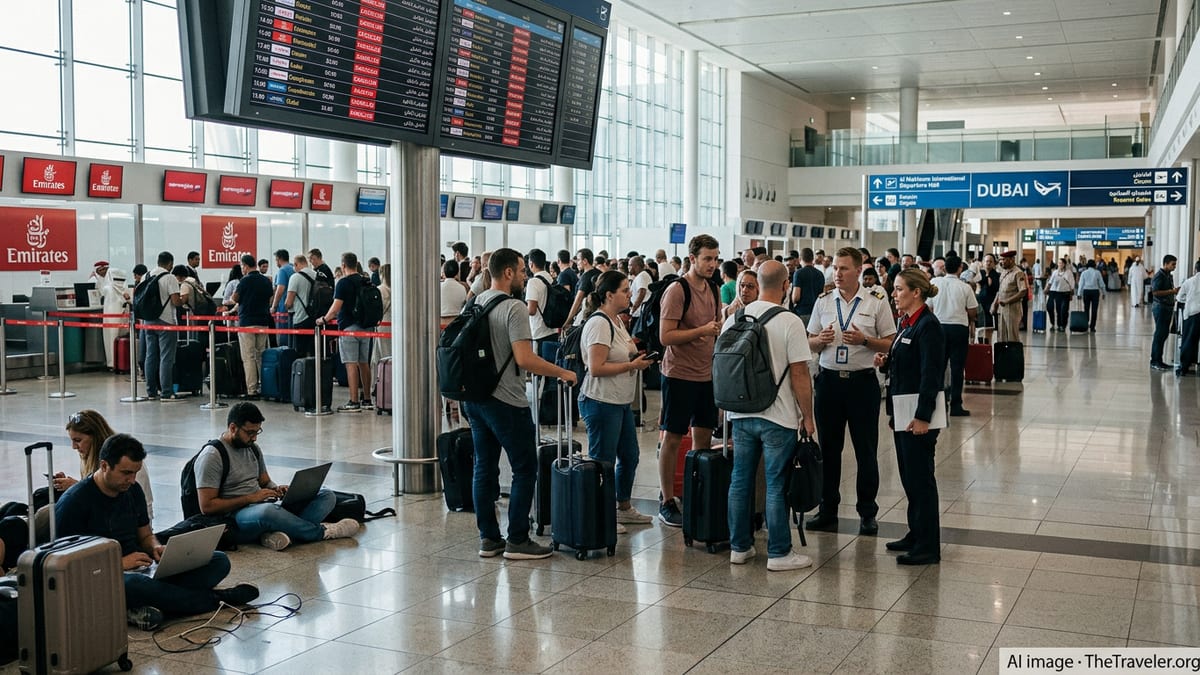
Fresh Turbulence at the Gulf’s Busiest Hub
Publicly available flight tracking data and passenger reports indicate that Dubai International Airport faced renewed operational strain over the weekend, with a concentrated cluster of cancellations and delays across short and medium haul services. While the wider Middle East has experienced intermittent airspace restrictions since late February, the latest figures at Dubai underline how even a partial tightening of routes can ripple through one of the world’s busiest hubs.
The seven recorded cancellations and 83 delays were spread across services operated by FlyDubai, Emirates, Air India, IndiGo and Gulf Air, all of which rely heavily on Dubai as either a primary base or a critical transfer point. Many of the affected flights served high-demand regional links where turnarounds are tight and schedules leave little room for recovery once congestion builds.
Operational summaries from aviation data providers show that delays at Dubai are clustering around peak connection banks, when inbound traffic from Asia and Europe converges with departures across the Gulf, the Indian subcontinent and East Africa. Once departure slots begin to slip, knock-on disruption can quickly compound, leaving passengers facing missed connections and extended unscheduled stays in Dubai.
Travel industry analyses published in recent days describe the situation as a fragile recovery phase, with Dubai operating near normal levels on some days but still vulnerable to sudden regional airspace constraints that force rerouting, altitude changes or holding patterns, all of which can cascade into ground delays.
Key Routes to Bahrain, Karachi and Salalah Hit Hard
The latest disruption has been particularly acute on routes linking Dubai with Bahrain, Karachi and Salalah, three corridors that are central to business travel, labour flows and leisure traffic in the region. Flight status boards and schedule trackers show repeated delays on services to Bahrain International Airport, a major hub for Gulf Air and an important connection point for passengers heading to South Asia and Europe.
On the Dubai Karachi corridor, passengers reported multiple instances of extended waits at departure gates and late-night rescheduling. Karachi is one of the busiest South Asian destinations served from Dubai, and when outbound flights are delayed or cancelled, large numbers of transit passengers travelling onward to interior Pakistani cities can be left with limited immediate alternatives.
Salalah, a key leisure gateway in Oman and a popular seasonal destination from Dubai, has also seen irregular operations, including delays on FlyDubai and Emirates services. Real-time trackers for recent days highlight departures from Dubai to Salalah pushing back significantly later than scheduled, with some services subject to last-minute timing changes that complicated connections for travellers originating in Europe and Asia.
In each of these markets, airlines have attempted to consolidate demand by combining lightly booked flights, rerouting via other Gulf hubs or operating ad hoc services when airspace conditions allow. However, the combination of short-haul aircraft rotations, constrained crew availability and shifting overflight permissions continues to limit the ability of carriers to restore reliable, clockwork-style operations on these links.
FlyDubai, Emirates, Air India, IndiGo and Gulf Air Under Pressure
The disruption has highlighted the exposure of leading regional airlines to ongoing instability in Middle East skies. FlyDubai, which is based at Dubai International and operates a dense network of short-haul routes, is particularly sensitive to small delays that disrupt its rapid turnaround model. When a morning departure leaves late, subsequent rotations throughout the day can accumulate progressively larger schedule slips.
Emirates, Dubai’s flagship carrier, has maintained a broad, if adjusted, schedule through the recent period of volatility, but its hub-and-spoke structure means even a modest number of delayed or cancelled feeder flights can strand connecting passengers. Public advisories from the airline in recent weeks have emphasised the need for customers to check their flight status frequently and to avoid travelling to the airport without a confirmed booking and departure time.
India’s Air India and IndiGo, both important players in the Dubai to South Asia market, have faced their own constraints. Air India’s recent operational notices list Dubai with limited scheduled services and a reliance on ad hoc flights, while also recording suspensions or reduced operations at destinations such as Bahrain and Salalah. IndiGo has continued to sell seats on Dubai routes, but travellers have used social media and online forums to describe sudden re-timings and route suspensions, prompting many to book backup itineraries.
Gulf Air, the flag carrier of Bahrain, remains heavily exposed to any restrictions affecting Bahrain’s airspace and its ability to operate Dubai Bahrain rotations. Passenger accounts of repeated cancellations on Bahrain linked itineraries in recent weeks illustrate how quickly options can narrow for travellers who depend on this corridor as a convenient bridge between India, Pakistan and Europe.
Why Disruption Persists Despite Partial Recovery
Analysts who track global air traffic patterns point to a combination of regional conflict, shifting overflight permissions and operational bottlenecks to explain why disruption at Dubai continues even as official statements describe a gradual resumption of services. Airspace closures and restrictions in several Middle East countries have forced airlines to fly longer, less direct routings that burn more fuel and require additional flight and cabin crew hours.
These route changes reduce the buffer capacity that airlines typically use to recover from everyday issues such as minor technical faults or late inbound aircraft. With many carriers still operating reduced fleets after previous global shocks, spare aircraft are not always readily available, making it harder to slot in replacements when a plane or crew goes out of position.
At airport level, operational documents show that Dubai International is juggling the twin challenges of high passenger volumes and irregular arrival flows. Ground handling teams and air traffic control must adapt to clusters of late arrivals, which place pressure on gates, stands and runway access. This can translate into departing aircraft waiting longer for a take-off slot, further lengthening delays and occasionally tipping borderline cases into cancellation.
Travel rights organisations also note that some airlines classify recent delays and cancellations as stemming from extraordinary circumstances, limiting eligibility for financial compensation under various consumer protection regimes. Even where compensation is not due, carriers are still expected to provide care such as meals, accommodation where necessary and rebooking on the next available services.
What Stranded Passengers Are Facing on the Ground
For travellers caught in the latest wave of disruption, the experience on the ground at Dubai International has varied widely depending on the airline, destination and time of day. Passenger accounts describe long queues at transfer desks during peak disruption periods, with some travellers receiving same day rebookings and others offered departures several days away, particularly on oversubscribed routes to Karachi and other South Asian cities.
Some carriers have proactively rerouted passengers via alternative hubs such as Doha or Riyadh when seats became available, though this often involved additional security checks and longer travel times. Others have relied on hotel accommodation and meal vouchers to bridge extended layovers while waiting for operational windows to reopen on their original route.
Travel advisers recommend that anyone booked to fly through Dubai in the coming days treat their itinerary as provisional, monitoring their booking closely and remaining flexible about routing. Passengers holding separate tickets for onward journeys are particularly vulnerable, as missed connections in Dubai typically require rebooking at the traveller’s own expense unless an airline chooses to assist.
With regional airspace conditions still fluid, industry observers caution that further short notice changes are possible. For now, Dubai International remains operational but fragile, with a single day’s tally of seven cancellations and 83 delays serving as a reminder that the Gulf’s premier hub has yet to regain the full resilience that characterised its pre crisis operations.