


I did not expect a painted white line through a village square to feel like a travel milestone. Yet stepping over the Arctic Circle in Santa Claus Village, on the outskirts of Rovaniemi in Finnish Lapland, was one of those quietly powerful moments that lingers long after the trip is over. It is at once unabashedly commercial and genuinely magical, a place where souvenir shops surround a latitude that has shaped exploration, climate science and childhood daydreams about the far north.
Get the latest updates straight to your inbox!
Arriving at the Edge of the Map
The Arctic Circle feels like an abstract concept when you read about it in schoolbooks. On the ground in Rovaniemi it becomes something you can ride a bus to. From the city center, local bus line 8 runs the 8 or so kilometers out to Santa Claus Village, dropping visitors beside a cluster of sharply pitched roofs, snowbanks and neon "Welcome" signs. Even in high season in December and January, that first glimpse of icicle-draped log buildings and floodlit spruce trees hints that you have left ordinary Europe behind.
Most visitors arrive wrapped in rental thermal suits, boots and balaclavas, faces flushed from the wind off the Kemijoki River. In winter, temperatures hover well below freezing, often dipping toward minus 15 degrees Celsius or lower, and the air has a dry, crystalline clarity. In summer, by contrast, the approach can be disorienting in a different way: the thermometer has been known to climb to around 30 degrees and yet every sign still insists you have reached the Arctic. Either way, the parking lot fills with coaches from Helsinki, charter flights from the UK, and self-drivers from as far as Germany and France who have inched their way north over days.
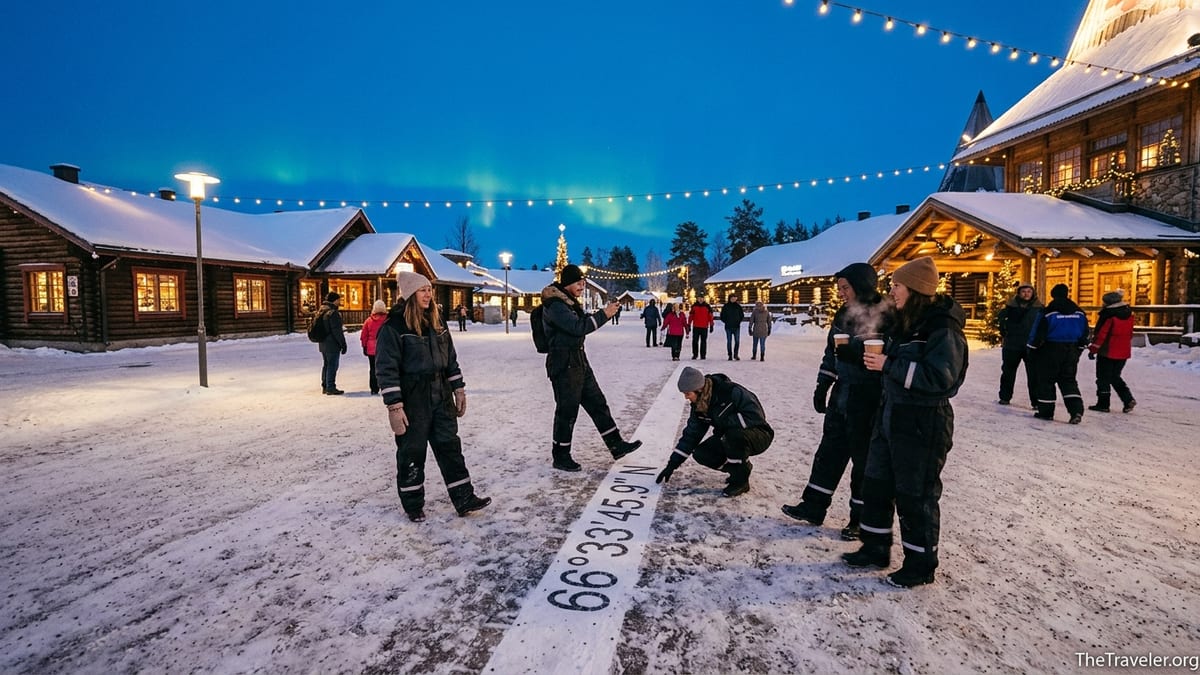
Step inside the village proper and the commercial side of Lapland is on full display. There are premium outdoor gear brands, rows of Lapland handicrafts, racks of stuffed reindeer and shelves of Santa-shaped chocolates. But beyond the souvenir façade, the village has a clear focal point: a wide central square where a bright white line cuts diagonally across the paving stones beneath strings of warm fairy lights. That is where the Arctic Circle ceases to be an idea and becomes a place.
Finding the Painted Arctic Circle Line
The Arctic Circle here is not a fence, a border post or even a dramatic natural feature. It is simply a heavy white stripe painted across the plaza between Santa’s Main Office and the post office, marked with bold lettering and latitude coordinates. The exact position of Earth’s Arctic Circle actually shifts slowly over time because of changes in the planet’s axial tilt, but Rovaniemi’s marker is fixed around 66 degrees 33 minutes north, a symbolic stand-in that has welcomed visitors for decades.
On a busy winter afternoon, the line becomes an attraction in itself. Children race back and forth from the "south" side to the "north" side, counting out how many times they can cross. Couples take turns posing with one foot in each hemisphere while a stranger from Portugal or Japan offers to press the shutter. Tour groups cluster for their guide’s explanation of polar night and midnight sun as overhead speakers loop soft Christmas music. It is chaotic, but there is a current of shared excitement, the sense that everyone there has intentionally chased a latitude they once only saw on classroom maps.
The village has learned to turn that excitement into ritual. A small kiosk beside the square sells ornately printed "Arctic Circle Crossing" certificates for just a few euros, complete with your name and the date, sometimes stamped with a special Lapland postmark. You can choose from versions in different languages, and many families buy one for each child. It is a commercial flourish, certainly, but also a tangible reminder that you stood in a place that most people only dream about visiting.
Why Crossing the Line Feels More Emotional Than It Should
Intellectually, I knew I was standing in a purpose-built tourist village. There were Christmas jingles playing in March, queues for souvenir photos with Santa, and more reindeer plush toys per square meter than anywhere else in Finland. Yet the moment I stepped over that line for the first time, from the "temperate" side into the "Arctic" side, something tightened in my chest. A row of icicles hung from a roof edge, a faint green smear of aurora glowed in the late afternoon sky, and the loudspeakers briefly fell silent under the hush of falling snow. For a second, the tackiness blurred and a lifetime of stories about the far north caught up with me.
Part of the power lies in how the mind frames distance. From central Europe or North America, the Arctic sits in the same mental category as the Sahara or the Amazon: remote, unforgiving, almost mythical. To be able to reach it by hopping on a train from Helsinki and a short city bus ride makes the world feel unexpectedly accessible. Even if your rational side knows that Rovaniemi is a modern city with shopping malls, universities and an airport, crossing the Arctic Circle connects you to centuries of polar exploration and indigenous Sámi culture spread across northern Finland, Norway and Sweden.
The line also functions as a little piece of theater. Guides invite visitors to step over with a deliberately solemn countdown, parents whisper to their children that "we are leaving the normal world now," and friends challenge each other to jump with both feet. Some visitors kiss on the line, others kneel to touch the snow coating the letters. Like tossing a coin into Rome’s Trevi Fountain or walking across the equator in Ecuador, the act is simple but surprisingly resonant because you know you are somewhere geophysically significant.
Beyond the Gimmick: Everyday Life at the Arctic Circle
What keeps Santa Claus Village from feeling like a pure stage set is that it doubles as a working hub at the edge of the Arctic. Postal workers sort bags of letters from children around the world inside Santa Claus Main Post Office, where you can read envelopes addressed simply to "Santa, Lapland" or "Father Christmas, the North Pole." Many of those letters mention real-world worries alongside wish lists, from bullying at school to parents working abroad, grounding the fantasy in ordinary life.
Just beyond the square, small family-run companies operate reindeer sleigh rides along short forest loops for roughly 30 to 50 euros per person in winter, depending on distance. A little further out, husky farms offer two kilometer taster rides from about 60 euros for adults, along with longer safaris that venture deeper into the snowy spruce forests. These are not polished amusement park attractions; the dogs bark impatiently, harnesses get tangled, and handlers in thick overalls shout instructions over the wind. For many travelers, leaning into the corners of a wooden sled while snow squeaks under the runners becomes as memorable as the crossing itself.
Then there is the simple pleasure of standing still. At midday in December the sun barely limps above the horizon, casting a copper light that makes every snowbank glow. In late August or early September, the same courtyard can be bathed in lingering twilight under a sky that never quite turns black. Cafés around the square sell hot chocolates and bowls of salmon soup for around 12 to 18 euros, and more substantial Lappish dishes like sautéed reindeer with lingonberries for perhaps 25 to 30 euros. Take your bowl out to the terrace, pull your gloves back on and you can watch a constant stream of new arrivals take their own first steps across the line.
Practical Tips for Experiencing the Arctic Circle Crossing
Timing your visit shapes how the crossing feels. In December, the village can be extremely crowded, with long queues for Santa’s office and tightly booked activity slots. If you are hoping for a slightly more contemplative experience of the Arctic Circle line itself, aim for early morning just after opening, late evening when tour buses have left, or the shoulder months of November, January and March. In those quieter windows, you are more likely to find the plaza half-empty, the snow squeaking under your boots and the painted letters only partially exposed through a soft white layer.
It is worth dressing for a proper Arctic outing even if your visit is short. Rental thermal overalls and boots available through local outfitters can make the difference between treating the crossing as a quick photo stop and lingering long enough for it to sink in. In winter, temperatures can vary dramatically from one week to the next, and a day hovering at minus 5 can quickly feel much colder in evening wind. Pack thin glove liners under heavier mittens so you can handle your camera without risking frostnip, and slip chemical hand warmers into pockets if you are traveling with children.
Budget planning also helps preserve the magic. The crossing itself is free, as is wandering the village and watching others step over the line. Costs rise quickly once you add Santa photos, certificates, rides and restaurant meals. Many travelers choose one or two paid experiences, such as a 400 to 800 meter reindeer ride and a family photo with Santa, and spend the rest of their time simply exploring the snowy paths and watching the sky. Booking key activities in advance for peak season, while leaving some unstructured hours around the Arctic Circle line, strikes a balance between structure and serendipity.
When the Arctic Circle Surprises You
Every traveler who crosses the line seems to carry away a slightly different story. Parents talk about the look on a five-year-old’s face when they are told they are now “officially in the Arctic.” Older couples mention a quiet sense of completion after decades of reading about polar explorers, finally being able to say they have stood north of the line themselves. Solo travelers remember small, unexpected encounters: sharing a thermos of coffee with a Finnish family on a wooden bench, or learning to pronounce "Napapiiri" as snow began to fall around them.
The weather can add its own drama. On some days the sky stays an unremarkable gray and the line is just another stripe in the snow. On others, a spike of cold brings needles of ice that tinkle when they hit your jacket, or a warm spell in July bathes the entire village in golden light while visitors in T-shirts look confused to read "Arctic Circle" beneath their feet. Occasionally, if you are lucky and visiting between late August and early April, a band of northern lights can ripple overhead in greens and purples just as someone steps over the line. It is not guaranteed, but even a faint auroral glow can transform the moment into something close to cinematic.
Perhaps the biggest surprise is how human the Arctic feels at this latitude. You can cross the line, warm your hands in a café, send a postcard and be back in a city hotel within an hour, far from the harsh pack ice and extreme remoteness many imagine. That accessibility does not diminish the experience. Instead, it invites you to think of the Arctic not as a distant other world but as a living region where communities work, study and raise families, even as they welcome visitors who still arrive expecting only reindeer and snow.
The Takeaway
Santa Claus Village is undeniably a curated version of the north, with every log cabin at a photogenic angle and a Christmas soundtrack that never quite stops. Yet somewhere between the souvenir displays and the sleigh ride booking desks, the Arctic Circle manages to assert itself as more than a marketing hook. That painted line in the snow is a reminder that you have pushed your personal map further than most, that you have crossed into a climate and a cultural zone that shapes global conversations about climate change, indigenous rights and sustainable tourism.
You may arrive expecting a quick selfie and a sense of mild disappointment at the commercialism. You might leave instead with a certificate folded into your backpack, a handful of half-melted snowflakes in your memory, and the quiet satisfaction of having stood at a latitude that once felt impossibly far away. For many travelers, crossing into Santa Claus Village on the Arctic Circle feels more special than they expected precisely because it mixes the ordinary and the extraordinary. It is a place where you can buy a fridge magnet and, at the same time, feel the subtle thrill of having stepped over an invisible line at the top of the world.
FAQ
Q1. Where exactly is the Arctic Circle line in Santa Claus Village?
The Arctic Circle line runs across the central square of Santa Claus Village, between Santa’s Main Office and the main cluster of shops and cafés.
Q2. Does it cost money to cross the Arctic Circle in Santa Claus Village?
No, crossing the line is free. You only pay for extras such as printed certificates, professional photos with Santa, or activities like reindeer and husky rides.
Q3. How do I get from Rovaniemi city center to Santa Claus Village?
You can take local bus line 8, a dedicated Santa bus service in peak season, a taxi, or a rental car. The journey takes around 15 to 20 minutes each way.
Q4. What is the best time of year to visit for a memorable Arctic Circle crossing?
December is the most festive and crowded, while November, January and March often offer colder temperatures, more space around the line and a good chance of snow.
Q5. Can I see the northern lights from Santa Claus Village?
Yes, it is possible between late August and early April on clear, dark nights, though visibility depends on solar activity, cloud cover and light pollution.
Q6. Are reindeer and husky rides available right next to the Arctic Circle line?
Yes, several operators based in and around the village offer short reindeer sleigh loops and husky rides that start within a short walk of the central square.
Q7. Is Santa Claus Village only for families with children?
No, many couples, groups of friends and solo travelers visit. The Arctic Circle crossing, northern lights and Arctic ambiance appeal to adults as much as to kids.
Q8. How cold does it get at the Arctic Circle in Rovaniemi in winter?
Winter temperatures commonly drop well below freezing, and can reach around minus 15 degrees Celsius or lower, so proper layered clothing is essential.
Q9. Can I get a certificate proving I crossed the Arctic Circle?
Yes, small offices and kiosks in the village sell personalized Arctic Circle crossing certificates for a modest fee, often with decorative designs and local stamps.
Q10. Is Santa Claus Village still worth visiting if there is no snow?
Yes. While snow adds to the atmosphere, the Arctic Circle line, Santa’s office, the post office, shops and summer activities still make the visit worthwhile in greener months.