


More news on this day
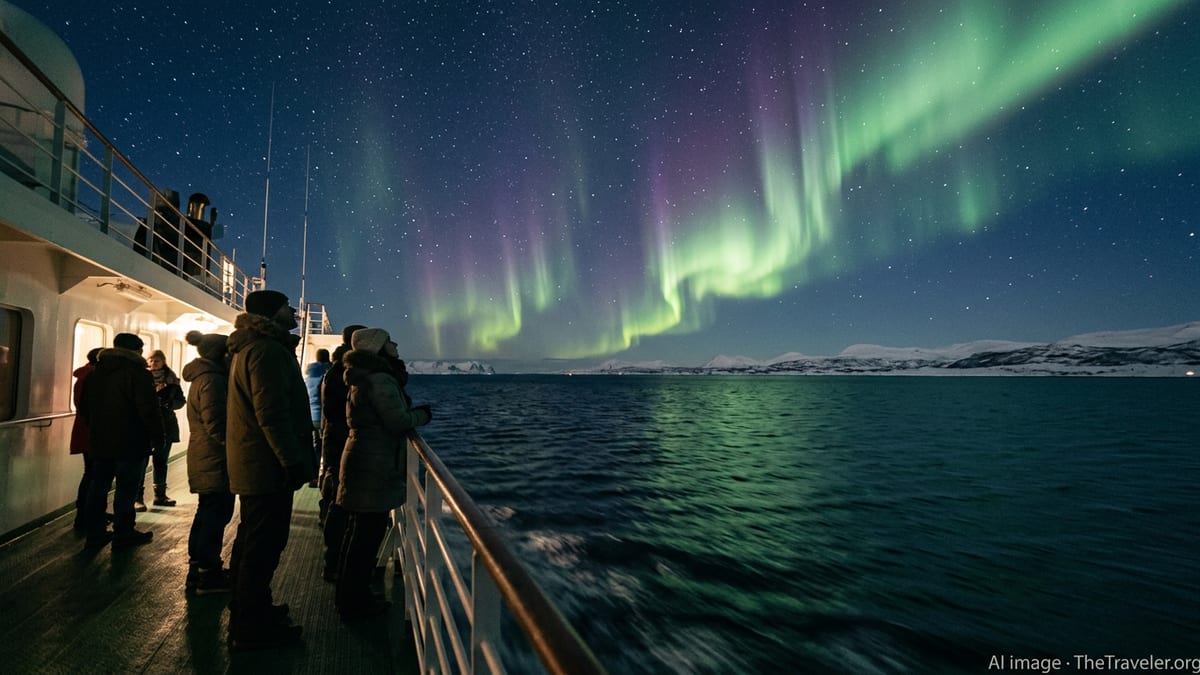
As solar activity builds toward a peak that scientists expect to fuel especially vivid aurora displays through 2026, cruise lines are racing to position ships on routes that promise front-row views of the northern lights across Norway, Iceland, Greenland, Canada and Alaska.
Get the latest news straight to your inbox!
Solar Peak Drives Demand for Aurora at Sea
The current solar cycle is approaching what astronomers describe as a solar maximum in 2025, a phase when more frequent flares and coronal mass ejections help power brighter, more widespread aurora borealis. Publicly available forecasting data indicates that heightened aurora activity often continues for several years on either side of this peak, creating an extended window of opportunity for travelers intent on seeing the phenomenon.
At the same time, cruising itself is expanding. Industry figures compiled by AAA for 2025 project ocean cruise passenger volumes in the United States at record levels, with tens of millions of travelers returning to ships each year after the pandemic slowdown. The overlap of surging cruise interest and unusually strong aurora conditions is encouraging operators to develop new itineraries and to market existing voyages more explicitly around northern lights viewing.
Travel coverage and booking data show that itineraries touching the auroral oval, the high latitude band where northern lights are most common, are drawing particular attention. Routes in northern Norway, Iceland, southern Greenland and the far north of Canada and Alaska are now being promoted not only for their fjords and polar wildlife but also as moving platforms from which to watch the night sky.
Norway’s Coastal Routes Turn Into Moving Aurora Platforms
Norway’s classic coastal sailings are among the highest profile examples of cruises repositioned as northern lights experiences. Companies operating on the historic Bergen to Kirkenes route, including Hurtigruten and Havila Voyages, have spent the past several seasons refining winter programs that keep ships within or near the Arctic Circle for days at a time, maximizing exposure to clear, dark skies.
Marketing materials and independent travel reports describe ships dimming exterior lighting at night, broadcasting aurora alerts over cabin systems and encouraging passengers to move quickly onto open decks when activity flares. Some departures are branded as astronomy or aurora voyages, with added lectures and guided sky watching to help guests interpret what they are seeing overhead.
Several lines now link these cruises directly to the prospect of a successful sighting by introducing so called northern lights promises. Public information from Norwegian coastal operators describes policies in which travelers who sail during specified winter windows and do not witness an aurora display are offered a complimentary or discounted return cruise of shorter duration, a move that effectively turns the natural spectacle into a repeat business driver.
New Itineraries Stretch from Greenland to Canada and Beyond
Beyond Norway, expedition and ocean cruise brands are adding routes that trace the auroral oval across the North Atlantic and Arctic. Small ship operators focused on polar travel are scheduling northern lights themed expeditions in Greenland, Iceland and the Canadian Arctic for 2026 and 2027, often pairing night sky viewing with zodiac landings, cultural visits and wildlife excursions.
Cruise calendars for boutique lines feature voyages such as round trip sailings from Nuuk timed for late summer and early autumn, when daylight begins to shorten but sea ice still allows for broad exploration. Other itineraries cross between Greenland and Canada or link Iceland with northern Norway, providing multiple nights at high latitude while also serving ports that are still relative newcomers to mainstream cruising.
Larger premium and luxury brands are also entering the segment. Itinerary announcements for the mid 2020s include extended voyages in northern Norway positioned specifically around aurora viewing, while some ships that would traditionally confine northern operations to summer are now remaining in the region into September and October. The growing range of options gives travelers choices that span intimate expedition vessels and full scale cruise ships with spas, entertainment venues and multiple dining rooms.
Technology, Guarantees and Onboard Experiences Raise the Stakes
The rise of aurora focused sailings is coinciding with advances in space weather forecasting and onboard technology. Recent research partnerships between polar tourism operators and space agencies highlight efforts to incorporate real time satellite data and solar cycle modeling into cruise planning, particularly for Alaska and Arctic ports. The goal is to help ships fine tune itineraries and adjust evening activities when conditions for aurora viewing appear especially favorable.
Onboard, operators are experimenting with ways to turn sightings into shared events. Some coastal lines publicize photo sharing systems that beam guest images of the lights onto interior screens, allowing passengers who chose to stay inside to witness the spectacle second hand. Others emphasize heated outdoor lounges, observation domes and hot tubs positioned to face the sky, blending comfort with the raw experience of standing outside in polar conditions.
The financial guarantees attached to some northern lights promises reflect a growing confidence in these tools and in long term forecasting of aurora likelihood during peak solar years. Publicly available terms show that in certain cases, passengers who do not see the lights during defined winter periods are eligible for complimentary return voyages with cabin and meals included, turning a potentially disappointing outcome into a built in incentive to sail again.
Balancing Bucket-List Demand with Climate Concerns
As more ships head north in search of clear skies, questions are emerging about how to balance northern lights tourism with the fragile environments that make such viewing possible. Several of the companies most closely associated with aurora cruises describe investments in hybrid propulsion systems, shore power connections and low sulfur fuels designed to reduce emissions along coastal routes in Norway and within sensitive fjords and Arctic waterways.
Destination authorities in parts of Norway have already set timelines to restrict or phase out fossil fuel powered ships in certain UNESCO listed fjords, prompting operators to upgrade vessels if they wish to maintain access. Travel reports point to recent milestone sailings in which battery enabled ships entered these waters emissions free, signaling how environmental regulation and demand for polar cruising are becoming increasingly intertwined.
Prospective passengers weighing a northern lights voyage now face a broader set of considerations than simply timing a trip for dark, clear nights. Ship size, propulsion technology, routing and the presence of scientific or cultural programming are all factors that differentiate the expanding menu of aurora oriented cruises. With solar activity forecast to remain high into the late 2020s, observers expect the competition to deliver memorable, low impact northern lights experiences at sea to intensify in the years ahead.