


Culebrita is one of those places that looks almost unreal in photos: white sand, shallow turquoise water, a crumbling lighthouse on the hill, and nearly no development in sight. That last part is key. Culebrita is part of the Culebra National Wildlife Refuge, so there are no shops, no restaurants, no bathrooms, and no place to buy more water if you run out. On my last trip to Culebra, I planned a full-day Culebrita outing with a local water taxi and had to think through every detail: breakfast, sun protection, cooler strategy, snorkeling gear, and exactly how much food and water two people would actually need for roughly seven hours on an exposed island. Here is how the day unfolded, from my guesthouse in Culebra to the boat dock and back, and what I would change next time.
Get the latest updates straight to your inbox!
Choosing an Operator and Understanding the “Full Day” Format
First, I had to commit to the fact that a Culebrita trip would be a full day, not a quick beach hop. Several Culebra operators describe Culebrita as a substantial daytime outing, not a short transfer. Cayo Norte Water Taxi, for example, advertises a standard Culebrita schedule of departing Culebra around 9:30 a.m. and returning about 4:30 p.m., with a boat ride of roughly 20 to 25 minutes each way. That means about six to seven hours on an undeveloped cay with no services of any kind. H2O Water Taxi and Gammy’s Water Tours promote similar formats and emphasize that guests need to be ready for a long, exposed beach and hiking day.
I booked with a local water taxi a few days in advance, timing it for the day after our arrival from the Ceiba ferry. Most operators leave from the waterfront in Dewey, the small town on Culebra, and either include or can add on basic gear like beach chairs and snorkels. Rates for Culebrita day trips in 2026 generally fall around 55 to 70 US dollars per person for a shared water taxi with beach time, depending on whether lunch or extra toys like paddle boards are included. Our boat provided chairs and a cooler but not food, which meant I had to plan every drink and snack myself.
The other factor was refuge rules. Culebrita is managed as part of the Culebra National Wildlife Refuge, and official brochures make the same point over and over: arrive by boat only, bring your own potable water, food, and sunblock, and do not expect any facilities. The refuge also protects sea turtle nesting habitat and seabird colonies, so you are expected to pack out everything you bring in, stick to marked trails, and keep clear of posted sensitive areas. Knowing there would be no kiosks or beach bars shaped every packing decision I made the night before.
Because the operators treat this as a proper day trip, late arrivals are a real problem. My captain asked us to be at the dock by 9:00 a.m. for a 9:30 a.m. departure so he could review safety basics and load everyone’s coolers. That meant carefully counting backwards from boat time to figure out when to wake up, eat breakfast, and arrange a taxi from our guesthouse.
Morning In Culebra: Breakfast, Last-Minute Shopping, and Transport
We were staying in a simple guesthouse in the Barrio Flamenco area, about a 10-minute drive from Dewey. I set my alarm for 7:00 a.m., which gave us around two hours to wake up, eat, pack the cooler, and get to town. There is no breakfast on Culebrita, so we made a point of eating a decent meal on Culebra itself: a couple of scrambled eggs, toast, and fruit from the small convenience store near our lodging the night before. Having that filling breakfast meant we were not tearing into our packed lunch at 10:30 a.m. out of sheer hunger.
Before the trip, I checked which shops in Dewey opened early enough to matter. On Culebra, small supermarkets such as Colmado Milka and other minimarts in town typically open by 7:00 or 8:00 a.m. and stock bottled water, ice, sandwich ingredients, chips, and basic sunscreen. Because the refuge guidelines stress bringing plenty of potable water and sun protection, I wanted one last chance in town to correct any packing mistakes. My plan was to bring non-perishable lunches from our guesthouse kitchen and use the Dewey minimart only as a backup for extra water and ice.
We called a publico-style taxi in Culebra at 8:15 a.m. and asked for a ride from Flamenco to the Dewey waterfront. Local drivers routinely shuttle people between the ferry dock and beaches for about 5 dollars per person each way, and our driver simply dropped us at the small pier that our boat used. I told him our return time and asked if he would be available around 4:45 p.m. when we got back. He suggested that we just send a quick message when the captain texted our estimated arrival; that flexibility was important, because return times can shift if weather picks up or if the group collectively asks to leave a bit earlier.
We reached Dewey just after 8:30 a.m., which gave us a solid 30 minutes before check-in to pop into the minimart. There, I bought one extra 1.5 liter bottle of water per person and a spare small tube of broad-spectrum SPF 50 sunscreen. Prices were island-high but not shocking: around 2 to 3 dollars for large water bottles and a bit over 10 dollars for branded sunscreen. That last-minute stop proved crucial later in the day.
Packing The Cooler: Exactly How Much Food and Water We Used
The hardest part of planning the day was getting realistic about consumption. We were two adults, expecting to be on Culebrita from roughly 10:00 a.m. until 4:00 p.m., with most of that time either on the beach or walking up to the lighthouse. It was late winter, but Culebrita still felt hot and exposed. Culebra guides often recommend at least one gallon of water per person for a full day on these offshore cays, and after experiencing it firsthand, I understand why.
Here is what we packed and what we actually used for two people. For water, we started with two 1-liter reusable bottles per person filled at the guesthouse (4 liters total) and added two 1.5 liter store-bought bottles from Dewey (3 liters). That gave us 7 liters, a bit under 1 gallon per person for the full day including the boat ride. In practice, we drank all 7 liters by the time we stepped back on the water taxi at around 4:15 p.m., with the last half liter going quickly during the hot wait on the boat. If I did it again, I would add at least one more 1.5 liter bottle for the pair to have some margin.
For food, we packed two large sandwiches (ham, cheese, and lettuce on local pan sobao), one each, plus an extra half sandwich to split midafternoon. We brought a small container of cut pineapple, two apples, and a bag of plantain chips. For snacks, we tossed in four granola bars and a small sleeve of cookies. Over the course of the day, we ate both full sandwiches at about 12:30 p.m., split the extra half sandwich around 3:00 p.m., finished all the pineapple and apples, and went through the bag of plantain chips. Two of the granola bars and the cookies came back untouched; sun and salt made us crave fresh, simple food much more than heavy sugary snacks.
Ice management mattered more than I expected. Our captain provided a medium hard-sided cooler with a bag of ice already inside, which we supplemented with one extra small bag from the minimart. In the tropical heat, that left us with cold drinks until around 2:30 p.m., after which everything hovered at cool but not icy. If your operator does not include a cooler, it is worth looking for a styrofoam or soft-sided cooler in Culebra the day before and buying at least one full bag of ice in the morning.
Sun Protection, Shade, and Where Things Got Uncomfortable
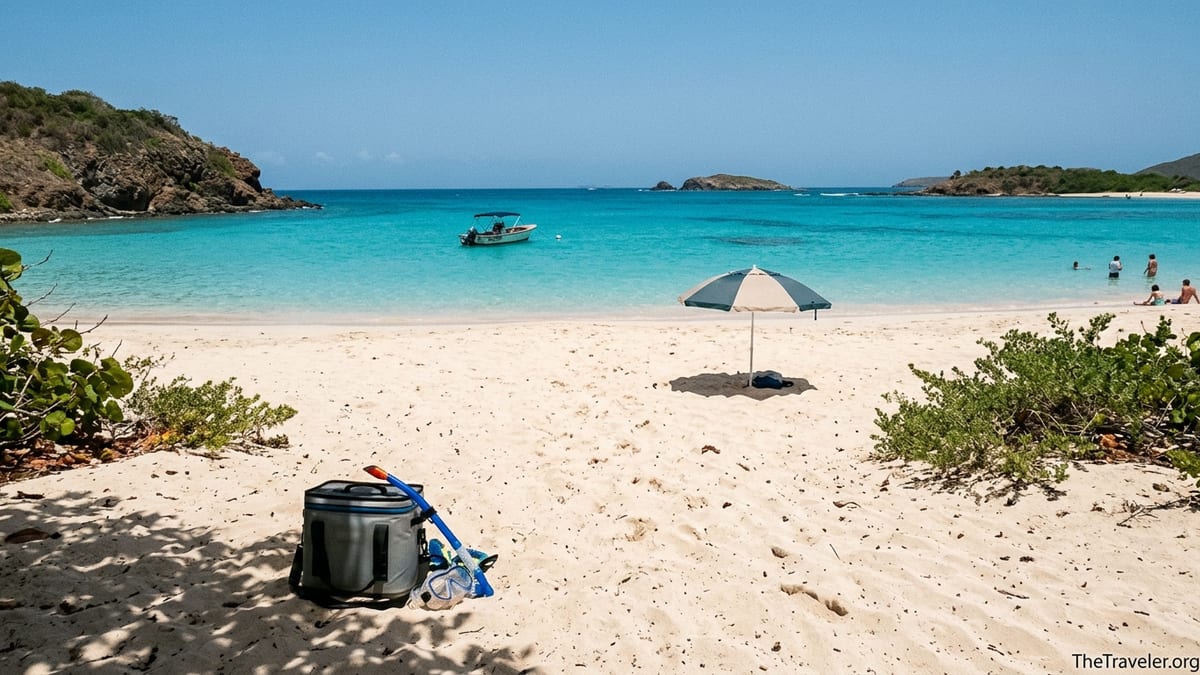
Every description of Culebrita mentions the lack of shade, and it is not an exaggeration. Playa Tortuga, the main landing beach on the western side of the island, is a wide arc of sand with only scattered low shrubs and a few small palms at the back. Refuge material and guidebooks alike urge visitors to bring hats, sunblock, and lightweight cover-ups. On our trip, the only real shade on the beach came from portable umbrellas brought by the water taxi and the fleeting narrow shadow of a scrubby tree line in the late afternoon.
We packed one large sand anchor beach umbrella provided by the boat, two lightweight long-sleeve rash guards, brimmed hats, polarized sunglasses, and that extra SPF 50 sunscreen tube from town. On the boat ride out, we applied a thick layer of sunscreen to exposed skin and then pulled on the rash guards once we started snorkeling. Even with that, the sun felt intense by 11:00 a.m., especially on the short hike toward the lighthouse where shade is nearly nonexistent. By noon, our umbrella created a small but valuable patch of shade just large enough for two beach chairs and the cooler.
By far the biggest comfort issue was the midday stretch between about 12:30 and 2:30 p.m., when the sun came straight over the beach and the wind eased a bit. Our small umbrella had to be repositioned more than once to keep the sun from slanting in, and anyone who stepped outside that circle for long started to feel it. I reapplied sunscreen three times during the day: once on arrival, once just before lunch, and once around 2:00 p.m. My partner, who only reapplied twice, still got a faint pinkness on his calves where sand had rubbed some off. If I were advising another traveler now, I would say to treat Culebrita like being on a boat all day: long-sleeve coverings, serious hats, and sunscreen every two hours minimum.
The other overlooked issue was reflective glare. The calm turquoise water in Playa Tortuga is wildly beautiful but also works like a mirror. After an hour of wading and floating, we both felt the strain on our eyes. Polarized sunglasses made a huge difference, and I was glad I brought them in a hard case. If you have sensitive skin on your shins or feet, consider water shoes or at least reapplying sunscreen there more often. I forgot to cover the tops of my feet after rinsing off sand, and they were the only part of me that burned.
Snorkeling, Hiking, and What Gear Actually Got Used
Culebrita is not just a beach; it is a small island with several coves and a hilltop lighthouse, and most day trips juggle time between snorkeling, walking, and simply sitting in the sand. Our captain followed the pattern that many local guides describe: first drop-off at Playa Tortuga, then optional hike to the old lighthouse in the late morning, followed by a dip in the natural tide pools on the north side known locally as Las Jacuzzis, then back to the main beach for the bulk of the afternoon.
For snorkeling, our operator supplied basic mask-and-snorkel sets and a couple of foam noodles. I brought my own mask and snorkel from home because I prefer a familiar fit. On the packing list the night before, I debated bringing full fins but ultimately left them behind to save room in the cooler and daypack. In retrospect, that was the right call for Playa Tortuga. The snorkeling just off the beach involved gentle currents and relatively shallow water, and I never missed having fins. I used my mask and snorkel for about a total of 90 minutes throughout the day, mostly in short 20- to 30-minute sessions broken up by breaks in the shade.
For footwear, I wore sturdy sandals with a good tread. The trail to the lighthouse is uneven and climbs steadily; guide sources describe it as about a 20 to 25 minute hike one way from the main beach, and that matched our experience. There is very little shade along the way. I carried a small daypack with one 1-liter bottle, a granola bar, and a travel-sized sunscreen for this portion of the day. My partner went in regular flip-flops and regretted it on the rocky sections. If you want to visit both the lighthouse and Las Jacuzzis, which involves walking over more uneven rock, shoes with some grip are worth the space in your bag.
What did we bring and not use? We packed a lightweight travel hammock and a deck of cards that never left the bag. There are few suitable hammock trees near the main beach, and in the end our time alternated between the water, the shallow shade of the umbrella, and short walks to explore neighboring coves. We also brought a compact Bluetooth speaker, which we decided not to turn on out of respect for the refuge’s quiet, wild feel and the other visitors. A thin quick-dry travel towel, on the other hand, was invaluable. It doubled as a shoulder cover during the hottest part of the day and made it easier to brush sand off before reapplying sunscreen.
Timing, Pick-Up Arrangements, and The Trip Back To Culebra
Because the standard schedule for many Culebrita trips runs roughly 9:30 a.m. to 4:30 p.m., I knew we would be committing our entire middle-of-the-day window to the island. Our captain set a loose check-in time on the beach when we first arrived, pointing to a specific spot on the sand and saying that if anything changed about the pick-up, he would let us know. Cell service on Culebrita existed but was patchy, so we could not rely entirely on messaging.
We agreed on a target departure of 4:00 p.m., which gave us enough time to finish a final swim, break down the umbrella, and repack the cooler without rushing. Starting around 3:15 p.m., the captain walked the beach to touch base with each group, confirming that everyone still wanted to leave on schedule. A sudden brief passing shower at about 3:30 p.m. made that timing welcome, as the sky clouded just enough to cool things down while we packed up.
By 4:10 p.m., everyone was on board and the boat began the 20- to 25-minute ride back toward Dewey. The return felt more tiring than the outbound trip, partly because the sun and salt had taken their toll. This was when having a small reserve of water and a quick snack paid off. We each drank the last of our bottles and shared one of the previously ignored granola bars. Arriving back in Culebra around 4:35 p.m., we walked straight off the dock and into the waiting taxi that we had messaged as soon as we saw the boat approaching.
Back at the guesthouse by a little after 5:00 p.m., we rinsed off salt and sand, took stock of what we had used, and noted what would change next time. We returned with a handful of uneaten snacks and a nearly empty sunscreen tube, but not a single drop of water left. That alone confirmed that the refuge advice to bring plenty of potable water is not just boilerplate language but a very practical warning.
What I Forgot, What I Brought Unnecessarily, and What I Would Change
Even with careful planning, I did not pack perfectly. The biggest oversight was not bringing a lightweight, packable long-sleeve sun shirt for my legs or a second small shade option. Our single beach umbrella served its purpose, but as the sun shifted, there were times when one of us had to choose between sitting in the sun or lying uncomfortably cramped to stay under its small circle of shade. If you are traveling as a group of four or more, having two umbrellas or a small pop-up sun shelter could make the difference between a relaxing afternoon and constantly jockeying for shade.
I also underestimated how abrasive sand and salt can be over a long day. I forgot a small tube of plain petroleum jelly or anti-chafe balm, which would have been helpful around sandal straps and swimsuit seams after hours of moving between water and sand. A basic first-aid kit stayed mostly untouched, but a few adhesive bandages and antiseptic wipes made us feel more comfortable walking the rocky path to Las Jacuzzis.
On the unnecessary side, the hammock and Bluetooth speaker were the obvious dead weight. Culebrita feels wild and quiet, and the sounds of wind and waves feel like part of the experience. Music would have felt out of place. There also are not many strong anchor points in the main beach area for a hammock, and when the sun is high, you want to be as close as possible to your one reliable shade structure. If you are packing from the mainland and trying to travel with carry-on luggage only, you can safely leave both at home.
If I were to redo the trip, I would make three concrete changes. First, I would increase water to at least 9 liters for two adults, giving each of us closer to 1.2 gallons for the full day. Second, I would pre-freeze one or two of the store-bought water bottles the night before in the guesthouse freezer so they could double as ice packs in the cooler and slowly melt into cold drinking water. Third, I would pack a lightweight, hooded long-sleeve sun shirt or sarong specifically for my legs and feet during the peak sun hours on the beach.
The Takeaway
A day trip to Culebrita from Culebra feels like stepping into a postcard, but it only works if you accept that you are responsible for everything you eat, drink, and use for shade. Local operators run Culebrita as a real full-day experience, with typical schedules around 9:30 a.m. to 4:30 p.m. and no possibility of wandering off to a snack bar or shop halfway through. The Culebra National Wildlife Refuge’s guidance to bring your own potable water, food, and sunblock is not abstract policy language; it matches the reality of standing on a wide, unshaded beach with no taps, no kiosks, and a long, bright afternoon ahead of you.
In practical terms, that means budgeting at least one gallon of water per person, planning a real breakfast on Culebra before departure, packing simple, hydrating food that will still sound appealing in the heat, and treating sun protection like gear rather than an afterthought. It also means arranging your morning and afternoon ground transport on Culebra so the day feels relaxed rather than rushed, with enough time to shop in Dewey for last-minute water, ice, and sunscreen before boarding the boat.
What I learned most from planning my own Culebrita day is that a little structure goes a long way. Deciding the night before who will wake up first to start breakfast, when you will call the taxi, how much water you will carry per person, and what gear you can happily leave behind makes the next day feel less like a logistical puzzle and more like what it should be: a long, unhurried day on one of Puerto Rico’s most beautiful offshore cays. With the right cooler, enough water, and real respect for the lack of facilities, Culebrita transforms from a challenging destination into a highlight of any Culebra trip.
FAQ
Q1. How long is a typical Culebrita day trip from Culebra?
Most shared water taxis run Culebrita as a full-day outing, departing Culebra around 9:30 a.m. and returning about 4:30 p.m., giving you roughly six to seven hours on the island.
Q2. How much water should I bring per person for the day?
Plan for at least one gallon of potable water per adult for a full Culebrita day, and more if you expect to hike to the lighthouse and tide pools in the midday heat.
Q3. Are there any bathrooms, shops, or restaurants on Culebrita?
No. Culebrita is part of the Culebra National Wildlife Refuge and has no permanent facilities, so there are no bathrooms, shops, or food services. You must bring everything you need and pack out all trash.
Q4. Do I need to book a Culebrita boat in advance?
Advance reservations are strongly recommended, especially in winter and holiday periods, because boats and water taxis have limited capacity and Culebrita trips are popular.
Q5. What kind of food packs best for a day without facilities?
Simple, non-perishable items like sandwiches, cut fruit, apples, nuts, and plantain chips work better than heavy or very sweet snacks, especially in the heat. Pack food in sealed containers in a cooler with ice.
Q6. Is shade available on the beach, or should I bring my own?
Natural shade on Playa Tortuga is minimal. Most comfort comes from portable shade such as beach umbrellas or a lightweight sun shelter provided by your boat or packed in your gear.
Q7. What footwear is best for the lighthouse hike and tide pools?
Sturdy sandals or light hiking shoes with a good tread are ideal, as the trail to the lighthouse and the path to the tide pools include uneven, rocky sections and very little shade.
Q8. Can I rent snorkeling gear on Culebrita itself?
No. There are no rentals on the island. Many Culebra-based operators include basic snorkel gear with Culebrita trips, or you can rent or bring your own on Culebra before departure.
Q9. Is Culebrita suitable for young children given the lack of facilities?
Families do visit with children, but the lack of bathrooms, strong sun, and long day length mean you should be very confident about shade, water, snacks, and how your kids handle heat and open water.
Q10. What is the single most important item people forget to bring?
Many travelers underestimate water and sun protection. Extra potable water, high-SPF sunscreen, and a physical shade option like an umbrella are the items that make the biggest difference in comfort and safety.