


More news on this day
Deadly security risks tied to regional conflict, targeted attacks and wrongful detention have prompted updated travel warnings for 13 countries, as governments refine their guidance for citizens contemplating trips through some of the world’s most volatile corridors.
Get the latest news straight to your inbox!
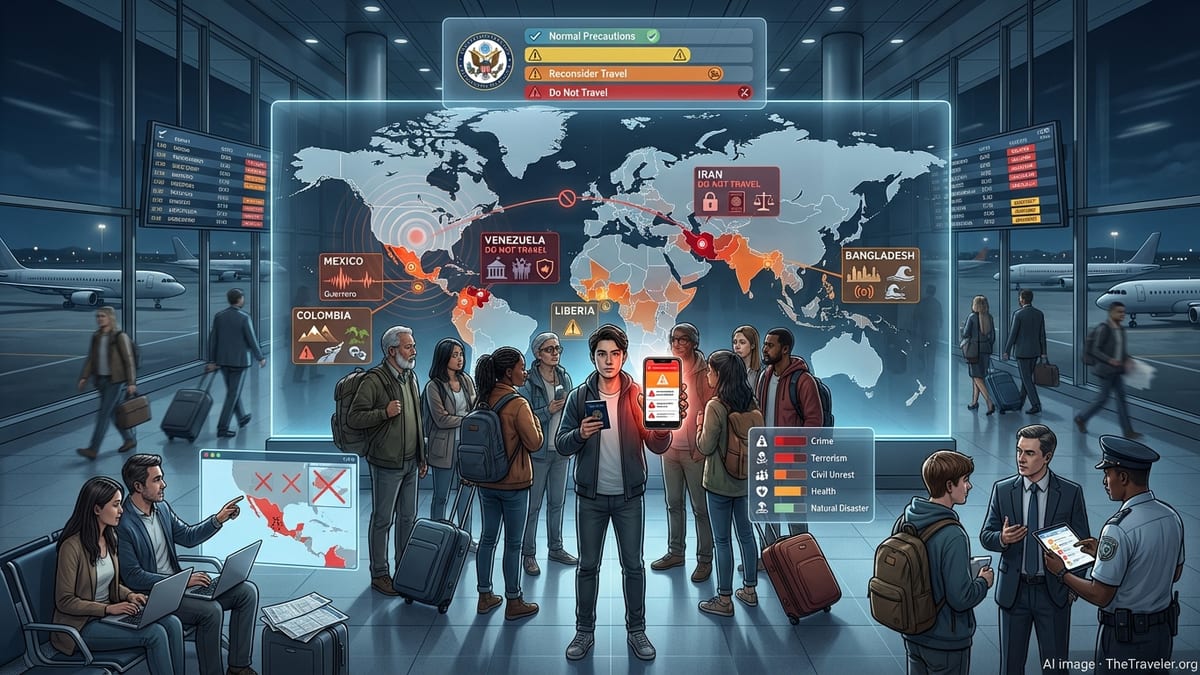
New assessments sharpen focus on Middle East flashpoints
Publicly available information from the United States and other governments shows that travel advisories for 13 countries, many of them in the Middle East, were updated in the second half of October 2026. The revisions follow months of conflict-related incidents, including missile and drone strikes on transport hubs, raids on energy infrastructure and cross-border attacks that have raised the likelihood of civilians being caught in violence.
According to recent coverage, the updates do not always change the formal risk tier assigned to each destination but add more explicit language about potential deadly threats. Eight of the affected countries are described as places where travelers are urged to reconsider nonessential trips, while five already sit in the highest warning category that advises people not to travel at all due to the danger of terrorism, armed conflict, kidnapping or state-imposed restrictions.
Analysts cited in public reports note that the latest advisories build on a broader worldwide caution issued earlier in 2026, which highlighted the risk that state-backed groups and their allies could target civilians, diplomatic facilities and commercial interests well beyond active front lines. The new country-specific wording is framed as a response to that evolving threat picture, with an emphasis on routes used heavily by business travelers and long-haul transit passengers.
Other governments, including several in Europe and the Asia-Pacific region, have also refreshed their own advisories for the same set of countries. While their rating systems differ, travel-risk maps and official destination pages generally align in classifying these areas as high or extreme security environments, underscoring a rare convergence among multiple national sources.
Conflict, terrorism and targeted strikes reshape risk maps
Recent incidents have played a central role in the tightening of warnings. Reporting from international outlets describes a pattern of attacks on airports, aviation infrastructure and border crossings linked to regional conflicts, particularly involving Iranian-backed armed groups. In one widely covered case, projectiles struck a major airport used by international carriers, prompting temporary diversion of flights and renewed scrutiny of airspace safety over parts of the Arabian Peninsula.
At the same time, projectile and drone activity near key shipping lanes has raised concern about spillover risks for ports and coastal cities. Insurance and security bulletins reviewed by news organizations indicate that some carriers have rerouted vessels or adjusted schedules in response to updated threat assessments, adding further weight to government advisories that warn of potential danger around strategic maritime chokepoints.
Ground travel has become more hazardous in several of the 13 countries, according to risk-monitoring services that aggregate official advisories. Roadside bombs, improvised checkpoints and ambushes have been documented on highways linking major urban centers to border areas and oilfields, with some incidents resulting in mass casualties. Travelers are now explicitly warned in many advisories to avoid particular regions, land borders or nighttime road movements, even if limited activity continues in capital cities.
In parallel, independent research on global terrorism trends for 2025 and 2026 points to a broader rise in the number of countries experiencing at least one terrorist incident. Although the intensity of attacks varies widely, experts quoted in these studies argue that the geographic spread of violence reinforces the need for more granular travel guidance that calls out specific provinces, transport corridors and public venues where the risk of being targeted is significantly higher.
Wrongful detention, surveillance and internal controls add to dangers
The latest round of advisories does not focus solely on open conflict. Several notices examined by reporters highlight the risk of wrongful detention, intrusive surveillance and restrictions on exit for foreign nationals in a subset of the 13 countries. These concerns are particularly acute where tensions between the destination government and the traveler’s home country are already high.
In publicly accessible guidance, potential visitors are warned that local authorities may impose exit bans, confiscate passports or hold individuals on broad national-security grounds, sometimes without transparent legal processes. Separate alerts relating to major powers such as China underscore the potential for electronic monitoring of devices, limited privacy protections and the prospect that travelers could be prevented from leaving during internal security campaigns or diplomatic disputes.
These non-violent risks can have life-changing consequences even in the absence of armed attacks. Legal analysts quoted in law firm advisories emphasize that foreigners have limited recourse if detained or placed under travel restrictions, particularly where consular access is constrained. As a result, travel warnings urge citizens to consider whether their personal profile, professional affiliations or public statements might draw unwanted attention from security services in destinations where space for dissent is tightly controlled.
Business travel policies are increasingly taking these factors into account. Companies that operate in or near the 13 countries identified in the latest updates are reviewing whether staff must carry sensitive data, use local SIM cards or rely on unsecured networks. Internal guidance frequently mirrors government language, advising that some trips be postponed, handled by regional partners or conducted virtually until the risk of detention or surveillance eases.
Health systems, evacuation options and neighboring hubs under strain
Beyond direct security threats, the strengthened advisories repeatedly highlight the fragile state of emergency services in several of the affected countries. Public information from consular agencies describes how conflict and political instability have degraded hospitals, ambulance networks and specialist care, particularly outside a handful of major cities. In some locations, even basic trauma treatment can be difficult to access quickly after an incident.
Travel-risk maps produced by insurers and assistance providers reinforce this picture, classifying parts of the Middle East and adjacent regions as high medical risk because of limited capacity, staff shortages and damaged infrastructure. These assessments warn that evacuations following serious injury or illness may be complicated by airspace closures, curfews or the need for special permissions to cross borders, all of which become more likely when security alerts are elevated.
The strain extends to neighboring transit hubs that serve as gateways into conflict zones. Airports in states that still maintain commercial links with higher-risk neighbors have seen a growing volume of rerouted passengers and emergency diversions, according to aviation-industry coverage. While these hubs are generally assessed as safer than the front-line countries themselves, their advisories increasingly contain cautions about potential knock-on effects such as sudden schedule changes, heightened security screening and temporary closures of terminals or routes.
For travelers who must pass through the wider region, official guidance stresses the importance of checking not only the advisory level of the final destination but also that of any country used for transit or overnight layovers. Changes to airspace permissions, overflight restrictions or local curfews can leave passengers stranded, sometimes with limited options for accommodation or onward travel if nearby states share similar security concerns.
What the updated warnings mean for upcoming trips
The practical impact of the new advisories varies depending on the traveler’s plans. Governments typically stop short of imposing outright bans on private travel, instead emphasizing that citizens who choose to enter or transit high-risk countries do so at their own responsibility. However, information compiled by public agencies explains that consular assistance becomes much harder to provide in areas where embassies have reduced staffing, security conditions prevent movement or local authorities place restrictions on foreign missions.
Recent advisories encourage travelers to scrutinize the detailed country pages behind each headline warning level. These documents generally list specific trigger factors, such as active fighting near major cities, credible threats to hotels popular with foreigners, frequent kidnappings on particular roads or a history of arbitrary enforcement of local laws against visitors. They also outline steps such as enrolling in alert systems, sharing itineraries with family or employers and preparing contingency plans if commercial transport is disrupted.
Risk consultants note in published commentary that the tightened language for these 13 countries is likely to influence corporate travel approvals, insurance coverage and the willingness of transport providers to maintain routes. Some insurers already exclude destinations under the highest warning tiers from standard policies, requiring additional premiums or imposing strict conditions on evacuation coverage. Airlines and tour operators may also reduce or suspend services if security conditions deteriorate further, regardless of whether formal border closures are announced.
For now, the updated advisories serve as a signal that the security environment across parts of the Middle East and surrounding regions remains fluid and, in some places, acutely dangerous. Travelers planning routes that touch any of the identified countries are being urged in publicly available guidance to track changes in official notices closely in the days before departure, remain flexible about itineraries and be prepared to cancel or reroute at short notice if deadly risks escalate again.