


More news on this day
Travel between Australia and New Zealand is facing fresh disruption, with publicly available data and local media reports indicating 392 flight delays and eight cancellations affecting trans-Tasman and connecting services in recent days.
Get the latest news straight to your inbox!
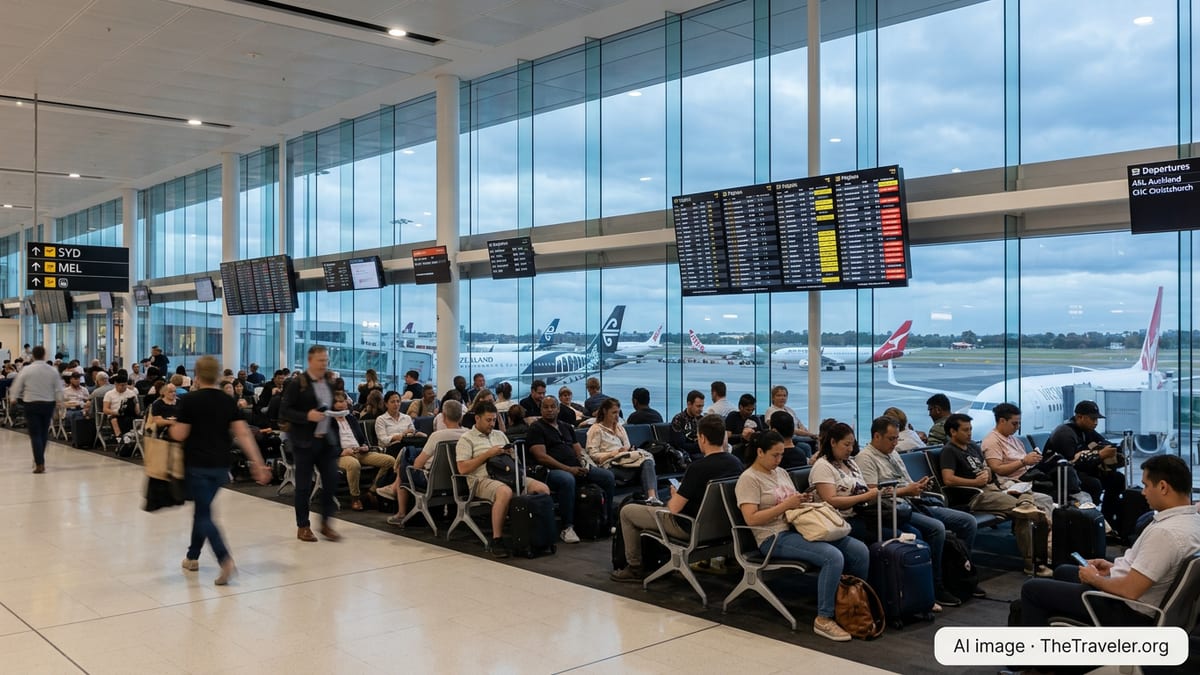
Sydney Bottlenecks Ripple Across Trans-Tasman Routes
Sydney Airport has again emerged as a key pressure point for travel between Australia and New Zealand, after multiple days of staffing-related constraints in the control tower reduced the number of aircraft able to land and depart each hour. Coverage from Australian outlets indicates that on the weekend of 8 to 10 August 2026, more than 150 flights experienced delays at Sydney alone, as air traffic controllers operated under temporary rostering restrictions that slowed traffic flows through the country’s busiest international gateway.
These operational limits have knock-on effects across the network, particularly on trans-Tasman services linking Sydney with Auckland, Wellington, Christchurch and Queenstown. When departures from Sydney are held on the ground or arrivals are placed into airborne holding patterns, aircraft and crews scheduled for later legs to New Zealand can miss their assigned slots, feeding into the tally of 392 delayed flights reported across Australia–New Zealand routes and associated domestic feeders.
Official statements and parliamentary commentary in early August also highlight growing concern about the resilience of the system. Publicly accessible transcripts show that the federal transport portfolio has pressed air navigation authorities to manage Sydney’s traffic more carefully for the rest of the month, following a series of incidents and near misses now under investigation, including runway and taxiway conflicts that occurred between late July and 10 August 2026.
As a result, airlines have adjusted schedules, padded buffers into rotations, and occasionally held aircraft on the ground at origin airports in both countries. While these measures aim to maintain safety and reduce the risk of airborne congestion, they have contributed to the elevated number of late departures and arrivals that passengers are currently experiencing on both sides of the Tasman.
Near Misses and Safety Investigations Add Operational Strain
The latest disruption figures come against a backdrop of heightened safety scrutiny at major Australian hubs. Earlier in August, a widely reported near miss at Sydney Airport involving a Jetstar aircraft and a Qatar Airways widebody on the tarmac prompted investigations by national safety agencies and the airport’s service providers. A separate occurrence in late July, described in investigation notices as a breakdown of coordination involving Qantas and QantasLink aircraft, is also under formal review.
These events have underscored the complexity of managing dense traffic at Sydney while simultaneously dealing with staffing and training shortfalls in air traffic control. Industry commentary notes that additional simulator capacity has recently been introduced to accelerate controller training for Sydney operations, but this capacity increase will take time to translate into more staff on duty and more flexible rostering.
In the interim, the system remains vulnerable to compounding delays. When investigative or precautionary measures are introduced after an incident, they can reduce runway throughput and lengthen turnaround times for arriving and departing aircraft. For trans-Tasman operations, which often rely on tight turnarounds in Sydney and Melbourne to keep aircraft productive, even minor slowdowns can quickly accumulate into widespread delays.
Safety agencies are continuing to examine several events around Sydney from late July to mid August, and the outcomes of those inquiries may inform future operating procedures. For now, Australia–New Zealand travelers are encountering a network that is functioning safely but under evident strain, with disruptions reflected in the current count of hundreds of delayed flights and a cluster of cancellations.
Weather, Fuel and Infrastructure Challenges Across the Region
Beyond air traffic control constraints, a mix of weather and infrastructure issues has added to the disruption burden on Australia–New Zealand travel. Historical on-time performance data compiled by New Zealand’s transport ministry point to weather as a consistent driver of schedule volatility on trans-Tasman routes, with past months showing reduced punctuality and modestly higher cancellation rates during periods of storms and strong winds over the Tasman Sea.
More recently, regional infrastructure problems have also complicated airline operations. In Fiji, a fuel contamination incident at Nadi International Airport reported on 21 August 2026 has forced several carriers, including Australian and regional airlines, to adjust flight plans. Public coverage notes that some services are operating with additional technical stops in New Caledonia or Vanuatu so that aircraft can refuel safely before returning to Australia, adding time and complexity to network planning.
While Fiji is not part of the Australia–New Zealand pair, it forms a key node in South Pacific itineraries that connect passengers onward to both countries. Disruptions on Fiji routes therefore reduce aircraft and crew availability for other services, and can trigger missed connections for travelers continuing on to New Zealand via Australian hubs. These secondary effects are factored into the broader disruption tally affecting the region’s travel flows.
On the ground in Australia, separate transport updates in Queensland have flagged industrial action affecting Brisbane-area ferries during August, highlighting that travel challenges this month extend beyond aviation. Although these ferry issues are not directly tied to trans-Tasman flights, they illustrate how concurrent disruptions in different parts of the transport system can combine to create a less predictable travel environment for domestic and international passengers alike.
Airlines Adjust Schedules as On-Time Performance Wobbles
Airlines serving the trans-Tasman corridor have been working to stabilise their schedules amid the current disruption cycle. Recent updates indicate that Air New Zealand has improved its overall network reliability compared with last year, reporting more than 83 percent of flights arriving within 15 minutes of schedule in July 2026 and a significant reduction in reactionary delays and cancellations across its system.
However, on-time performance for specific Australia–New Zealand city pairs remains sensitive to conditions at key hubs. Government aviation performance reports from earlier periods show that routes such as Brisbane to Christchurch or Wellington have historically recorded mid-range punctuality and low but notable cancellation rates, leaving limited margin for additional network stress before delays materialise. In the latest episode of disruption, these existing vulnerabilities have combined with air traffic control constraints in Sydney and weather-related challenges across New Zealand to push delay numbers higher.
Across the region, airlines have responded with a mix of schedule tweaks, aircraft swaps and, in some cases, preemptive cancellations. According to public data collated from airport boards and flight tracking platforms, eight flights on Australia–New Zealand or closely associated feeder routes have been cancelled over the current disruption window, while a further 392 have arrived or departed later than scheduled.
Carriers are encouraging travelers to monitor flight status closely on the day of travel and to allow extra connection time, particularly when itineraries involve Sydney or other busy hubs at peak periods. Flexible rebooking policies and travel waivers have been applied selectively during the worst of the disruption, though availability varies by airline and route.
What Travelers Between Australia and New Zealand Should Expect
For passengers planning trips between Australia and New Zealand over the rest of August, publicly available information points to a network that is improving but still fragile. Air traffic control authorities have indicated that they are working to balance safety with throughput in Sydney, while airlines continue to refine schedules and rotation plans. Nonetheless, the elevated number of delays recorded in recent days suggests that further day-to-day variability is likely.
Travelers connecting through Sydney or Melbourne to or from New Zealand should expect the possibility of last-minute gate changes, extended boarding times and occasional holding patterns on approach. Those flying on early morning or evening departures, when traffic peaks and staffing constraints can be most acute, may be particularly exposed to rolling delays.
Industry groups representing Australian and New Zealand carriers have publicly described the recent performance issues as severe and have called for accelerated measures to bolster air traffic control staffing and training capacity. Until those measures are fully implemented and seasonal weather patterns become more stable, the trans-Tasman market is likely to continue experiencing intermittent bouts of disruption similar to the one currently pushing delay numbers toward the 400 mark.
Passengers are being advised by airlines and transport agencies to check their flight status frequently, use official apps and notification services, and consider travel insurance products that offer coverage for delays and cancellations. With 392 delayed services and eight cancellations already logged in this disruption cycle, advance preparation has become a critical part of planning any journey between Australia and New Zealand.
Guardian coverage of Sydney air traffic disruption
eGlobal Travel Media analysis of Sydney ATC strain
ABC News report on Fiji fuel contamination and flight impacts