


More news on this day
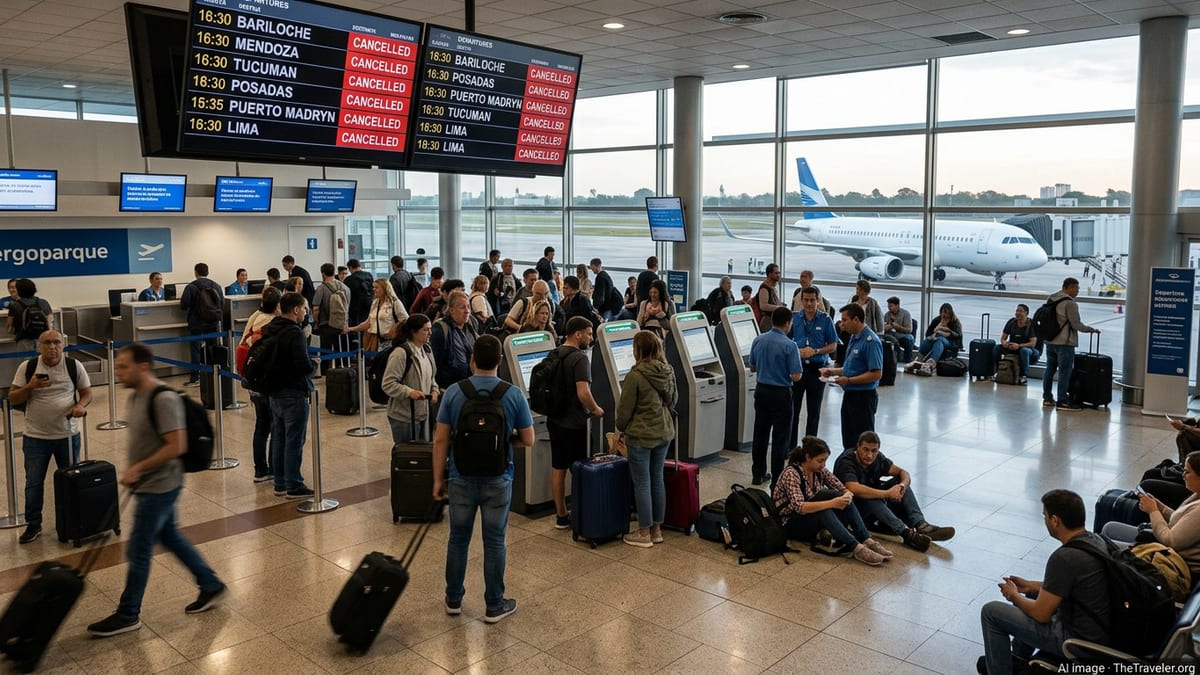
Travelers at Buenos Aires’ Aeroparque Jorge Newbery faced extensive disruption on June 8 as 44 flights were reported delayed and 3 canceled, snarling domestic and regional operations for Aerolíneas Argentinas, JetSMART, Flybondi and other carriers and leaving passengers stranded in crowded terminals.
Get the latest news straight to your inbox!
Operational Turbulence Hits Key Buenos Aires Hub
Publicly available airport and flight-tracking data indicate that Aeroparque Jorge Newbery, the main downtown airport serving Buenos Aires, experienced a wave of schedule disruptions on Monday affecting a broad cross-section of domestic and short-haul regional services. With 44 departures and arrivals running behind schedule and three flights canceled, knock-on delays rippled across Argentina’s dense network of internal routes as well as links to neighboring countries.
The disruption came at one of the country’s most critical aviation hubs, where Aerolíneas Argentinas, JetSMART Argentina and Flybondi all maintain sizable operations. Reference schedules show Aeroparque handling a mix of high-frequency services to cities such as Córdoba, Mendoza, Salta and Ushuaia, as well as regional routes to Brazil, Chile, Paraguay and Uruguay. When a significant share of those flights falls out of sync, aircraft and crews quickly end up out of position, compounding the impact on later departures.
Passengers posting on social platforms and local forums described long queues at check-in and security, congested boarding areas and limited real-time information on revised departure times. Reports indicate that some travelers were forced to wait hours for updated estimates, while others scrambled to rebook via alternative airlines or long-distance buses as it became clear their flights would not operate as planned.
While specific causes for individual delays varied, the clustered nature of the disruption at a single hub on the same day suggests a combination of tight scheduling, limited fleet slack and heavy traffic volumes. Even minor technical issues or crew-availability challenges can trigger cascading delays when utilization is high across several airlines at the same airport.
Aerolíneas Argentinas, JetSMART and Flybondi Among Most Affected
According to published coverage and timetable data, flights operated by national flag carrier Aerolíneas Argentinas accounted for a substantial share of the delayed schedule at Aeroparque, reflecting its dominant position in Argentina’s domestic market. The airline uses the downtown airport as a core base, feeding routes to major provincial capitals and tourist gateways such as Bariloche and Iguazú.
Low-cost rivals JetSMART Argentina and Flybondi, both of which also hub at Aeroparque, were heavily exposed to Monday’s disruption. JetSMART operates Airbus A320-family aircraft across a growing network of point-to-point routes, while Flybondi relies on a smaller fleet of Boeing 737s that, according to recent press reports, has been under pressure following months of intense utilization and previous waves of cancellations. When fleets are small and turnaround times tight, any unplanned maintenance or crew limitation can remove a critical aircraft from the rotation and force rapid schedule changes.
Local media coverage in recent months has highlighted Flybondi’s particular operational strain, citing thousands of canceled flights over the past year and significant passenger impacts. At the same time, on-time performance indicators for Aerolíneas Argentinas and JetSMART have generally been stronger, although Monday’s pattern at Aeroparque shows that even carriers with better punctuality records are not immune when systemic bottlenecks occur at a shared hub.
Observers note that Argentina’s domestic aviation market has grown rapidly in the post-pandemic period, with demand returning on leisure routes and a rising number of low-cost seats. However, infrastructure and staffing have not always scaled at the same pace, leaving airport and airline operations vulnerable during peak travel days or when weather and industrial or technical issues converge.
Domestic and Regional Routes See Knock-On Effects
The delays and cancellations recorded at Aeroparque on June 8 were concentrated on domestic services but also extended to a subset of regional flights. Schedules from the airport show high-frequency operations to cities such as Córdoba, Rosario, Mendoza, Salta and Tucumán, as well as international links to destinations including São Paulo, Rio de Janeiro, Santiago and Asunción.
On busy short-haul corridors, aircraft frequently turn around in under an hour, meaning that a single late inbound arrival can set back a full day of rotations. For example, a delayed morning flight from Buenos Aires to Córdoba may cause a corresponding delay on its afternoon return sector, followed by further slippage on an evening service to another city using the same aircraft. Over the course of several cycles, modest initial delays can extend to several hours.
Regional routes are especially sensitive to these ripple effects because many are operated just once or twice per day. If one of those flights is canceled outright, passengers often have limited alternatives, particularly on days when loads are already high. Reports from affected travelers at Aeroparque on Monday described last-minute cancellations on flights to provincial capitals, resulting in missed business meetings, lost hotel nights and hastily arranged overnight stays in Buenos Aires.
In some cases, passengers turned to overnight buses or rebooked from Aeroparque to the more distant Ezeiza International Airport in search of an earlier connection. Travel forums and consumer advocacy platforms in Argentina have long noted that such workarounds can significantly extend total journey times, eroding the primary advantage of air travel on domestic and regional sectors.
Stranded Passengers Confront Compensation Maze
For travelers stuck at Aeroparque, Monday’s disruption has once again brought attention to passenger rights and compensation rules for delays and cancellations involving Argentine and regional carriers. Publicly accessible guidance from consumer organizations and legal information sites in the country underscores that outcomes can vary depending on the airline, route, cause of disruption and applicable legislation.
On domestic flights within Argentina, passengers may be entitled to rebooking, vouchers, accommodation or partial refunds in certain circumstances. However, reports from previous incidents suggest that procedures can be uneven, with some travelers receiving timely assistance while others face long waits at service desks or are directed to submit claims online that can take weeks or months to resolve.
International routes between Buenos Aires and neighboring countries are governed by a patchwork of national and regional rules, as well as each airline’s own conditions of carriage. Advocacy groups monitoring the sector note that low-cost carriers have tended to steer passengers toward refunds rather than alternative transport, which can be problematic when fares on remaining flights have spiked due to last-minute demand.
Consumer forums tracking Argentina’s aviation sector indicate growing frustration over what some travelers describe as a lack of proactive communication when flights are significantly delayed or canceled. The scenes at Aeroparque on June 8, with large numbers of passengers relying on public screens and mobile apps for fragmented updates, appear consistent with those broader concerns.
Ongoing Scrutiny of Argentina’s Airline Reliability
The latest wave of delays and cancellations at Aeroparque is likely to feed into continued scrutiny of airline reliability in Argentina, particularly among price-sensitive domestic travelers who have increasingly turned to low-cost carriers. Online discussions in recent months have featured recurring complaints about abrupt schedule changes, last-minute cancellations and slow refunds, especially involving Flybondi, alongside more mixed reviews for JetSMART and comparatively steadier assessments of Aerolíneas Argentinas.
Industry data published this year indicate a widening performance gap among carriers, with some airlines maintaining on-time departure rates near or above 90 percent while others struggle to keep a majority of flights within standard punctuality windows. Analysts point out that such disparities can influence traveler behavior, pushing frequent flyers toward operators perceived as more reliable even when fares are higher.
At the same time, Argentina’s broader economic and regulatory context continues to shape airline operations. Currency volatility, fuel costs, taxation and infrastructure constraints all contribute to thin margins, especially for low-cost models that depend on high aircraft utilization and fast turnarounds. When fleets are lean and spare capacity limited, any systemic shock at a key hub such as Aeroparque can quickly escalate into the kind of disruption seen on June 8.
For now, travelers with upcoming itineraries through Buenos Aires are advised by consumer publications and travel forums to monitor flight status closely, allow additional buffer time for connections and consider flexible tickets where possible. As airlines and airport operators assess the causes and consequences of Monday’s disruption, the events at Jorge Newbery Airport add another data point to the ongoing debate about how well Argentina’s rapidly evolving domestic aviation market can keep pace with rising demand.