


Indira Gandhi International Airport and New Delhi Railway Station are two of India’s busiest transport hubs, and many trips through Delhi involve a tight connection between them. Whether you are landing late from an international flight and rushing to catch an early morning train, or arriving by rail for a same-day departure abroad, choosing the right route between the airport and New Delhi Railway Station can make the difference between a smooth transfer and a missed connection.
Get the latest updates straight to your inbox!
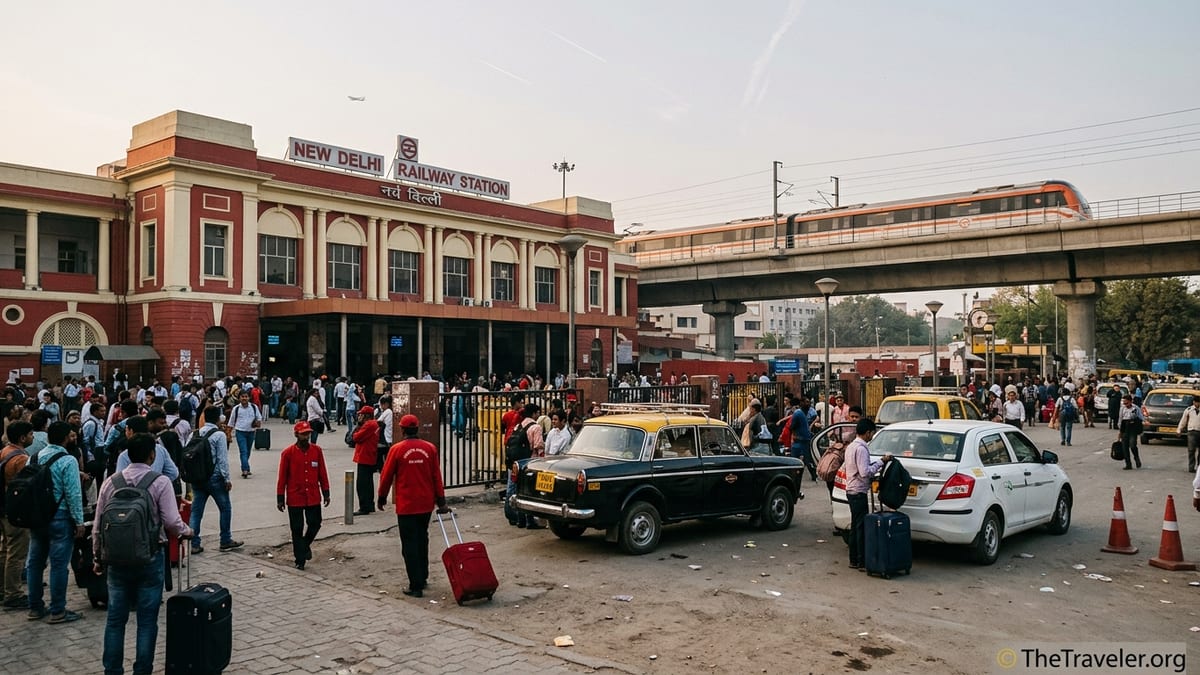
Understanding the Delhi Airport to New Delhi Station Corridor
The main airport serving India’s capital is Indira Gandhi International Airport, commonly called IGI, located in the southwest of the city. The bulk of domestic and almost all international traffic uses Terminal 3, with Terminal 1 handling low-cost domestic flights. New Delhi Railway Station, known by its code NDLS, sits near the city’s center, not far from Connaught Place. The road distance between the airport and NDLS is roughly 18 to 22 kilometers depending on terminal and route, and typical transfer times range from 30 minutes in light traffic to well over an hour at peak times.
Delhi’s Airport Express Metro line, often called the Orange Line, directly links IGI Airport (Terminal 3 / Terminal 2 area) with New Delhi Metro Station, which is connected by footpaths and a skywalk to the railway station. Most travelers who can access Terminal 3 will find this the most predictable, time-efficient route, with a scheduled journey time of about 22 to 23 minutes between IGI Airport and New Delhi and a flat fare of roughly 60 rupees per person as of mid-2026.
For those landing at Terminal 1, options include a short shuttle or taxi ride to the Airport Express at Aerocity or Terminal 3, an app-based cab directly to NDLS, or, less commonly, a city bus into central Delhi. Each choice has trade-offs: the metro is fast and immune to traffic, while point-to-point taxis and app cabs are better if you have multiple heavy bags, small children, or mobility issues that make station transfers difficult.
When planning your connection, remember that New Delhi Railway Station itself is large and busy, with entrances on both Paharganj and Ajmeri Gate sides and long walking distances to some platforms. The transfer is not simply “airport to station” but “airport to your actual platform,” which is why building in extra time is almost always wise.
Airport Express Metro: The Fastest and Most Reliable Option
The Airport Express Metro is the backbone of most smart itineraries between Delhi Airport and New Delhi Railway Station. Trains run roughly every 10 to 15 minutes and cover the distance between IGI Airport and New Delhi in about 22 minutes, avoiding the unpredictable traffic of the Ring Road and central city. Services typically start in the early morning and run until late evening; schedules can shift slightly, so it is sensible to check same-week timings, especially for departures before 6 am or after 11 pm.
From Terminal 3, you reach the Airport Express via a signed walkway from arrivals into the integrated metro building. Travelers with checked luggage can use trolleys up to a point before the security screening area. Standard single-journey tickets are inexpensive, in the ballpark of 60 rupees from IGI Airport to New Delhi for any adult. Payment is at ticket counters or vending machines using cash or domestic digital payment apps; international visitors relying mainly on cards should carry at least a small amount of rupees to avoid delays at the machine.
At New Delhi Metro Station, the Airport Express platforms are in the same complex as the Yellow Line platforms but on a separate level. To reach New Delhi Railway Station, follow signs for “New Delhi Railway Station” or “NDLS” rather than the generic “Exit.” One exit leads toward the Paharganj side, popular with backpacker guesthouses, while another takes you toward the Ajmeri Gate side and the main station building. In practice, even a traveler unfamiliar with Delhi can walk from the Airport Express platform to the railway concourse in about 10 to 15 minutes at a normal pace.
For example, a traveler landing at 10:00 in the morning at Terminal 3, with a 13:30 Rajdhani Express from NDLS, could typically clear immigration and baggage by 11:15, walk to the metro and catch a train by around 11:30, arrive at New Delhi Metro Station close to noon, and be standing on the correct platform by about 12:15. That builds in more than an hour of cushion before the train’s departure without ever sitting in road traffic.
Taxi, Prepaid Cab, and App Cabs: When Door-to-Door Wins
Despite the advantages of the Airport Express, there are situations where a direct road transfer from the airport to New Delhi Railway Station is preferable. This is especially true for families with multiple large suitcases, elderly passengers, or anyone who would struggle with escalators, crowded corridors, or long walks at the station. In these cases, traditional taxis, airport prepaid cabs, or app-based services such as Uber and Ola can provide genuine door-to-door convenience.
Outside each terminal you will find an official taxi area, including government-regulated prepaid booths where you pay an estimated fare upfront and receive a slip for your driver. For a mid-range sedan between IGI and NDLS, travelers commonly pay in the low hundreds of rupees, with final costs depending on time of day and waiting charges in traffic. This option is easy for first-time visitors because it avoids haggling; you simply quote “New Delhi Railway Station” at the counter and follow the sign to the allocated taxi rank.
App-based cabs operate widely around the airport. At Terminal 3, there is a marked app cab pickup zone in the multilevel parking area near arrivals, and the app will guide you to the exact pickup column. Recent changes have added an airport pickup fee on top of the normal app fare, which may add a few dozen rupees to your total, and drivers sometimes request extra payments for airport parking or use of a roof carrier. If a driver asks for money beyond the app fare and official surcharges, it is acceptable to decline politely, cancel if necessary, and book another car.
In light traffic, a taxi or app cab can cover the airport–NDLS route in about 30 to 35 minutes via the expressway and central Delhi. At peak hours, particularly weekday mornings around 9:00 to 11:00 and evenings from about 17:00 to 20:30, the same ride may take 60 to 75 minutes or more. A realistic example: a traveler landing at 18:00 at Terminal 1 with two heavy suitcases and a 22:30 train from NDLS might leave arrivals around 19:00, meet an Uber at the Terminal 1 pickup zone, and reach the station around 20:00 to 20:15 if traffic is moderate, still allowing time for security queues and navigating to the right platform without stress.
New Delhi Railway Station: Navigating Entrances, Platforms, and Luggage
New Delhi Railway Station is one of India’s largest and busiest rail hubs, with more than a dozen platforms, multiple overbridges, and two main sides: the Paharganj side, often associated with budget hotels and backpacker streets, and the Ajmeri Gate side, which many long-distance travelers prefer for its slightly more orderly traffic flow. The Airport Express Metro connects conveniently into this complex, but the final leg from metro exit to your exact platform can still be confusing if you arrive for the first time with minutes to spare.
On arriving at New Delhi Metro Station from the airport, follow the directional signs to the railway station side that matches your train coach position or platform information. Many express trains list which side of the station is closest to your coach on railway apps and display boards. Even if you choose the “wrong” side, you can use internal overbridges to cross to other platforms, but this will involve climbing staircases and walking through crowds. With heavy luggage, that can easily add 10 to 20 minutes.
Porters, known locally as coolies, are widely available on both sides of NDLS and can be useful if you have heavy bags or mobility concerns. They usually wear numbered uniforms and can help carry your luggage from the taxi stand or metro exit directly to your coach door. Rates are loosely standardized but still often negotiated; asking a porter for the price before you start walking and agreeing clearly avoids awkwardness later. For many travelers, especially after a long international flight, paying a modest fee for porter help is a sensible trade-off for reduced stress and faster movement through the station.
Security at New Delhi Railway Station generally involves baggage scanning for long-distance platforms and occasional personal checks. At busy times, such as holidays or festival weekends, there can be queues at the entrance X-ray machines. Factoring this in, it is prudent to be at the station concourse at least 30 to 45 minutes before a major express train departure, particularly if you still need to locate your coach position along a very long platform.
How Much Time to Allow for Airport–Train Connections
Time planning is the single most important aspect of a successful transfer between Delhi Airport and New Delhi Railway Station. While it is technically possible to travel from the airport terminal door to the railway station in under an hour in ideal conditions, relying on that best-case scenario is risky. Traffic, immigration queues, baggage delays, and security checks can all eat into your margin.
For international arrivals landing at Terminal 3, a conservative rule of thumb is to allow at least 4 to 5 hours between scheduled flight landing time and a major long-distance train departure from NDLS. That accounts for up to 90 minutes for immigration and baggage, 30 minutes to reach the Airport Express, 30 minutes for metro travel and walking into the station, and a further hour’s buffer for unforeseen delays. For domestic arrivals at Terminals 1 or 2 with only cabin baggage and the Airport Express as your main route, some experienced travelers are comfortable with a 3-hour gap, though 3.5 to 4 hours is safer.
For example, if your domestic flight is scheduled to land at 14:00 and your train from NDLS departs at 17:30, you might deplane and collect any checked bags by 14:45, transfer to the metro at Terminal 3 and be on a train around 15:15, arrive at New Delhi Metro by roughly 15:40, and be at your train platform by 16:00. Any delay of more than about 45 to 60 minutes in the flight schedule or baggage delivery will start eating into your cushion, so you should be mentally prepared with a fallback plan, such as switching to a later train if your ticket conditions allow.
The reverse direction, from New Delhi Railway Station to the airport, also demands caution. Morning rush-hour road traffic toward the airport can be heavy on weekdays, so if you are taking a taxi for a morning international flight, consider leaving NDLS 3 to 3.5 hours before the check-in cut-off time. If you rely on the Airport Express, you can usually cut this cushion slightly because rail travel is not affected by traffic jams. However, you must still account for walking distances, security screening at the airport, and the occasional queue at airline check-in counters.
Late Arrivals, Overnight Layovers, and Safety Considerations
Many long-haul flights land in Delhi either late at night or in the small hours of the morning, and some premium trains from other Indian cities depart NDLS before dawn. Transferring between the airport and the railway station during night hours requires a few extra safety and comfort considerations. Although Delhi’s main corridors remain active around the clock, services like the Airport Express run on a limited timetable, and frequency may drop during the earliest and latest trains of the day.
If you land at Terminal 3 around midnight with a train leaving NDLS at 4:30 in the morning, verify in advance whether the Airport Express is operating at the needed hour. If the last metro has already departed or you would be waiting alone at a closed station, booking an official taxi or a reputable app-based car directly from the terminal is usually wiser. The airport arrival areas and designated cab zones are well lit and continuously monitored, and cars drive directly to the main station drop-off points, reducing the amount of walking required through quiet city streets at night.
In reverse, if you arrive by train at New Delhi Railway Station between midnight and 4:00 and have a morning flight, the Airport Express may not yet be running frequently. In that case, consider staying in a nearby hotel for a few hours’ rest or using an authorized taxi service from the station taxi stand. Solo travelers, particularly those unfamiliar with Delhi, often feel more comfortable using prepaid taxis or app cabs that provide driver details and trip tracking in the app for added reassurance.
In all cases, keep your luggage close, avoid displaying large sums of cash in public, and be cautious of unsolicited offers of help from individuals who are not in uniform, especially near ticket counters or station exits. Using official staff, accredited porters, and clearly signed service desks dramatically reduces the chances of misunderstandings or scams during a tired, late-night transfer.
Choosing Between Metro and Road: Practical Scenarios
To decide between the Airport Express and a road transfer, it helps to imagine a few real-world scenarios. A solo backpacker landing at Terminal 3 at 09:00 with only a 40-liter rucksack and a reserved 14:00 express train from NDLS is almost always better off taking the Airport Express. With one inexpensive ticket, no haggling, and a predictable 22-minute ride, they can be in the station area well over two hours before departure, with extra time to find breakfast nearby.
Contrast that with a family of four arriving at Terminal 1 at 18:30 with two large checked bags and two carry-ons, traveling with a grandparent who struggles with stairs. Their overnight train from NDLS leaves at 22:00. While it is possible to shuttle or taxi to the Airport Express and change to the metro, the escalators, elevators, and transfers may be stressful and slow. In such a case, a larger taxi or app cab big enough for passengers and luggage, even at a higher fare than the metro, may provide better value because it delivers them straight to the most convenient station entrance with minimal walking.
A business traveler arriving at NDLS by mid-morning Shatabdi train with just cabin luggage and a 16:00 international flight from Terminal 3 represents another typical case. Here, the Airport Express stands out: they can walk from the railway platform to New Delhi Metro, tap in for the Airport Express, and be at IGI’s Terminal 3 check-in area within about 40 minutes, with almost zero variability due to traffic. A taxi in late-morning central Delhi traffic could easily take an hour or more and offers no real comfort advantage with such light luggage.
These examples underline a simple principle: use the Airport Express whenever your route naturally passes through Terminal 3 and you can comfortably handle a short station walk with your bags. Choose a direct cab when luggage, mobility, or timing constraints make “door to door” more important than cost, especially at very early or very late hours when metro frequency is reduced.
The Takeaway
Connecting between Delhi Airport and New Delhi Railway Station need not be stressful if you understand your options and plan realistic buffers. The Airport Express Metro is usually the fastest and most reliable way to travel between Terminal 3 and NDLS, with predictable journey times of a little over 20 minutes, modern air-conditioned trains, and straightforward transfers to the railway platforms. For many travelers, especially those with modest luggage and daytime arrivals, it should be the default choice.
At the same time, traditional taxis, prepaid airport cabs, and app-based services such as Uber and Ola remain essential tools, particularly for passengers with bulky luggage, mobility challenges, or travel during hours when metro services are sparse. These options provide true door-to-door service from terminal to station entrance and can be well worth the extra cost in comfort and reduced walking.
Above all, give yourself more time than you think you need. Delays at immigration, baggage belts, station security, or on crowded station overbridges can all erode a tight margin. By understanding how long each leg of the journey normally takes and building in a sensible buffer, you transform what could be a stressful race through Delhi into a smooth, almost routine connection between air and rail.
FAQ
Q1. How long does it usually take to travel from Delhi Airport to New Delhi Railway Station?
In typical daytime conditions, the Airport Express Metro takes about 22 to 23 minutes from IGI Airport to New Delhi Metro, plus 10 to 15 minutes of walking into the station. By taxi or app cab, the road journey can be as quick as 30 minutes in very light traffic, but 45 to 60 minutes is more common, and at peak times it can take longer than an hour.
Q2. Is the Airport Express safe and convenient for first-time visitors to Delhi?
Yes, the Airport Express is generally considered one of the safest and most straightforward ways to reach central Delhi. Stations are well signed in English and Hindi, trains are air-conditioned, and airport staff can direct you from arrivals to the metro entrance. For a first visit during daytime hours, it is often easier than negotiating taxi fares.
Q3. What is the approximate fare on the Airport Express from IGI Airport to New Delhi?
The Airport Express uses a simple flat-fare structure, and the single-journey ticket from IGI Airport to New Delhi is typically in the range of 50 to 70 rupees per person. Fares can be revised periodically, so you should treat this as a guide rather than a guaranteed price.
Q4. How much should I budget for a taxi or app cab between the airport and NDLS?
For a standard sedan from IGI Airport to New Delhi Railway Station, many travelers report paying a few hundred rupees, with the exact amount varying by time of day, traffic, and whether an airport pickup fee or parking charges apply. Larger vehicles or premium categories will cost more, but they can be cost-effective for groups or families sharing the fare.
Q5. I land late at night. Should I still use the Airport Express or take a taxi?
If your flight arrives after the last metro or leaves you with a very long wait for the first morning service, an official taxi or reputable app cab from the airport terminal is usually the better option. Late-night road traffic is lighter, and traveling door to door reduces the amount of time you spend walking through quiet stations.
Q6. How much connection time do I need between my flight and train at New Delhi Railway Station?
For international arrivals at Terminal 3, aim for at least 4 to 5 hours between scheduled landing time and long-distance train departure. For domestic arrivals with light luggage using the Airport Express, some travelers are comfortable with 3 to 3.5 hours, but adding extra time is wise if your train is important and difficult to rebook.
Q7. Is it easy to move with heavy luggage between New Delhi Metro and the railway platforms?
The connection is walkable but can feel long with heavy bags, especially in hot or crowded conditions. There are escalators and lifts in many parts of the metro station, but staircases and busy overbridges at the railway station are common. Hiring a licensed porter to carry your bags from the metro exit or taxi stand directly to your coach can make the transfer much easier.
Q8. Which side of New Delhi Railway Station should I use when arriving from the airport?
New Delhi Railway Station has two primary sides: Paharganj and Ajmeri Gate. The Airport Express connects into the station complex with exits toward both sides. The best side depends on your train and coach position, which you can check in railway apps or on station displays. If you are unsure, staff at the station entrances can usually point you toward the shortest route.
Q9. Are there any common scams or issues I should watch out for on this route?
Most trips are uneventful, but you should be cautious of unofficial taxi touts inside or just outside the terminals and station buildings, as well as drivers who insist on large extra payments not shown in the app or prepaid slip. Using official taxi counters, clearly marked app cab pickup zones, and licensed porters reduces the likelihood of problems. Always confirm the agreed fare or use an app-based fare estimate before starting your journey.
Q10. What should I do if my flight is delayed and I risk missing my train from NDLS?
If a delay makes your original connection unrealistic, focus first on reaching New Delhi Railway Station safely and then speak to railway staff or use official apps to explore options such as waitlisted alternatives, same-day changes, or booking a later train. In some cases it may be more comfortable to stay overnight in Delhi and continue your journey the next day, especially after a long international flight.