


Landing in Delhi with the Taj Mahal on your mind is both exciting and slightly overwhelming. Agra is only around 220 to 230 kilometers from Indira Gandhi International Airport, but working out the best onward route, how long it will really take, and whether a same-day Taj visit is realistic depends on your arrival time, budget, and comfort level. This guide breaks down the main options from Delhi Airport to Agra, with real-world timings, price ranges, and on-the-ground tips so you can choose the route that actually fits your flight and travel style.
Get the latest updates straight to your inbox!
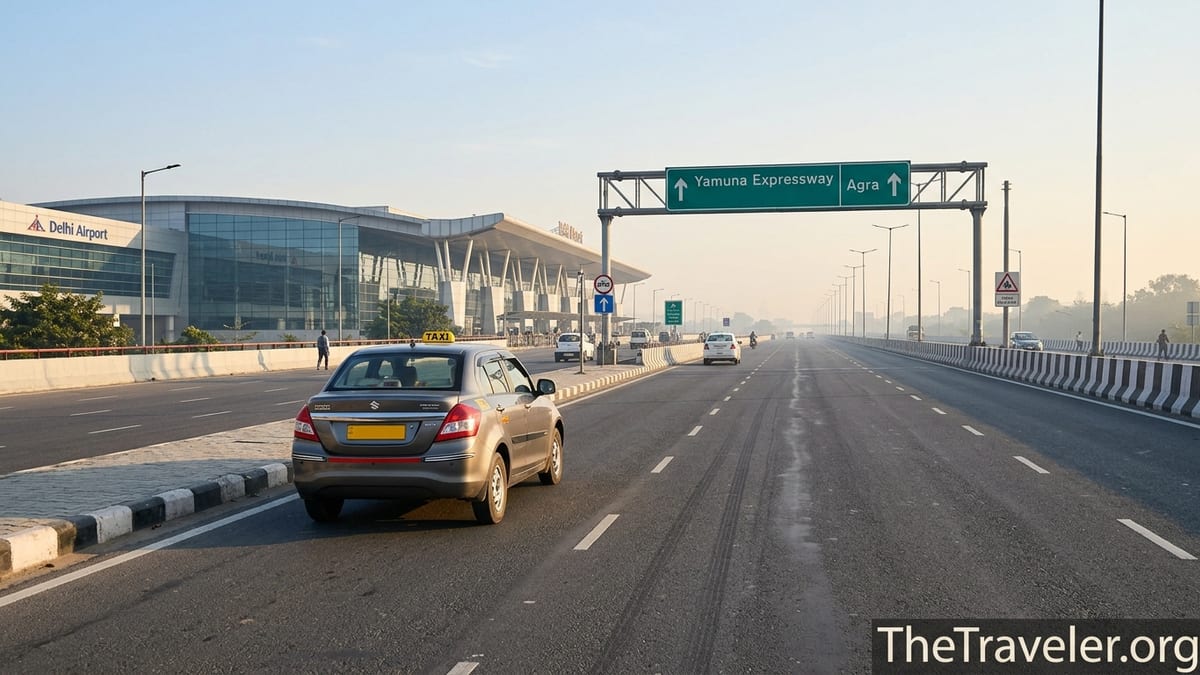
Understanding the Delhi Airport to Agra Journey
Agra lies roughly 220 to 230 kilometers south of Delhi, and almost all road traffic now uses the six-lane Yamuna Expressway. This modern toll road has turned what was once a 5-hour slog into a 3 to 4 hour run in normal conditions. That does not include airport formalities or city traffic at either end, which is where most travelers underestimate total travel time.
From Indira Gandhi International Airport (IGI), you first have to clear immigration and baggage, which typically takes 45 to 90 minutes for international flights during busy periods. Then there is the 30 to 60 minute run from the airport area through south Delhi or the outer ring roads to reach the start of the Yamuna Expressway. Only once you are on the expressway does the fast part of the journey begin.
Most visitors either book a direct taxi or private driver from IGI to Agra, or transfer into central Delhi for a high-speed train from New Delhi or Hazrat Nizamuddin stations. There is no direct train station at IGI, and Agra’s own airport is a small seasonal military airfield, so flying directly into Agra is not a realistic option for most international travelers. Your choice boils down to road vs road-plus-train, and whether you want to organize everything yourself or lean on a tour operator.
As a rough benchmark, a well-planned door-to-door trip from IGI to an Agra hotel near the Taj Mahal typically takes 4.5 to 6 hours in total, depending on time of day, route, and how quickly you move through the airport. Any Taj Mahal plan you make should be built around that reality rather than pure map distance.
Taking a Taxi or Private Car from Delhi Airport to Agra
The simplest onward route is to step out of the terminal and get into a pre-booked taxi or private car to Agra. Several online car services and local operators quote flat one-way fares from IGI to Agra that, as of mid-2026, commonly start around 2,200 to 3,300 Indian rupees for a basic sedan, with tolls on the Yamuna Expressway either included or added on top. Premium operators with English-speaking drivers and better vehicles often quote in the 3,500 to 4,500 rupee range for the same one-way run, which is still good value for a 3 to 4 hour private transfer.
To give a concrete example, one popular intercity taxi platform currently advertises IGI Airport to Agra around 2,200 rupees for a small car if booked online in advance, while a more premium Agra-focused operator quotes approximately 3,300 rupees for a one-way sedan with a verified driver and Fastag toll payment handled automatically. On-the-spot airport taxi counters can be more expensive and may quote closer to or above 4,000 rupees, especially at odd hours, though you do get the certainty of an official booking desk inside the terminal.
Travel time by road is usually 3 to 4 hours of driving via the Yamuna Expressway once you are clear of Delhi traffic. In practice, many travelers report 4 to 4.5 hours door to door from IGI to hotels in Agra’s Taj Ganj area in daytime. Leaving at 7 am on a weekday might see you in Agra around 11 am. Leaving at 3 pm on a winter afternoon could mean arriving closer to 7 or even 8 pm if you hit peak Delhi congestion or heavy fog on the expressway.
For weary long-haul passengers, a pre-booked private car with meet-and-greet inside the arrivals hall can be worth the slight premium. You can have a driver holding your name board, help with bags, and drive directly via the expressway with no need to negotiate at the kerb. For families with children, older travelers, or anyone carrying large luggage, this road option is often the least stressful way to get from Delhi Airport to Agra in one continuous journey.
Using the Yamuna Expressway: Fastest Road Route Explained
The Yamuna Expressway is the backbone of most Delhi to Agra road trips. Stretching around 165 kilometers from Greater Noida to Agra, it is one of India’s smoothest intercity corridors, with three lanes in each direction, a central barrier, limited access, and relatively consistent speeds. From IGI, your driver will typically head via south Delhi and Noida or use outer ring roads to reach the expressway entrance near Greater Noida, then cruise towards Agra.
At the time of writing, the posted speed limit on much of the expressway is around 100 kilometers per hour for cars, with some stretches marked lower, and there are fixed speed cameras. Although the road surface is good and drivers are tempted to go faster, staying within limits is strongly advised; police enforcement and automated fines have become more consistent, and for visitors it is not worth the risk. Expect 2 to 2.5 hours from the expressway start to the Agra exit, plus your approach and exit times on city roads.
Tolls are collected at plazas along the expressway and are typically paid electronically via Fastag by local taxi operators. For a private car, you might not see a separate toll line item because many intercity taxi companies roll tolls into their quoted fare. If you are self-driving in a rental car or friend’s vehicle, you can expect to pay a few hundred rupees in tolls for a one-way journey; the exact amount can change over time, so think of it as a modest but worthwhile fee for a much smoother drive compared with the older national highway.
Weather can affect travel time on the expressway. In winter months, particularly December and January, dense morning fog around Delhi and the Yamuna river can slow traffic significantly and occasionally leads to advisories or temporary restrictions. In the monsoon, heavy rain can reduce visibility but the road drainage is generally reasonable. When planning a same-day Taj visit, factor in the possibility of fog-related delays if you are traveling in peak winter.
Train via New Delhi or Hazrat Nizamuddin: When Rail Makes Sense
If you are comfortable with Indian Railways and want to minimize road time, taking a fast train from central Delhi to Agra can be an excellent option. The most popular high-speed services are the Gatimaan Express from Hazrat Nizamuddin to Agra Cantt, which typically covers the distance in roughly 1 hour 40 minutes, and various Shatabdi and Intercity Express trains from New Delhi station that complete the run in around 2 to 3 hours depending on stops and schedule.
In real terms, the train itself may be faster than a car, but you must add on the airport-to-station leg at the Delhi end and station-to-hotel transfer at the Agra end. From IGI, the airport metro line takes about 20 minutes to reach New Delhi Railway Station, plus transfer time between the metro and mainline platforms. A road transfer from IGI to Hazrat Nizamuddin typically takes 35 to 60 minutes in normal traffic. Many travelers therefore allow a minimum of 2.5 to 3 hours between scheduled flight arrival and train departure to be safe.
To illustrate how this works in practice, consider an international traveler landing at IGI at 9:00 am. If immigration and baggage take 60 to 75 minutes and they have hand luggage only, they might reasonably target a Gatimaan Express departure from Hazrat Nizamuddin around 12:30 to 1:00 pm, arriving in Agra Kem around mid-afternoon. By the time they exit Agra Cantt station and get a taxi to a hotel near the Taj, it could easily be 3:30 or 4:00 pm. In that scenario, a sunset Taj Mahal visit is possible, but only if everything runs smoothly and tickets are secured in advance.
Train fares are generally good value. Air-conditioned chair car seats on fast services often cost in the region of several hundred to around one thousand rupees per person, depending on class and demand. First-class or executive chair car is usually priced higher but still very affordable by international standards. The catch is availability: popular trains can sell out days or weeks in advance in peak season, so same-day bookings are not guaranteed. For many first-time visitors, the logistics of getting into central Delhi and navigating major rail stations after a long flight outweigh the time savings of the train.
Private Driver vs Point-to-Point Taxi: Which Is Better?
Although they sound similar, there is a practical difference between booking a simple point-to-point taxi and hiring a private driver for the day or for a multi-day tour. A point-to-point airport-to-Agra cab will pick you up at IGI, drop you at your hotel or chosen address in Agra, and the job is done. A private driver engaged through a tour operator or specialist company will usually stay with you all day in Agra, take you to the Taj Mahal and other sights, and then either remain in Agra for onward journeys or drive you back to Delhi.
For example, many Agra-based tour companies advertise “same-day Agra from Delhi” packages that include an early-morning pickup at IGI or a Delhi hotel, road transfer via Yamuna Expressway, a licensed local guide in Agra, visits to the Taj Mahal and Agra Fort, lunch at a recommended restaurant, and return to Delhi in the evening. Pricing for such all-inclusive private tours varies widely, but a typical mid-range package for two people in 2026 might fall somewhere in the equivalent of 6,000 to 12,000 rupees, depending on the car category, guide services, and whether monument tickets and meals are included.
The key advantage of a private driver for newly arrived travelers is not just comfort but decision-making. Your driver can advise if fog is too dense for an early start, adjust your itinerary if your flight is delayed, and coordinate with a local guide in Agra. With a simple one-way taxi, once you reach Agra you have to organize local transport yourself, which is easy enough for confident travelers but can feel like a lot on the first day in India.
On the other hand, if you plan to stay at least one night in Agra and wander the city at your own pace, a straightforward one-way taxi from IGI to your Agra hotel is usually the most cost-effective option. You can then book local autos, app cabs, or hotel cars for visits to the Taj Mahal, Agra Fort, and Mehtab Bagh without paying to keep a Delhi-based driver waiting all day.
Managing Luggage, Jet Lag, and Comfort on the Route
One of the most common mistakes travelers make is planning a long road transfer to Agra immediately after an overnight flight, with no buffer for rest or unexpected delays. The combination of jet lag, India’s heat, and several more hours on the road can make even a smooth journey feel exhausting. If your flight lands very late at night or in the early hours, consider staying at an airport-area hotel in Delhi and traveling to Agra after breakfast instead of pushing through the night.
Most intercity taxis and private cars from Delhi to Agra are standard sedans such as Toyota Etios or Maruti Dzire, which comfortably fit two to three passengers with two large suitcases and hand luggage. For families or groups of three or more with multiple large bags, upgrading to an SUV such as an Innova-style vehicle is worth the modest extra cost for comfort and luggage space. When booking online with a taxi company or aggregator, it is good practice to send a quick message or note about how many pieces of large luggage you are carrying.
For those planning to go by train, luggage deserves special thought. While Indian Railways does not usually weigh luggage for normal passenger classes, you will be responsible for lifting your bags into the coach and stowing them either on overhead racks, under seats, or at the end of the carriage. Rolling suitcases are fine, but very large or multiple heavy bags can make station changes and boarding stressful, especially if you must navigate stairs, crowded platforms, or footbridges at New Delhi or Hazrat Nizamuddin after a long flight.
Whichever route you choose, keep essential items like passport, cash, and any medication in a small daypack you carry with you at all times. In both taxis and trains, it is advisable to keep wallets and phones in zipped pockets and avoid leaving them unattended while you sleep. Bottled water is widely available at the airport and on the road, and most private taxis will happily stop at services or fuel stations along the Yamuna Expressway for restrooms and quick snacks.
Is a Same-Day Taj Mahal Visit from Delhi Airport Realistic?
Whether you can realistically see the Taj Mahal on the same day you land in Delhi depends primarily on your flight arrival time, the season, and how tightly you are willing to schedule your day. As a broad guideline, travelers landing before about 7:00 or 8:00 am on a relatively on-time international flight have a reasonable chance of reaching Agra in time for an afternoon or sunset visit to the Taj, especially if they use a pre-booked private car via the Yamuna Expressway and move efficiently through the airport.
Take a hypothetical case: Your flight touches down at IGI at 6:00 am in October. You clear immigration and collect luggage by 7:15 am. A pre-arranged driver meets you in arrivals and you are on the road by 7:30 am. Traffic is moderate, and you reach the Yamuna Expressway around 8:15 am. With steady driving and a short comfort stop, you could reach your hotel near the Taj in Agra around 11:30 am or noon. After checking in and freshening up, you might be at the Taj ticket counter by 1:00 or 2:00 pm, giving you several hours before closing and sunset. In such a scenario, a same-day Taj visit is quite feasible.
Now change one variable: arrival in peak winter fog. If the same flight lands in early January and dense fog is affecting both Delhi roads and the expressway, your driver might need to travel significantly slower for safety, stretching the drive to 5 hours or more. In that case, you could arrive in Agra mid-afternoon, leaving just a short window before dusk. Similarly, if your flight is scheduled to land in the early afternoon or evening, you are realistically looking at a next-morning Taj visit, not same day, if you go by road.
Attempting a same-day Taj visit via train after an international arrival is riskier unless your flight lands very early and your train is booked for midday or later. Because many premier trains to Agra run in the morning, aligning an early train with a long-haul arrival can be difficult. In many cases, the best strategy is a one-night stopover near the airport or in central Delhi, traveling to Agra the following morning by train or road and enjoying the Taj either that afternoon or at sunrise the day after.
For some travelers, particularly those on tight business schedules or long layovers, a professionally arranged same-day “Taj from Delhi Airport” tour can remove much of the stress. These services typically monitor your flight, adjust pickup times, and provide local guidance on when to aim for the Taj Mahal during the day, but they still cannot override airport delays or severe weather, so a degree of flexibility is always necessary.
The Takeaway
Planning the route from Delhi Airport to Agra is less about distance and more about managing time, comfort, and uncertainty. The Yamuna Expressway has made the road journey fast and straightforward, and a pre-booked taxi or private car is the easiest option for most first-time visitors, especially after a long flight. Expect 3 to 4 hours of driving and 4.5 to 6 hours door to door when you include airport procedures and city traffic.
High-speed trains from New Delhi or Hazrat Nizamuddin to Agra offer a quick and atmospheric alternative, but they work best if you are already staying in central Delhi or if your flight schedule comfortably matches a train departure. For travelers landing into IGI and heading straight on to Agra, the extra station transfers often offset the speed advantage of the train, unless you especially want the rail experience.
Same-day Taj Mahal visits from Delhi Airport are possible if you land early, the weather is kind, and you have a car waiting. They are far less realistic for afternoon or evening arrivals, or during periods of heavy winter fog. If in doubt, it is wiser to plan an overnight in Delhi or Agra and give yourself time to see the Taj properly rather than racing straight from the arrivals hall to the monument.
Above all, choose the combination of route and timing that fits your energy levels and travel style. A slightly slower schedule that lets you arrive in Agra rested, showered, and ready will almost always make your first view of the Taj Mahal more memorable than the quickest possible dash.
FAQ
Q1. How long does it really take to travel from Delhi Airport to Agra?
In normal conditions, expect around 4.5 to 6 hours door to door, including immigration, baggage, meeting your driver, city traffic, and a 3 to 4 hour road journey via the Yamuna Expressway.
Q2. What is a realistic taxi fare from Delhi Airport to Agra?
As of 2026, online bookings for a one-way sedan from IGI to Agra usually fall roughly in the 2,200 to 3,300 rupee range, with some premium services charging a bit more and airport counter taxis sometimes quoting higher prices.
Q3. Is it better to book a taxi in advance or take one on arrival?
Booking in advance is generally safer and more comfortable, especially after a long flight, because you lock in an approximate fare, have a driver waiting with your name board, and avoid negotiating at the kerb when you may be tired.
Q4. Which is faster from Delhi to Agra, taxi or train?
The train between central Delhi and Agra can be faster in pure travel time, but once you add airport-to-station transfers and station formalities, a direct taxi or private car from IGI is often equally fast or more convenient for newly arrived visitors.
Q5. Can I visit the Taj Mahal on the same day I land in Delhi?
Yes, if your flight lands early in the morning, your onward transport is well organized, and weather conditions are normal. For afternoon or evening arrivals, or during heavy winter fog, a same-day visit is usually not practical.
Q6. Is the Yamuna Expressway safe for tourists?
In general, yes. It is a modern, well-maintained six-lane expressway widely used by tourists. The main safety advice is to use reputable drivers, wear seatbelts, avoid overspeeding, and be cautious in fog or heavy rain.
Q7. Should I stay overnight in Delhi or go straight to Agra?
If you arrive very early and feel rested, going straight to Agra can work well. If you land late at night, very early morning, or are worried about jet lag, an overnight near the airport or in Delhi with travel to Agra the next day is usually more comfortable.
Q8. Which Delhi station is better for trains to Agra, New Delhi or Hazrat Nizamuddin?
Both work. Hazrat Nizamuddin is often slightly less chaotic and serves the fast Gatimaan Express, while New Delhi has more overall train options. Your choice depends on which train you can book and where you are staying in Delhi.
Q9. How much luggage can I take in a taxi from Delhi to Agra?
A typical sedan comfortably handles two to three passengers with two large suitcases and hand luggage. For more people or more bags, an SUV or larger vehicle is advisable so that everyone has space to sit safely with seatbelts.
Q10. Do I need to buy Taj Mahal tickets in advance if I am coming straight from Delhi Airport?
Advance online tickets are strongly recommended in this case, as they save precious time at the monument and reduce the risk of queues eating into your limited same-day sightseeing window.