


Landing at Delhi’s Indira Gandhi International Airport with meetings lined up in Gurgaon can feel like a race against the clock. Between traffic on the Delhi–Gurgaon Expressway, a maze of taxi options and the lure of the Airport Express Metro, your first decision after customs can shape the rest of your day. This guide breaks down the best real world routes from the airport to Cyber City, Aerocity and key business hotels, with current prices, timing expectations and practical tips on luggage, safety and smooth hotel arrivals.
Get the latest updates straight to your inbox!
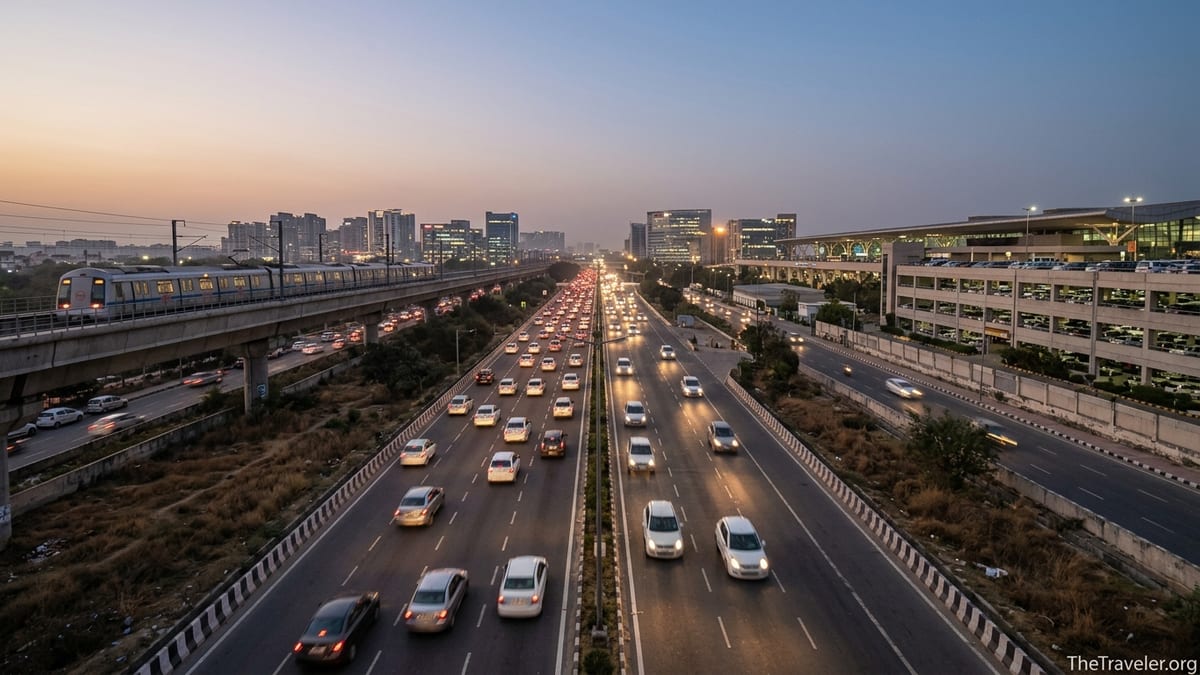
Understanding the Delhi Airport to Gurgaon Corridor
Gurgaon, officially Gurugram, lies roughly 15 to 20 kilometres south west of Indira Gandhi International Airport via National Highway 48 and the Delhi–Gurgaon Expressway. In light traffic, the drive from Terminal 3 to Cyber City can take about 25 to 35 minutes, but in peak office hours it can stretch closer to an hour, especially near the old toll plaza area and Udyog Vihar junctions where bottlenecks are still common.
Most business hotels and offices for visiting travelers are clustered in three pockets: Aerocity, Cyber City and the MG Road / HUDA City Centre area. Aerocity is just a short hop from the terminals and mainly serves overnight stays and quick airport meetings. Cyber City and Udyog Vihar sit just across the Haryana border and host major offices for companies like Deloitte, EY, American Express and several global tech firms. Further down the Yellow Line corridor, MG Road and HUDA City Centre have more mid range hotels and serviced apartments that appeal for longer stays.
For business travelers, the main choice is between road based options such as prepaid taxis and app rides, and a rail based combo using the Airport Express Metro plus the Delhi Metro Yellow Line into Gurgaon. Each has a different balance of time, cost and comfort. In practice, many travelers combine them, for instance taking the Airport Express to New Delhi and then an Uber from there if they are heading to the Golf Course Road business district.
Time of arrival plays a major role. Very early morning flights between about 1:00 and 4:00 tend to face light traffic on the expressway but limited public transport options, pushing you towards taxis. Daytime and evening arrivals can leverage both metro and cabs, but need to account for office rush hours where the same journey can vary by 20 to 40 minutes.
Taxi, Prepaid Cabs and Chauffeur Cars
For many business travelers the simplest option remains a car directly from the terminal. Official prepaid taxi counters are located inside arrivals at the main terminals. You pay a fixed fare upfront based on your destination band and receive a printed voucher with the taxi’s registration number. For central Gurgaon or Cyber City the all in fare for a standard sedan typically sits somewhere around the mid to high hundreds of rupees, often in the vicinity of 900 to 1,500 rupees depending on category and time, which includes government approved tariffs and surcharges.
Prepaid taxis are useful if you want a regulated fare and do not want to rely on a mobile app or local SIM immediately. They also avoid haggling or surprise add ons at the end of the ride. The trade off is that the cars can be older and air conditioning or cleanliness may not match what you might expect from a corporate car service. If you are arriving in mid summer wearing business formals ahead of an afternoon presentation, that comfort gap can be noticeable during a 45 minute expressway run.
Private chauffeur services and hotel cars sit at the other end of the spectrum. Many higher end business hotels in Cyber City and Aerocity, such as premium international chains, offer airport pick up in a sedan or SUV billed either per car or as part of a corporate contract. Base prices to Gurgaon from the airport can easily exceed 1,800 to 2,500 rupees one way, sometimes more for larger vehicles or luxury brands. In exchange you get a clearly identified driver waiting with a placard in the arrivals hall, luggage assistance, newer vehicles and direct coordination with the hotel, useful if your flight is delayed.
When using any taxi at the airport, walk only to the clearly marked taxi areas or follow staff guidance inside the terminal. Ignore freelance drivers approaching you in the arrivals hall with vague offers such as “cheap taxi to Gurgaon.” Official counters and app based pickups provide much better traceability and recourse in case of issues such as lost items or billing disputes.
Uber and Ola from the Airport to Cyber City
Uber and Ola operate widely at Delhi airport and are a popular choice for tech savvy business travelers, particularly between Terminal 3 and Gurgaon’s office corridors. App based fares from the terminal to Cyber City or MG Road fluctuate, but recent journeys often fall in a rough band of about 400 to 700 rupees for smaller categories during off peak times, going higher into the hundreds or beyond 1,000 for larger cars, surge pricing or peak evening hours.
The airport currently levies an additional pickup fee, often around 150 rupees, on app cabs that collect passengers directly from the terminal pickup zone. Apps usually show this as an added line item in the price estimate. An increasingly common work around for cost conscious travelers is to take the short airport shuttle or a quick hop by local taxi to Aerocity, located one metro stop away on the Airport Express line, and then order Uber or Ola from there, where the airport pickup charge does not apply. This can make sense for solo travelers comfortable with a small extra transfer but is less attractive if you have heavy luggage or a tight schedule.
Pickup zones for app cabs are generally in the multi level car park adjacent to the arrival terminal. The app will guide you to a specific pillar or zone, which can be busy during late evening arrival waves. Allow at least 10 to 15 minutes from opening the app to actually sitting in the car, especially around 8:00 to 11:00 at night when both domestic and international flights converge. At more off peak times, such as mid afternoon or very late night, cars often reach you within 5 to 10 minutes.
Travel time by Uber or Ola to Cyber City broadly mirrors that of any taxi: as quick as 25 to 30 minutes in light traffic, and nearer 50 to 60 minutes or more in the weekday morning and evening rush. Real world experience shared by commuters suggests that even small incidents, monsoon downpours or construction near Dwarka Expressway can add unpredictable extra delays. If you have a client presentation scheduled at 10:00 in DLF Cyber Hub, it is prudent to book your pickup to allow a full hour or slightly more from terminal curbside to office reception.
Airport Express Metro and Metro to Gurgaon
The Airport Express Metro is often the fastest and most predictable way to leave the airport, especially during rush hour or if there is heavy rain on the expressway. Trains run from Terminal 3 and other connected stations to New Delhi Metro Station in roughly 18 to 20 minutes. The single journey fare between the airport and New Delhi is around 60 rupees, with small discounts when using a stored value smart card. Operating hours usually begin before 5:00 in the morning and extend until late evening, but it is wise to check the current first and last train times on arrival, particularly if you land very late.
To reach Gurgaon by metro you transfer from the Airport Express at New Delhi to the Yellow Line. This transfer happens within the same large interchange complex, following signage down to the main Delhi Metro platforms. From New Delhi station on the Yellow Line you travel south through central Delhi, passing hubs like Rajiv Chowk and AIIMS, before crossing into Gurgaon. Key stops for business travelers include Sikanderpur, MG Road and the Millennium City Centre Gurugram terminus, which serves the older HUDA City Centre area.
Yellow Line travel from New Delhi to most Gurgaon stations generally takes 35 to 50 minutes, depending on how far you are going and how long you wait between trains. Single journey fares on the standard Delhi Metro network for that distance are usually on the order of tens of rupees, often somewhere between about 30 and 60 rupees per person. Taking the Airport Express plus Yellow Line therefore keeps the total one way cost to Gurgaon well under 150 rupees per person, which can be very attractive for solo travelers or teams who are more budget conscious and not carrying heavy bags.
The tradeoffs are important. You will need to manage your own luggage through two metros and at least one interchange, including security checks. During weekday morning and evening peaks, Yellow Line trains through central Delhi and into Gurgaon can get crowded, particularly around Rajiv Chowk and AIIMS, although conditions usually ease somewhat by the time you cross into Haryana. For travelers with a roller bag and backpack this is workable. For those with large suitcases or sample cases, or who are tired after a red eye flight, a direct car may feel more realistic.
Choosing the Best Route for Cyber City and Key Business Hotels
Cyber City and DLF Cyber Hub sit very close to the old Delhi–Gurgaon border and are among the first major office clusters you reach when coming from the airport side. Many global firms as well as international hotels such as well known premium brands have properties within a short drive of Cyber Hub and the adjacent Udyog Vihar phases. From Terminal 3 these areas are easily reached by road along NH 48 and the expressway slip roads, often in under 40 minutes outside peak windows.
For door to door convenience, app cabs and prepaid taxis remain the preferred choice for most visitors heading direct to Cyber City. A typical itinerary for a visiting manager flying in from Mumbai for a same day client review might involve booking an Uber Premier from the airport, riding straight to a hotel like one of the large branded towers near Cyber Hub, freshening up, and then walking or taking a short cab to the client’s building. In this scenario every transfer eats into preparation time, so a single uninterrupted ride is a worthwhile expense.
For those combining work in central Delhi and Gurgaon over the same day, the metro becomes more attractive. One common pattern is to take the Airport Express into New Delhi, hold meetings in Connaught Place in the morning, then board the Yellow Line to MG Road or Millennium City Centre Gurugram for an afternoon session. Depending on your exact destinations, you might step out at Sikanderpur and take a short auto rickshaw or cab ride into Cyber City or along Golf Course Road. This approach reduces your exposure to surface traffic on the expressway, though it does mean more vertical travel and platform changes.
Hotel location should heavily influence your arrival plan. Aerocity hotels are so close to the airport that taxis or even quick shuttle transfers make the most sense, and many properties operate their own shuttles. Cyber City hotels favour direct cabs for most guests. Hotels further south around Golf Course Road, Sector 29 or near Millennium City Centre Gurugram can work well with either a cab straight from the airport or a combination of metro to HUDA City Centre and a short local ride, especially outside late night hours.
Traffic Patterns, Timing and Safety Considerations
Traffic between Delhi airport and Gurgaon is highly sensitive to time of day and weather. Informal commuter reports frequently describe weekday peaks on the Delhi–Gurgaon Expressway roughly between 8:00 and 11:00 in the morning towards Gurgaon and between about 6:00 and 9:00 in the evening towards Delhi, though local conditions and special events can shift these windows. During these periods, what is a 30 minute off peak drive can more realistically become a 60 to 75 minute journey.
Early mornings around 5:00 to 7:00 and late evenings after about 10:30 often see smoother flows, though maintenance work or incidents in the Dwarka Expressway tunnel and other connecting roads can still trigger surprise jams. Monsoon season can sharply reduce speeds due to standing water and cautious driving, and travelers have reported even late night backups near Kapashera and the old toll plaza area during heavy rain. For any important meeting, build in at least 20 to 30 minutes of buffer beyond what a maps app suggests.
From a safety perspective, both the Airport Express Metro and the main Delhi Metro network are widely used by office workers and students and are generally considered a safe, predictable choice, particularly during operational hours when coaches are busy but orderly. Stick to the main paid areas of stations, follow security instructions and avoid traveling with open laptops or phones near doors when crowds surge. Inside cabs, always confirm the driver and number plate with what your app or voucher shows, and keep luggage in the boot rather than on the front seat.
Solo travelers arriving very late at night often prefer a pre arranged hotel car or trusted app cab directly from the terminal for simplicity and safety. In these hours, the metro may not be running, and roadside cabs outside the official queue may be more aggressive in soliciting passengers. If your employer has a travel desk, ask them to book a car that tracks the journey and shares details automatically, rather than making ad hoc arrangements after you land.
Luggage, Connectivity and Arrival at Your Hotel
The nature of your luggage will strongly shape which route feels realistic. With only a cabin bag and laptop backpack, business travelers can comfortably navigate the Airport Express and Yellow Line, including escalators and occasional staircases. If you are carrying product samples, trade fair materials or multiple large suitcases, dragging them through turnstiles and crowded trains may quickly become exhausting. In that case, the incremental cost of a taxi compared with metro fares can be justified purely on back and time savings.
Delhi airport offers free Wi Fi, but you usually need a mobile number for the login code, which can be a challenge if you arrive without roaming. International roaming or an e SIM activated before departure makes booking Uber or Ola much smoother. Alternatively, you can use airport Wi Fi briefly to request a cab if the system allows OTP delivery over email or app notification. For those without any data at all, the prepaid taxi counters are simpler as they do not rely on connectivity.
On arrival at your hotel in Gurgaon, expect some properties, particularly in Cyber City, to conduct quick vehicle checks and luggage scanning at the gate. This is standard practice and can add a few minutes to your final approach. Having your booking confirmation handy, either printed or on your phone, speeds up check in. If you are arriving with colleagues on separate flights, it can be efficient to agree a rendezvous point like a coffee shop in Cyber Hub or the lobby of a central hotel, so that latecomers can join without everyone waiting at the airport together.
For tight turnarounds where you land in the morning and have a meeting nearby within a couple of hours, it can be worth booking a day use room in an Aerocity hotel to shower, change and take calls before heading to Gurgaon once traffic stabilises. Some travelers also base themselves at Aerocity for very short trips, commuting to Gurgaon by cab only for the specific meetings required, balancing hotel loyalty points and flight convenience against the added road time.
The Takeaway
There is no single perfect route from Delhi airport to Gurgaon for every business traveler. Instead, the best option depends on your landing time, luggage, meeting schedule and comfort with transfers. App cabs and prepaid taxis offer the most straightforward door to door experience, especially for Cyber City and Aerocity hotels, at a moderate but predictable cost and exposure to expressway traffic.
The Airport Express plus Yellow Line metro combination introduces more steps but can be both cheaper and more time reliable in heavy traffic, particularly if your meetings span central Delhi and Gurgaon in the same day. Private hotel cars and chauffeurs sit at the premium end, offering seamless arrivals that many corporate travellers and visiting executives value when they want to focus on preparation rather than navigation.
Whichever route you choose, build in realistic buffers, keep an eye on local traffic and metro advisories, and avoid improvising with unregistered cabs. With a little planning, the journey from the jet bridge to your Gurgaon hotel lobby can be just another smooth step in your business trip rather than its most stressful chapter.
FAQ
Q1. How long does it usually take to travel from Delhi airport to Gurgaon?
In light traffic it can take around 25 to 35 minutes by car from Terminal 3 to Cyber City, but in peak hours you should allow 45 to 60 minutes or more.
Q2. What is the most reliable way to avoid traffic delays between the airport and Gurgaon?
The Airport Express Metro to New Delhi combined with the Yellow Line to Gurgaon tends to be the most time predictable option, as it bypasses expressway congestion, though it adds transfers and requires handling your own luggage.
Q3. Roughly how much does a taxi or Uber from the airport to Cyber City cost?
Typical app cab fares often fall somewhere around 400 to 700 rupees for smaller cars in off peak times and can rise into the higher hundreds or above 1,000 with larger vehicles or peak pricing.
Q4. Is it safe to take the Delhi Metro with luggage if I am traveling alone?
Yes, many solo travelers use the Airport Express and Yellow Line with cabin bags or a suitcase. Keep valuables close, avoid blocking doors and travel within normal operating hours for added reassurance.
Q5. Are there any advantages to staying in Aerocity instead of Gurgaon for business trips?
Aerocity offers very quick access to the terminals and a dense cluster of international hotels and dining, which is ideal for short overnight stays or trips focused on airport side meetings, though it adds commute time to Gurgaon offices.
Q6. Do hotels in Cyber City usually offer airport transfers?
Many mid range and high end hotels in and around Cyber City provide paid airport transfer services, often in sedans or SUVs, which can be arranged while booking or through the concierge in advance.
Q7. When is traffic between Delhi and Gurgaon at its worst?
Weekday office rush hours, roughly mid morning towards Gurgaon and early evening towards Delhi, tend to be the slowest, with added delays during heavy rain or construction.
Q8. Can I use the metro if my flight lands very late at night?
If you land close to or after the last Airport Express departure, you may find the metro closed and will need to rely on taxis or app based cabs from the terminal instead.
Q9. What is the best option if I have multiple large suitcases?
With heavy or bulky luggage, a direct car from the airport, whether an app cab, prepaid taxi or hotel transfer, is usually more practical than navigating multiple metro lines and station staircases.
Q10. How far in advance should I book a car from the airport for an important meeting in Gurgaon?
If you have a fixed meeting time, it is sensible to plan your pickup so that you reach the Gurgaon area at least 30 minutes before, allowing for potential delays and hotel security or check in formalities.