


More news on this day
Back-to-back cancellations on Delta Air Lines’ Lagos–Atlanta route in late August 2026 have left transatlantic travelers stranded for days, intensifying scrutiny of reliability on one of West Africa’s most important links to the United States.
Get the latest news straight to your inbox!
Back-to-back disruptions on a key transatlantic link
Delta’s nonstop service between Lagos’ Murtala Muhammed International Airport and Hartsfield-Jackson Atlanta International Airport is widely viewed as a critical corridor for business travelers, the Nigerian diaspora, and passengers connecting onward across North America. The route typically operates several times per week, with flights marketed under numbers such as DL55 and DL9895 on the Lagos–Atlanta leg.
According to Nigerian media coverage and publicly available flight information, a Lagos–Atlanta departure scheduled for Sunday, August 23, 2026 was cancelled with passengers already at the airport. Travelers expecting to board flight DL9895 reported being informed that the service would not operate, triggering a scramble for rebookings and accommodation at short notice.
Reports indicate that many of those affected were rebooked onto a subsequent Lagos–Atlanta departure planned for Tuesday, August 25. However, passengers and local coverage describe a second disruption to the rescheduled service, leaving some travelers facing multi-day delays as they waited for space on later flights or alternative routings via Europe and the Middle East.
Separate tracking of the regular DL55 operation on the corridor suggests that the August 23 flight was cancelled, while the August 25 service ultimately departed behind schedule after a maintenance check, underscoring a period of instability on the route during a peak summer travel window.
Operational issues and crew constraints at the center
Publicly available passenger notifications shared in local media attribute the initial late-August cancellation to operational problems, including maintenance or technical concerns identified before departure. In a message circulated to ticket holders for the August 25 flight, Delta referenced “an issue that limited crew availability,” which aligns with broader reports of staffing and scheduling pressures across parts of the network in recent months.
The combination of a technical issue on one day and crew availability challenges on another illustrates how long-haul disruptions can quickly cascade on a route with limited frequencies and tight aircraft utilization. When a widebody aircraft operating a transatlantic rotation is taken out of service in Lagos, there are few immediate replacement options, and crews must remain within strict duty-time limits, which can constrain recovery efforts.
Industry reporting on earlier operational incidents in August, including separate Delta flights that were forced to divert or return to Atlanta after technical concerns, has highlighted how complex long-haul operations remain particularly sensitive to weather, maintenance findings and crew scheduling rules. In the case of the Lagos–Atlanta corridor, these factors appear to have converged at a time of strong summer demand, magnifying the impact on passengers who found themselves stranded far from their final destinations.
Analysts note that while such cancellations are relatively rare compared with the total number of flights operated, they can significantly affect traveler confidence on routes with few non-stop alternatives. For many Nigeria–US itineraries, re-accommodation typically requires routing passengers through European or Middle Eastern hubs, often adding at least one extra connection and, in some cases, an additional travel day.
Passenger experience: long waits, limited alternatives
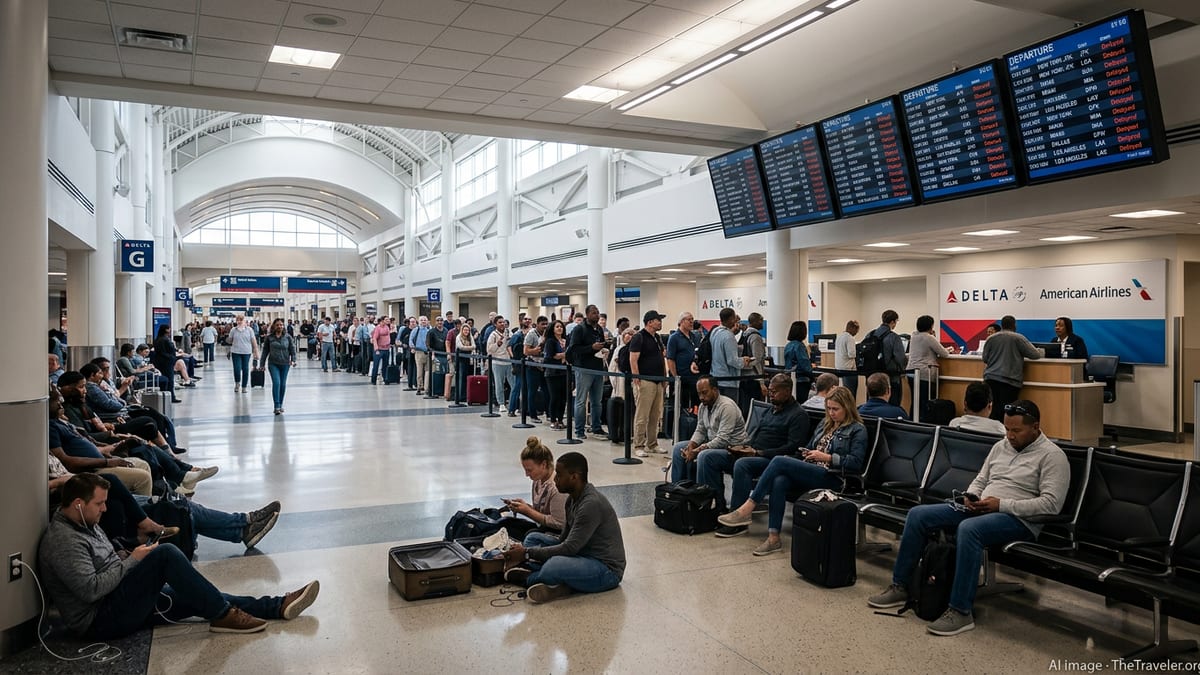
Accounts compiled in Nigerian news reports describe scenes of frustration at Murtala Muhammed International Airport as travelers queued at service desks, sought hotel rooms and tried to secure new itineraries after the twin disruptions. Some passengers reportedly spent multiple days in Lagos, incurring extra accommodation and local transport costs while they waited for confirmed seats.
Because Delta is one of only a small number of carriers offering direct Nigeria–United States services, options for immediate rebooking on non-stop flights were limited. Travelers who wished to depart sooner often had to consider itineraries via European cities such as London, Paris or Amsterdam, or through Middle Eastern hubs, depending on availability and visa requirements.
Travel advocacy resources emphasize that extended delays can be especially challenging for families, business travelers on tight schedules and passengers connecting onward to domestic flights within the United States. Missed meetings, disrupted events and lost vacation time frequently accompany multi-day cancellations on long-haul sectors, and the Lagos–Atlanta case has been no exception, according to regional coverage of the incident.
Observers also point out that high seasonality on the Nigeria–US market means that spare seats on alternative carriers may be scarce at short notice. When a heavily booked flight is cancelled during the summer peak, it can take several days to accommodate all affected passengers across multiple subsequent departures.
What protections apply on Nigeria–US itineraries
The back-to-back cancellations have renewed traveler interest in what protections apply on routes that connect Nigeria and the United States. Unlike flights operating wholly within the European Union or departing an EU airport, Nigeria–US services are not covered by EU261 compensation rules unless operated under specific circumstances involving an EU carrier and departure point.
Instead, passengers typically rely on a combination of the carrier’s contract of carriage, Nigerian aviation consumer regulations and, where applicable, U.S. Department of Transportation rules for the transatlantic segment. Publicly available guidance from consumer advocates stresses that travelers should retain boarding passes, e-tickets and receipts for meals, hotels and ground transport purchased during a disruption, as this documentation is often necessary when seeking reimbursement.
Delta’s published customer commitment states that when cancellations are within the airline’s control, such as those linked to maintenance or crew availability, the carrier may offer hotel and meal vouchers when overnight stays are required, subject to local policies and availability. For disruptions caused by severe weather or air traffic control restrictions, assistance may be more limited, although some form of rebooking is generally provided.
Travel insurance can also play an important role on long-haul itineraries. Policies that include trip interruption or delay benefits may cover additional lodging, transport and incidental expenses up to specified limits. Industry advisers recommend that passengers review policy wording carefully before travel and contact their insurer promptly when a significant disruption occurs.
Growing focus on reliability of West Africa–US routes
The recent Lagos–Atlanta cancellations are part of a wider conversation around long-haul reliability to and from West Africa. While overall connectivity between Nigeria and the United States has expanded at times over the past decade, the market remains relatively concentrated, and extended disruptions on one major route can have outsized effects on travelers and trade flows.
Specialist aviation outlets note that operational challenges on transatlantic routes from Africa have been influenced by factors ranging from aircraft availability and maintenance capacity to crew scheduling and infrastructure constraints at hub airports. In the case of Lagos, congestion and the complexity of coordinating long-haul operations can add further pressure during busy travel periods.
For airlines, safeguarding reliability on key intercontinental links is increasingly seen as a competitive differentiator, particularly for premium passengers and frequent travelers who depend on predictable schedules. Analysts expect carriers serving Lagos and other West African gateways to continue reviewing contingency plans, spare aircraft coverage and crew deployment strategies in response to recent disruptions.
For passengers, the events of late August serve as a reminder to monitor flight status closely, build in extra connection time where possible and understand the specific protections that apply on international tickets. As travel demand between Nigeria and the United States remains strong, future decisions on fleet planning, schedules and consumer rights frameworks are likely to shape how resilient routes such as Lagos–Atlanta prove during periods of operational stress.
Vanguard Nigeria: Delta disrupts two Lagos–Atlanta flights
Travel Trade Today: Delta leaves Lagos–Atlanta passengers stranded