


More news on this day
Delta Air Lines’ nonstop service between Lagos and Atlanta has come under renewed scrutiny after two closely spaced cancellations on the Lagos–Atlanta leg left travelers stranded at Murtala Muhammed International Airport and intensified concern about the reliability of one of West Africa’s most important transatlantic links.
Get the latest news straight to your inbox!
Back-to-back disruptions on a vital transatlantic route
Recent coverage from Nigerian media and aviation-tracking services indicates that passengers booked on Delta’s Lagos to Atlanta service experienced two significant disruptions in late August 2026. Reports describe an initial cancellation of a Lagos–Atlanta departure scheduled for Sunday, August 23, followed by severe problems with the departure that passengers were rebooked onto two days later.
According to Nigerian outlet Vanguard, travelers initially scheduled on a Lagos–Atlanta flight identified as DL9895 on August 23 were informed that their service would not operate, leaving many stranded at Lagos’ Murtala Muhammed International Airport. Some of those passengers were rebooked on a subsequent departure planned for Tuesday, August 25, but that service also failed to depart as planned, prompting renewed complaints at the terminal.
Publicly available flight-status feeds corroborate that Delta’s Lagos–Atlanta operation has faced irregularities in recent weeks, including both outright cancellations and heavily delayed departures. An earlier special-service Lagos–Atlanta flight listed as DL9905, which appeared in schedules earlier in the summer, was canceled on August 3 and then removed from upcoming timetables, according to independent flight-tracking databases that aggregate airline schedule data.
The disruptions come on a route that typically sees seven weekly nonstop departures operated by Delta, providing a direct link between Nigeria’s commercial capital and the carrier’s Atlanta megahub. Schedule aggregators still show daily nonstop service in late August and into September, underscoring that the problems relate to specific operating days rather than a suspension of the route itself.
Reasons cited: crew availability and operational constraints
Notifications sent to affected customers and reproduced in local reporting indicate that at least one of the canceled Lagos–Atlanta services was attributed to crew availability issues. Messages shared with passengers referenced an “issue that limited crew availability” as the reason for the disruption, language that aligns with standard industry phrasing used when airlines cannot staff a flight within duty-time and rest regulations.
Separate coverage of the same sequence of disruptions notes that one of Delta’s Lagos departures in the same period departed significantly behind schedule after technicians worked to resolve a maintenance issue with the aircraft. Flight-status dashboards used by travelers also show that the carrier’s associated Atlanta–Lagos rotation, branded as DL54 on some platforms, has recorded at least one cancellation in August alongside late departures on other days.
In addition to crew-related constraints, recent anecdotal reports from frequent flyers globally have highlighted a broader pattern of delays and cancellations across parts of Delta’s international network, often linked to aircraft maintenance checks, tight crew schedules and congested hub operations. The Lagos–Atlanta problems appear to fit within this wider pattern, where individual long-haul flights are disproportionately affected when irregular operations ripple through the system.
Public information suggests that while Delta has continued to operate the majority of its planned Lagos–Atlanta flights, days with cascading delays or a grounded aircraft can quickly lead to cancellations, particularly when spare widebody capacity is limited. On such days, passengers at outstations like Lagos may face longer waits for reaccommodation compared with travelers departing from the carrier’s US hubs.
Passenger impact at Lagos’ Murtala Muhammed International Airport
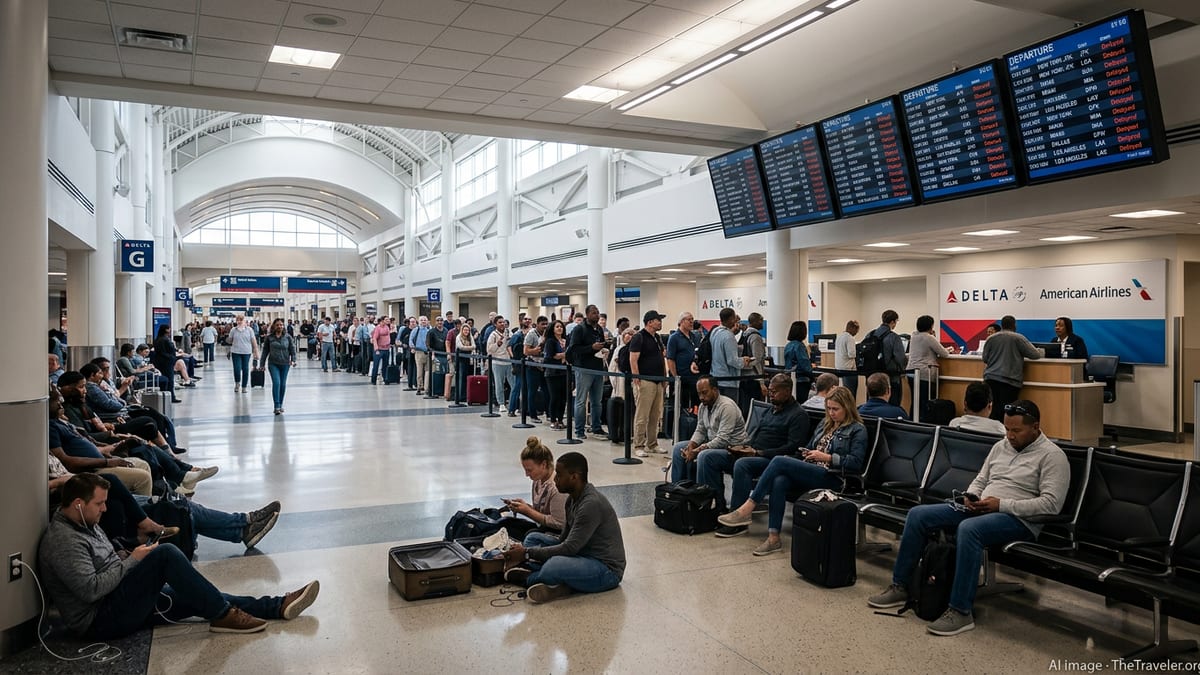
Travelers caught up in the two Lagos–Atlanta cancellations described spending extended hours in the departure hall and at check-in counters while seeking updated travel options. Nigerian press reports detail scenes of frustrated passengers who had already endured an initial cancellation being informed that their new flight would also not operate as expected or would face extensive delays.
With the Lagos–Atlanta link serving as a primary nonstop gateway for business travelers, students and relatives visiting the United States, disruptions on back-to-back operating days can leave limited short-term alternatives. While some passengers may be rerouted via other African or European hubs on partner airlines, economy and peak-season loads often mean same-day options are scarce.
Available accounts suggest that passengers were offered rebooking on later dates and, in some cases, on alternative routings. However, reports also indicate that the uncertainty around departure times and the lack of immediate clarity about new itineraries contributed to heightened frustration. Long-haul travelers facing visa restrictions, tight academic start dates or onward connections in North America can be particularly vulnerable when a nonstop service fails twice in succession.
Consumer advocates generally advise passengers on long-haul routes such as Lagos–Atlanta to maintain flexible accommodation plans and to keep digital copies of all airline notifications, as these can be helpful when seeking refunds, expense reimbursement or travel insurance claims after disruptions.
Schedule resilience and the role of Atlanta as a hub
Despite the disruptions, data from schedule aggregators continue to show that Delta’s Lagos–Atlanta pairing remains in regular operation, with approximately one nonstop flight per day in the current timetable. The route is an important component of Delta’s Africa strategy, connecting West Africa to the airline’s network of domestic and international destinations via Atlanta.
Because the service typically operates as a daily rotation with a dedicated widebody aircraft, a single operational problem can have knock-on effects for both the outbound Lagos–Atlanta sector and the inbound Atlanta–Lagos leg. If an aircraft remains on the ground in the United States due to maintenance or a crew timing issue, the following day’s departure from Lagos can be delayed or canceled, and vice versa.
Flight-status tools tracking the Atlanta–Lagos flight number DL54 in late August show instances of cancellations as well as lengthy delays, alongside days where the flight operated broadly on schedule. This pattern underscores how long-haul operations can oscillate between normal service and significant disruption within a short window, depending on crew availability, aircraft readiness and weather at major hubs.
For travelers planning trips between Nigeria and the United States, these dynamics highlight the importance of monitoring flight status closely in the 24 to 48 hours before departure and considering how missed connections in Atlanta might affect onward journeys to secondary US cities.
What the disruptions signal for West Africa–US connectivity
Delta’s back-to-back cancellations on the Lagos–Atlanta leg arrive at a time when connectivity between West Africa and North America remains relatively limited compared with other intercontinental markets. Direct flights from Lagos to US gateways are operated by a small number of carriers, and many travelers rely on one-stop connections through Europe, the Middle East or other African hubs.
A series of cancellations on a marquee nonstop route can therefore resonate beyond the immediate group of affected passengers, feeding broader perceptions about the reliability of long-haul travel options in and out of Lagos. Aviation analysts have previously highlighted that sustained operational reliability is critical for airlines seeking to attract high-yield corporate and premium-leisure traffic on Africa–US sectors.
Publicly available schedules still show Delta committed to maintaining its Lagos–Atlanta operation in the months ahead, with daily service listed across multiple independent schedule databases. However, the recent irregular operations underscore the challenges airlines face when balancing fleet utilization, crew staffing and maintenance on long-haul flying at a time of strong global demand.
For now, travelers and travel agents watching the Lagos–Atlanta market are likely to pay close attention to on-time performance data and to how future disruptions, if any, are handled. The recent episode of two canceled or heavily disrupted Lagos–Atlanta departures in quick succession may serve as a reminder of the importance of contingency planning on routes where alternatives are limited and demand remains robust.