


More news on this day
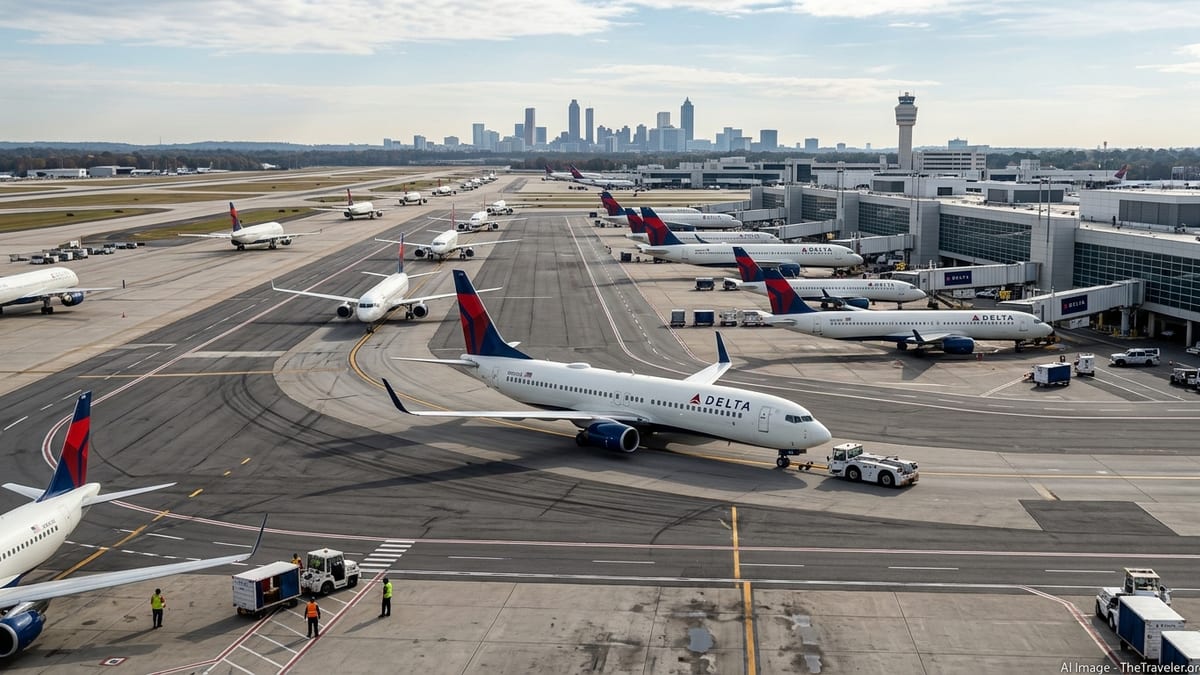
Delta Air Lines suffered a widespread technology outage on Sunday, November 22, when its automated weight-and-balance system failed, prompting a brief Delta-only ground stop into Atlanta, nationwide delays affecting more than 1,000 flights and residual disruption as the busy U.S. Thanksgiving travel period got underway.
Get the latest news straight to your inbox!
What Delta confirms happened to its automation system
Delta and federal aviation advisories confirm that the airline’s automated system for calculating aircraft weight and balance malfunctioned on the morning of Sunday, November 22, 2026. The system, which Delta flight operations identify as the Automated Load Instruction System, or ALIS, normally generates digital load instructions and weight-and-balance data used by pilots, dispatchers and ramp crews before every departure.
According to public statements cited by multiple news organizations, the failure prevented ALIS from reliably transmitting load instructions, forcing teams to switch to established manual procedures. That meant weight-and-balance calculations that are usually produced automatically for each flight had to be checked and prepared by hand before aircraft could push back, significantly slowing turnarounds across the network.
Flight-tracking data reported by several outlets show that by late afternoon on November 22 more than 1,000 Delta mainline and Delta Connection flights had departed at least 15 minutes late, representing close to half of the carrier’s schedule that day. At Hartsfield–Jackson Atlanta International Airport, Delta’s largest hub, local coverage and FAA summaries indicate that delays peaked at roughly an hour for many departures and arrivals while the outage was ongoing.
Ground stop into Atlanta and how the disruption spread
Once the scale of the automation problem became clear, Delta requested that the Federal Aviation Administration hold some of its Atlanta-bound traffic. FAA air traffic advisories issued on November 22 show a Delta-only ground stop for flights destined for Hartsfield–Jackson beginning at 13:00 UTC, or mid-morning local time, and lasting just over 30 minutes before being replaced by a ground delay program that metered Delta arrivals into the hub for several hours.
The restrictions applied specifically to Delta and Delta Connection flights, rather than to all airlines serving Atlanta, but the operational effect for Delta passengers was significant. Travelers on flights from airports including New York LaGuardia, Orlando, Seattle and Boise reported being held at gates or on taxiways while crews waited for manually produced load sheets. Pilots on several affected flights told customers over their public-address systems that they could not depart until final weight-and-balance figures were calculated and verified without the usual automation.
Although the failure centered on software used before departure, the knock-on effects extended throughout Delta’s Sunday schedule. Aircraft that left their origins late often arrived into hubs too far behind schedule to operate their next planned sectors on time, and crew duty limits further constrained what could be recovered on the day. To stabilize the operation, Delta canceled some later flights and consolidated others, a pattern reflected in higher-than-normal cancellation counts reported by tracking services on Sunday evening and into early Monday.
Context: timing with Thanksgiving travel and the earlier FAA outage
The outage landed just as the 2026 Thanksgiving travel period was ramping up. Transportation Security Administration data and airline forecasts had pointed to the Tuesday November 24 to Monday November 30 window as one of the busiest stretches of the year, with national passenger volumes close to or just below 2025’s record levels. For Atlanta specifically, local forecasts ahead of the holiday highlighted heavy traffic on the Sunday–Monday outbound wave, the moment when Delta’s system problem emerged.
The incident also followed an unrelated but high-profile disruption in the U.S. airspace system. On Friday, November 13, 2026, the FAA ordered a rare nationwide ground stop for all carriers after a separate communications network issue affected multiple air traffic control facilities. That earlier episode, which lasted several hours and led to thousands of delays and cancellations across airlines, prompted congressional attention to the resilience of federal aviation technology.
Because the nationwide FAA ground stop on November 13 and the Delta-specific outage on November 22 fell only nine days apart and both affected November travel, some passengers initially questioned whether the two events were connected. FAA statements and airline comments since then are consistent in saying that they were not. Federal officials describe the November 13 disruption as stemming from FAA network infrastructure, while Delta and the FAA characterize the November 22 delays as originating entirely within Delta’s own automation system, with no fault in federal air traffic equipment.
How quickly systems were restored and what recovery looked like
Delta has said that engineers restored its automated weight-and-balance system on Sunday afternoon, several hours after the initial failure. Outlets citing the airline’s statement report that once ALIS was brought back online, the FAA lifted the Delta-only ground stop for Atlanta-bound flights and progressively relaxed the associated ground delay program as throughput at the hub improved.
Even with the core system running again, recovery was not immediate. Aircraft and crews were still out of their planned positions on Sunday evening, and flight data for Monday, November 23, show that Delta continued to record an elevated number of delays compared with more typical November days, although at a substantially lower level than during the height of Sunday’s disruption. In public comments carried by national and local media, the airline described its Monday operation as stable but still in recovery mode as it worked to reposition aircraft and adjust crew schedules ahead of the heaviest outbound Thanksgiving travel days.
As of November 27, Delta has not released a detailed technical explanation of the root cause beyond identifying the affected system as the automation used for weight-and-balance calculations. Reporting that draws on internal briefings indicates that engineers isolated and resolved the immediate fault and that the airline considers the specific incident closed. However, there has been no public breakdown from Delta of whether the malfunction involved hardware, application software, or connectivity problems affecting data flows between its operations center and aircraft or stations.
What affected travelers are entitled to and what to check next
In guidance published on its channels and summarized by several news organizations, Delta has directed customers whose trips were disrupted on November 22 and in the immediate aftermath to monitor their bookings in the airline’s app or on its website and to look for rebooking options there before calling customer service. The carrier has been allowing many impacted passengers to switch to the next available Delta or Delta Connection service without paying a fare difference, subject to seat availability and the specific fare rules on each ticket.
For travelers who faced major delays or overnight interruptions clearly linked to the automation failure, Delta has said that it is providing meal vouchers and hotel accommodation in line with its existing policies for controllable operational issues. Entitlements vary by case, but consumer advocates consistently recommend that passengers retain boarding passes, any written delay notifications and receipts for food or lodging they purchase themselves, as this documentation can support subsequent reimbursement or goodwill requests to the airline’s customer care teams.
Looking beyond the initial disruption, Delta and the FAA both say there is no indication that the November 22 system failure is ongoing. Federal advisories and media monitoring of flight operations through at least Monday, November 23, do not show a repeat of the same automation problem, and Atlanta has not been under a new Delta-specific ground stop related to weight-and-balance issues in the days since. Even so, with Thanksgiving passenger volumes remaining high and winter weather always a possibility, travelers booked on Delta through the rest of the holiday period may wish to allow extra time at the airport, confirm that their contact details are accurate in their reservations so they can receive alerts, and recheck flight status on the day of travel in case schedules are further adjusted as the airline continues to balance its network.