


More news on this day
Delta Air Lines passengers across the United States faced widespread delays and cancellations on Sunday, November 22, after the carrier’s automated weight‑and‑balance system malfunctioned during one of the busiest travel periods of the year, prompting a short ground stop into Atlanta and manual workarounds that rippled through the network into Thanksgiving week.
Get the latest news straight to your inbox!
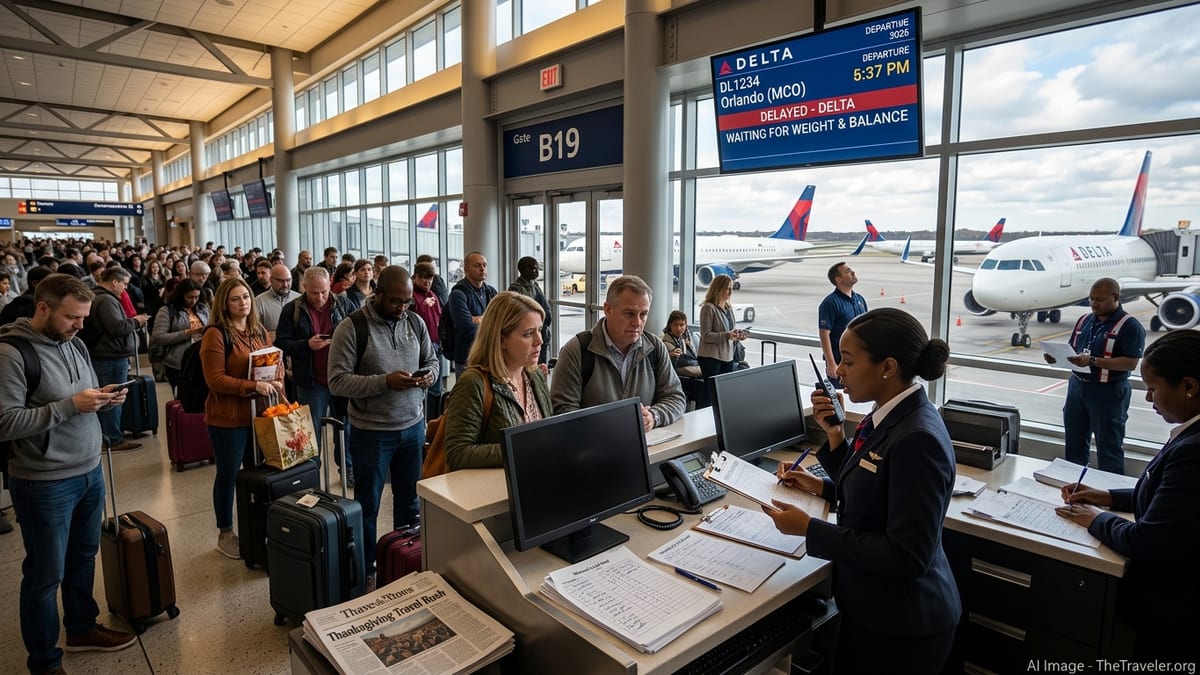
What happened to Delta’s automation system on November 22
Delta has confirmed that the disruption on Sunday stemmed from a failure in an automated system used to calculate aircraft weight and balance before departure. The tool, described by the airline and flight-operations documents as its automated weight‑and‑balance or load‑instruction system, normally generates digital load sheets for crews and ground staff so that an aircraft’s total weight and how that weight is distributed can be verified before pushback. When the system failed on November 22, those calculations had to be performed manually, significantly slowing departures across the Delta network.
By early Sunday evening, more than 1,000 Delta flights were reported delayed, with figures from flight‑tracking services and multiple news outlets indicating that roughly half of the airline’s scheduled services that day departed at least 15 minutes late. At Hartsfield‑Jackson Atlanta International Airport, Delta’s largest hub, data compiled by several media organizations showed delays affecting well over 1,100 arrivals and departures at the peak of the outage, along with dozens of cancellations as crews and aircraft fell out of position for later flights.
Delta said in public statements that around 70% of its delays and cancellations on Sunday were directly tied to the automation problem, with most of the remaining disruptions attributed to weather conditions in the New York area. The carrier stressed that safety margins were maintained throughout the incident, noting that flights could not depart without accurate weight‑and‑balance figures and that its teams reverted to established manual procedures while technicians worked to restore the automated system.
Ground stop into Atlanta and how the disruption spread
The failure of Delta’s automation system triggered a specific response at its primary hub. On Sunday morning, at Delta’s request, the Federal Aviation Administration issued a ground stop affecting Delta and Delta Connection flights destined for Hartsfield‑Jackson Atlanta International Airport. That stop, which applied only to Delta-operated services and not to all carriers at the airport, lasted for roughly an hour before the FAA replaced it with a ground delay program that metered the rate of Delta arrivals into Atlanta for several more hours.
During the ground stop, some Delta flights already on the taxiway or awaiting departure at outstations reported being held on the ground while operations teams attempted to generate manual load sheets and confirm final weights. Passengers on flights from airports such as New York LaGuardia, Orlando, Seattle and Boise reported that flight crews attributed their delays to a Delta‑wide issue affecting weight‑and‑balance tools, with several pilots explaining over the public‑address system that they could not depart until the necessary calculations were completed by hand.
Although the outage centered on the system that supports departures, its impact quickly cascaded through Delta’s schedule. Aircraft and crews that arrived late into Atlanta and other hubs were frequently unable to operate their next assigned sectors on time, and in some cases flights were canceled outright to prevent further knock‑on disruption. By late Sunday and into Monday morning, airlines and tracking services were still reporting elevated numbers of Delta delays and cancellations as the carrier worked to reposition aircraft and reset crew schedules ahead of the core Thanksgiving travel days.
Timing with the wider Thanksgiving and FAA disruption picture
The automation failure came at a particularly sensitive moment for U.S. air travel. It occurred just as the 2026 Thanksgiving travel period was getting underway, a stretch when airlines schedule dense flight programs and airports prepare for some of the heaviest passenger volumes of the year. Transportation Security Administration projections and airport advisories had already warned travelers to expect crowded terminals and full flights in the week of November 22, with the Sunday–Monday window marking the start of the outbound rush for many travelers.
The Delta outage also followed closely on the heels of a separate, nationwide disruption that did not involve any one airline. On Friday, November 13, the FAA ordered a rare nationwide ground stop after a telecommunications and communications-network failure affected multiple air traffic control facilities. That incident, which lasted for nearly five hours, resulted in thousands of flight delays and cancellations across carriers and raised fresh questions in Washington about the resilience of the national airspace system’s technology infrastructure.
Because the FAA ground stop and the Delta outage occurred within nine days of each other and both affected November travel, some travelers initially questioned whether the two were connected. However, the FAA and Delta have both stated that the November 22 delays were not caused by any FAA air traffic system. Federal advisories and airline statements describe the Delta episode as a carrier‑specific problem originating in its internal automation tools, distinct from the earlier government‑run network issue that affected all airlines.
How quickly Delta restored systems and what recovery looked like
Delta reported that its automated weight‑and‑balance system was restored on Sunday afternoon, several hours after the initial failure. By that time, the immediate ground stop into Atlanta had been lifted, and the FAA’s ground delay program was also progressively relaxed as throughput at the hub improved. In subsequent updates, Delta said its automation for departing flight weight and balance calculations was once again functioning and emphasized that operations teams were focused on rebooking affected customers and arranging meals or overnight accommodation where required.
Even after the system returned to service, the airline warned that disruptions would continue while it cleared backlogs and repositioned aircraft and crews. Flight data and news reports on Monday, November 23, showed that Delta was still experiencing an elevated level of delays and cancellations relative to its normal performance, although the figures were lower than at the peak of Sunday’s outage. The carrier described its Monday operations as “stable” while acknowledging that recovery work was ongoing.
As of November 24, Delta had not publicly detailed the underlying technical cause of the automation failure, beyond confirming that it involved the system used for weight‑and‑balance calculations. Available statements indicate that engineers isolated and resolved the immediate fault, but there has been no specific explanation from the airline about whether the issue was linked to hardware, software, or connectivity within its operational technology environment. Regulators had not announced any separate investigation into the airline-specific outage, in contrast with the federal reviews already underway into the November 13 nationwide FAA ground stop.
What travelers affected by the outage should know now
For travelers whose plans were disrupted on November 22 and the following days, Delta advised customers to monitor their booking status through its website and mobile app and to consider adjusting travel times where flexible options were available. Public statements from the airline indicate that it has been offering rebooking on the next available Delta or Delta Connection flight at no additional fare difference for many affected customers, particularly those scheduled to travel during the immediate recovery period when seat availability was constrained.
Where passengers experienced significant delays or overnight disruptions because of the automation failure, Delta has said that it is providing meal vouchers and, where necessary, hotel accommodation, consistent with the carrier’s existing customer‑service commitments for controllable operational events. Specific entitlements can vary depending on the circumstances of each itinerary, and travelers are encouraged to retain boarding passes, delay notifications and receipts for any expenses they hope to reclaim, since written documentation can help support later claims through customer care channels.
Looking ahead to the remainder of the Thanksgiving period and the December holidays, there is no indication as of November 27 that the automation problem is ongoing. Delta and the FAA have both described the November 22 episode as resolved, and subsequent days have not seen a repeat of the same system failure. However, because heavy holiday traffic can amplify the effects of any disruption, passengers booked on Delta in the near term may still want to allow extra time at the airport, keep contact details updated in their reservations so they can receive alerts, and check flight status frequently on the day of travel in case residual schedule adjustments are required as part of the airline’s continued network balancing.