


Ask most international visitors about New York and they picture skyscrapers, yellow cabs, and Times Square. Yet step a few hours outside the city and you are in a different New York entirely: a state of glacier-carved lakes, art-filled river towns, old canal villages, farm stands, and mountain trails where you might share the view with more hawks than humans. For travelers willing to look beyond the five boroughs, New York State can feel like an entirely new country hiding in plain sight.
Get the latest updates straight to your inbox!
Why Most Travelers Stop at New York City
New York City dominates bucket lists and airline routes, so it is no surprise that many trips to the state begin and end in Manhattan. International marketing campaigns, Broadway coverage, and film locations foreground the city, while regions like the Finger Lakes, the Hudson Valley, or the Adirondacks rarely earn screen time. Visitor research commissioned by state tourism officials shows that while the Finger Lakes, New York City, and the Adirondacks are among the most popular regions for those who do explore beyond the city, a large share of first-time visitors never get that far north at all. They might squeeze in a quick day trip to a nearby outlet mall or Statue of Liberty cruise, then head home thinking they have “done” New York.
On the ground, the pattern is easy to see. Hotels in Midtown and around Times Square charge some of the highest nightly rates in the state, and major attractions routinely operate at or near capacity on peak weekends. Meanwhile, three to five hours away by car or train, lakefront inns still have last-minute availability in shoulder seasons, and hiking trails in the Catskills or Adirondacks can feel uncrowded just after school holidays end. Travelers focused only on New York City often miss how quickly the experience changes once you cross the Hudson River heading north, or leave the Metro-North service area entirely.
There is also a perception issue. When people hear “upstate,” some imagine endless snowbound towns or fading industrial cities. The reality is much more varied. Upstate New York encompasses the Hudson Valley’s riverfront communities, the wine trails of the Finger Lakes, the craft breweries of the Capital Region, the canal-side towns of Central New York, and the mountain villages of the Adirondacks and Catskills. Major cities like Albany, Syracuse, Rochester, and Buffalo serve as gateways rather than final destinations, but they also offer dining, museums, and revitalized waterfronts that can anchor a long weekend in their own right.
For travelers used to relying on public transportation, the idea of renting a car can be a deterrent. Yet for those willing to drive, the rewards are immediate: lower prices on lodging and meals, easier access to nature, and the chance to blend small-town charm with distinctly New York character. From a practical standpoint, adding three or four days upstate onto a New York City stay often costs less than extending the city visit by the same number of nights, especially in summer and fall.
The Finger Lakes: Waterfalls, Wine, and Small-Town Streets
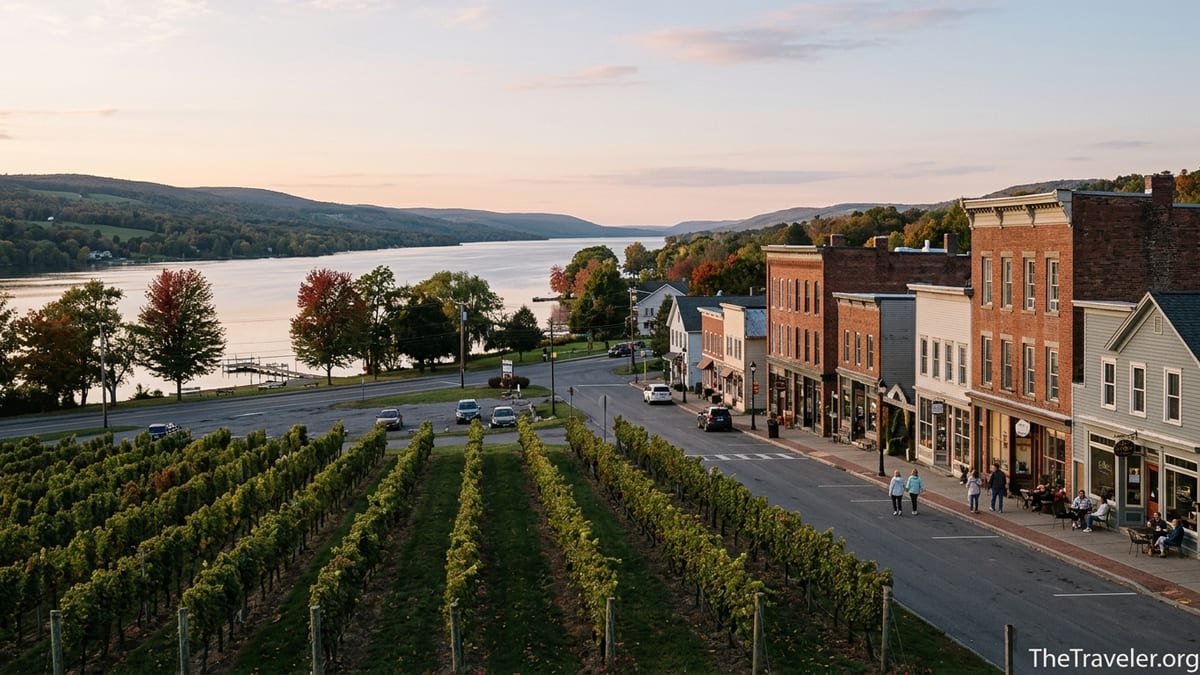
One of the most surprising regions for city-focused visitors is the Finger Lakes, a group of long, narrow glacial lakes stretching south of Rochester and Syracuse. The landscape here is soft and rolling, cut by gorges and waterfalls that feel worlds away from Broadway. The region is also one of the premier wine-producing areas in the eastern United States, with hundreds of wineries, cideries, and breweries tracing the lakeshores. Towns such as Geneva, Ithaca, and Watkins Glen frequently act as hubs, but many travelers never learn how simple it is to reach them from New York City in about four to five hours by car.
Ithaca, on the southern tip of Cayuga Lake, captures much of what makes the Finger Lakes special. Within a 10 to 20 minute drive of downtown, you can walk the gorge trail in Robert H. Treman or Buttermilk Falls State Park, where stone staircases climb beside cascades that look more like a national park than a college town backdrop. To the north, Taughannock Falls State Park offers a mostly flat, family friendly trail to a waterfall that is among the tallest in the eastern United States, dropping more than 200 feet in a single plunge. In town, the Ithaca Commons pedestrian area packs independent bookstores, coffee shops, and farm-to-table restaurants into a few lively blocks.
Along Seneca and Keuka Lakes, classic small towns like Watkins Glen, Penn Yan, and Hammondsport pair lake views with wine tasting rooms and marina walks. Driving the Seneca Lake Wine Trail in summer or during the foliage season in late September and early October is an easy way to sample Rieslings and cool-climate reds without straying far from the water. Many tasting rooms charge modest fees that can be applied toward bottle purchases, and casual eateries serve everything from wood-fired pizza to local cheese boards with views across the vineyards.
Visitors who equate New York State with hectic schedules are often caught off guard by the slower pace here. Midweek, it is possible to find a lakefront motel in towns like Geneva or Skaneateles for rates that undercut midrange Manhattan hotels by a wide margin, especially outside high summer. Kayak rentals, half-day boat cruises, and bike hire around the lakes are typically priced competitively compared to coastal resort regions. For travelers combining the region with New York City, the Finger Lakes work particularly well as a three day extension focused on hiking, wine tasting, and small-town strolling.
The Hudson Valley and Catskills: Art Towns and Mountain Trails
North of New York City, the Hudson Valley and neighboring Catskills have long served as the city’s unofficial backyard, but they remain underused by international visitors who rarely stray beyond a day trip to a single river town. A two to three day stay reveals a chain of distinct communities, each with its own personality. In Columbia County, the small city of Hudson has become a weekend hub, known for its 19th century streetscape, independent galleries, and antique shops. The main commercial strip, Warren Street, runs from the train station up through town and is filled with cafes, design stores, and vintage clothing boutiques that feel like a quieter cousin to Brooklyn.
Farther south along the river, Beacon and Cold Spring offer quick access from New York City by commuter rail, yet only a fraction of global visitors know them by name. Beacon combines a vibrant arts scene anchored by a major contemporary art museum inside a former factory with hiking on Mount Beacon, where a steep trail and old incline railway route lead to broad views over the Hudson Highlands and, on clear days, all the way to the distant Catskills. Cold Spring is more low-key, with antique shops, riverside benches, and access to popular trails in Hudson Highlands State Park.
Turn west into the Catskills and the mood shifts again. Here, old resort towns and farm valleys are seeing a quiet revival, with boutique hotels, new campgrounds, and renovated farmhouses sitting alongside classic diners and small-town hardware stores. The Catskill Park covers nearly 700,000 acres of forest and mountains, with accessible peaks such as Slide, Wittenberg, and Giant Ledge drawing hikers in summer and early fall. Lakes and rivers support kayaking, tubing, and fly fishing in warmer months, while ski areas like Hunter and Windham pick up in winter. Despite increased attention, especially after national travel outlets highlighted the Catskills as one of the United States’ underrated destinations for 2025, trailheads can still feel uncrowded on weekdays outside holiday periods.
From a logistical standpoint, the Hudson Valley and Catskills are the easiest regions to add onto a New York City visit without flying. Many visitors simply rent a car in Manhattan and drive north on the New York State Thruway, but it is equally possible to take a train to Poughkeepsie, Hudson, or Beacon and pick up a rental car there. Lodging ranges from small riverside motels and restored Victorian inns to contemporary design-forward hotels in towns like Kingston and Hudson. For cost-conscious travelers, choosing a Catskills cabin or Hudson Valley farm stay instead of extra nights in the city can free up budget for activities like guided hikes, art museum tickets, or a splurge restaurant meal.
The Adirondacks and Lake Country: New York’s Wild Side
While Central Park and Prospect Park offer valuable green space, they cannot match the sense of scale and quiet found in the Adirondack Mountains of northern New York. The Adirondack Park is one of the largest protected areas in the continental United States, an expanse of peaks, lakes, and forested valleys that includes both public and private land. It contains the state’s highest point, Mount Marcy, and a network of hiking and paddling routes that range from easy lakeside walks to multi day canoe trips. For many residents of New York City and the surrounding states, this is where they come to feel genuinely out of the urban world for a few days.
Lake Placid, a village ringed by mountains and best known for hosting two Winter Olympics, still functions as a gateway to this wild side of the state. Travelers use it as a base for hiking, boating, and visiting Olympic legacy sites such as the ski jumping complex and speed skating oval. Nearby, smaller communities like Saranac Lake offer a slightly quieter atmosphere while still providing lodging, restaurants, and access to trails and waterways. In summer, paddlers shuttle canoes between put ins and takeouts along routes through chains of lakes. In winter, snowshoeing and cross country skiing take over many of the same paths.
To the south, Lake George bills itself as a classic American lake resort, with family friendly hotels, boat tours, and public beaches ringing a long, clear lake. It is particularly popular with visitors from New York and New England during school holidays, but remains less known abroad compared to Niagara Falls or the city itself. Just beyond the village, however, are quieter coves, state campgrounds, and short hikes to viewpoints at places like Prospect Mountain that can be reached in under an hour from town.
Reaching the Adirondacks from New York City usually involves a four to six hour drive, depending on the exact destination, though there is also an overnight train serving some corridor towns along the way from the city and from Montreal. Accommodation ranges from rustic state park campsites and traditional lakeside lodges to modern boutique hotels in villages like Lake Placid. Costs are often lower than in major ski resorts in the western United States, especially outside peak foliage weeks and winter holiday periods, making the Adirondacks a compelling value for travelers seeking mountains without the crowds of more famous ranges.
Western New York: Buffalo, Niagara, and Erie Lakeshores
For many international visitors, Niagara Falls is the only part of western New York that appears on the itinerary. They may fly into Buffalo Niagara International Airport, ride a tour bus directly to the falls, and leave within a day or two. That approach misses a region that has spent the past decade reshaping its image from industrial corridor to lakefront destination. Buffalo in particular has seen a quiet revival, combining historic architecture with a growing food and cultural scene.
In the city’s core, restored grain elevators and old warehouses now house breweries, performance spaces, and riverfront walkways along the Buffalo River and Lake Erie. Neighborhoods like Elmwood Village and Allentown, filled with late 19th and early 20th century homes, offer walkable streets lined with cafes, independent shops, and murals. The city’s architectural heritage is a surprise to many first-time visitors, who find works by Frank Lloyd Wright and a monumental early skyscraper in the form of Buffalo City Hall.
Just beyond Buffalo, the south towns along Lake Erie offer beaches, small marinas, and access to wine country that continues into neighboring Chautauqua County. Summer brings sailing regattas, lakefront concerts, and classic roadside ice cream stands. Inland, Letchworth State Park, often called the “Grand Canyon of the East,” cuts a dramatic gorge through the Genesee River valley, with scenic overlooks and hot air balloon rides during some summer evenings. Many travelers reach Niagara Falls and leave without realizing that this kind of scenery lies a short drive to the south.
From a practical standpoint, Buffalo’s airport frequently sees lower airfares than New York City’s for domestic connections, and rental car rates often reflect the region’s more modest demand. Lodging around the falls itself can be expensive during summer, but hotels in Buffalo or nearby small cities like Rochester sometimes offer more favorable rates, especially on weekends when business travel slows. For those already visiting Toronto or other parts of Ontario, western New York can be an easy cross-border add-on that introduces a different facet of the state.
Planning an Itinerary Beyond the Five Boroughs
Designing a New York State trip that goes beyond the city does not have to be complicated. A common pattern is to spend three or four nights in New York City, then rent a car and head either north along the Hudson River or west toward the Finger Lakes. From there, travelers can choose between a loop that returns to the city or a one way journey that ends in another airport like Buffalo, Rochester, or Albany before flying on to the next destination. Because driving distances are moderate by North American standards, it is easy to combine several regions in a week or ten days without feeling rushed.
For example, a ten day visit in late September might start with four nights in Manhattan, followed by two nights in the Hudson Valley, two nights in the Finger Lakes, and a final two nights in Buffalo with a side trip to Niagara Falls. Another option focuses on mountains: three nights in the Catskills, three in the Adirondacks around Lake Placid or Lake George, and one final night in the city before departure. Both itineraries mix urban and rural experiences and highlight the state’s seasonal changes, from river fog and orchard visits in the Hudson Valley to peak foliage along Adirondack highways.
Transportation planning is often the biggest hurdle for visitors used to European or East Asian rail networks. While trains connect New York City with cities such as Hudson, Albany, Syracuse, Rochester, and Buffalo, the most flexible way to explore smaller towns and state parks remains a rental car. For those uncomfortable driving, a compromise is to take the train to a midsize city like Albany or Syracuse, then book guided day tours or local car services to reach hiking areas, wineries, and lake towns. Several regional tourism offices maintain current listings of private guides, shuttle companies, and seasonal bus routes that operate on popular corridors.
Seasonality plays a major role. Summer school holidays bring higher prices in beach and lake areas, but also long daylight hours and warm water. Autumn, roughly from late September through mid October in many upstate regions, is popular for foliage drives and harvest festivals, so advance reservations help. Winter is quieter, apart from ski resorts and holiday periods, and can be rewarding for travelers seeking frozen waterfalls, snowshoe trails, and lower hotel rates. Spring, especially late April and May, offers waterfalls at full strength from snowmelt, but weather can be changeable, so packing layers is essential.
The Takeaway
New York City deserves its fame, but treating it as the whole of New York State means leaving many of the state’s most memorable experiences on the table. A short drive or train ride reveals wine trails draped over rolling hills, old industrial cities reinventing their waterfronts, art towns along a historic river, and mountain valleys where the night sky still feels dark and deep. The contrast between the glass towers of Midtown and the clapboard houses of lake villages is stark, yet both are authentic expressions of the same state.
For travelers willing to carve out just a few days beyond the five boroughs, the reward is a richer understanding of New York’s geography and culture, as well as a more relaxed, often more affordable, extension to a city stay. Whether you find yourself tasting Riesling by a Finger Lake, climbing a Catskills ridge at sunrise, lingering over coffee on a Hudson side street, or watching the spray rise from Niagara at sunset, you will be experiencing a New York that most visitors never see. That alone makes the journey worthwhile.
FAQ
Q1. How many days should I add to my New York City trip to see more of the state?
For a first visit, adding three to five days beyond New York City is usually enough to explore one or two regions, such as the Hudson Valley and Catskills or the Finger Lakes and Niagara, without feeling rushed.
Q2. Do I need a car to explore upstate New York, or can I rely on trains and buses?
You can reach larger cities like Albany, Hudson, Syracuse, Rochester, and Buffalo by train or intercity bus, but a rental car offers far more flexibility for reaching small towns, state parks, and lakes.
Q3. Which region is best if I only have a long weekend after New York City?
The Hudson Valley and Catskills are ideal for a three day extension because they are two to three hours from the city, combine river towns with mountain trails, and do not require a domestic flight.
Q4. When is the best time of year to visit the Finger Lakes or Hudson Valley?
Late spring through early fall is most popular. May and June offer waterfalls and moderate temperatures, while September and early October bring foliage and harvest events at farms and wineries.
Q5. Are upstate New York destinations much cheaper than staying in Manhattan?
In general, yes. Hotel rates and dining costs in smaller towns and lake regions are often significantly lower than in central Manhattan, especially midweek and outside peak holiday periods.
Q6. Is it realistic to visit Niagara Falls on the same trip as New York City?
It is realistic if you have at least three extra days. Many visitors fly or take a train to Buffalo, spend a night or two there with a side trip to the falls, then return or continue to another city.
Q7. What kind of outdoor activities can I expect in the Catskills and Adirondacks?
In warm months, hiking, paddling, swimming, and cycling are common. In winter, downhill and cross country skiing, snowshoeing, and ice skating are popular, especially around Lake Placid and major ski areas.
Q8. Are there family friendly options outside New York City?
Yes. Regions like the Finger Lakes, Lake George, and western New York offer kid friendly hikes, beaches, boat tours, museums, and farm visits that work well for multi generational trips.
Q9. How far in advance should I book accommodation in popular upstate areas?
For summer weekends and autumn foliage periods, aim to book at least a few months ahead in small towns, especially if you want lakefront or mountain view rooms. Midweek stays can often be arranged closer to arrival.
Q10. Can I visit several regions of New York State without constantly packing and unpacking?
It is possible by choosing two well located bases, such as a Hudson Valley town and a Finger Lakes town, and making day trips from each. This keeps driving manageable while still showcasing very different parts of the state.