


Narita International Airport remains one of Asia’s busiest long-haul gateways, serving millions of travelers connecting Japan with North America, Europe, and the rest of Asia. Whether you are flying home after a Tokyo trip or starting a multi-stop itinerary, understanding how check-in, security, and boarding work at Narita can save you time and stress. This guide focuses on practical, real-world details so you know what to expect from the moment you leave central Tokyo to the moment you step on board.
Get the latest updates straight to your inbox!
Understanding Narita’s Terminals and Airline Layout
Narita Airport sits about 60 kilometers east of central Tokyo and has three terminals, but most international passengers will use Terminal 1 or Terminal 2. Terminal 1 is divided into a North Wing and South Wing connected by a central building, while Terminal 2 is a separate complex with its own train station access and facilities. Terminal 3 mainly serves low-cost carriers on shorter regional routes and is less commonly used for long-haul flights.
Broadly, airline alliances are grouped by terminal. Star Alliance carriers such as ANA and United typically use Terminal 1 South Wing, SkyTeam airlines like Delta and Korean Air usually depart from Terminal 1 North Wing, and Oneworld partners including Japan Airlines, American Airlines, and British Airways normally use Terminal 2. This layout has been stable for years, but individual airlines can shift check-in counters or wings, especially during renovations or seasonal schedule changes.
Because of these possible adjustments, always check the terminal and wing printed on your e-ticket or in your airline app before setting off. For example, a traveler flying ANA to Los Angeles will usually depart from Terminal 1 South Wing, while someone flying JAL to San Francisco will depart from Terminal 2 on the third-floor international departure level. Code-share flights can be particularly confusing: an American Airlines flight operated by JAL will check in at the JAL counters in Terminal 2, not at an American Airlines desk elsewhere.
Once at the airport, terminal signage is clear in both Japanese and English. If you accidentally arrive at the wrong terminal, free terminal shuttle buses run between Terminals 1, 2, and 3, but transferring can easily add 20 to 30 minutes in busy periods. Planning your terminal in advance is one of the simplest ways to keep your departure day smooth.
Getting to Narita: Timing Your Arrival
Because Narita is quite far from central Tokyo, your departure experience effectively starts when you choose how to get there. The two most popular rail options are the JR Narita Express (often called N’EX) from major hubs like Tokyo Station and Shinjuku, and the Keisei Skyliner from Ueno and Nippori. In typical conditions, the Skyliner reaches Nippori in about 36 minutes and Keisei Ueno in around 40 minutes, while the Narita Express takes roughly 53 minutes from Tokyo Station and up to around 80 to 85 minutes from Shinjuku or Shibuya, depending on the train.
For travelers staying near Ueno or Asakusa, booking the Skyliner can be both faster and cheaper than heading first to Tokyo Station for the Narita Express. By contrast, if your hotel is near Tokyo Station, Shinagawa, or Shinjuku, the Narita Express offers a convenient, one-seat ride directly to the airport stations beneath Terminals 1 and 2. Seat reservations are mandatory on both services, and in peak holiday periods such as Golden Week or New Year, popular departure times can sell out, so it is wise to reserve a train at least a few hours ahead.
Highway buses and airport limousines connect Narita with many major hotels and districts such as Shibuya, Ginza, and Yokohama. Buses can be cost-effective, especially if you are traveling with large luggage or a family. However, travel times are more vulnerable to traffic on the expressways, and evening congestion can add 30 minutes or more. If your international flight leaves around 18:00, avoid a bus departing central Tokyo after mid-afternoon unless you have a generous time buffer.
As a general rule, aim to arrive at Narita at least three hours before long-haul international departures, and two hours before shorter regional flights. That means, for a 19:00 flight to Los Angeles, a traveler staying in Shinjuku might book a Narita Express train around 14:30 or 15:00, leaving room for minor delays. Arriving early not only protects you from disruptions but also gives you time to use currency exchange, duty-free shopping, or airport lounges without rushing.
Check-In and Baggage: What to Expect at Narita
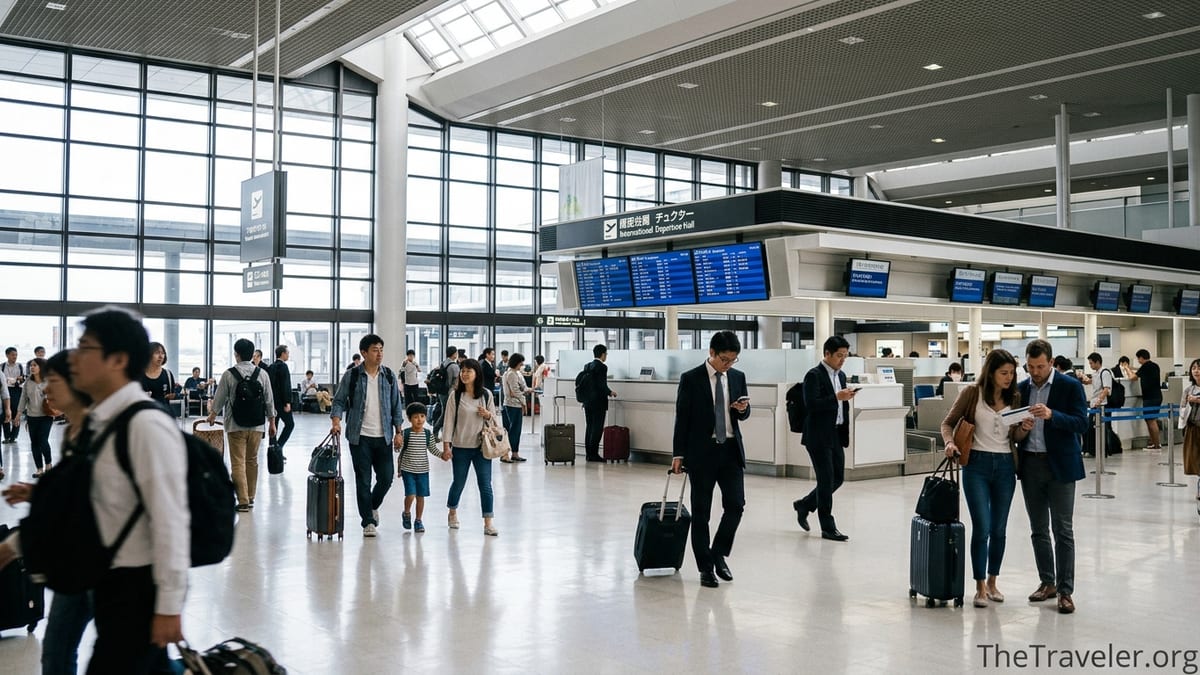
Narita’s international departure lobbies are located on the fourth floor of Terminal 1 and the third floor of Terminal 2. As you step into the building from the train station or bus drop-off area, large flight information displays in English and Japanese list airlines, destinations, and check-in counter rows. These rows are labeled with letters, such as “Row C” or “Row J,” making it straightforward to find your carrier’s counters once you know your row.
Most major airlines operating from Narita now offer a mix of staffed counters, self-service kiosks, and dedicated bag-drop points. For example, travelers on ANA or JAL can often check in via the airline app before arriving and then use self-service kiosks to print baggage tags, dropping suitcases at designated counters. This approach reduces waiting times, especially when large tour groups are using full-service desks in adjacent rows.
Airlines at Narita are fairly strict about checked and carry-on baggage limits. A passenger flying economy class on a transpacific route with ANA or JAL will usually be allowed two checked bags of up to 23 kilograms each, but low-cost and some Asian carriers may allow only one bag, or charge per item. Check your airline’s rules carefully before packing, as excess baggage fees can be steep and must often be paid in Japanese yen or by credit card on the spot. Oversized sports equipment or musical instruments generally need prior registration.
During busy travel seasons, queueing for check-in at Narita can take anywhere from 20 to 60 minutes for economy passengers on large aircraft like the Boeing 777 or Airbus A350. Premium cabin and elite status customers typically have separate counters and shorter lines. If you are traveling with young children or have tight transfer connections, consider arriving on the earlier side of the recommended three-hour window. For example, a family departing on a JAL flight to Honolulu at 21:00 might target a 17:30 arrival at Terminal 2 to comfortably handle check-in, stroller tagging, and any seat changes at the counter.
Clearing Security and Immigration Efficiently
After check-in, departing passengers follow clear signage to security screening and outbound immigration. At Narita, security comes before passport control for international flights. Operating hours and typical congestion patterns vary slightly between terminals and wings, but mornings between roughly 08:00 and 11:00 and evenings from about 18:00 to 21:00 are often the busiest, as banks of long-haul flights depart for Europe and North America.
Security procedures are familiar to most international travelers. You will place your carry-on bags, jacket, and loose items into trays on the conveyor belt, then walk through a metal detector or body scanner. Laptops and larger electronics are usually required to be removed from bags unless you are using a designated lane that permits them to stay inside, and liquids must generally follow the global 100-milliliter per container rule inside a clear bag. While some airports have loosened liquid restrictions with new scanners, Narita still expects travelers to prepare liquids similarly to other major Asian hubs, so it is safer to pre-pack cosmetics and toiletries accordingly.
Wait times at security can vary considerably. On a typical weekday morning, a passenger departing from Terminal 1 South Wing might clear security in 15 to 25 minutes, but during peak holiday periods queues can stretch to 30 to 45 minutes or more. Narita publishes general guidance about congestion by time band, but conditions change quickly. If you arrive at security and see crowds pushing back toward the check-in area, consider removing belts, watches, and laptops from your bag in advance so you move through the line more efficiently once you reach the trays.
Immediately after security comes Japanese outbound immigration. For most foreign visitors, the process is straightforward: you present your passport and boarding pass, and an officer scans your details before exiting stamps are added or logged electronically. Automated e-gates are available for many passport holders, which can speed up the process considerably. Even when queues appear long, immigration often moves faster than security, and many travelers clear this step in under 10 minutes outside of peak times.
Inside the Departure Area: Lounges, Shopping, and Last-Minute Tasks
Once you are airside, Narita’s departure zones offer a mixture of international-standard duty-free shopping, Japanese souvenirs, and a range of dining options. In Terminal 1 South Wing, for example, passengers will find a duty-free mall with major cosmetics and luxury brands, along with shops selling Japanese confectionery such as Tokyo Banana, Shiroi Koibito, and Royce chocolate. Prices for premium skincare and fragrance often match or slightly undercut downtown department stores, making this a popular location for last-minute gifts.
Food options range from quick noodle counters and curry rice eateries to sit-down sushi and tempura restaurants. A traveler departing from Terminal 2 in the mid-afternoon might choose a simple bowl of tonkotsu ramen for around 1,000 to 1,500 yen or grab a bento box and bottled tea from a convenience-style shop near the gates. Vegetarian and halal options are available but more limited than in some newer airports, so travelers with strict dietary requirements should check the airport’s restaurant listings in advance or consider eating before arrival.
Many international airlines and card issuers operate lounges at Narita, including ANA and JAL flagship lounges, alliance-branded lounges, and independent facilities accessible with certain premium credit cards or day passes. Facilities typically include showers, buffet-style meals, snacks, soft drinks, and alcoholic beverages, plus Wi-Fi and quiet seating. For instance, a business-class passenger on a JAL flight to New York can access a JAL lounge in Terminal 2, take a shower after a long train ride, and enjoy a quick Japanese curry before their late-afternoon boarding call.
Before you relax completely, double-check your gate number and walking time. Narita’s international gates are spread across multiple satellites and concourses, some of which are a 10 to 15-minute walk from central shopping and lounge areas. Electronic boards update gate changes continuously, so it is wise to re-check within an hour of departure, especially in the evening when aircraft swaps or delays are more common.
Boarding Procedures and Gate Habits at Narita
Boarding at Narita is generally orderly but can feel different depending on the airline. Many major carriers use group-based boarding, calling families with young children and those needing assistance first, followed by premium cabins and elite status members, and then economy passengers in several numbered or lettered groups. For example, an ANA flight to San Francisco from Terminal 1 might call boarding groups one through five, while a low-cost carrier to Southeast Asia at Terminal 3 may simply call rows from the back to the front.
Gate areas usually open well before boarding begins, and seat availability varies. At bus gates where passengers are transported to remote stands, boarding may start earlier and proceed in larger waves. Overhead bin space can fill quickly on full flights, particularly on routes popular with tourists carrying sizeable duty-free purchases. To increase your chances of securing space near your seat, arrive at the gate shortly before boarding is scheduled to start rather than waiting for the final call.
Boarding staff at Narita are typically strict about carry-on size and quantity. If a roller bag clearly exceeds the airline’s cabin limits, you may be asked to check it at the gate. This commonly happens on flights operated by low-cost or regional partners, where overhead bin space is tighter. To avoid last-minute repacking, use a carry-on that fits within your airline’s published dimensions and keep valuables, medication, and fragile electronics in a smaller personal item you can keep under the seat.
Multiple languages are used at the gate, typically Japanese and English, with additional announcements in the language of the destination where appropriate. Boarding times printed on boarding passes are sometimes conservative; you may see “Boarding 18:25” for a 19:00 departure, with actual door closing closer to 18:50. Treat the printed time as your cue to be in the gate area, especially if you are seated far from the gate or returning from a distant lounge.
Special Situations: Families, Mobility Needs, and Tight Connections
Travelers with young children, reduced mobility, or other special circumstances can expect considerate handling at Narita, but planning is still crucial. Families traveling with strollers usually check them in at the counter or at the gate, depending on the airline’s policy. For example, parents on a JAL flight might be allowed to use a stroller inside the terminal and surrender it at boarding, receiving it again at the aircraft door on arrival. Because policies differ, confirm with staff at check-in rather than assuming you can wheel a stroller all the way to the gate.
Passengers needing wheelchair assistance or extra time to board should notify their airline in advance when booking tickets or at least 48 hours before departure. At Narita, airline or contracted staff escort such passengers through security and immigration using elevators and step-free routes. In Terminal 1, where some gates are located on satellite concourses accessed by escalators and moving walkways, this support can make a significant difference in comfort and timing.
For tight international connections, Narita offers transit security and immigration routes that keep transfer passengers airside. However, minimum connection times can still be challenging if your inbound flight is delayed. For instance, a traveler connecting from a Southeast Asia flight to a North America departure with only 70 minutes scheduled may find that a 30-minute inbound delay leaves very little margin. In such situations, moving quickly from your arriving gate to transit security, following airline staff signs, and avoiding long stops in shops or lounges is essential.
If you miss a connection at Narita due to a delayed inbound flight on a single ticket, your airline should typically rebook you on the next available service, but options may be limited on long-haul routes that operate only once per day. Knowing the timing of alternative flights, such as late-evening departures to major hubs like Los Angeles, New York, or London, can help you discuss practical solutions with airline agents more effectively.
The Takeaway
Departing from Tokyo Narita Airport becomes far less stressful when you understand the airport’s layout, allow enough travel time from central Tokyo, and anticipate the key steps of check-in, security, immigration, and boarding. Concrete choices, such as selecting the Skyliner from Ueno or the Narita Express from Shinjuku, arriving three hours before departure, and using online check-in with bag-drop, have a bigger impact on your experience than small details like where you buy bottled water.
Once airside, Narita offers a solid mix of shopping, dining, and lounge facilities, but distances to some gates can be longer than they first appear. Keeping an eye on flight displays, listening for boarding announcements, and staying realistic about walking times will help you avoid a last-minute sprint. For families, travelers with mobility needs, or those with tight connections, early communication with airlines and a bit of extra buffer time are the best safeguards.
With a little preparation and the practical tips in this guide, Narita can feel like a calm, efficient launch point rather than a confusing final hurdle. Treat the journey to the airport as part of your travel day, build in time for inevitable queues and checks, and you are much more likely to board your flight from Tokyo feeling relaxed and ready for the trip ahead.
FAQ
Q1. How early should I arrive at Narita Airport for an international flight?
For most long-haul international flights, plan to arrive at Narita about three hours before departure. During busy holiday periods or if you need to check multiple bags, consider adding an extra 30 minutes.
Q2. Which terminal does my airline use at Narita?
As a general guide, Star Alliance airlines usually depart from Terminal 1 South Wing, SkyTeam carriers from Terminal 1 North Wing, and Oneworld airlines from Terminal 2, but you should always confirm on your ticket or airline app.
Q3. What is the fastest train from central Tokyo to Narita Airport?
The Keisei Skyliner from Nippori or Ueno is typically the fastest, reaching Narita in around 36 to 40 minutes, while the JR Narita Express connects major stations like Tokyo and Shinjuku in about 50 to 80 minutes depending on the route.
Q4. Are security lines at Narita very long?
Security wait times vary by time of day and season. Outside peak hours, many travelers clear security in 15 to 25 minutes, but during busy mornings and evenings queues can extend to 30 to 45 minutes or more.
Q5. Do I need to remove liquids and laptops at Narita security?
Yes, you should generally follow standard international rules by placing liquids of 100 milliliters or less in a clear bag and removing laptops or large electronics from your carry-on, unless directed otherwise by staff.
Q6. Can I use lounges at Narita if I am flying economy?
Yes, several airline and independent lounges allow access for economy passengers with paid day passes, qualifying credit cards, or lounge membership programs, subject to capacity.
Q7. Is food and shopping better before or after security?
You will find more international duty-free shopping and a wide choice of restaurants after security in the departure area, so it is usually better to clear formalities first and then eat or shop airside.
Q8. What happens if my bag is too big for carry-on at the gate?
If gate staff decide your bag exceeds the airline’s cabin limits, they will usually ask you to check it there. You may need to pay a fee, especially on low-cost carriers, so it is best to comply with size rules in advance.
Q9. How far in advance do trains like Narita Express and Skyliner need reservations?
Seat reservations can often be made on the same day, but popular departure times and holiday dates may sell out. Booking at least several hours or a day ahead gives you more choice and peace of mind.
Q10. What should I do if I have a tight connection at Narita?
If your connection time is short, move directly from your arrival gate to transit security and your next gate, follow airline staff instructions, and avoid lingering in shops. If you miss your onward flight because your first flight was delayed on a single ticket, contact your airline promptly for rebooking options.