


More news on this day
Thousands of passengers traveling through Dubai International Airport and Riyadh’s King Khalid International Airport are facing major disruption after a wave of delays and cancellations hit services operated by leading Gulf, European and Indian carriers.
Get the latest news straight to your inbox!
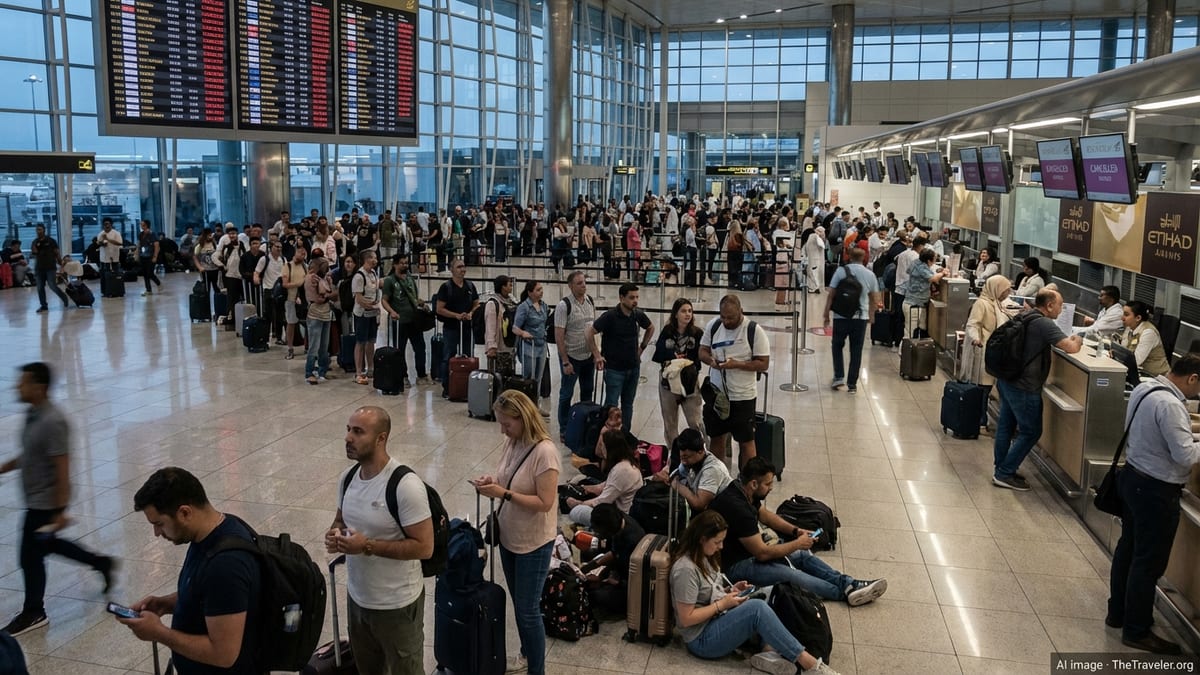
Major Gulf Hubs Grapple With Wave of Disruptions
Operational data compiled from airport status boards and airline advisories shows at least 174 flights delayed and 54 canceled across Dubai International Airport and King Khalid International Airport within a short window, straining two of the Middle East’s most important aviation hubs. The disruptions are concentrated on regional and long haul routes linking the Gulf with Europe, South Asia and other parts of the Middle East.
Dubai International, one of the world’s busiest airports for international passengers, has been particularly exposed because of its role as a global transfer point. Publicly available information indicates that not all scheduled services to and from the emirate are currently operating, with airlines encouraging travelers to verify flight status before heading to the airport. This has amplified the impact on connecting itineraries, as delays in Dubai cascade through onward journeys.
Riyadh’s King Khalid International Airport, a key gateway for Saudi Arabia, is also experiencing notable schedule disruption. Saudia and low cost carrier Flynas, both major users of the Riyadh hub, have adjusted frequencies and, in some cases, suspended or rerouted services on short notice, creating further uncertainty for travelers transiting through or originating in the kingdom.
Together, the two hubs serve tens of millions of passengers annually, and simultaneous disruption at both locations magnifies the effect across airline networks that rely on tightly timed banked connections through the Gulf.
Emirates and flydubai Networks Under Pressure
Emirates and flydubai, the largest operators at Dubai International, are among the carriers most visibly affected. Flight status tools and advisory pages show that some services have been delayed, consolidated or removed from regular schedules, with passengers urged to monitor updates through airline channels and registered contact details.
Published information from Emirates highlights that the airline is not yet operating its full schedule to and from Dubai, and that customers are being asked to check email notifications and online flight status before traveling. These measures are intended to reduce congestion at check in and security areas by discouraging early airport arrivals for flights that are running significantly late or have been canceled.
Flydubai, which uses Dubai as its primary hub for a dense network of regional routes, has faced similar operational strain during recent disruption events. Historical coverage of earlier weather related slowdowns in Dubai shows that flydubai services can be heavily impacted when airport movements are constrained, particularly on short haul sectors with tight turnarounds. A comparable pattern has emerged during the latest wave of delays and cancellations.
As flight banks compress and recovery windows narrow, both carriers have had to re sequence aircraft and crews, which can lead to rolling delays across multiple rotations even after the initial trigger has passed.
Saudi, Qatar and Indian Carriers Adjust Schedules
At King Khalid International Airport, Saudia and Flynas have made adjustments to services within the wider region, as schedules are recalibrated around capacity limits and changing demand. Public advisories and industry dashboards tracking the Middle East indicate that Saudia has temporarily curtailed some flights to nearby Gulf capitals and high frequency regional destinations during recent disruption cycles.
Flynas, a major Saudi low cost airline, has previously responded to regional instability and airspace constraints by suspending selected international routes to neighboring states. Recent operational summaries suggest similar caution, with flights into certain Gulf markets scaled back, which contributes to the tally of delayed and canceled services affecting passengers in and out of Riyadh.
Qatar Airways, which funnels much of its traffic through Doha, has also appeared in disruption summaries associated with the region, particularly when airspace restrictions, severe weather or knock on effects from neighboring hubs have affected its schedules. While Doha remains its primary base, any turbulence in the broader Gulf network can impact flights touching Dubai and Riyadh, especially on multi segment itineraries.
Indian carrier Air India has faced its own constraints on operations to the United Arab Emirates earlier this year, after limitations were placed on certain ad hoc flights into Dubai. Press statements from the airline outline cases in which planned additional services to the UAE were scaled back at short notice, underscoring how quickly capacity in the Gulf market can shift and leaving some travelers reliant on rebooking or refunds.
European Airlines Tighten Middle East Operations
Several European carriers listed among the disrupted airlines have already been operating with reduced flexibility in the region. British Airways has publicized a series of suspensions and cancellations affecting services to and from Gulf destinations, including Dubai and Riyadh, citing the combination of airspace restrictions and broader uncertainty in regional operations.
Lufthansa and partner airlines in its wider group have also trimmed schedules to Middle Eastern airports during recent disruption waves. Industry monitoring tools and prior media coverage describe suspensions of flights to Dubai and other regional destinations during periods of heightened risk, with operations periodically limited to repatriation style services or select trunk routes.
Turkish Airlines, which routinely offers extensive connectivity between Europe, the Middle East and beyond via Istanbul, appears among the carriers experiencing flight delays and cancellations into Dubai as conditions fluctuate. When connecting hubs in both the Gulf and Turkey experience pressure, passengers traveling between Africa, Asia and Europe can see multiple segments of their journey affected.
These overlapping adjustments by European and Gulf carriers contribute to a more fragile schedule environment for travelers, as options for re routing become narrower and popular alternative hubs quickly absorb displaced passengers.
What Affected Travelers Can Expect
The combination of 174 delayed flights and 54 cancellations at Dubai International and King Khalid International highlights how quickly disruption in a concentrated time frame can ripple through global networks. In such conditions, airlines typically prioritize reaccommodating passengers on the next available services within their own networks, sometimes using larger aircraft or consolidating flights to restore capacity.
Publicly available guidance from several carriers operating at the two hubs indicates that travelers whose flights are substantially delayed or canceled may be offered options to rebook on alternative dates or routes, request refunds in certain cases, or receive basic care at the airport, such as meals and hotel accommodation, depending on the length and cause of the disruption and the jurisdiction of departure.
Airlines including Emirates, British Airways and others encourage customers to use digital tools and mobile apps to check real time status, rebooking possibilities and eligibility for changes or refunds. Many carriers also state that passengers should ensure their contact information is up to date so that notifications can be delivered promptly when schedules change.
With major Gulf hubs again confronting significant operational pressure, travelers planning trips through Dubai or Riyadh in the coming days are likely to continue facing residual delays, altered routings and tighter connections, even as airlines work to normalize schedules following the latest disruptions.