


More news on this day
Rail traffic between Mumbai and Gujarat was disrupted on Tuesday after a Virar–Bharuch MEMU train derailed at Bhilad station in Gujarat, causing cascading delays to several long-distance services on the busy Western Railway corridor.
Get the latest news straight to your inbox!
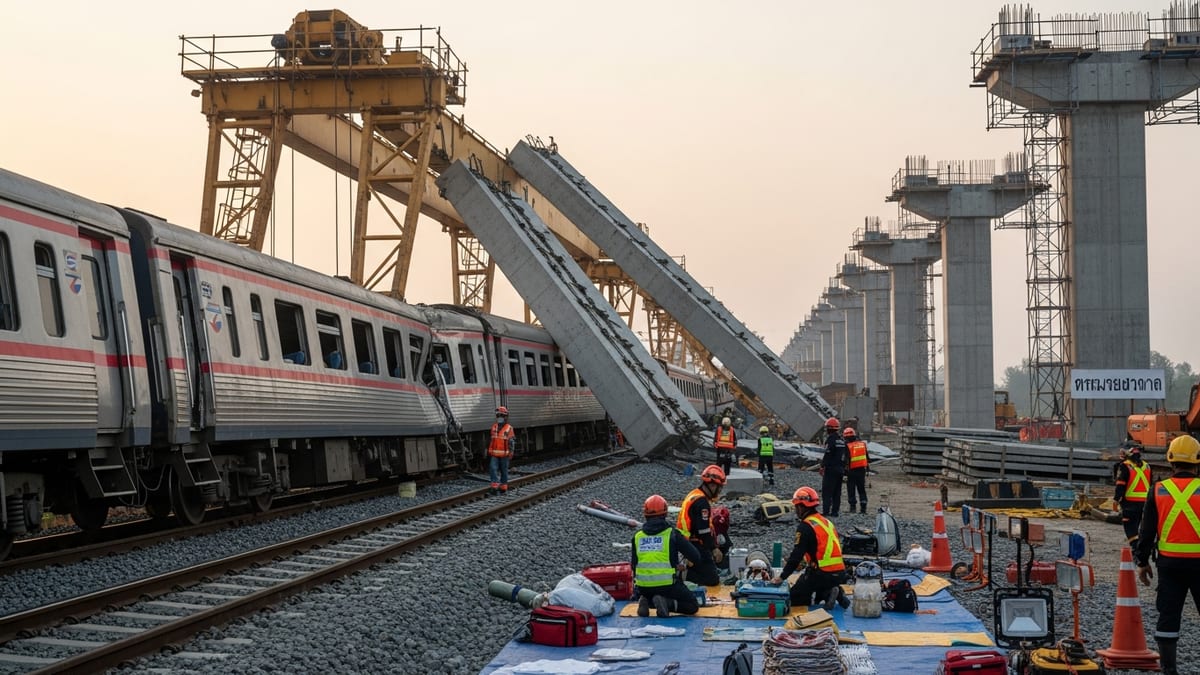
Minor Derailment Halts Key Mumbai–Gujarat Link
According to published coverage, the Virar–Bharuch MEMU train derailed at Bhilad station in the early hours of July 28, 2026, on the Mumbai–Surat section of Western Railway. Initial reports indicate that a few coaches left the tracks on a loop line, prompting an immediate halt to train movements through the area while inspections and safety checks were initiated.
Preliminary information suggests there were no serious injuries reported among passengers on the MEMU service. However, the incident occurred on a heavily used stretch that handles both suburban-bound passengers and long-distance trains connecting Mumbai with southern Gujarat and further north, amplifying the operational impact across the network.
Railway teams began re-railing work shortly after the incident, using cranes and track equipment to place the affected coaches back on the rails. Early visuals and updates in local media highlight intensive engineering activity at the site, as officials focus on clearing the section for safe passage of stranded and delayed trains.
The derailment comes at a time when Western Railway has already been coping with repeated disruptions linked to intense monsoon conditions in Maharashtra and south Gujarat, making Tuesday’s incident particularly disruptive for commuters and long-distance travelers alike.
Long-Distance Trains Delayed Across Western Railway
Reports from Mumbai and Gujarat indicate that several long-distance trains on the Mumbai–Gujarat route experienced significant delays following the derailment at Bhilad. Services bound for Ahmedabad, Vadodara and other destinations in Gujarat were either halted en route or moved at restricted speed as traffic was regulated around the affected stretch.
Trains originating from Mumbai Central and Bandra Terminus were among those impacted, with ripple effects seen on premium and mail–express services that share the same corridor. Some services were reported running late by more than an hour, and passengers on board experienced prolonged unscheduled halts while control rooms adjusted train paths and priorities.
Published reports on Western Railway’s recent operations show that the Mumbai–Ahmedabad and Mumbai–Surat sectors have been carrying a high volume of diverted, rescheduled and regulated trains over the past week due to weather-related restrictions. The Bhilad derailment added an additional bottleneck, complicating efforts to restore normal timetables.
Passengers at intermediate stations reported crowding on platforms and in concourses as information boards were updated with revised departure and arrival timings. Publicly available information suggests that railway personnel at key junctions such as Vadodara, Surat, Vapi and Mumbai Central focused on decongesting priority services while waiting for clearance from the Bhilad section.
Monsoon-Struck Corridor Faces Fresh Setback
The Mumbai–Gujarat rail corridor has faced repeated interruptions this monsoon, with heavy rains causing waterlogging and high river levels in stretches of Maharashtra’s Palghar district and south Gujarat. Recent coverage has documented multiple instances where rail traffic between Gholvad and Umargam had to be suspended or heavily regulated as water levels near bridges crossed danger marks.
In the days leading up to the Bhilad derailment, a series of advisories and updates from Western Railway, as reported in the press, highlighted cancellations and diversions affecting services such as Vande Bharat Express, Shatabdi, Rajdhani and other prominent trains. The network has therefore been operating with limited margin to absorb fresh operational shocks.
Infrastructure on this coastal corridor is particularly vulnerable during intense monsoon phases, when saturated embankments, track washouts, and reduced visibility can complicate operations. While the Bhilad incident is being described in local reports as a relatively minor derailment on a loop line, its timing amid an already stretched timetable has magnified the disruption felt by passengers.
Observers note that the combination of weather-related speed restrictions and incident-driven blocks can quickly cascade across a network that handles a dense mix of suburban, intercity and freight traffic. The current disruption highlights how even non-fatal derailments can have region-wide implications when they occur at critical junctions along major national corridors.
Restoration Efforts and Advisory for Passengers
Re-railing work at Bhilad is reported to be progressing with the goal of restoring full line capacity as early as possible. Engineering teams are focusing on checking track geometry, signaling equipment and overhead power lines before allowing normal-speed operations to resume. Until these checks are completed, trains are expected to pass through the section under caution or via limited available tracks, prolonging delays.
Publicly available information and media updates indicate that several trains have been rescheduled, with departure times pushed back from origin stations, while others are running on altered paths or at reduced speeds. Passengers are being advised in news coverage to verify the status of their trains through official railway information channels, station announcements and customer information systems before heading to stations.
Travelers planning journeys between Mumbai and major Gujarat cities such as Surat, Bharuch, Vadodara, Ahmedabad and beyond may face longer travel times through the day. Those with time-sensitive connections, including flights or onward rail and bus links, are being encouraged by travel advisories to factor in additional buffer time and consider flexible plans if possible.
With monsoon conditions forecast to persist over western India, the incident at Bhilad is likely to prompt renewed scrutiny of inspection regimes, maintenance windows and contingency planning along the Western Railway network. For now, the priority remains to stabilize operations on the Mumbai–Gujarat corridor and gradually bring train movements back to their published schedules.