


More news on this day
Australia’s plans for high speed rail between Newcastle and Sydney have advanced, with global engineering group Bechtel appointed as delivery partner for the project’s two year development phase.
Get the latest news straight to your inbox!
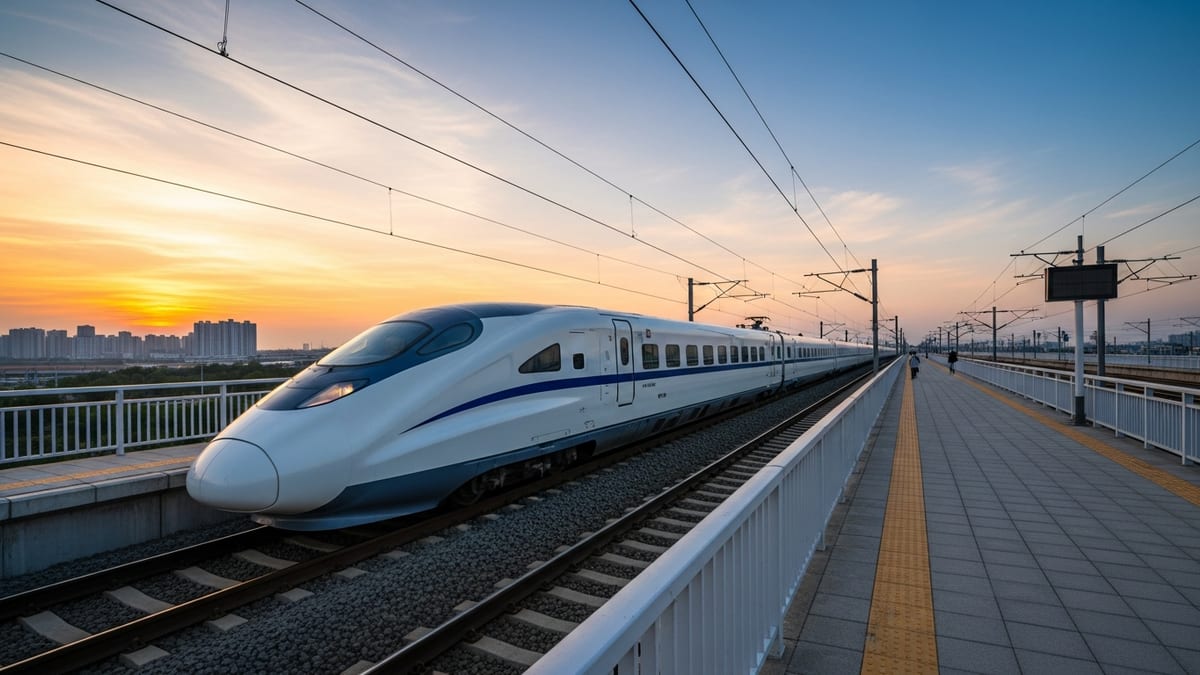
Strategic partner selected for flagship east coast corridor
Publicly available information from the High Speed Rail Authority and Bechtel indicates that the delivery partner contract covers the development phase of the proposed Newcastle to Sydney high speed rail section, a key segment of the wider vision for an east coast network linking Melbourne, Canberra, Sydney and Brisbane. The appointment follows the completion of a federal business case for the corridor and the allocation of planning funds by the Australian government.
Industry reports describe the planned Newcastle–Sydney high speed line as a 194 kilometre corridor designed for speeds of up to 320 kilometres per hour, with a target journey time of around one hour between the two cities. The project is positioned as the first operational stage of a longer term high speed rail program intended to reshape intercity travel along Australia’s populous eastern seaboard.
The High Speed Rail Authority was formally established in 2023 to progress this agenda, focusing initially on the Newcastle–Sydney section seen as having strong demand from daily commuters, leisure travellers and regional visitors. The Bechtel partnership is framed as a way to bring international delivery experience to what is regarded as one of the country’s most complex transport investments.
Scope of Bechtel’s delivery partner role
According to project summaries released in mid July 2026, Bechtel’s role during the two year development phase will concentrate on getting the project “construction ready” ahead of a future investment decision by the federal government. This encompasses detailed design coordination, refinement of the project’s scope and staging, schedule and cost estimates, and preparation of procurement strategies for major works packages.
The delivery partner is also expected to support planning and environmental approval processes, working alongside the High Speed Rail Authority and other technical advisers. Industry coverage suggests this will include helping to integrate land use planning, housing growth areas and station precinct development into the overall delivery strategy, reflecting the project’s potential to catalyse urban change along the corridor.
Bechtel’s involvement is being presented as an extension of a delivery partner model the company has applied on other large transport and airport schemes. Public material from the firm highlights a focus on program-wide risk management, constructability input during early design, and the packaging of contracts in ways intended to attract competitive interest from the construction market.
Projected economic, housing and mobility impacts
The Newcastle–Sydney high speed rail project has been promoted in federal business case documentation as a long term economic catalyst, with projections indicating a potential boost to national economic output worth hundreds of billions of Australian dollars over several decades. The corridor is expected to support tens of thousands of direct and indirect jobs across planning, construction and operation, alongside broader productivity gains from faster travel between key centres.
Government papers and independent commentary link the project to housing and regional development objectives, particularly around proposed station locations such as Broadmeadow in Newcastle, Lake Macquarie, the Central Coast, central Sydney, Parramatta and Western Sydney International Airport. Faster rail access is viewed as a way to open up new housing markets while allowing residents to maintain realistic commuting times to major employment hubs.
From a transport perspective, planners see high speed rail as a means to shift a portion of trips from private cars and short haul aviation to high capacity electric trains. Studies of overseas high speed rail systems have highlighted reductions in per passenger emissions compared with road and air travel, and project material for the Newcastle–Sydney line references similar potential environmental benefits if strong patronage is achieved.
Linking Australian plans to global high speed experience
Bechtel’s selection reflects its long record on complex rail and metro projects, cited in public information that references involvement with the United Kingdom’s High Speed 1 line, major London rail schemes and tunnel and station works on Sydney Metro. The company also points to recent delivery partner roles on large airports and urban rail systems in North America, Europe and the Middle East.
Observers note that this experience is likely to be applied to challenges specific to the Newcastle–Sydney corridor, including difficult terrain north of Sydney, interfaces with existing rail and road infrastructure, and the need to manage construction impacts in densely populated areas. Lessons from international high speed rail programs, such as timetable planning, rolling stock specification and maintenance regimes, are expected to inform the development phase.
Parallel to Bechtel’s appointment, the High Speed Rail Authority has also named a separate partnership led by French operator Keolis as business, operations and maintenance adviser for the corridor. Reports indicate that this group will act as a shadow operator, ensuring that customer, operations and maintenance considerations are embedded into technical design from the outset, complementing Bechtel’s delivery-focused role.
Next steps and timeline toward construction
Publicly available timelines suggest that the two year development phase now underway will run through to around 2028, at which point the federal government is expected to consider a final investment decision for construction. During this period, the High Speed Rail Authority, Bechtel and other partners will refine alignments, station concepts, construction methodologies and funding options.
Industry reporting points to an indicative schedule where major construction on the Newcastle–Sydney high speed line could begin from 2028, subject to approvals and funding, with opening dates to be determined as the program matures. The development phase is regarded as critical to testing staging scenarios, managing interfaces with existing line upgrades and coordinating with broader infrastructure plans in Greater Sydney and the Hunter region.
For travellers and communities along the corridor, progress over the next two years will be watched closely as an indicator of whether high speed rail, long discussed in Australia, is on track to transition from planning into delivery. The appointment of Bechtel as delivery partner for the Newcastle–Sydney project marks one of the clearest signals to date that the national high speed rail program is moving into a more concrete phase of preparation.