


By 2027, many international travelers will routinely look into a camera instead of handing over a passport at airport checkpoints. Biometric boarding gates, facial recognition at security, and early pilots of digital travel credentials are moving from niche experiments to mainstream options. Yet the shift to digital identity is uneven, and in most cases, a physical passport will still be essential. Understanding where these systems are live, what they mean for privacy, and which documents you will actually need can help you plan trips in the second half of this decade.
Get the latest updates straight to your inbox!
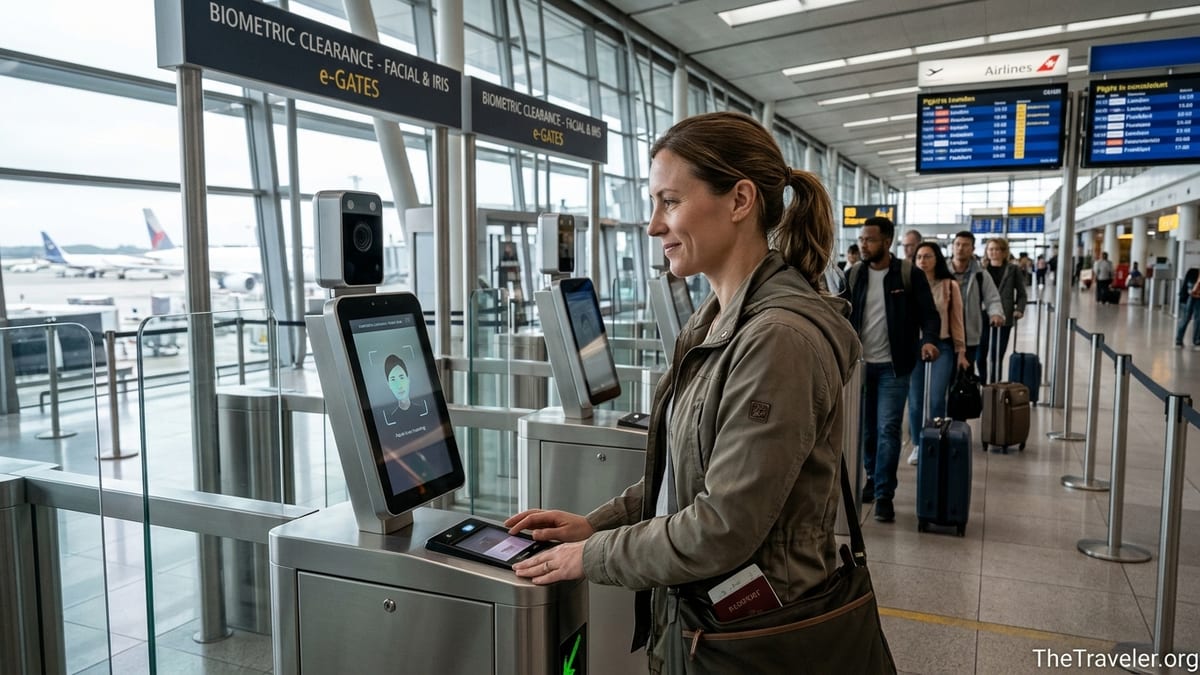
Biometric Travel Is Moving From Pilot to Everyday Reality
In October 2026, the International Air Transport Association released its latest Global Passenger Survey. The findings underscored how quickly attitudes are changing. A clear majority of respondents said they are willing to use biometric identification to speed up airport processes and expressed strong interest in digital passports that could simplify check in and document checks. IATA links this shift directly to its One ID program, which envisions passengers arriving at the airport "ready to fly" after completing identity and document checks in advance using digital credentials.
On the ground, this is already visible at many large hubs. In the United States, Customs and Border Protection has processed more than a billion travelers using facial comparison systems, and its Simplified Arrival program now covers most major international airports for entry processing. At departure, CBP works with airlines to run biometric exit at international boarding gates, where cameras capture a live photo at the jet bridge and match it against government records before a traveler steps on the aircraft. Airlines such as Delta, United, American, JetBlue, and Southwest use this infrastructure at selected gates in airports like Atlanta, New York JFK, Los Angeles, Orlando, and others.
Outside the United States, biometric systems are becoming part of the standard airport experience. At Singapore Changi, automated lanes that use facial and iris recognition handle most immigration checks for Singaporeans, permanent residents, and long term pass holders without requiring them to present a passport at the booth. In Europe, eGates using facial recognition and electronic passports are widely deployed at airports including London Heathrow, Amsterdam Schiphol, Madrid Barajas, and Frankfurt. These systems do not eliminate passports, but they change how often and where travelers have to show them.
For travelers planning trips in 2027, this means that biometrics will be part of many journeys, especially on international routes and at major hubs. It does not mean every step of the journey will be digital, and it does not guarantee a faster path in every airport, but it is increasingly likely that you will encounter at least one biometric checkpoint between home and your destination.
Where Digital Identity and Biometrics Are Already Available
Biometric services vary significantly by region and airport, so it helps to look at concrete examples rather than assume a uniform global rollout. In North America, CBP’s Simplified Arrival uses facial matching at primary inspection booths in dozens of international gateways, including New York JFK, Newark, Boston, Washington Dulles, Miami, Atlanta, Houston, Dallas Fort Worth, Los Angeles, San Francisco, Seattle, and Chicago O’Hare. At these airports, returning U.S. citizens and visitors often step up to a camera and answer questions without handing their passport to an officer for manual inspection, although the passport must still be carried and is usually scanned at some point in the process.
Biometric exit is equally visible. Travelers flying from U.S. airports such as Orlando, Chicago Midway, Miami, Los Angeles, San Francisco, or Dallas on airlines that participate in CBP’s biometric exit program may board by simply facing a camera at the gate. For example, Southwest has publicly described using facial recognition at boarding in Orlando and Chicago Midway, while Air Canada and United passengers have reported biometric boarding on U.S. departures to Canada, Europe, and Latin America. In these cases, a successful facial match can replace both an in hand boarding pass scan and a visual passport check at the podium.
In Asia, Singapore is one of the most advanced examples. In late 2024, authorities announced that passportless clearance would be available at all four Changi terminals for eligible travelers. Singapore citizens, permanent residents, and long term pass holders can clear immigration using only their face and iris, with their travel document information retrieved from government systems. However, they are still required to carry a passport when crossing borders, because airlines and foreign border agencies may need to see or verify the physical document even if Singapore itself has digitized its side of the process.
Europe is experimenting with fully digital travel documents through Digital Travel Credential pilots. Finland and Croatia, for instance, have tested a system where selected passengers on specific routes, such as flights between Zagreb and Helsinki, could use a digital representation of their passport stored on a mobile device for border checks. The Netherlands, working with partners including KLM and the Royal Netherlands Marechaussee, ran a pilot on a transatlantic route to Canada to see how a digital travel credential could work with facial recognition at Schiphol’s border controls. These pilots ended in 2024 but are feeding into broader European Union initiatives on digital identity and travel credentials that could influence how passengers move through airports from 2027 onward.
Digital Travel Credentials, Mobile Passports, and How They Differ
It is easy to conflate terms like digital passport, mobile passport, and digital travel credential, but they describe different pieces of the emerging ecosystem. A digital travel credential, as described in European Commission documentation, is a digital representation of the data stored in the chip of an electronic passport or similar document. The credential is securely linked to the underlying physical passport and is designed to be used at border controls through devices like smartphones in combination with biometric verification. Importantly, current pilots in Finland, Croatia, and the Netherlands treat this as a hybrid concept rather than a stand alone replacement for a passport.
By contrast, mobile passport applications such as U.S. Mobile Passport Control work more like a pre arrival form and express lane than a digital passport. U.S. citizens and Canadian visitors at certain U.S. airports and cruise ports can use an official smartphone app to submit their passport information and customs declaration before reaching the inspection area. On arrival, they follow dedicated signage and show a QR style receipt along with their physical passport to a CBP officer. The app is currently available at dozens of U.S. airports and several preclearance locations overseas, but at no point does it remove the requirement to carry and present a valid passport.
Trusted traveler programs that rely heavily on biometrics are another piece of the puzzle. Global Entry in the United States, NEXUS for travel between the U.S. and Canada, and programs such as Registered Traveller in the United Kingdom and Smart Entry in South Korea all use fingerprint or facial recognition at automated kiosks or eGates. Once again, they speed processing but do not change document rules. A Global Entry member arriving at New York JFK may simply look into a camera at a kiosk before being waved through, but airline staff and CBP can still request to see the passport and may deny boarding or entry if the document is missing or invalid.
For travelers, the practical takeaway is that digital tools usually layer on top of, rather than replace, traditional documents. You may preload your passport into an airline app for online check in, enroll a faceprint with a trusted traveler program, or generate a mobile credential for customs. Yet the legal authority to cross a border still rests on the physical passport or national identity card that meets the requirements of the destination country.
Why a Digital Identity Does Not Replace a Physical Passport (Yet)
There are several reasons why digital identity acceptance at airports does not automatically eliminate the need to carry an actual booklet style passport in 2027. First, international travel rules are based on treaties and national legislation that assume a physical travel document issued by a state. International Civil Aviation Organization standards define how machine readable and electronic passports are constructed, how inspection systems verify them, and what counts as a valid document at an international border. While work is ongoing on digital travel credentials, most legal frameworks still expect a physical document to exist and be presented on request.
Second, not all parts of an international journey are digitized to the same degree. A traveler flying from Austin to Frankfurt via Chicago, for instance, might benefit from facial recognition at TSA security, biometric boarding on the transatlantic leg, and eGate entry in Germany. However, if there is a disruption and the traveler needs to rebook via a different airline or airport, airline agents or border officers may revert to manual checks. In secondary inspection rooms, land border crossings, or smaller regional airports without biometric infrastructure, officers will still rely on physical documents.
Third, a physical passport can serve as a fallback when digital systems fail. Cameras can malfunction, networks can go down, and algorithmic matching can struggle with lighting conditions or changes in appearance. Even in advanced environments such as Changi or Schiphol, manual counters remain open precisely because some passengers cannot or do not want to use biometrics. Carriers also remain responsible for ensuring that passengers are properly documented, and many keep their own visual checks in place at check in counters and boarding gates even when participating in biometric programs.
Finally, not all countries accept the same digital schemes. A digital identity or travel credential that works seamlessly on a pilot route between an EU member state and a neighboring country might have no status when entering the United States, Japan, or Brazil. An airline or border officer facing uncertainty about whether a digital credential is legally valid for a given route is likely to default to the most conservative approach: asking to see a traditional passport. Until international standards and bilateral agreements catch up, travelers should treat digital identity as a convenience layer rather than a passport replacement.
Privacy, Data Retention, and the Trade Offs Travelers Face
Biometric systems at airports bring inevitable questions about privacy and data protection. When you step up to a camera at a boarding gate, several things may happen behind the scenes. A live image is captured, converted into a biometric template, and compared against a gallery created from government records such as passport photos or entry records. In some programs, the live photo is retained for a limited period to document an inspection, while the biometric template is discarded quickly. In others, there may be longer retention or additional uses, such as analytics or system testing.
In the United States, CBP describes Simplified Arrival as allowing many travelers to opt out and use manual document inspection instead. The agency’s privacy assessments explain that certain groups, such as U.S. citizens, are not required to provide facial biometrics during entry and can request an alternative process. At the same time, these documents acknowledge that CBP works with airline and airport partners to expand biometric exit and that data sharing arrangements exist with technology vendors that help operate the systems. Travelers concerned about surveillance should understand that participation at many touchpoints is nominally voluntary but that social and operational pressure may make opting out less straightforward in practice.
In Europe, data protection rules such as the General Data Protection Regulation impose strict conditions on biometric use. Digital travel credential pilots led by Finland, Croatia, and the Netherlands emphasize that credentials are stored locally on the traveler’s device, cryptographically protected, and only shared with border authorities for narrowly defined purposes. Nonetheless, privacy advocates in Europe have raised concerns about potential function creep if large scale biometric databases become normalized at borders and in airports, especially when combined with entry exit systems and advanced passenger information.
Airports in Asia offer both advanced convenience and real privacy trade offs. Singapore’s use of biometric corridors at Changi is backed by national legislation that allows authorities to collect and process biometric identifiers for immigration control, while local discussions continue over how long data should be retained and for what secondary uses. Similar debates have played out in Hong Kong, South Korea, and the Gulf states, where smart gates record faces, fingerprints, or iris patterns as part of fast track entry schemes. In many of these locations, opting out may mean considerably longer queues and more cumbersome procedures.
For individual travelers, the decision to embrace or resist biometric systems often involves weighing time savings against comfort with data collection. Someone flying regularly between Toronto and New York may accept facial recognition at boarding to shave minutes off each trip, while another traveler might choose to stand in a slower manual line to avoid creating additional biometric records. Understanding your options at each stage of the journey can make those decisions more deliberate rather than automatic.
What Documents and Enrollments Travelers Will Still Need in 2027
Even as digital identity systems mature, the core document requirements for international travel will remain familiar in 2027. A valid physical passport, with enough validity remaining to satisfy destination rules, will still be the primary document for crossing borders. Many destinations will also continue to require visas or electronic travel authorizations, such as Canada’s eTA, the United States ESTA for certain visitors, or the forthcoming European travel authorization system. Digital travel credentials, where available, will generally rely on passport data rather than replace the underlying document.
In practice, travelers should expect to carry and occasionally present several layers of identity. For example, a U.S. citizen flying from Boston to London in 2027 might upload their passport details and a selfie to an airline’s app for online check in, generating a token that can be used at automated bag drops and security. At the TSA checkpoint, a Credential Authentication Technology machine might scan a physical driver’s license and capture a live photo, removing the need to show a boarding pass. At boarding, facial recognition at the gate could verify the traveler’s identity against CBP records. On arrival at Heathrow, the traveler might use an eGate that reads the electronic passport chip and compares it to a live image. At each step, the physical passport would still need to be in the traveler’s carry on bag and ready to show if something in the automated process fails.
Enrollment in trusted traveler schemes and airline programs will remain optional but useful. A business traveler who joins Global Entry and TSA PreCheck, for instance, might pay a combined fee of around 100 to 150 U.S. dollars for five years of membership through credit card reimbursements or direct payment. In return, they get faster lanes supported by biometrics at U.S. airports. In Europe, frequent travelers might register for programs such as Germany’s EasyPASS for residents or the United Kingdom’s potential future schemes associated with its border modernization plans, depending on how these evolve by 2027.
Travelers should also pay attention to national digital identity initiatives that may interact with travel. The European Union is developing a digital identity wallet that could store credentials for services including travel, building on experience from the EU Digital COVID Certificate. Several member states are already testing how verified identity attributes could be shared with airlines and border agencies. Although timelines and technical details may shift, the direction of travel is clear: more pre travel digital verification, supported by biometrics at the airport, layered on top of the traditional requirement for a valid passport.
How to Use Biometric and Digital Options Safely and Effectively
To get the most benefit from biometric check in and digital travel tools by 2027, travelers should approach them much like any other piece of travel infrastructure: helpful when understood, frustrating when used blindly. A first step is to check what your departure and arrival airports already offer. Airport and airline announcements often indicate whether biometric boarding is available on a given route, whether automated border gates are open to your nationality, and whether mobile apps can pre register your passport or face. Checking a few days before your trip can prevent surprises at the terminal.
Next, travelers can fine tune privacy choices. At U.S. ports of entry, for example, you can inform a CBP officer that you prefer manual processing and present your passport for a traditional visual inspection instead of using Simplified Arrival. At biometric boarding gates run by airlines, politely telling the gate agent that you are opting out should trigger a manual boarding pass and passport check, even if the screen suggests that everyone must face the camera. Some travelers also choose to enroll only in programs they feel comfortable with, such as Global Entry where background checks and biometric collection are explicit and documented, while opting out of ad hoc airline biometric trials not tied to a clear benefits program.
On the technical side, keeping control of how your digital credentials are stored matters. When participating in European digital travel credential pilots or future digital identity wallet schemes, travelers should pay attention to whether credentials are stored locally on a device or in a remote cloud account, how they are protected, and what happens if the phone is lost or replaced. Using strong device security settings and enabling features such as on device encryption can reduce the risk that a stolen phone becomes a gateway to sensitive travel data.
Finally, travelers should build redundancy into their plans. Carry printed copies of key documents such as visa approval notices or travel authorizations in case an airline system cannot retrieve them electronically at check in. Keep your physical passport accessible during every stage of an international trip, even if you expect to use a digital credential or biometric lane. If you rely heavily on mobile boarding passes and digital IDs, ensure that your phone has sufficient battery and consider a small power bank for long days in transit. Biometric systems are designed to streamline travel, but your own preparation remains the best safeguard against disruptions.
The Road to 2027 and Beyond
By 2027, biometric airport journeys and early digital passports will be mature enough that many travelers barely notice them, much as electronic boarding passes have become unremarkable today. IATA’s latest survey shows that passengers are increasingly open to these tools when they clearly speed up processes and reduce the number of times documents must be shown. At the same time, concerns about privacy, data security, and the potential misuse of biometric information are not going away.
Governments and industry partners are still working through the legal and technical frameworks needed to make digital travel credentials fully interoperable and trusted across borders. The European Union’s pilots with Finland, Croatia, and the Netherlands, Singapore’s biometric corridors at Changi, and the widespread expansion of CBP’s facial recognition programs in the United States all point toward a shared goal: allowing passengers to prove who they are with minimal friction while preserving security and integrity at the border.
For travelers, the lesson is to treat biometrics and digital identity as tools rather than as magical shortcuts. They can make many steps of the journey faster or more convenient, but they do not erase the basic responsibilities of carrying proper documents, understanding entry rules, and allowing extra time for unfamiliar procedures. A traveler who embraces these tools with clear eyes, informed consent, and a backup plan will be best positioned to navigate airports in 2027 and beyond.