


More news on this day
European aviation regulators have extended heightened risk guidance for flights over the Gulf region, maintaining conflict zone warnings as tensions between the United States and Iran continue to unsettle key air corridors linking Europe with Asia and Africa.
Get the latest news straight to your inbox!
Fresh Extension to Europe’s Gulf Airspace Warning
Recent conflict zone bulletins from European aviation authorities show that guidance covering large parts of the Gulf region remains in force, with validity dates pushed further into 2026 as military activity and political friction persist. The notice, originally issued after a sharp escalation involving US and Israeli strikes on Iran followed by Iranian missile and drone attacks across the Gulf, advises airlines to avoid or severely limit operations within multiple flight information regions that sit astride traditional Europe–Asia routes.
According to publicly available safety material, the warning covers a patchwork of airspace stretching over Iran, Iraq, Bahrain, Kuwait and nearby areas, where missile launches, drone operations and heightened military traffic have at times intersected with civil aviation corridors. While some states have partially reopened their skies or implemented structured air traffic management measures, the European guidance continues to classify the broader area as a conflict zone where miscalculation or misidentification risks remain elevated.
The extension underlines that, despite intermittent ceasefire efforts and diplomatic signals toward de escalation, risk assessments have not returned to pre crisis norms. European regulators are keeping a particular focus on the potential for rapid changes on the ground, directing airlines to maintain close monitoring of official airspace updates and to route around the highest risk areas whenever feasible.
US Iran Tensions Keep Risk Levels Elevated
The decision to prolong the warning is closely tied to the broader confrontation between Washington and Tehran, which has spilled across the region’s skies and seas since late February 2026. Open source reporting on the conflict describes how coordinated US and Israeli strikes on Iranian targets were followed by waves of Iranian missiles and drones aimed at bases, infrastructure and strategic facilities in Gulf states, prompting several governments to close or heavily restrict their airspace to civil traffic.
Even as the most intense barrages have subsided, observers note that both Iran and US forces retain a significant presence in and around the Gulf, and that the risk of renewed exchanges has not disappeared. Safety assessments continue to factor in the possibility of surface to air fire, long range missile launches and electronic interference that could affect aircraft operating at cruising altitude. The combination of unpredictable military activity and dense commercial traffic has driven regulators to adopt a cautious stance on overflights.
Publicly accessible conflict analyses also emphasize the link between airspace risk and the unresolved political dispute over Iran’s nuclear program, regional proxy networks and maritime security in the Strait of Hormuz. With negotiations described as fragile and episodic, aviation planners are preparing for a prolonged period in which operational assumptions must account for sudden spikes in tension rather than a quick return to routine.
Rerouted Traffic, Longer Flights and Operational Strain
For airlines, Europe’s continued warning over Gulf airspace translates into longer routings, higher fuel burn and more complex scheduling across some of the world’s busiest intercontinental corridors. Industry briefings on the current disruption describe how carriers have shifted many Europe–Asia services away from the central Gulf, using northern tracks through Turkey and the Caucasus or southern arcs via Egypt, Saudi Arabia and Oman to bypass the most sensitive skies.
Airport and airline reporting indicates that these diversions can add significant time to flights, cut into aircraft utilization and put pressure on crew rotations, particularly for long haul operations that already operate near duty time limits. In parallel, higher insurance premiums for war risk zones and a global jet fuel market tightened by conflict related supply constraints are weighing on margins. Some carriers have temporarily suspended services to specific Gulf hubs or secondary cities, while others are operating reduced frequencies with carefully selected routings.
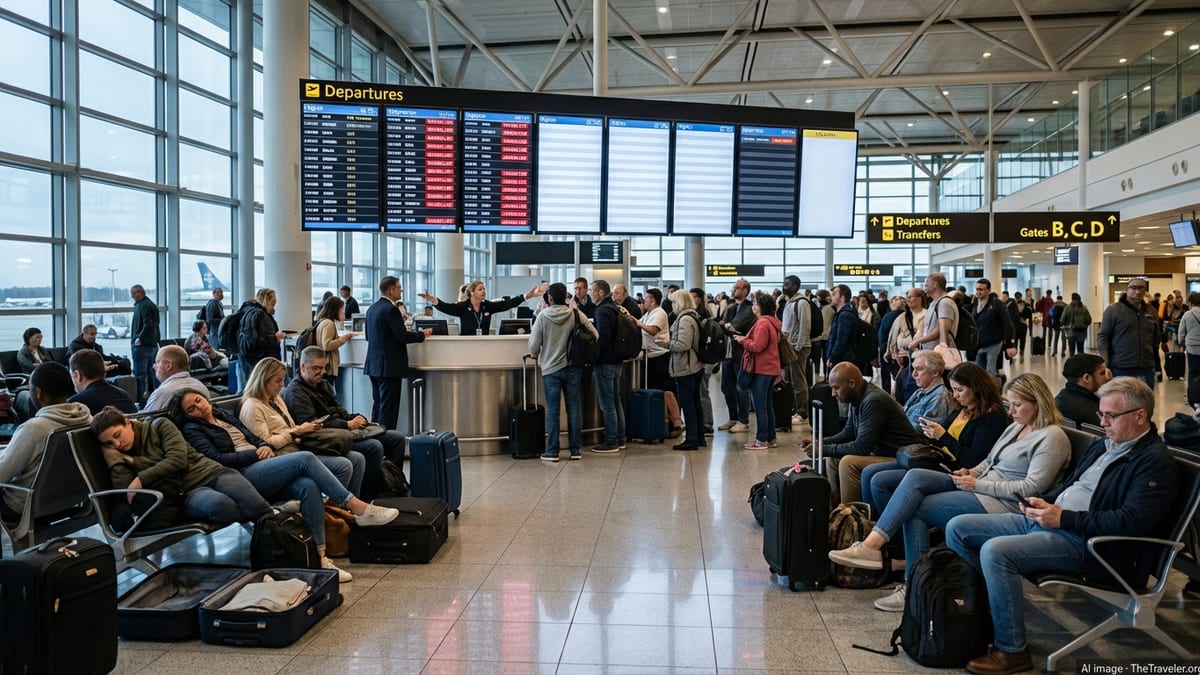
Passenger facing consequences are visible in recurring waves of delays, extended journey times and short notice schedule changes. Travel advisories compiled from airline and airport statements encourage passengers transiting the region to build in additional connection time, monitor booking updates closely and remain flexible on routings, with some itineraries being reprotected via alternative hubs further from the conflict zone.
Gulf Hubs Balance Connectivity and Caution
Major Gulf hubs, which rely heavily on their role as crossroads between Europe, Asia, Africa and Oceania, are navigating a difficult balance between maintaining connectivity and adhering to strict safety protocols. Public documentation and regional aviation reports show that at the height of the early 2026 escalation, several Gulf states implemented sweeping airspace closures or altitude caps, temporarily grounding thousands of flights and forcing diversions to airports well outside the region.
As conditions have shifted, authorities have gradually reopened some corridors under defined constraints, coordinating with international partners to segregate civil and military traffic wherever possible. Nevertheless, the continued European conflict zone designation underscores that, from an external risk management perspective, the region has not reached a level of stability sufficient to lift precautionary measures.
Gulf based carriers, many of which are state linked and central to national diversification strategies, have publicly framed their responses in terms of safety first decisions guided by international standards. They have also emphasized efforts to sustain essential links, including relief or repatriation flights when regular schedules are disrupted. These dual imperatives reflect the wider economic stakes for states that have invested heavily in aviation, tourism and logistics as pillars of their post oil future.
What Travelers Should Expect in the Months Ahead
For travelers planning routes between Europe and destinations in Asia, Africa or Australasia, the extension of European Gulf airspace warnings signals that some level of volatility is likely to persist through at least the medium term. While the majority of flights continue to operate safely on revised routings, journey times on certain city pairs may remain longer than before the crisis, and last minute adjustments by airlines will continue to be possible if security assessments change.
Consumer facing guidance built from airline notices and aviation advisories suggests that passengers should pay close attention to the specific routing and connection points on their tickets, especially when itineraries involve Gulf hubs or overflight of the wider region. Booking with sufficient layover time, enabling notifications in airline apps and confirming visa or transit requirements for potential alternative hubs are all measures that can reduce the impact of disruption.
Industry analysts generally stress that aviation regulators, air navigation providers and airlines have substantial experience managing operations around conflict zones, using rerouting, altitude restrictions and real time intelligence sharing to mitigate risk. The ongoing European warnings over Gulf airspace, and their repeated extensions, form part of that risk management architecture, signaling that safety considerations continue to override convenience while US Iran tensions and the regional conflict remain unresolved.