


More news on this day
Passengers travelling through Manchester Airport today are facing significant disruption, with dozens of departures showing as delayed or cancelled on the live departure boards across all three terminals.
Get the latest news straight to your inbox!
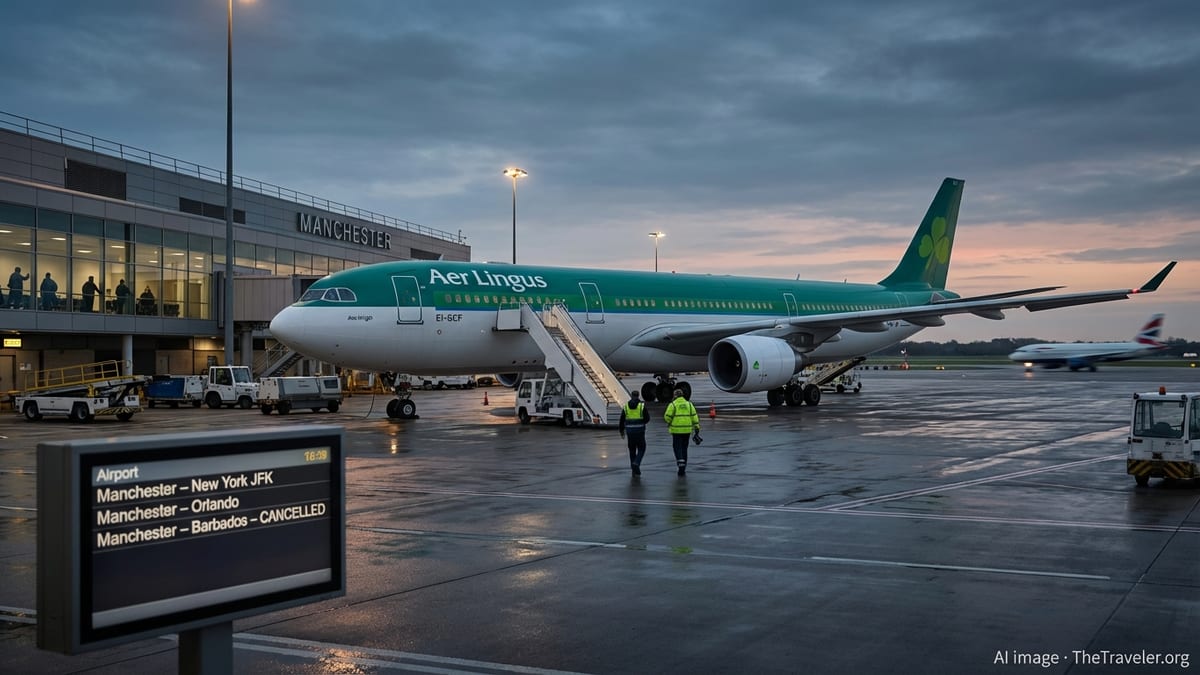
Significant disruption across morning and midday departures
Publicly available departure-board data for Manchester Airport today indicates a broad pattern of disruption, particularly affecting the morning and midday wave of flights. A substantial number of short-haul services to popular European destinations are listed as delayed, while several departures to major hubs such as Amsterdam, Frankfurt and Paris are marked as cancelled.
The impact is visible across multiple airlines and terminals, suggesting a combination of factors rather than a single technical issue. Low-cost carriers, leisure airlines and full-service operators all show altered schedules, ranging from short delays of 15 to 30 minutes to extended hold-ups exceeding two hours. Some flights are removed from the schedule entirely and re-listed later in the day, indicating aircraft and crew rotations being reworked in real time.
Domestic services are also affected, with a number of flights to other UK and Irish airports operating off-schedule. While many departures are still leaving, the live data suggests that passengers should be prepared for revised boarding times and gate changes, even when their flight is not formally classified as delayed.
The pattern mirrors previous busy travel days at Manchester, when concentrated early-morning traffic and tight turnaround times have amplified knock-on effects from even relatively minor operational challenges.
Weather, air traffic control and knock-on effects behind delays
Recent published coverage of UK aviation points to a familiar mix of contributing factors on disruption days of this kind. Periods of unsettled weather across parts of the UK and near-continent can slow arrivals and departures, forcing aircraft into holding patterns and leading to temporary restrictions on movements that then cascade through the day’s schedule.
In parallel, air traffic control capacity in congested European airspace continues to be a recurring pressure point, especially during peak holiday season. When neighbouring control centres apply flow restrictions or require greater spacing between aircraft, Manchester-bound and Manchester-originating flights can be held on the ground or in the air. Those delays in turn affect the availability of aircraft and crews for later rotations from the airport.
Operational staffing constraints and ongoing industrial relations issues affecting some carriers and ground-handling providers across Europe add further complexity. Industry analyses note that, even when Manchester Airport’s own infrastructure is functioning normally, disruption elsewhere in an airline’s network can manifest as late-arriving aircraft and revised departure times for Manchester services.
Taken together, these factors help explain why today’s delays and cancellations do not appear limited to a single airline or terminal, but instead form a patchwork of disruptions across the departure boards.
Destinations and airlines most visibly affected today
Based on the current departure information, short-haul leisure routes appear among the most visibly affected today. Services to Mediterranean holiday destinations, including Spanish islands and mainland Spanish resorts, show a mix of outright cancellations and extended delays. This is particularly disruptive for package-holiday travellers who are tied to specific charter or low-cost services bundled with accommodation.
Several flights to key European hubs are also off-schedule, which can create additional complications for passengers connecting onward to long-haul destinations. When an early connecting leg from Manchester is delayed or cancelled, travellers may miss onward flights in mainland Europe, resulting in rerouting or overnight stays arranged by airlines at destination hubs rather than at Manchester itself.
Different airlines are responding in different ways, according to schedule changes visible on public trackers. Some carriers have consolidated services, effectively merging two lightly loaded flights into a single departure and cancelling the other, while others appear to be substituting aircraft types or using spare capacity elsewhere in their fleets to keep disruption to a minimum.
Long-haul operations from Manchester are less numerous, but even a small number of changes on transatlantic or Middle East routes can affect a large volume of passengers because of the larger aircraft involved. Today’s data shows isolated long-haul delays, with departure times pushed back, though many intercontinental flights are still scheduled to operate.
What passengers flying from Manchester today should do
Passenger-guidance pages for Manchester Airport and its airlines consistently advise travellers to monitor their flight status as closely as possible on disruption days. The most up-to-date information is typically found on airline apps, text or email alerts, and on the live departure boards, rather than in printed tickets or older booking confirmations.
Travellers are generally encouraged to arrive in line with airline check-in recommendations, even when delays are reported, unless their carrier has explicitly advised otherwise. Security processing times can still vary, and being airside early gives more flexibility if a gate is reassigned or a delayed flight is brought forward once an aircraft and crew become available.
Published consumer advice also highlights the importance of understanding passenger rights when flights are significantly delayed or cancelled. Under UK and European air passenger regulations, travellers may be entitled to rerouting, refunds, meals, accommodation or financial compensation, depending on the cause of the disruption, the length of the delay and the distance of the flight.
On days such as today, when multiple flights are affected, rebooking options on later services from Manchester or nearby airports can become limited. Passengers whose journeys are time-sensitive are therefore advised, where possible, to keep flexible plans and allow additional margin for onward rail or road connections.
Manchester Airport’s recent record on punctuality and complaints
Manchester Airport has been the subject of increasing scrutiny in recent years over crowding, queue times and punctuality during peak travel periods. Consumer surveys and media reports have noted that the airport has featured prominently in national rankings of passenger complaints, particularly during the busy summer season when terminal capacity is under the greatest strain.
At the same time, recent investment in terminal infrastructure, especially in Terminal 2, has aimed to improve the overall passenger experience and support more reliable operations. Airport documentation highlights expanded security facilities, new departure-lounge space and updated stands and taxiways designed to reduce congestion on the ground.
Despite these upgrades, today’s pattern of cancellations and delays underlines how vulnerable large hub airports remain to wider pressures in the aviation system. Weather patterns over the North Atlantic and continental Europe, staffing levels at remote air-traffic centres and operational decisions by individual airlines can all shape the experience of travellers departing Manchester on any given day.
With the school-holiday period in full swing and demand for air travel remaining strong, aviation analysts expect Manchester Airport and its airline partners to remain under pressure to limit the extent and duration of disruptions like those seen today.