


More news on this day
Newly surfaced emergency dispatch audio from the recent freight train derailment in southwest Calgary is offering a clearer picture of how first responders mobilized around a busy transportation corridor that links several growing residential communities.
Get the latest news straight to your inbox!
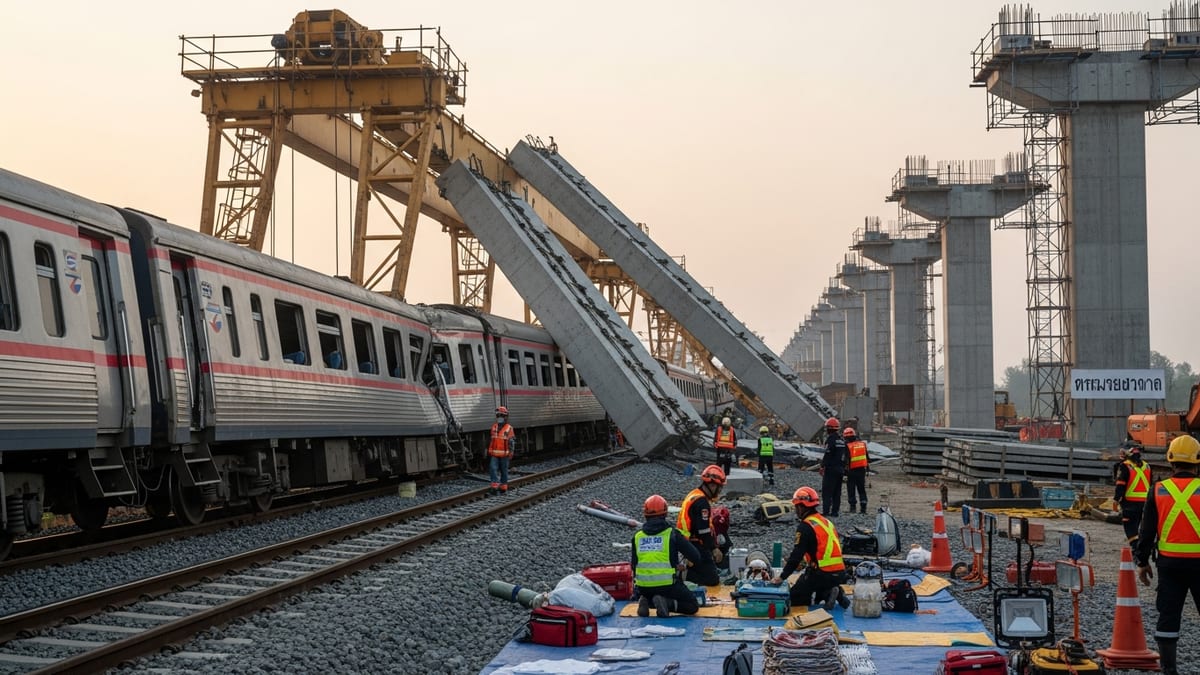
Moments After the First Call Comes In
Published coverage indicates that the derailment occurred on the morning of July 13, 2026, when a Canadian Pacific Kansas City freight train left the tracks near Sheriff King Street in southwest Calgary, sending multiple railcars into the Priddis Slough pond between the neighborhoods of Silverado and Chaparral. The line runs parallel to key commuter routes and not far from the city’s CTrain Red Line, making the location particularly sensitive for both local travel and regional freight movement.
The recently shared dispatch recordings, circulated alongside media reports and social media posts, capture the early minutes after the first reports of a train off the tracks. The audio reflects how call takers and radio operators quickly worked to pinpoint the exact location of the incident using cross streets, nearby communities, and references to both rail and roadway landmarks.
In the recordings, dispatchers can be heard relaying evolving information about the number of cars involved, the proximity to water, and the possibility of hazardous materials. Publicly available descriptions of the audio suggest that early exchanges focused on confirming whether there were injuries, whether any cars were leaking, and how close the derailment was to nearby residential areas and transit infrastructure.
As the incident unfolded, the audio portrays a scene in which travel and safety concerns were intertwined. Crews were directed not only to the rail corridor but also to surrounding access roads and vantage points, an approach that allowed responders to quickly assess impacts on both freight operations and local mobility.
Coordinating Fire, Police, and Rail Resources
The dispatch audio underlines how multiple agencies converged on the site within minutes. Reports indicate that fire services, police, and medical responders were all routed toward the pond area, while communication channels remained active with rail personnel responsible for the freight consist. This layered response is typical when a derailment intersects with urban infrastructure and environmentally sensitive areas.
Descriptions of the recordings suggest that dispatchers repeatedly confirmed unit positions, staging areas, and safe access routes as additional details emerged. The rail line’s alignment alongside residential streets, stormwater facilities, and utility corridors appears to have necessitated careful traffic control planning as more vehicles moved into the area.
Publicly accessible accounts of the audio also point to regular status checks on whether any hazardous materials were involved. Early reports indicate that the derailed cars primarily carried non-dangerous commodities, but dispatchers continued to verify train documentation and relay updates as on-scene crews inspected individual cars and the water’s surface for signs of contamination.
Coordination with rail operators is another theme running through the audio. Call logs and media coverage describe ongoing exchanges about train movements on adjacent tracks, power to the locomotives, and the need to halt or reroute other rail traffic through the southwest corridor while the situation was assessed.
Travel Disruptions Around a Growing Southwest Corridor
For Calgary travelers, the derailment became an unexpected disruption along an already busy growth area. The affected rail line borders arterial roads that serve commuters from bedroom communities in the city’s south and southwest, and it sits near commercial nodes that act as everyday hubs for shopping, services, and transfers to public transit.
According to local coverage, traffic restrictions were put in place on nearby streets as emergency vehicles accessed the pond and as heavy equipment arrived to stabilize railcars in the water. The dispatch audio captures repeated reminders for responders to manage congestion, direct arriving crews to specific checkpoints, and keep key intersections clear so that additional resources could get through.
For residents and travelers using the adjacent CTrain and bus network, publicly available reports indicate that the incident prompted questions about infrastructure resilience and redundancy. Even though initial information suggested no direct impact on passenger rail operations, the proximity of freight tracks to transit lines, multiuse paths, and roadways underscored how a single incident can ripple across several layers of the urban transportation system.
Dispatch instructions preserved in the recordings highlight the need to protect both responders and bystanders. Operators referenced the presence of onlookers at nearby pathways and road shoulders, leading to requests for units to establish wider perimeters and guide the public away from unstable ground and work zones.
Environmental and Safety Concerns at Priddis Slough
The Priddis Slough pond, which functions as both a natural wetland and a stormwater feature for surrounding communities, quickly became a focal point of the emergency response. Media outlets have reported that several railcars came to rest partially or fully in the water, raising concerns about potential impacts on water quality and wildlife.
The dispatch audio reflects that responders were asked early on to observe the color and odor of the water, identify any visible sheen, and note debris fields around the floating or submerged cars. Those observations, relayed in real time, helped guide subsequent cleanup efforts and the deployment of specialized environmental response teams.
Reports indicate that booms and containment measures were later installed to manage any minor releases from derailed equipment, while pumps and cranes were brought in as part of the prolonged recovery operation. The recordings show how these later stages were anticipated in the first hours, with dispatchers discussing access routes suitable for heavy machinery and safe locations for staging equipment away from soft ground and saturated embankments.
For travelers and residents in the vicinity, the visual presence of cranes, vacuum trucks, and work crews along the shoreline became a fixture in the days following the incident. According to ongoing local coverage, those operations are expected to continue until rail infrastructure is fully inspected, damaged cars are removed, and environmental sampling confirms that conditions in and around the pond have stabilized.
Raising Broader Questions About Rail and Urban Growth
The derailment and the newly highlighted dispatch audio are now part of a broader discussion about how freight operations intersect with a rapidly expanding urban edge. The corridor where the train left the tracks runs between established suburbs and newer developments, with homes, schools, and commercial centers steadily filling in previously open land.
Published commentary has noted that the recordings provide a real time snapshot of how complex these corridors have become. Dispatchers not only had to direct crews along tracks and access roads but also account for residential streets, school zones, and transit stations that did not exist when some sections of the rail infrastructure were first constructed.
Travel and tourism interests are also watching the investigation closely. Calgary increasingly promotes its southwest gateways as launch points for trips toward the Foothills and Rockies, and the same rail lines that carry freight through suburban neighborhoods also frame the experience of visitors arriving by road or transit. Any prolonged disruption or future safety measures could influence how people move through this part of the city.
As federal transportation safety investigators continue to gather data on the derailment, the dispatch audio stands out as an important record of the first critical minutes. It demonstrates how communication centers act as a command backbone, transforming scattered public reports into coordinated action at a location where freight logistics, local commuting patterns, and environmental stewardship all converge.