


More news on this day
A rush-hour collision between two passenger trains near Bedford, north of London, has left the driver of one train dead and at least 33 passengers seriously injured, according to early reports from June 19, 2026.
Get the latest news straight to your inbox!
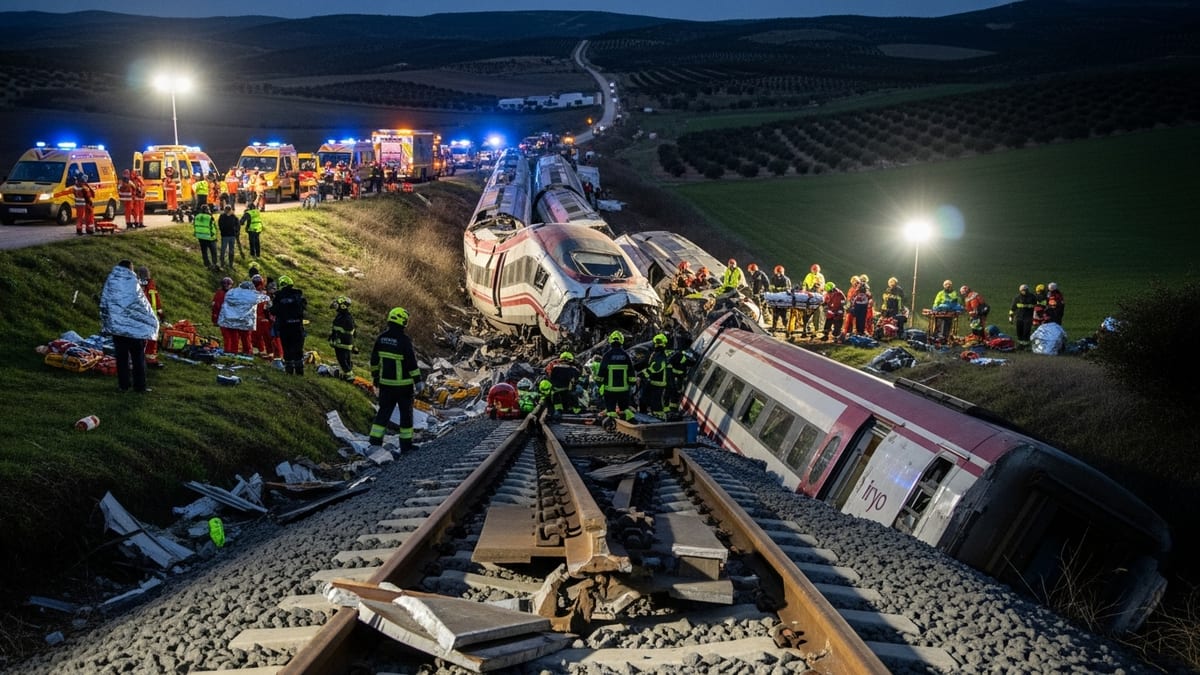
Rush-hour crash on key route to London
The collision occurred on Friday evening on a busy section of track south of Bedford, along one of the main corridors linking the Midlands and northern England with central London. Initial information from rail tracking data and published coverage indicates that both trains were heading toward London St Pancras International when the impact happened.
One of the services involved was a high speed train operated by East Midlands Railway, while the other was reported to be a Luton Airport Express service. The southbound trains came together near a stretch used heavily by commuters and airport passengers, magnifying the disruption on a traditionally crowded route at the end of the working week.
Images and video circulating on social platforms show a crumpled leading cab on one of the trains and at least one derailed carriage, with passengers standing on the trackside awaiting assistance. Debris can be seen around the front of the train, suggesting a powerful impact focused on the driver’s cab.
Published accounts describe one of the trains apparently striking the rear of the other at speed rather than a low speed shunting collision, a factor that is likely to have intensified the forces transmitted through the carriages and contributed to the scale of injuries on board.
Casualties and emergency response
Publicly available information from news wires and regional outlets indicates that the driver of one train died at the scene, becoming the first confirmed fatality from the collision. Early medical assessments from the scene report at least 33 passengers with serious injuries, alongside a larger number with minor wounds.
Passengers described being thrown from their seats by the sudden impact, with some recalling scenes of significant blood loss and visible fractures. Several accounts mention people lying on the floor of the carriages, unable to move, while others attempted to provide basic first aid using clothing and onboard supplies.
Emergency services from across the region were dispatched to the site, including paramedics, fire crews and specialist hazardous incident teams. An air ambulance was deployed to support the transfer of the most seriously injured patients to trauma centres in the East of England and greater London area.
Given the number of people on board both trains during the late afternoon peak, responders established a triage system on or near the tracks, separating passengers based on the severity of their conditions before transport to hospitals. Rail operators arranged onward road transport for those able to leave the scene once they had been assessed.
Disruption to rail services and passenger impact
The collision has caused substantial disruption across a wide area of the rail network, with services between Bedford, Luton and London St Pancras heavily affected. Rail operators have suspended or diverted trains on both the intercity and commuter networks while the line remains blocked for rescue work and initial investigation.
Passengers traveling between London and destinations such as Nottingham, Corby and Sheffield are being advised through service updates to expect extended journey times, cancellations and significant diversions. Replacement bus services have been brought in on some sections, but capacity constraints mean that many travelers are facing delays into the late evening and potentially into the weekend.
Those on board the affected trains have reported leaving via trackside walkways and being escorted to safe collection points, a process that can be slow and physically demanding, especially for the injured and those with mobility challenges. Some passengers have described long waits in the open air as emergency teams moved systematically from carriage to carriage.
The timing of the incident at the start of the summer travel period, and on a route linking central London with a major international airport, is expected to add to the broader travel impact, with knock-on delays for people heading to and from flights at Luton Airport.
Early focus of investigation
While it is too early for firm conclusions, several strands of information are shaping the first questions for investigators. According to summaries of coverage in national media, one East Midlands Railway service is reported to have developed a technical fault and come to a halt or reduced speed on the main line shortly before the crash.
Reports circulated that the driver of the affected train had been in contact with maintenance or control staff regarding the problem when the second train, identified by some accounts as a Luton Airport Express service, struck the rear of the stationary or slow moving train. This sequence, if confirmed, would point investigators toward signalling, communication protocols and train protection systems as critical lines of inquiry.
Modern British passenger trains are designed with crumple zones at the front to absorb impact energy and to protect passengers in the carriages behind. Images from the scene appear to show severe deformation of the driver’s cab, consistent with the fatal injuries reported, but relatively less visible damage to the body shells of the trailing coaches where most passengers were seated.
Specialist teams from the national rail accident investigation body are expected to examine onboard data recorders, signalling logs and radio communications, as well as the condition of the track and trains. Witness statements from passengers and staff will also be important for reconstructing the final minutes before the crash.
Safety context and questions for travellers
Major train collisions involving significant loss of life have become comparatively rare on the United Kingdom’s railways in recent decades, a trend widely attributed in public reporting to improvements in signalling systems, automatic train protection and rolling stock design. Events such as the Bedford collision are therefore likely to prompt detailed scrutiny of whether existing safeguards performed as intended.
For travelers, the incident is a reminder that high speed rail, while statistically one of the safest modes of transport, is not risk free. Many passengers on the Bedford route have spoken publicly about routinely using the line for daily commuting or airport trips, underscoring how routine journeys can be suddenly and violently disrupted.
Rail users planning journeys through the affected corridor in the coming days are being advised, through operator statements and travel bulletins, to check the latest service information before setting out, to allow extra time for connections, and to be prepared for changes at short notice as recovery and investigation work continues on site.
As the situation develops, attention is expected to shift from the emergency response to the experiences of those injured and the family of the driver who died, along with the broader question of what changes, if any, are needed to prevent a similar collision on one of the country’s most important passenger rail arteries.