


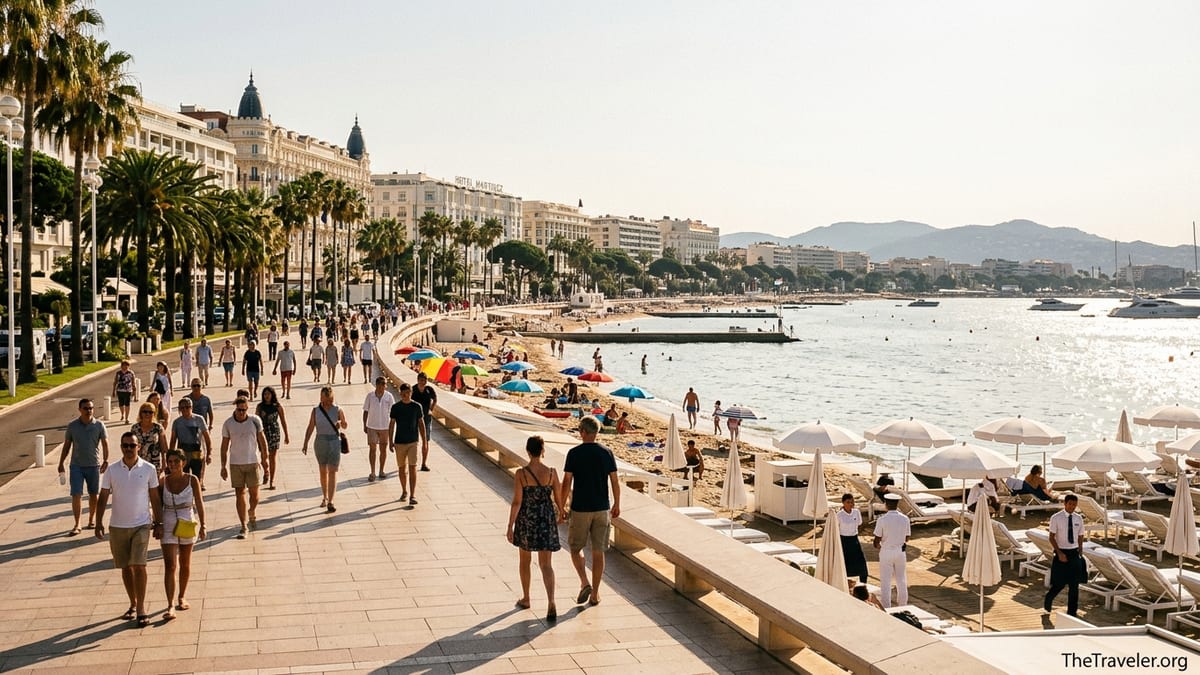
Few places capture Riviera glamor like Boulevard de la Croisette in Cannes. It curves along the Bay of Cannes in front of legendary hotels such as the Carlton, Martinez and Barrière Le Majestic, lined with designer boutiques, beach clubs and palm trees. It can also be one of the priciest and most bewildering strips of pavement in France. Visitors often arrive with Instagram dreams and leave with an overdraft and a mild sense of disappointment. With a little practical knowledge, you can avoid the classic mistakes and enjoy La Croisette for what it is: a spectacular seaside promenade that rewards those who plan smartly.
Get the latest updates straight to your inbox!
Confusing Public and Private Beaches
One of the first surprises along Boulevard de la Croisette is how much of the sand is operated by private beach clubs. From just east of the Palais des Festivals almost all the way to the Port Canto area, you will find a patchwork of club terraces and a few narrow public stretches. First time visitors often assume any sand visible from the promenade is free to use, then feel blindsided when staff stop them at the wooden decks or quote a sunbed price that rivals their hotel bill.
On Croisette itself, classic clubs tied to big hotels such as Carlton Beach Club and Martinez’s La Plage du Martinez typically charge around 60 to 100 euros per person in high season for a front row sun lounger with mattress, umbrella and towel. Slightly less famous clubs further along may still be 35 to 60 euros per day. Those prices can climb even higher during the Cannes Film Festival or Cannes Lions when demand spikes and many sections are partly rented out for corporate events.
At the same time, there are several entirely free public beaches tucked between these concessions. Plage Macé and Plage Zamenhof sit roughly opposite Rue du Commandant André and near the Casino area, while Plage du Casino and the small strip by the Palais des Festivals offer additional public access. They are popular with locals and budget conscious travelers who bring their own towel and umbrella. In July and August space on these beaches can be tight by late morning, so arriving before 10 a.m. makes a big difference if you want a decent patch of sand.
A common mistake is paying for a private beach every day of a weeklong stay simply because “that is what you do in Cannes.” In reality, many visitors are happier mixing one or two “treat” days at a Croisette club with cheaper or free days at Plage du Midi or Plage de la Bocca to the west, where sunbeds and meals are often significantly less expensive and the sand is more spacious. Checking prices on club menus as you walk the promenade before committing helps avoid sticker shock once you have already changed into your swimsuit.
Underestimating Costs Along the Strip
La Croisette is designed to part people from their money as pleasantly as possible. Restaurants on the sand, rooftop bars in the luxury hotels and branded popup terraces during major events all advertise chilled rosé, seafood platters and live DJs. What visitors often misjudge is how quickly “a quick drink on the beach” becomes a 40 or 60 euro line on the bill. In smart beach clubs, a basic aperitif cocktail commonly runs 18 to 25 euros, while a beer may be around 10 to 12 euros. A simple pizza or club sandwich can easily be 25 to 30 euros once you add the obligatory bottle of mineral water that might cost 9 or 12 euros.
The same applies to spontaneous shopping. The boulevard’s ground floors are dominated by names like Dior, Chanel, Gucci and Van Cleef & Arpels. Even non luxury boutiques on the Croisette tend to price far above what you would find in more local streets. Travelers sometimes wander in “just to look” and end up buying a logo cap or silk scarf that costs more than their flight. It is not that these stores are dishonest, simply that everything on this strip is calibrated to a wealthy clientele including yacht owners, festival delegations and conference visitors with expense accounts.
If you want to enjoy the scene without wrecking your budget, make specific decisions in advance. For instance, you might plan one sunset cocktail on a Croisette terrace, then have dinner on Rue Meynadier or in Le Suquet where main dishes often start closer to 16 or 18 euros. You could window shop at Dior on Boulevard de la Croisette then actually buy clothes or cosmetics on Rue d’Antibes, the parallel shopping street behind the promenade, where mid range French and international chains offer more realistic prices.
Another easy way to overspend is transportation. Taxis waiting near the Palais des Festivals and in front of the big hotels are convenient but not cheap, and some visitors report drivers taking scenic detours for short rides along the seafront. Unless you have a lot of luggage, it is usually more sensible to walk La Croisette and use the local Palm Bus network for longer hops along the bay. A single bus ticket within Cannes typically costs only a couple of euros, and services run regularly along the seafront and up to residential areas behind the promenade.
Picking the Wrong Time of Day or Season
The Croisette looks dramatically different depending on when you visit. In the height of summer and during high profile events such as the Cannes Film Festival in May or Cannes Lions in June, the boulevard can feel like a continuous traffic jam of taxis, branded shuttles and delivery vans. Sidewalks clog with festival badge holders, photographers and curious day trippers craning for a glimpse of anyone famous emerging from the Majestic or climbing the red steps at the Palais. Visitors who expect a relaxed beach resort promenade may find themselves overwhelmed by noise and crowds.
Even outside festival dates, midday on a sunny day in July or August is often the least pleasant time to walk the Croisette. The white stone pavements reflect heat, and there is limited shade once you are away from the hotel frontages. At the same time, public beaches along the boulevard reach peak occupancy after lunch, meaning late arrivals struggle to find a free patch of sand while private clubs are operating at full capacity. Many first timers only experience La Croisette under these conditions and leave with a skewed impression of Cannes as nothing but traffic and queues.
The promenade is at its most enjoyable earlier and later in the day. Around 8 or 9 a.m., locals walk dogs, joggers trace the curve of the bay and hotel staff set out neat rows of loungers on the sand. Shops begin opening from 10 a.m., but crowds are still manageable. Early evening, particularly just before sunset, brings a softer light on the bay and cooler temperatures, with families strolling between the carousel near the Palais and the gardens around Port Canto. Planning your main Croisette walk for these windows rather than the hottest midday hours makes the same stretch of pavement feel like a different city.
Seasonality also matters more than many visitors realize. March, April, late September and October can offer warm, bright days when you can still sit on the sand or a terrace but find hotel rates and beach club prices less aggressive than in high summer. In winter, Croisette’s palm lined curves remain beautiful but several beach clubs dismantle their decks, and swimming becomes more symbolic than comfortable. A common mistake is assuming the same beach experience is available year round; in reality, the Riviera operates on a clear seasonal rhythm that shapes what La Croisette can offer.
Ignoring Better Value Just One Street Back
Another classic error is sticking so closely to the waterfront that you never discover how different Cannes feels a few minutes inland. Boulevard de la Croisette itself is intentionally polished and international, focused on luxury hotels, designer brands and standardized beach menus. Just behind it, Rue d’Antibes runs parallel as the main shopping street for a broader mix of residents and visitors, with high street fashion, perfumeries and French chains at more accessible prices. Walk a little further and Rue Meynadier and the covered Marché Forville area become more recognizably Provençal, with bakeries, cheese shops and stalls piled with seasonal fruit.
Visitors who only ever eat and shop on the Croisette often leave believing Cannes is eye wateringly expensive and strangely generic. They may spend 30 euros on a mediocre salad at a beachfront restaurant, then pay similar prices for basic souvenirs from a kiosk that mainly sells to cruise ship passengers. Meanwhile, a five minute walk away, locals are lunching on daily specials in small bistros for under 20 euros or buying takeaway roast chicken and Niçoise dishes from market counters at reasonable prices.
The same principle applies to viewpoints. Many people assume you need to pay for a fancy rooftop bar to get a good panoramic shot of the bay, but if you turn away from the sea and walk up into the old quarter of Le Suquet, you will quickly reach streets that look and feel like an older Mediterranean town. From the terrace near the church of Notre Dame d’Espérance, the entire curve of the Croisette and the Lérins Islands opens up below, free of charge. Skipping this simple detour in favor of lingering only at hotel frontages is one of the biggest missed opportunities in Cannes.
As a practical rule, if you see a row of supercars outside and menus in several languages on glossy boards, you are probably still on Croisette tourist pricing. For more local flavor and value, aim inland to narrower streets such as Rue des États-Unis, Rue du Commandant André and Rue Hoche, then keep walking toward the station or Le Suquet until French rather than English dominates the chalkboard specials.
Misunderstanding Local Etiquette, Dress and Tipping
Boulevard de la Croisette is international, but it is still in France, and misunderstanding local habits can create awkward moments. Dress codes are more flexible than they look, yet some visitors go too casual or too formal for the situation. Beach clubs are used to people arriving in swimwear, but most expect you to cover up when using the restaurant or bar area. Turning up for lunch shirtless or in a dripping bikini is frowned upon even if you are only a few meters from the sand. Conversely, you do not need evening wear to sit on a hotel terrace for a drink, but smart casual clothing and closed shoes for men are safer than flip flops and gym shorts.
Tipping is another area where visitors, especially from North America, often feel uncertain. By law, restaurant and café prices in France include service, and that applies on La Croisette as much as anywhere else. Leaving a little extra is appreciated but not mandatory. A common practice among locals is to round up the bill or leave a few coins, or perhaps 5 to 10 percent for particularly attentive service in a higher end venue. Problems arise when staff assume that foreign guests do not understand the norms. Some visitors report servers not returning change unless specifically asked, or presenting card terminals with a preselected tip percentage.
To avoid confusion, always check your bill. If it says “service compris,” service is already included. If you pay by cash and expect change, wait for it and do not be shy about asking if it does not appear. When paying by card, you can politely decline suggested tip prompts if you feel they are excessive. In busy periods on the Croisette some venues focus heavily on speed and turnover; you should not feel obliged to reward indifferent service with a large extra percentage simply because that is what you might do at home.
General politeness goes a long way. Starting interactions with a simple “bonjour” when entering a shop or addressing staff, and “s’il vous plaît” when ordering, is considered basic courtesy in France. Skipping these small phrases in the rush of tourism can unintentionally make you seem rude, and on a strip where staff deal with huge numbers of people every day, it may influence how warmly you are treated.
Overplanning Around Celebrity Glamour
La Croisette’s global image is tightly linked to the Cannes Film Festival. Many visitors arrive convinced that the boulevard is a permanent red carpet populated by actors and influencers. In reality, outside a few weeks of the year it is more likely you will see families with strollers and convention attendees with lanyards than movie stars in couture gowns. Scheduling a trip or structuring your days entirely around the hope of celebrity spotting on the Croisette often leads to frustration.
During the festival itself in May, the central stretch around the Palais des Festivals and the adjacent hotels becomes a security zone with barriers, accreditation checks and press pens. Unless you have official passes or specific invitations, your experience of La Croisette at that time may be limited to distant glimpses of black SUVs and formal wear from behind crowd control fences. You will likely find beach clubs part booked for private events, restaurant reservations harder to secure, and hotel prices several times higher than in shoulder seasons.
Even when no festival is in town, marketers know how much the Cannes brand sells. Temporary installations for luxury labels and technology companies often appear on the Croisette during conferences such as Cannes Lions, with rooftop parties and branded experiences. While these can be fun to witness from the outside, many are invitation only, and devoting an evening to trying to talk your way into one is seldom productive. The best strategy is to treat any celebrity sightings or party invitations as a bonus, not a goal.
If you appreciate cinema, a more satisfying way to connect with Cannes’ film history is to visit the murals depicting classic movie scenes scattered around town, or to attend the free open air screenings that sometimes take place on Macé Beach during festival periods for the general public. Combined with a simple walk past the Palais’ famous steps when they are not in use, this gives you a sense of the city’s role in film culture without building your entire itinerary on the unlikely chance of a selfie with a star on the Croisette sidewalk.
Overlooking Practicalities: Sun, Safety and Logistics
Finally, visitors often become so focused on glamor that they forget basic seaside common sense. The south facing bay ensures that most of the Croisette is exposed to direct sun through the middle of the day, and the sea breeze can hide how strong that sun is. It is easy to spend hours wandering the promenade, stopping for an ice cream near the carousel or a coffee at a hotel terrace without reapplying sunscreen or drinking enough water. Sunburn is one of the most common unglamorous souvenirs people take home from Cannes.
Shade is uneven along the boulevard. While palm trees and hotel awnings give some relief in front of properties like the Majestic and Carlton, large open stretches between the Palais and Port Canto are exposed. In high summer, consider sun protection as seriously for a walk on the Croisette as you would for a full day on the beach: hat, sunglasses, high factor sunscreen and a refillable water bottle. Public fountains exist but are not as frequent as in some cities, so buying a large bottle from a supermarket on Rue d’Antibes before heading to the promenade usually saves money over repeatedly purchasing small waters from kiosks.
Petty theft is relatively low key compared with big capitals, but crowded summer evenings and festival weeks do attract pickpockets who work the promenade and the area near the Palais. The most frequent problems involve unattended bags on the sand, valuables left on café chairs, or phones placed on terrace tables close to the street. Simple precautions make a big difference: keep your bag closed and in front of you, avoid leaving belongings unattended while you swim, and be wary of overly friendly strangers causing distractions near your table.
Finally, think about logistics in and out of the Croisette. Driving directly onto the boulevard in peak season is almost always a mistake unless you are staying in one of the seafront hotels with reserved parking. Public underground car parks exist, including near the Palais and in the vicinity of the large hotels, but spaces can be scarce and daily rates add up quickly. For day visitors, it often makes more sense to park slightly inland or arrive by train at Cannes station, then walk down to the sea. Once there, the Croisette is perfectly walkable from the old port end all the way to Port Canto if you pace yourself and take breaks on benches or café terraces along the way.
The Takeaway
Boulevard de la Croisette is neither a tourist trap to avoid nor a fantasyland where everyone lives on champagne and private yachts. It is a polished seafront boulevard with specific rules, rhythms and price levels that reward visitors who do a little homework. Common mistakes tend to cluster around three themes: misreading the public versus private nature of the beaches, underestimating how much the Croisette premium will add to food, drinks and shopping, and overlooking how much more varied and interesting Cannes becomes as soon as you step a few blocks away from the water.
If you arrive understanding that most of the sand in front of the big hotels is chargeable, that a glass of wine will cost more here than in a back street bar, and that celebrity sightings are an occasional bonus rather than a guarantee, you are far less likely to feel disappointed. Combine an early morning or sunset stroll along the bay with an excursion up to Le Suquet, plan at least one meal off the main strip, and use public transport or your own feet rather than taxis wherever possible. Under those conditions, La Croisette becomes what it has been for decades: a beautiful promenade to enjoy on your own terms, rather than a stage on which you feel obliged to play a role.
FAQ
Q1. Are any beaches on Boulevard de la Croisette actually free to use?
Yes. Small public stretches such as Plage Macé, Plage Zamenhof and the area near the Palais des Festivals are free. You will need to bring your own towel and shade, and they fill quickly in summer.
Q2. How much should I expect to pay for a sun lounger on a Croisette beach club?
In high season, most well known clubs charge roughly 60 to 100 euros per person for a front row lounger with umbrella and towel, while second or third rows and less famous clubs might start around 35 to 50 euros.
Q3. Is it worth visiting La Croisette if I am on a tight budget?
Yes, as long as you manage expectations. Walking the promenade, using the public beaches and window shopping are free, and you can eat and drink more cheaply on nearby streets like Rue d’Antibes or in Le Suquet.
Q4. What is the best time of day to walk along the Croisette?
Early morning and early evening are the most pleasant. Temperatures are cooler, light on the bay is beautiful and crowds are thinner than at midday in summer.
Q5. Do I need to dress formally to visit hotels or bars on La Croisette?
No formal wear is required, but smart casual clothing works best. Beachwear is fine on the sand, yet you should cover up with at least a shirt or dress when entering restaurants, bars or hotel lobbies.
Q6. Is tipping mandatory in Croisette restaurants and beach clubs?
No. Service is normally included in menu prices. Locals might leave a small extra amount or round up the bill for good service, but large percentage tips are not expected.
Q7. How crowded is La Croisette during the Cannes Film Festival?
Extremely. Areas near the Palais des Festivals and main hotels are fenced and packed with accredited guests, media and onlookers. Prices rise and access to some beach sections is restricted.
Q8. Is it safe to walk along the Croisette at night?
Generally yes. The area is well lit and busy late into the evening, particularly in summer. As in any tourist hotspot, keep an eye on bags and phones and avoid leaving valuables unattended.
Q9. Can I find more affordable food close to the Croisette?
Yes. Within a 5 to 10 minute walk inland you will find bistros, bakeries and supermarkets on streets such as Rue d’Antibes, Rue Meynadier and around Marché Forville with more moderate prices.
Q10. Is it better to drive or use public transport to reach the Croisette?
Public transport or walking is usually easier. Parking on or near the boulevard can be expensive and scarce in peak season, while trains and local buses stop a short walk away from the seafront.