


More news on this day
A low-speed collision between two passenger trains north of London has left at least one person dead, multiple passengers injured and services severely disrupted on one of Britain’s busiest intercity corridors, according to early reports from British media and rail observers.
Get the latest news straight to your inbox!
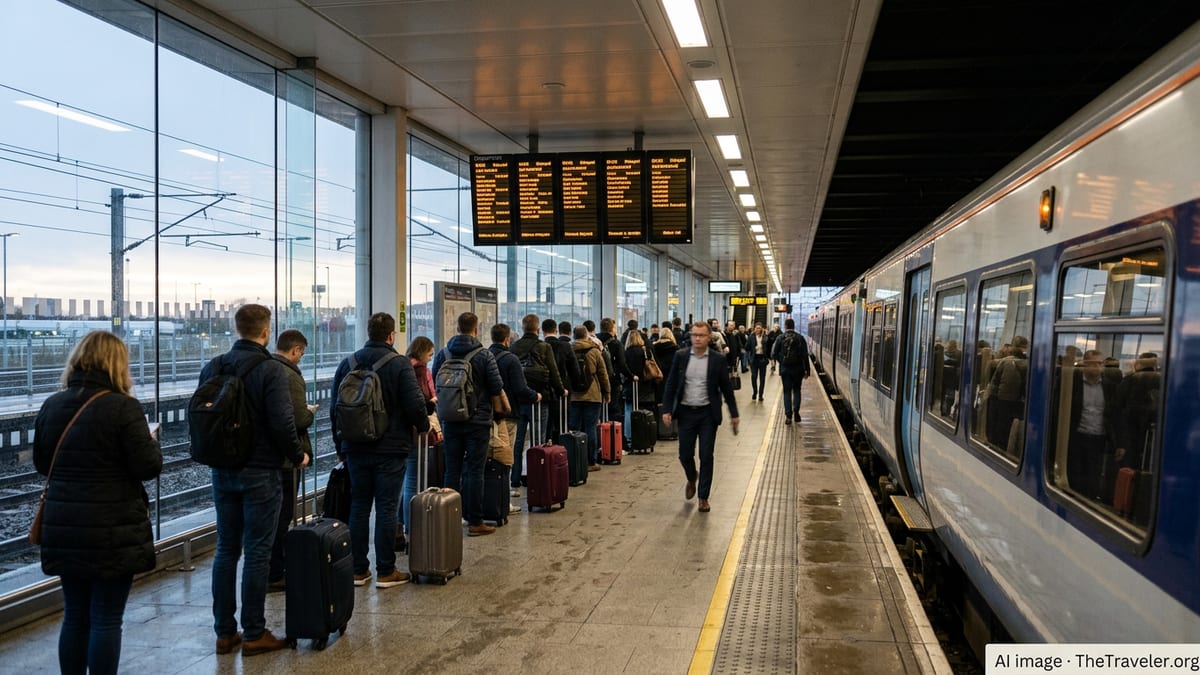
Collision On Main Line North of London
Reports indicate that the incident took place on the afternoon of 19 June 2026 on the Midland Main Line near Bedford, a key junction on the route linking London St Pancras with the East Midlands. Early information drawn from live rail data and local coverage suggests that two southbound services were involved, both operated by East Midlands Railway.
Publicly available information shows that one train running from Nottingham to London St Pancras came into contact with a second service from Corby to the capital. The impact appears to have occurred a few miles south of Bedford station, on a multi-track section that normally handles a dense mix of fast intercity and airport express services.
Initial accounts shared by passengers online describe a sudden jolt and abrupt deceleration rather than a high-speed crash, suggesting that the collision happened at relatively low speeds. Even at modest velocities, however, the forces involved in a rear-end impact between two modern trains are substantial, capable of throwing standing passengers off their feet and causing significant internal damage to rolling stock.
Emergency services, rail staff and local responders were quickly visible in images and video circulating on social platforms, working around the stopped trains in open countryside. The line was swiftly closed in both directions to allow rescue and assessment operations, cutting a major artery between London, the East Midlands and connections further north.
Casualties, Injuries And Passenger Experience
Early accounts shared through local media and witness reports online indicate that at least one person has died as a result of the collision, with a number of other passengers suffering injuries ranging from minor to serious. The precise toll is still the subject of evolving coverage, and official figures have not yet been consolidated.
Passengers on board describe scenes of confusion immediately after the impact, with some carriages losing power and lighting before staff began moving through the trains to check on those who had fallen or been struck by luggage. In crowded peak-time services, many travellers stand in vestibules or aisles, which can increase the risk of injury when a train stops suddenly.
Images shared from the scene show visible damage to the leading cab of one unit and to the rear of the other, but no evidence of extensive derailment or jack-knifing. That pattern is consistent with a low-speed rear-end event where the energy of the collision is partially absorbed by the sacrificial structures at each end of the trains, which are designed to crumple in order to protect the passenger saloons.
While comprehensive medical assessments are still under way, rail safety specialists often note that even non-fatal rail collisions can result in long-lasting physical and psychological effects for passengers and crew, particularly for those seated or standing close to the point of impact.
Major Disruption For Travelers And Operators
The collision occurred on a vital section of the network that carries fast intercity trains, regional services and airport links towards Luton Airport and central London. In the immediate aftermath, services on the Midland Main Line were halted, with trains held at stations or diverted where infrastructure allowed.
Rail journey planners and real-time tracking data show widespread cancellations affecting journeys between London, Bedford, Luton, Kettering, Corby, Nottingham and Sheffield. Some passengers reported being asked to remain on stranded trains for extended periods while the line ahead was assessed for damage and clearance.
Published information from rail operators suggests that replacement bus services and alternative ticket acceptance on other routes are being arranged for stranded travelers. However, the geography of the corridor and limited parallel main lines mean that many journeys are likely to be significantly extended, particularly for those needing to reach London from the East Midlands or vice versa.
For visitors and business travelers, the disruption highlights the vulnerability of tightly timed itineraries that rely on single mainline corridors. Travel advisers typically recommend allowing additional time, especially when onward flights or cruise departures are involved, to absorb unexpected shocks such as major infrastructure incidents.
Early Focus On Signalling, Spacing And Train Protection
Although it is too early for any definitive assessment of cause, publicly available commentary from rail professionals and enthusiasts has focused on how two modern passenger trains came to occupy the same stretch of track. Britain’s mainline network is equipped with layers of signalling and train protection systems designed to prevent such events, including automatic warnings in the cab and automatic brake applications if signals are passed at danger.
Specialist discussion has centred on the possibility of a low-speed rear-end collision, potentially involving a train approaching a signal protecting a stationary service ahead. In such scenarios, automatic systems can intervene only after certain thresholds are crossed, leaving a short window in which a slow but still damaging impact can occur if braking begins too late or adhesion is poor.
The Rail Accident Investigation Branch is expected to be notified and to begin gathering data from on-train recorders, signalling logs and trackside equipment. Investigations of comparable incidents in Britain and elsewhere typically examine whether drivers had clear information, whether signals and lineside signs were working as intended and how the design of the timetable and traffic management might have contributed to trains operating in close proximity.
For regular rail users and the wider public, the presence of an independent technical investigation provides a structured route to understanding what went wrong and what can be improved, though such inquiries usually take months before full findings are released.
Safety Record And Implications For UK Rail Travel
The collision near Bedford unfolds against a backdrop in which fatal train-to-train crashes in Britain have become comparatively rare. Official statistics and previous safety reports describe a network where serious passenger accidents are infrequent by global standards, even as overall train movements and passenger numbers remain high.
Recent years have nonetheless included a small number of high-profile incidents involving derailments, buffer stop collisions and infrastructure failures. Each has prompted targeted technical changes, from modifications to track drainage and embankment monitoring to updates in driver training, signalling design and emergency procedures.
Travel analysts observing the Bedford collision note that, while the apparent low speed and survival of the train structures point to the effectiveness of modern safety design, the human impact remains severe for those involved. The event is likely to intensify scrutiny of how close together trains are scheduled on intensively used main lines and how quickly automatic protection systems can intervene when risks emerge.
For domestic commuters and international visitors alike, the incident is a reminder that rail travel, though statistically one of the safest modes of transport in Britain, is not entirely free of risk. As services gradually resume on the Bedford corridor, attention is expected to shift from immediate disruption and casualty figures to the longer-term lessons for infrastructure managers, train operators and the regulators responsible for keeping Britain’s railways moving safely.