


More news on this day
A deepening drought and an unfolding electricity crisis in Hungary are beginning to reshape the country’s transport map, with publicly available information indicating that rail operators are curbing some services to ease pressure on the power grid just as summer travel demand peaks.
Get the latest news straight to your inbox!
Drought, Danube Lows and a Nuclear Shutdown
The current disruption to rail operations in Hungary is rooted in an exceptional spell of hot, dry weather that has pushed the Danube River to record low levels. According to recent international coverage, reduced river flows have impaired cooling capacity for power stations along the waterway and severely constrained electricity generation in several Central European countries, including Hungary.
Hungary is particularly exposed because its sole nuclear power plant at Paks traditionally supplies a large share of the country’s electricity. Recent reports indicate that in late July and early August the facility progressively powered down, and by Sunday, August 2, operations were halted for the first time in its 44-year history as cooling water levels in the Danube fell below safety thresholds. The shutdown has removed a critical pillar of Hungary’s baseload power at precisely the moment when air conditioning use and industrial demand are near seasonal highs.
Government communications and independent energy analyses describe the situation as an energy emergency driven by the combined effects of prolonged drought, extreme heat and the unplanned loss of nuclear and thermal capacity. With limited domestic generation available, Hungary has been drawing heavily on cross-border interconnections within the European power grid, but transmission constraints and high regional demand have kept prices elevated and left system operators searching for additional ways to cut consumption.
Rail Restrictions as a Tool to Stabilize the Grid
Rail transport, which is largely powered by electricity in Hungary, has now become a focus of these emergency efforts. According to regional media summaries and sector briefings, the national grid operator has requested cuts in consumption from major industrial users and infrastructure operators. Rail companies have responded by announcing time-limited reductions in electrically hauled services during evening peak hours, when overall demand and spot prices tend to spike.
Reports circulating on European transport and energy platforms indicate that freight trains are bearing a significant share of the immediate restrictions. From Monday, operators are expected to halt or sharply reduce rail cargo movements during a multi-hour window in the late afternoon and early evening to free up capacity on the grid. Some passenger services on secondary lines are also being thinned out or replaced with diesel traction and bus substitutions where rolling stock and infrastructure allow.
These steps are framed domestically as extraordinary but temporary measures designed to prevent broader blackouts. Publicly available information shows that railway timetables have already been heavily modified this summer for planned track works around Budapest and on several regional corridors. The new energy-saving cuts are being layered on top of those engineering-related changes, creating a patchwork of detours, bus replacement routes and altered departure times that is becoming difficult for passengers and logistics planners to navigate.
Passenger Disruption and Freight Bottlenecks
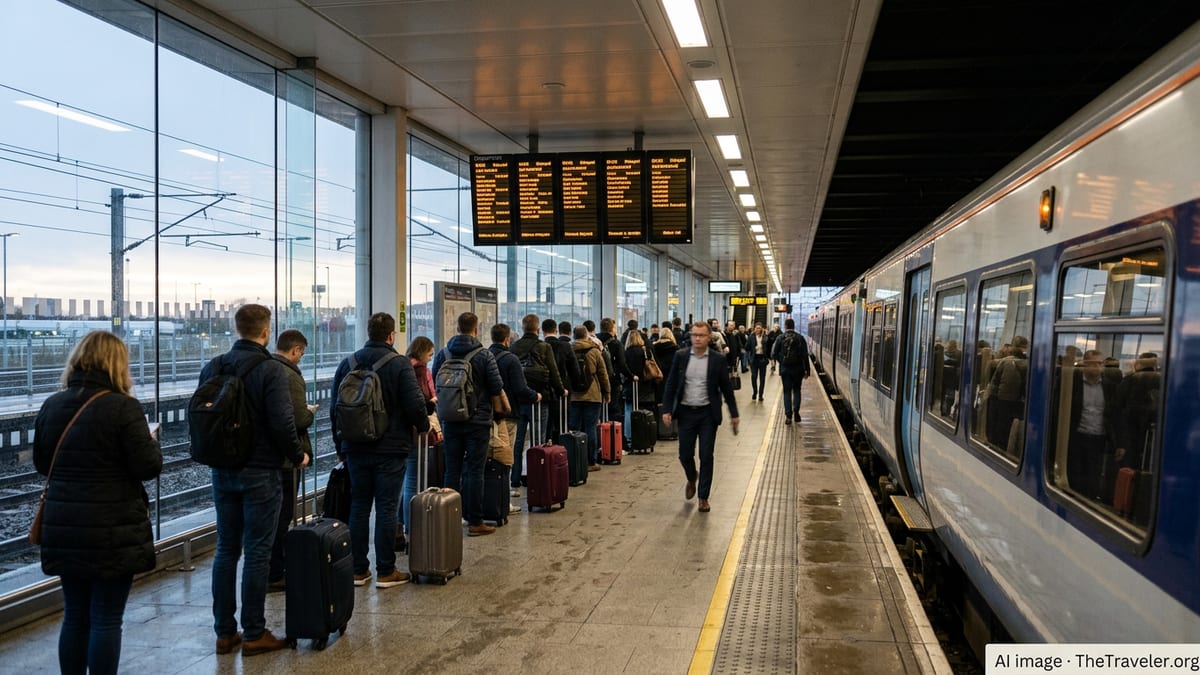
The impact on passengers is most visible in and around Budapest, where commuter and regional services typically depend on dense, electrically powered timetables to move large numbers of people in and out of the capital. Hungarian transport notices and local news coverage point to reduced frequencies on certain suburban routes during the late afternoon peak, with operators encouraging travelers to shift journeys to earlier or later trains where possible.
On longer-distance routes, the picture is mixed. On some electrified main lines, operators are reportedly prioritizing core intercity passenger services while scaling back slower regional trains and non-urgent freight. Where diesel locomotives and compatible rolling stock are available, these are being redeployed to keep at least a skeleton service running on lines that would otherwise fall silent during the grid’s most stressed hours. However, Hungary’s supply of modern diesel traction is limited, and some older equipment is already heavily utilized for planned construction diversions.
Freight operators are signaling growing concern about bottlenecks, particularly on east-west corridors that connect Hungarian logistics hubs with ports and manufacturing centers in neighboring countries. Industry advisories from international logistics firms earlier this year had already warned of structural delays on key routes because of infrastructure works and congestion in adjacent rail networks. The new power-driven restrictions, which cluster additional train movements into narrower off-peak windows, are expected to compound those pressures and may force some shippers to temporarily shift cargo to road transport.
Economic Stakes and Regional Interdependencies
The electricity crunch arrives at a sensitive moment for Hungary’s economy. Energy-intensive industries, including automotive manufacturing and chemicals, rely on predictable rail freight and steady power supplies. According to recent public statements cited in regional press, policymakers and business representatives are warning that prolonged dependence on expensive imports and constrained logistics could weigh on growth and competitiveness in the second half of 2026.
At the same time, the situation highlights Hungary’s deep interdependence with its neighbors. The country’s power grid is tightly integrated into the European system, and current coverage indicates that increased imports from surrounding states are helping to cover part of the shortfall left by Paks. Several Central European governments are reportedly reviewing their own generation and export capacities as river levels fluctuate and hydropower or cooling systems face similar constraints.
For rail, these cross-border links are equally critical. Timetable changes in Austria, Slovakia and Romania feed directly into the reliability of Hungarian services, and any knock-on energy-saving measures in those countries could further reshape the schedule of international trains. Logistics bulletins in recent months have already documented rerouted and delayed trains on the main corridors into and out of Hungary because of infrastructure works; drought-induced power limits now add a second layer of uncertainty.
Climate Risks and the Future of Rail Resilience
The current rail restrictions are being widely interpreted in policy and academic discussions as another illustration of how climate-related stresses can cascade across infrastructure systems. Hungary’s own climate and energy planning documents have previously identified heatwaves, drought and hydrological variability as emerging risks for both electricity and rail operations. This summer’s events are giving those risk assessments an immediate, real-world test.
Analysts note that electric rail is generally regarded as a climate-friendly transport mode, and decarbonization strategies across Europe lean heavily on shifting passengers and freight from road to rail. However, the Hungarian experience shows how dependent such systems remain on the resilience of power generation and cooling water supplies. If nuclear and thermal plants linked to rivers become less reliable during extended heat and drought periods, operators may need to rethink backup options, from diversifying generation sources to maintaining a strategic reserve of diesel traction for emergencies.
In the short term, Hungarian travelers are likely to face continued disruption while drought conditions persist and the power system remains under strain. Rail operators are publishing rolling updates on schedule changes, and travel planners in the region are beginning to build in additional buffer time for connections. Over the longer term, the intersection of climate risk, energy security and rail reliability is likely to feature more prominently in transport debates not only in Hungary but across the wider Danube basin.