


More news on this day
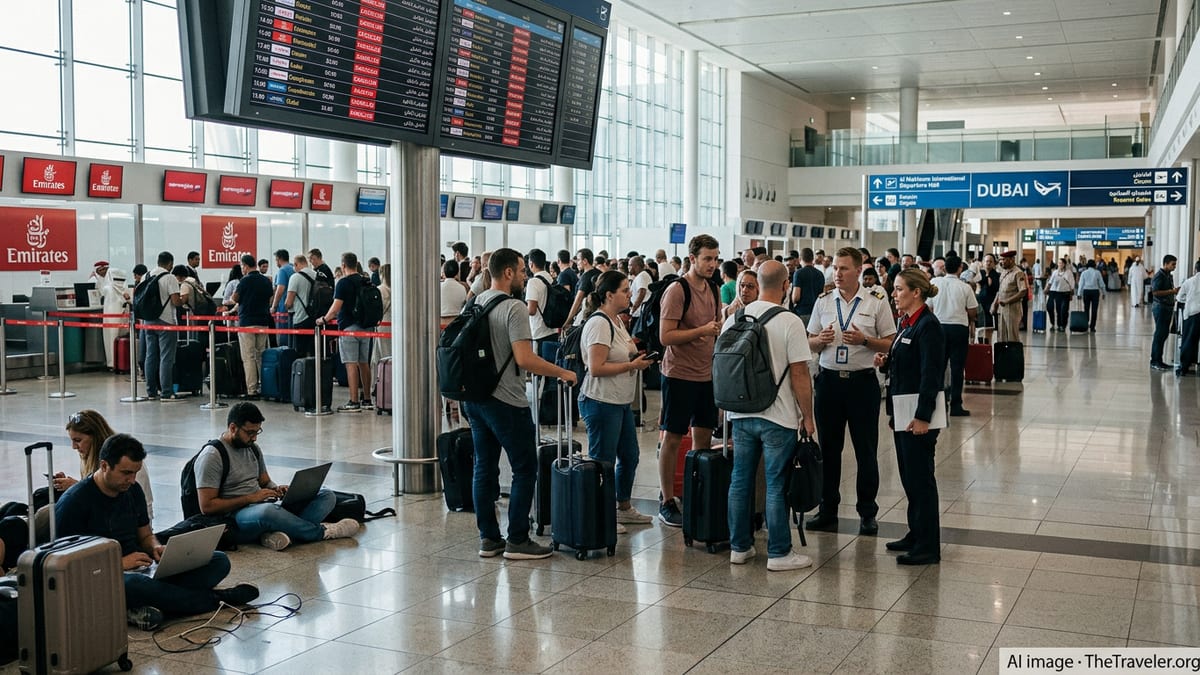
Travelers transiting Dubai International Airport faced fresh disruption this weekend as 91 flights were reported delayed and 9 canceled, affecting major carriers and key long haul connections linking London, Mumbai, New York, Riyadh, Singapore and other global hubs.
Get the latest news straight to your inbox!
Knock on delays across one of the world’s busiest hubs
Publicly available flight tracking data and regional aviation coverage show that Dubai International Airport, already operating under constrained airspace in recent weeks, has again seen a spike in disruption concentrated over a single operational window. The latest figures indicate 91 delayed movements and 9 outright cancellations, a pattern consistent with the rolling operational adjustments that have followed regional airspace restrictions since March 2026.
Dubai International regularly handles close to 400 scheduled departures a day, and industry databases suggest even a few dozen off schedule flights are enough to send ripples through an already dense timetable. Recent analytics on regional disruption estimate that each hour of delay at the hub can translate into significant additional costs in fuel, crew, and passenger care, while also straining turnaround capacity at congested gates.
The newest wave of delays follows a period during which carriers using Dubai, Sharjah and Abu Dhabi have repeatedly trimmed timetables, consolidated services, or swapped aircraft types in response to changing routings and airspace availability. Recent traffic summaries for the first quarter of 2026 highlighted that London, Mumbai and Jeddah remain among Dubai’s busiest city markets, which means disruption at the hub is quickly felt across Europe, South Asia and the Gulf.
Operational summaries released in May pointed to a gradual rebuilding of capacity through Dubai as airspace restrictions eased, but they also acknowledged that scheduling remains fragile. The current pattern of 91 delays and 9 cancellations underlines how a single day of tight capacity, weather variation or route restrictions can still push the hub back into visible disruption.
Major carriers adjust schedules on key long haul routes
The wave of affected flights includes services operated by Emirates, flydubai, Air India and Turkish Airlines, alongside other international carriers that route traffic through Dubai. According to flight status pages and published schedule updates, Emirates has continued to operate on a reduced and frequently adjusted timetable, with some A380 operations on European and North American routes being replaced by Boeing 777 services through June.
Recent schedule bulletins show that London and New York services remain core to Emirates’ long haul network, but aircraft changes and occasional consolidations have been introduced to manage capacity. Aviation analysts note that even when flights operate, changes in aircraft type can reduce total available seats, tightening conditions for rebooking on days when cancellations occur.
Low cost carrier flydubai, which shares the hub and feeds a large portion of regional traffic into Dubai, is also listed as operating a trimmed schedule, with its own flight status tools urging passengers to reconfirm departure times on the day of travel. Because many travelers use flydubai to connect into Emirates long haul services, any disruption to shorter regional sectors can lead to missed onward connections and unplanned overnight stays.
Indian and Turkish carriers remain important players in the current disruption pattern. Air India and its low cost arm have been publishing rolling operational notes for the Gulf region, detailing ad hoc operations to and from Dubai and other UAE hubs. Turkish Airlines, meanwhile, continues to channel a portion of Middle East and South Asia traffic through both Istanbul and Dubai, meaning delays in the UAE can also feed into timing pressures at its own hub.
Global passengers on routes between Europe, Asia and North America hit
The distribution of affected flights underscores Dubai’s role as a bridge between continents. Current disruption data highlights delays and cancellations on services connecting London, Mumbai, New York, Riyadh and Singapore, among other cities. These routes sit at the core of the so called east west trunk, where passengers frequently rely on tightly timed overnight connections.
London remains Dubai’s single busiest city pair by passenger volume, and even relatively minor changes in departure times can cascade into missed connections for those heading onward to North America or Africa. For travelers flying between London and destinations such as Sydney, Johannesburg or Manila via Dubai, a delayed inbound flight can turn a planned short layover into a misconnection and the need for rerouting.
Mumbai and Riyadh represent two of the most heavily trafficked markets between India, the Gulf and beyond. Published traffic figures for early 2026 show that India once again ranked as Dubai’s largest country market, with Saudi Arabia close behind. When flights between these cities and Dubai run late, ripple effects are quickly seen on onward departures to Europe and North America, including services to New York and major regional capitals.
On the Asia Pacific side, Singapore and other Southeast Asian gateways rely on Dubai for both point to point and connecting flows. Industry schedule trackers show that some planned A380 services between Dubai and key Asian cities, including Singapore, have remained on smaller widebody equipment into June, limiting seat availability for passengers trying to rebook after a disrupted connection.
Ongoing regional airspace constraints underpin disruption
Behind the day to day list of late or canceled flights lies a broader pattern of constrained airspace and network realignment across the Middle East. Aviation advisory services and passenger rights organizations have tracked weeks of elevated disruption in and around UAE hubs, after temporary airspace restrictions forced airlines to re route or suspend some services earlier in 2026.
In mid April, analysis of regional operations counted several thousand delays and hundreds of cancellations across Middle Eastern and adjacent Asian airspace within a 24 hour window, with Dubai International, Abu Dhabi and Sharjah all significantly affected. Although capacity has gradually been restored, many airlines continue to operate with limited operational slack, making their schedules more vulnerable to localized weather or technical issues.
Industry commentary notes that rerouted flights often take longer paths over alternative territories, increasing block times and narrowing the window for on time turnarounds in Dubai. When a succession of such flights arrives behind schedule, airport resources, including stands and ground handling, can quickly become saturated, leading airlines to hold departures or, in the most constrained cases, cancel selected services.
Operational reports from Dubai’s airport operator in early May credited cooperation between local carriers, service partners and airspace managers with sustaining global connectivity through the disruption. The same updates cautioned, however, that the events were unprecedented for a major hub of Dubai’s scale, and that a full return to pre disruption resilience would take time.
What travelers through Dubai should expect in the near term
While the latest count of 91 delays and 9 cancellations represents only a fraction of the hundreds of daily movements at Dubai International, passenger experiences shared across travel forums and social media suggest travelers should still build in additional time and flexibility when routing through the hub in the coming days.
Recent first hand accounts describe crowded transfer areas, fuller than usual terminal trains, and longer queues at connection security during peak banks of arrivals from Europe and Asia. Some passengers connecting from regional flights into long haul services to London or New York report being rebooked onto later departures or having itineraries rerouted through alternative hubs when misconnections occur.
Airlines operating through Dubai continue to advise passengers to monitor flight status closely in the 24 hours before departure, to ensure contact details are updated in bookings so that schedule changes can be communicated promptly, and to allow generous connection times whenever routings offer that option. Industry observers also recommend that travelers holding separate tickets for connecting flights build in significantly more buffer than the minimum connecting time published by the airport.
Given Dubai’s central role in linking Europe, Asia, Africa and North America, aviation analysts expect that the hub will remain under close scrutiny from airlines, regulators and passengers until airspace conditions and schedule stability fully normalize. For now, the latest cluster of delayed and canceled flights highlights how even a partially recovered system can still deliver a difficult travel day for thousands of people passing through one of the world’s busiest airports.