


More news on this day
Flight disruption across Dubai and the wider Middle East is set to continue as regional and international airlines prolong route suspensions and cut capacity in response to ongoing security concerns and constrained airspace.
Get the latest news straight to your inbox!
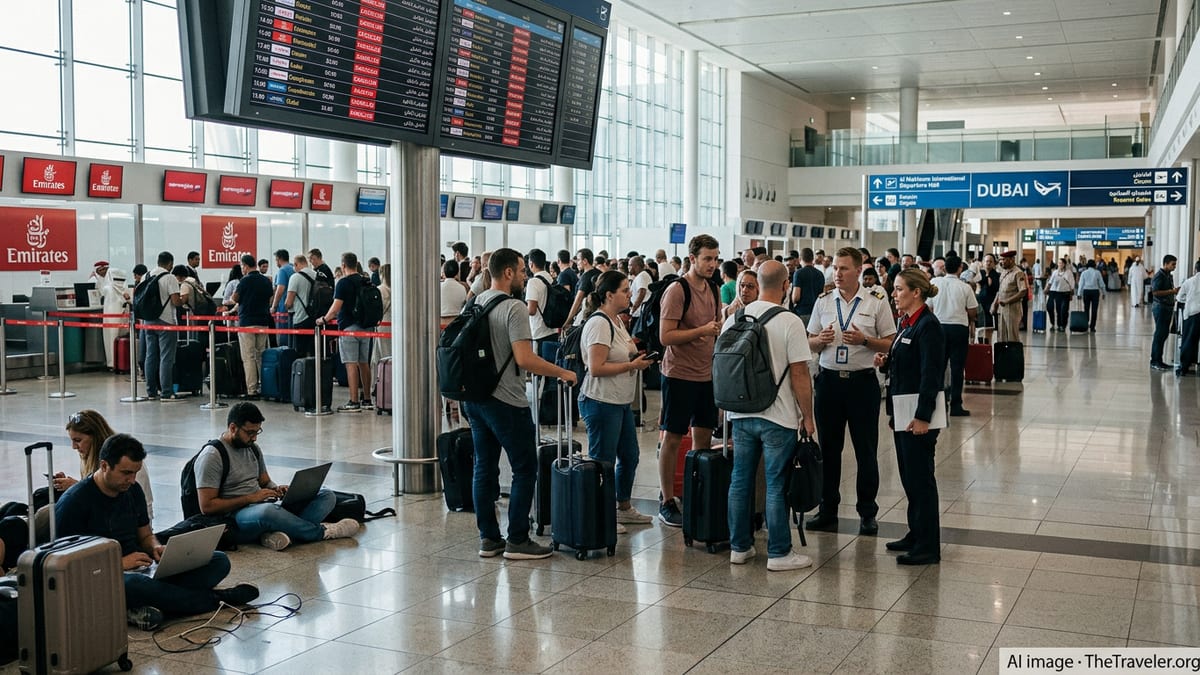
Air France, Singapore Airlines and others keep Dubai services on hold
Published coverage from European and Gulf outlets indicates that several major foreign carriers are maintaining, and in some cases extending, suspensions on flights to Dubai despite a recent pause in US strikes on Iran. Air France has pushed back the restart of some services to the emirate and other Gulf cities, tying any resumption to periodic security reviews rather than fixed dates.
According to recent travel reports, Singapore Airlines has taken an even more conservative stance, extending the halt on its Singapore–Dubai route until late October while redeploying capacity to long-haul links such as Singapore–London Gatwick and Singapore–Melbourne. The airline has framed the move as a response to both regional risk and shifting demand patterns on safer corridors.
Factboxes compiled by international newswires show that a number of European carriers, including LOT Polish Airlines and Finnair, are also adjusting their Middle East networks. LOT plans to keep a focus on seasonal Dubai services from later in the year, while Finnair has cancelled Doha flights into October and continues to avoid key stretches of regional airspace, highlighting the uncertainty that still shapes route planning into and around the Gulf.
These decisions mean that, even as some flights are restored, travellers from Europe and Asia heading to Dubai remain reliant on a patchwork of options, with fewer non-stop choices and longer journey times via alternative hubs.
Gulf carriers juggle capacity as airspace restrictions linger
For homegrown airlines in the United Arab Emirates and neighbouring states, the challenge has shifted from outright shutdowns to managing constrained skies and volatile demand. Earlier this year, carriers including Emirates, Etihad Airways, flydubai, Air Arabia and Qatar Airways introduced sweeping suspensions and diversions as missile activity and airspace closures rippled across the region.
More recent UAE aviation updates show that these airlines have gradually rebuilt much of their core Gulf and long-haul networks, particularly through Dubai International and Abu Dhabi’s Zayed International Airport. However, selective cancellations remain in place to destinations such as Kuwait, parts of Saudi Arabia and segments of the wider Middle East where risk profiles are still rated as elevated.
Publicly available route summaries indicate that some Gulf low-cost and regional operators have withdrawn services on certain city pairs altogether, while maintaining connectivity through alternative airports and road links. In several cases, passengers booked to or from airports affected by suspensions are being transported by bus to nearby hubs where flights can still operate safely, underscoring the operational complexity created by shifting airspace corridors.
Airports across the UAE are continuing to process large passenger volumes, but airlines are relying on longer routings that skirt Iranian, Iraqi and other sensitive airspaces, adding to flight times and squeezing already tight schedules.
Dubai International holds its hub role amid reduced frequencies
Despite months of disruption, Dubai International Airport has retained its position as a central waypoint between Asia, Europe and Africa. Recent traffic data released by airport operators show that DXB handled tens of millions of passengers in the first quarter of 2026, even as regional airspace closures limited capacity on some of its busiest corridors.
Officials have previously highlighted that a significant share of global transfer traffic between East and West either passes through or could be routed via the Middle East, with Dubai capturing a substantial slice of that flow. During the height of airspace restrictions earlier in the year, flight movements into and out of the emirate were sharply curtailed, but the airport has since ramped up operations as precautionary measures on UAE airspace have been eased.
Nonetheless, recovery remains uneven. Some carriers have announced reduced frequencies on Dubai routes over the northern summer season, citing operational constraints and the need to maintain schedule resilience. British Airways, for example, has scaled back services to Dubai and other Middle Eastern destinations as part of a broader rebalancing of its network in light of continuing tensions.
For travellers, this means that while Dubai’s terminals appear busy and most local airlines are operating near-normal timetables, the overall menu of international options to and from the city is slimmer than it was before the current wave of instability.
Security advisories and traveller warnings keep demand in flux
Governments including the United States, United Kingdom, Canada and Australia have renewed travel advisories for parts of the Middle East in recent days, noting that the security situation remains unpredictable. Public guidance from these states emphasises that airports and other civilian infrastructure have previously been affected during spikes in regional tension and that further disruption cannot be ruled out.
Travel industry bulletins and corporate mobility alerts point to thousands of flight cancellations across the Middle East and North Africa since the conflict escalated earlier this year, with key hubs in the Gulf, Levant and Iran’s neighbourhood bearing the brunt of airspace closures. While Dubai and Abu Dhabi are now operating more consistently, many corporate travel managers continue to classify the region as high-risk for sudden schedule changes.
In response, a number of global airlines have extended flexible rebooking policies for tickets involving Dubai and nearby destinations, allowing passengers to change travel dates or itineraries without standard penalties. These waivers, introduced in March as unrest intensified, have been repeatedly prolonged into the late summer and early autumn travel periods.
The combination of government advisories and airline flexibility has tempered demand on some routes, even where flights are technically available, contributing to an environment in which schedules can change at short notice and capacity is repositioned quickly between markets.
What passengers flying via Dubai and the region should expect
For travellers planning trips through Dubai or other Middle East hubs over the coming weeks, the latest developments point to an extended period of uncertainty rather than a swift return to pre-crisis normality. While core UAE-based carriers are largely keeping their long-haul networks intact, a rotating cast of cancellations, aircraft swaps and schedule adjustments continues to affect regional spokes and select international routes.
Passenger accounts and airline notices shared online highlight several recurring issues: longer flight times due to detours around closed airspace, last-minute changes to departure times, and occasional overnight delays as airlines wait for security clearances or more favourable routing options. These complications are particularly acute for itineraries involving tight connections between Gulf hubs and smaller regional airports.
Travel experts advising corporate clients recommend building additional buffer time into connections, favouring itineraries that remain on a single carrier where possible, and paying close attention to airline apps and notifications in the 24 hours before departure. For leisure travellers, the key message from recent advisories is to remain flexible on dates and routings, and to familiarise themselves with refund and rebooking options before setting off for the airport.
With tensions still simmering and route suspensions by foreign carriers such as Air France and Singapore Airlines extending well into the autumn, Dubai’s role as a global hub is intact but operating under persistent strain. Passengers can still cross the region, but they are likely to do so on a more limited set of airlines, along more circuitous paths, and with a higher risk of disruption than in recent years.