


More news on this day
Dubai’s busy Eid holiday travel season is colliding with continued disruption from the US–Iran war, as shifting airspace restrictions and security measures tighten capacity on key Middle East routes.
Get the latest news straight to your inbox!
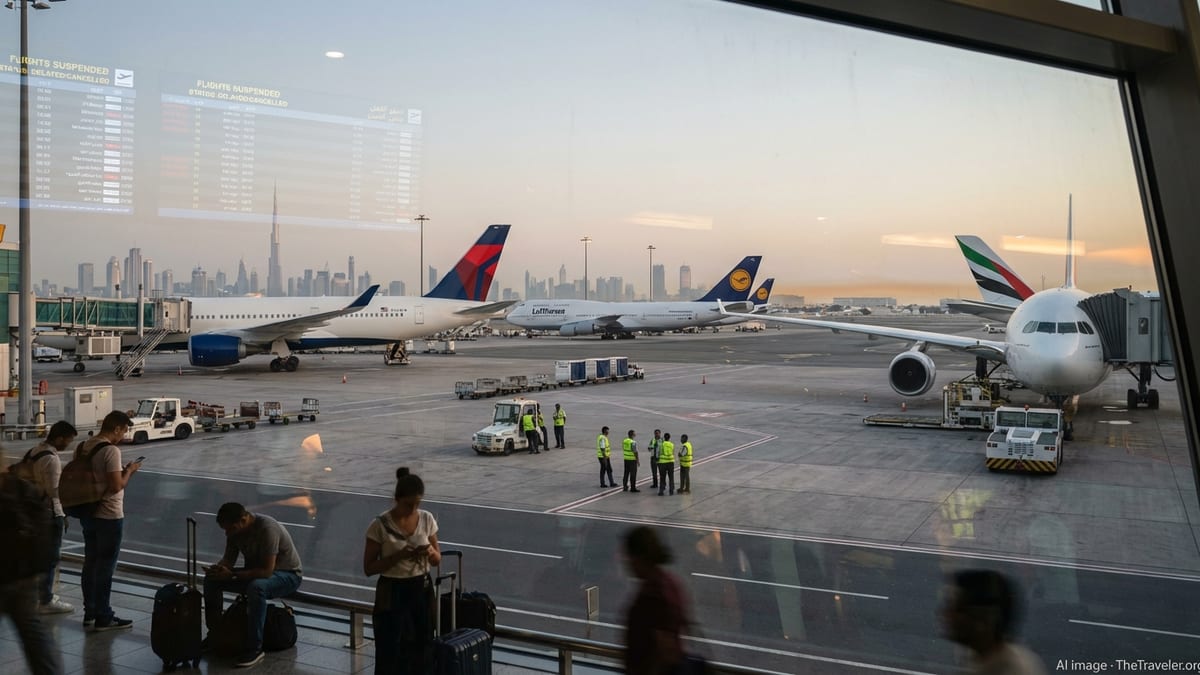
Eid surge meets a still-fragile Gulf airspace
Dubai International Airport is heading into one of its heaviest travel periods of the year with the start of the Eid Al Adha rush, even as the wider region continues to absorb the shock of the US–Iran conflict. Dubai Airports has signalled it expects hundreds of thousands of passengers to move through the hub over the coming days, with local media reporting that May 31 could be the single busiest Eid travel day, driven by Gulf holidaymakers and Hajj-related demand.
The surge arrives after months of instability in regional skies. Since late February, fighting involving Iran, the United States, Israel and their allies has triggered rolling airspace closures, missile and drone incidents and emergency reroutes across the Gulf and Levant. Although Emirati regulators moved in early May to restore more normal traffic levels, the network of overflight permissions and security restrictions around Iran and its neighbours remains tight, leaving airlines with less flexibility just as demand peaks.
While Dubai’s main airports are open and handling traffic, publicly available tracking data and industry analysis indicate that flows are still being channelled through narrower corridors than before the conflict. That concentration raises the stakes for any renewed flare-up just as families across the region begin their Eid journeys.
From blanket closures to controlled corridors
The immediate shock to Middle East aviation came in late February and early March, when Iran’s retaliatory missile and drone strikes on Gulf states prompted widespread precautionary measures. Several countries, including Iran, Iraq, Israel, Kuwait and the United Arab Emirates, either closed their airspace outright or imposed strict limits, sending cancellations and diversions surging across the region. Flight data analysed by specialist platforms shows that traffic at key Gulf hubs fell by more than 90 percent at the height of the initial crisis.
In the UAE, authorities first tightened, then gradually eased restrictions. Sector briefings describe how, after Iranian projectiles targeted Emirati territory in early May, regulators issued notices limiting movements to a handful of pre-approved corridors through the Emirates’ Flight Information Region. Only flights able to use these routes could operate, effectively capping hourly traffic while defence forces monitored the skies for further threats.
By early May, official statements reported that precautionary measures introduced at the start of the Iran war had been lifted and that overall air traffic across the UAE had returned to a more normal pattern. However, risk consultancies and airline advisories emphasise that this “normalisation” still rests on a more constrained route network than before the conflict, with operators avoiding large parts of Iranian and adjacent airspace and relying heavily on alternative paths over Saudi Arabia, Egypt, the Caucasus and Central Asia.
Airlines juggle reroutes, suspensions and higher costs
Global and regional carriers are entering the Eid peak with schedules that have already been heavily reshaped by the war. European airlines such as Lufthansa and Air France extended suspensions on services to several Middle East destinations earlier in the conflict, citing safety and operational concerns. While some of those suspensions have since been adjusted or partially lifted, published timetables show that capacity into Gulf hubs remains below what had been planned before the war.
Carriers based in the region have also faced weeks of turbulence. Gulf Air, Qatar Airways and other operators have periodically shifted flights to alternative airports or reduced frequencies as neighbouring states restricted airspace or limited movements. Data compiled by aviation analytics firms suggests that thousands of flights across the wider Middle East and North Africa were cancelled or heavily delayed during the first weeks of the conflict, with long-haul sectors between Europe or Asia and the Gulf among the hardest hit.
Even where services continue to operate, routings have often lengthened considerably. Consulting and industry reports highlight how airlines have been forced to bypass Iranian skies and, at times, portions of Iraqi and Kuwaiti airspace, instead sending aircraft over the Caucasus, the eastern Mediterranean or deep into Saudi territory. These detours increase fuel burn and crew costs at a time of strong seasonal demand, a dynamic that can translate into higher fares and tighter seat availability for passengers heading to or transiting through Dubai during Eid.
What passengers to and from Dubai are experiencing now
For travellers, the most visible impact in late May is inconsistency. Departures and arrivals at Dubai International and Al Maktoum International are largely proceeding, but with a greater risk of short-notice schedule changes. Airline apps and airport information screens show a patchwork of minor delays mixed with occasional cancellations on routes that cross or approach the conflict zone, particularly services linking Dubai with parts of Iraq, Iran and the Levant.
Travel advisories, including those issued by governments and aviation risk specialists, encourage passengers to build additional time into connections and to monitor flight status closely in the 24 hours before departure. The potential for renewed missile or drone incidents, or for further US military strikes on Iranian targets, continues to pose a risk of sudden ground stops or new airspace restrictions, even if such measures are likely to be temporary.
Despite these uncertainties, Dubai’s role as a global hub is proving resilient. Industry bodies point out that the Middle East has become a critical bridge between Europe, Asia and Africa, and that airlines are highly motivated to preserve connectivity through the region. For now, that means keeping hubs like Dubai operational during Eid, but with tighter route options, elevated security procedures and a heightened sensitivity to any shift on the battlefield.
Regional outlook as Eid travel builds
Looking beyond this week’s peak, analysts warn that the balance between strong travel demand and geopolitical risk will remain delicate for the rest of the summer. Economic and aviation research published in recent days notes that the Iran war has already become the most disruptive conflict for regional aviation since the pandemic, altering traffic flows and forcing a long list of airlines to rework networks and budgets.
The Eid rush provides an early stress test of how well these adapted systems can cope. If the fragile ceasefire periods around Iran and the Gulf hold, airlines may gradually restore some suspended services and reduce the length of detours, easing pressure on fares and capacity. If hostilities intensify, governments could again restrict airspace with little warning, rapidly amplifying disruption for travellers using Dubai as a gateway.
For now, publicly available information indicates that flights into and out of the emirate are operating under close watch rather than outright suspension. As families begin their Eid journeys and expatriates take advantage of the holiday to travel, that uneasy equilibrium between celebration and conflict will define the experience of many passengers passing through Dubai and other Middle Eastern hubs.