


More news on this day
Air travelers across Europe faced a difficult start to the weekend as severe weather, staffing constraints and wider network bottlenecks combined to cancel at least 74 flights and delay about 1,840 more, disrupting operations for major carriers including Air France, British Airways, Austrian Airlines and LOT Polish Airlines at hubs from Milan and Vienna to Warsaw and London.
Get the latest news straight to your inbox!
Storm Systems And Congested Skies Hit Key European Hubs
Operational data from flight-tracking and aviation analytics platforms indicate that a series of fast-moving storm systems over parts of Italy, France, Austria and the United Kingdom triggered substantial air traffic control restrictions, forcing airlines to trim schedules and slow departures. The knock-on effect reached busy city pairs and holiday routes, compounding existing summer congestion.
Major hubs serving northern Italy, including Milan, reported clusters of cancellations and rolling delays as thunderstorms and turbulence bands moved across the Po Valley. In central Europe, traffic into and out of Vienna saw extended holding patterns and reroutes, while Warsaw experienced schedule pressure as airlines attempted to re-accommodate passengers from earlier disrupted flights elsewhere in the network.
Publicly available network briefings and historical performance reports show that Austria, France and the UK are among the European countries most frequently affected when weather and staffing pressures coincide, as capacity limits are imposed to maintain safe spacing between aircraft. Recent EUROCONTROL assessments highlight that these three states regularly account for a large share of region-wide delay minutes during peak traffic periods.
The latest wave of disruption followed a familiar pattern for summer in Europe: a day that begins with scattered delays around storm cells evolves into more extensive knock-on problems as rotations fall behind schedule and aircraft arrive late to operate subsequent sectors. By late evening, this typically results in cancellations on shorter routes where turnaround margins are tightest.
Flag Carriers And Regional Airlines See Schedules Thrown Off
Among the airlines most visibly affected were several of Europe’s best-known full-service and network carriers. According to compiled operational data, Air France experienced punctuality challenges on services linking France with Italy and central Europe, while British Airways coped with a combination of outbound delays from London and inbound aircraft arriving late from storm-affected airports.
Austrian Airlines, which relies heavily on Vienna as a transfer hub, faced schedule compression as inbound flights from western and southern Europe reached Austrian airspace later than planned. Industry data suggest that when Vienna encounters even modest flow restrictions, the impact can cascade across connecting banks of flights, affecting passengers on both intra-European and long-haul itineraries.
LOT Polish Airlines also reported pressure on operations as late-running aircraft from western Europe rotated onto departures from Warsaw. Regional and low-cost operators feeding traffic into hubs at Milan, Vienna and Warsaw further contributed to congestion, as ground handling teams worked through backlogs created by earlier weather-related holds.
Travel industry observers note that the pattern mirrors recent episodes in which no single carrier or country is solely responsible for widespread disruption. Instead, a combination of shared airspace, common weather systems and interdependent schedules means issues in one part of the network can quickly ripple across multiple airlines and destinations.
Passengers Confront Missed Connections, Long Lines And Rebooking Headaches
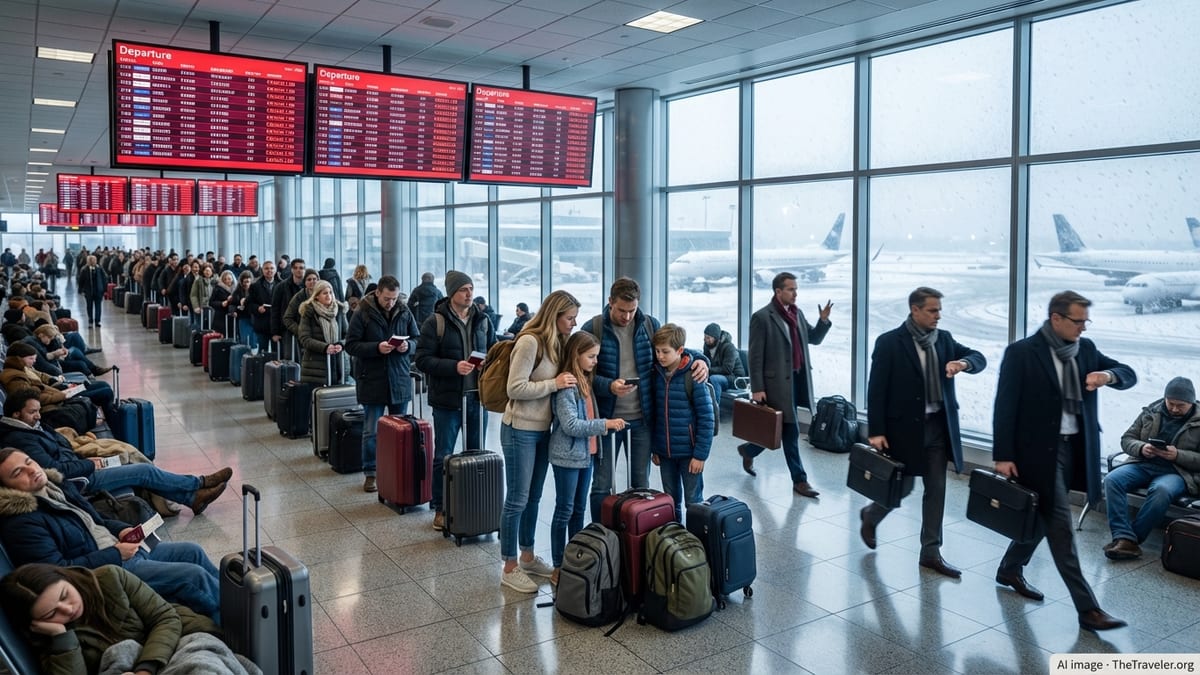
The operational strain translated into long queues at check-in counters, security lanes and rebooking desks across affected airports. Publicly available posts from travelers and airport information channels described crowded departure halls in Milan, Vienna, Warsaw and London as passengers waited for updated departure times or sought alternative routings.
Missed connections were a recurring theme, particularly for travelers booked on multi-leg itineraries using European hubs as transfer points. When early morning flights into key hubs depart late or divert around storms, tight connection windows quickly become unworkable, forcing airlines to re-accommodate passengers on later services or, in some cases, on partner carriers.
Consumer-rights organizations and flight-compensation platforms reported increased interest from travelers seeking clarity on their entitlements under European air passenger regulations. Guidance from these groups emphasizes that eligibility for compensation often depends on whether disruption is linked to extraordinary circumstances such as severe weather, or to issues within an airline’s control, such as crew or maintenance planning.
For many passengers, the most immediate challenges were practical rather than legal. Limited hotel availability near major hubs, late-night transport constraints and language barriers for those stranded far from home created a stressful environment, particularly for families and those traveling with tight time constraints for events, tours or cruise departures.
Weather, Staffing And Structural Constraints Under Scrutiny
Aviation analysts point to a combination of structural factors behind the scale of the disruption. Years of incremental traffic growth, evolving weather patterns and complex post-pandemic staffing dynamics have left parts of the European aviation system operating close to capacity during peak periods. When severe storms or localized air traffic control issues arise, there is often little slack in the system.
Recent network performance briefings show that France and Austria, in particular, can become delay hotspots when demand is high and staffing is stretched in key control centers. The United Kingdom’s busy airspace around London is similarly vulnerable when thunderstorms or technical constraints require aircraft to be spaced more widely or routed away from normal flight paths.
Industry data from previous summers demonstrate that such pressure points do not exist in isolation. When flights are forced to divert around weather systems in one state, traffic may shift into neighboring sectors, increasing workload for controllers in Italy, Germany, Switzerland or central and eastern European countries. These knock-on effects have become more pronounced as overall traffic has risen.
While airlines have invested in more sophisticated planning tools and collaborative decision-making with airports and air navigation service providers, observers note that last-minute adjustments remain difficult when fleets and crews are already tightly scheduled. As a result, even modest weather events can lead to larger-than-expected disruption once the full day’s rotations are taken into account.
What Summer Travelers In Europe Can Expect Next
With the peak holiday season under way, travel experts suggest that the current wave of cancellations and delays is unlikely to be the last significant disruption of the summer. Forecasts for continued periods of unstable weather in parts of southern and central Europe, combined with strong demand, imply that airports in Italy, Austria, France, the UK and neighboring countries will remain under pressure.
Published commentary from airlines and travel organizations recommends that passengers build additional buffer time into their itineraries, particularly when connecting between separate tickets or relying on tight transfer windows at major hubs. Allowing several hours between flights, traveling with hand luggage where possible and monitoring flight status closely in the days and hours before departure are among the commonly cited strategies.
Some carriers have already adjusted schedules or trimmed marginal frequencies on routes where repeated delays have occurred, in an effort to improve reliability and create more resilience in daily operations. However, analysts caution that such measures can only partially offset the impact of intense storm systems or sudden capacity reductions in critical airspace sectors.
For now, travelers planning to pass through Milan, Vienna, Warsaw, London or other busy European airports are being advised by publicly available travel guidance to prepare for potential disruption, remain flexible with plans and make full use of airline apps and airport information channels. With at least 74 flights cancelled and about 1,840 delayed in the latest episode, the message from recent experience is that even a single day of turbulent weather can reverberate across Europe’s skies.