


More news on this day
Dubai’s Port Rashid is consolidating its role in global cruise tourism as new air-sea partnerships, upgraded terminal facilities and rising Gulf itineraries combine to turn the historic harbor into a key link between international flights and regional voyages.
Get the latest news straight to your inbox!
Port Rashid Repositions as Cruise-Focused Gateway
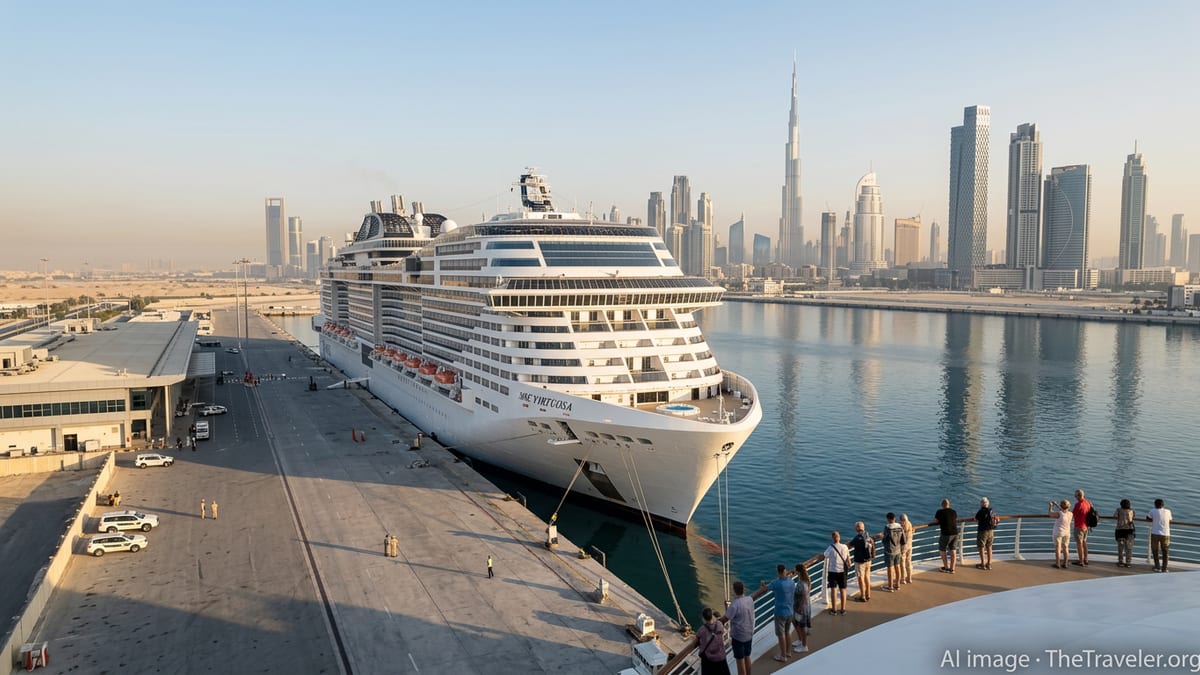
Port Rashid, also known as Mina Rashid, has evolved from Dubai’s original cargo harbor into a dedicated cruise-focused hub, supporting the emirate’s wider push to become a leading homeport for Gulf itineraries. Cargo operations were shifted to the deep-water Jebel Ali complex several years ago, freeing the older harbor to specialize in passenger traffic and marina activity while remaining close to the historic city center and Dubai Creek.
Operator DP World highlights the Hamdan bin Mohammed Cruise Terminal at Mina Rashid as one of the world’s largest single covered cruise facilities, designed to manage simultaneous calls by multiple large vessels. Publicly available information describes dedicated cruise berths, expanded customs and baggage areas, and shore-side services oriented to transit and turnaround calls rather than cargo handling, aligning Port Rashid with the needs of modern homeport operations.
While Dubai now has two primary cruise hubs, with Dubai Harbour Cruise Terminal on the Palm-facing waterfront and Mina Rashid near the old town, sector reports indicate that Port Rashid continues to handle a substantial share of passenger movements, particularly for ships using Dubai as a starting and ending point for Gulf voyages.
Fly-Cruise Partnerships Tighten Links to Global Flight Networks
The strategic influence of Dubai’s cruise sector is increasingly tied to its aviation ecosystem, with Port Rashid benefitting from a series of fly-cruise agreements tied to Dubai International Airport. Emirates has expanded long-running collaborations with major cruise brands, including renewed partnerships with Costa Cruises and MSC Cruises, with memoranda of understanding focused on integrated itineraries and coordinated transfers between flights and cruise departures in Dubai.
According to published coverage of these agreements, the Emirates and Costa Cruises partnership has been extended through 2027 and emphasizes smoother connectivity between Dubai International Airport and the city’s cruise facilities, including Mina Rashid and Dubai Harbour. A separate extended deal with MSC Cruises and a new arrangement with Hapag-Lloyd Cruises similarly concentrate on joint packages that bundle air tickets with Gulf sailings, with Dubai positioned as the central embarkation point.
These arrangements build on Emirates’ broader network strategy, which connects Dubai to hundreds of cities worldwide through direct routes and codeshare agreements. By aligning cruise turnarounds with peak inbound flight banks, the partnerships are designed to attract long-haul travelers from Europe, Asia and the Americas who can arrive in Dubai, board a ship at Port Rashid, cruise the Gulf, and return to their home countries on a single coordinated itinerary.
Cruise Volumes Climb as Gulf Itineraries Expand
Data from the Dubai Department of Economy and Tourism show that the city’s cruise sector has expanded rapidly since the resumption of international travel. The 2022 to 2023 season saw 166 scheduled ship calls across Mina Rashid and Dubai Harbour, with projections of roughly 900,000 passengers and crew across the two terminals. Subsequent seasons have built on that base as more lines deploy capacity in the Gulf.
The emirate’s 2023 to 2024 season overview highlighted surging traffic at both main cruise hubs. Dubai Harbour Cruise Terminal reported around 300,000 passengers in the 2022 to 2023 season, roughly four times its inaugural year, while Mina Rashid was recognized at regional industry awards as the Middle East’s leading cruise port and was expected to welcome close to one third more visitors in 2023 to 2024 than in the previous season. These trends underscore how Port Rashid remains central even as new facilities come online.
Operational data from Dubai Customs further underline the momentum. Between January and November 2024, the agency reported handling more than 1.23 million bags for nearly 282,000 passengers on 187 cruise ship calls at Port Rashid and Dubai Harbour. With several of the world’s largest cruise ships scheduled to homeport in Dubai for the 2024 to 2025 season, industry observers anticipate continued growth in passenger throughput at Mina Rashid.
On-the-Ground Connectivity Between Ship, City and Airport
Port Rashid’s growing strategic importance also reflects practical connectivity between ship, city and airport. Emirates promotes a dedicated cruise check-in facility at Cruise Terminal 3 in Port Rashid that allows passengers disembarking from vessels to complete airline check-in formalities, hand over luggage for delivery to Dubai International Airport, and then spend additional time in the city before heading directly to their departure terminal.
According to public information from the airline, this service is designed to remove the need for cruise guests to return to port to collect bags on the day of departure, effectively turning Port Rashid into a hybrid cruise and aviation gateway. The terminal’s location near heritage districts such as Al Fahidi and Dubai Creek also means that visitors have relatively short transfers to cultural sites, even as road infrastructure projects continue around the harbor area.
Travel advisories and user reports note that Port Rashid is not yet directly linked to Dubai’s metro network and relies primarily on taxis, shuttle buses and private transfers. Nonetheless, as cruise volumes climb and tourism authorities encourage longer stopovers, the ability to hand off luggage at the cruise terminal, explore the city and connect seamlessly to outbound flights is emerging as a competitive differentiator for Dubai compared with other regional ports.
Regional Cruise Ecosystem Elevates Dubai’s Role
Port Rashid’s air-sea integration is taking place within a broader Gulf cruise ecosystem that is attracting growing investor attention. Market reviews by hospitality and real estate consultancies describe substantial port and terminal investments across the GCC, including new or expanded facilities in the UAE, Oman, Qatar and Saudi Arabia, supported in part by the Cruise Arabia Alliance linking Dubai with neighboring coastal cities.
This regional coordination allows cruise lines to design week-long Arabian Gulf itineraries that start and finish in Dubai while calling at Abu Dhabi, Doha, Bahrain and Omani ports. With Dubai positioned as the primary air gateway and homeport, Port Rashid becomes an essential hinge between international long-haul flights and a multi-stop regional cruise circuit that is still in an early growth phase compared with the Mediterranean or Caribbean.
As Gulf destinations add new shore attractions and develop waterfront districts adjacent to cruise terminals, Dubai is using Port Rashid’s established infrastructure and its proximity to the urban core to retain a leading position in the market. Observers note that the combination of large-scale terminal capacity, extensive airline connectivity and coordinated visa policies for cruise travelers is giving the emirate an increasingly influential role in shaping the trajectory of cruise tourism across the wider region.
Dubai Department of Economy and Tourism – Annual Visitor Report 2023 (cruise section)
Government of Dubai Media Office – Emirates and Costa Cruises extend strategic partnership
Government of Dubai Media Office – Emirates and MSC Cruises reinforce air-sea collaboration