


If you plan to drive on toll roads, bridges, or tunnels in the northeastern or mid-Atlantic United States, E-ZPass can save you money, time, and stress. For first-time users, though, the system can feel confusing: multiple states, different agencies, unfamiliar toll plazas, and a small plastic tag that somehow charges your account at highway speed. This guide breaks down how E-ZPass works in real life, how to set it up correctly, and what every new user should know before their next road trip.
Get the latest updates straight to your inbox!
What E-ZPass Is and Where You Can Use It
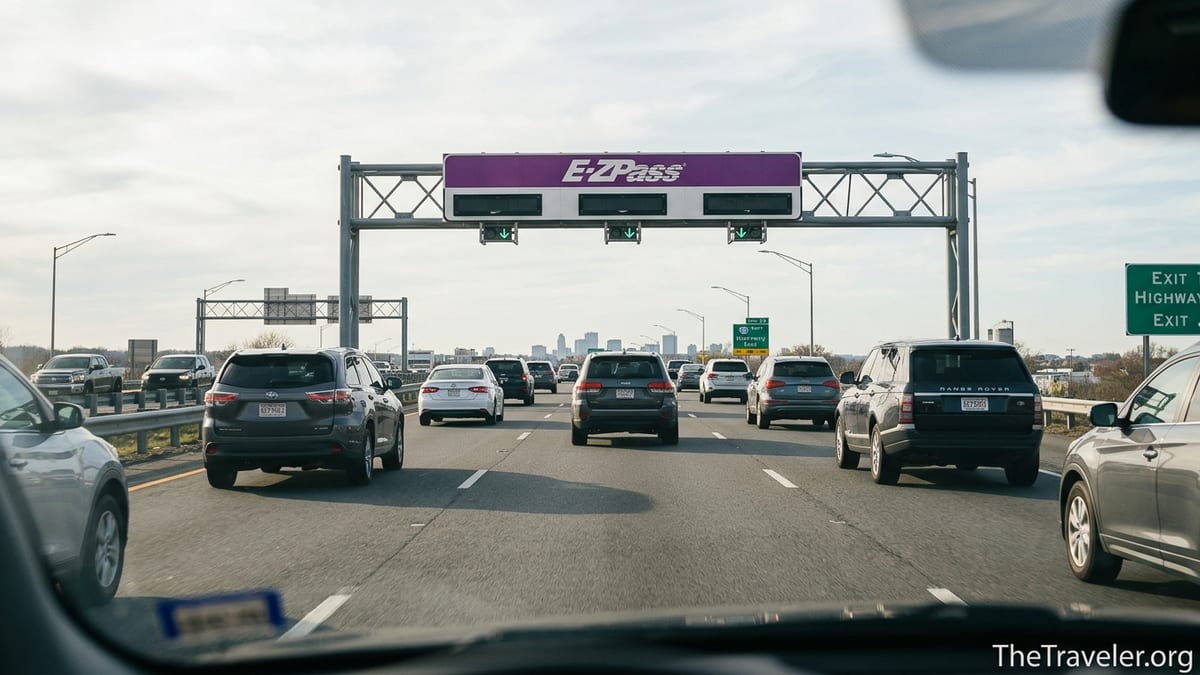
E-ZPass is an electronic toll collection system used by a network of toll agencies across much of the eastern and midwestern United States. When you attach an E-ZPass tag to your windshield, overhead readers at toll plazas can detect your vehicle as you drive through, automatically deducting the toll from your prepaid account. Instead of stopping to pay cash, you simply keep moving, often at highway speeds in dedicated E-ZPass lanes.
The system is widely accepted from Maine to Florida on many major routes, including the New York State Thruway, New Jersey Turnpike, Pennsylvania Turnpike, Massachusetts Turnpike, and most toll facilities in states like Maryland, Virginia, Delaware, and West Virginia. It is also used on many urban bridges and tunnels, such as the George Washington Bridge between New Jersey and New York, the Chesapeake Bay Bridge in Maryland, and the Fort McHenry Tunnel in Baltimore. Travelers driving from Boston to Washington, DC, for example, can rely on E-ZPass for most tolled segments along the way.
Over the past few years, E-ZPass compatibility has expanded beyond the Northeast. Certain toll roads and express lanes in states such as Illinois, Indiana, and Ohio accept E-ZPass, and some southern states accept it on select facilities. Before a long interstate trip, it is wise to check which stretches of your planned route actually use E-ZPass and where you might encounter different systems such as SunPass in Florida or TxTag in Texas.
Even when toll roads are advertised as cashless, they may offer different payment options for drivers without E-ZPass, such as pay-by-mail based on license plate images or short-term online payments. Those alternatives usually cost more in administrative fees than E-ZPass rates, which is why many regular travelers and long-distance road trippers adopt E-ZPass as their default toll solution.
How the E-ZPass System Works in Practice
At its core, E-ZPass links three elements: your transponder tag, your vehicle license plate, and a funding account. The tag contains a unique ID that toll readers recognize. When you drive through an E-ZPass lane at a toll plaza, an overhead or roadside antenna reads the tag, matches it to your account, and deducts the toll amount instantly. In many locations you will see the toll amount and a “Toll Paid” message on an electronic sign as you pass.
If the reader cannot detect your tag, most systems fall back on taking a photo of your license plate and trying to match the plate with the vehicle registered to that E-ZPass account. This is why it is important to keep your license plate and vehicle details up to date in the system. For example, if you move from New Jersey to Pennsylvania and change your plates, but forget to update your E-ZPass profile, you might start receiving toll-by-mail invoices for “unmatched” trips instead of having those tolls come out of your prepaid balance.
Behind the scenes, your E-ZPass account runs on a prepaid model. You fund it with a credit card, debit card, or bank transfer, then tolls draw down that balance over time. Most agencies set a minimum balance threshold. When your account dips below that amount, they automatically recharge it by a preset amount from your card. For example, a commuter who crosses a tolled bridge twice a day might have an automatic replenishment of around 40 to 50 dollars when their balance drops under 20 dollars. Occasional travelers might set lower numbers because they do not use tolls daily.
Some states have moved nearly all toll facilities to all-electronic operation with no cash booths at all. On the Massachusetts Turnpike, for instance, drivers pass under gantries at highway speed. If you have E-ZPass, your toll is charged at the E-ZPass rate. If not, the system mails a bill to the registered vehicle owner. In many of these locations, the E-ZPass rate is lower than the pay-by-plate rate, so your tag acts not just as a payment method but also as a discount card.
Choosing the Right E-ZPass Agency and Plan
Each E-ZPass tag is issued by a member agency, usually a state or regional toll authority, but the tags are interoperable across the entire E-ZPass network. That means you can live in Ohio, open an E-ZPass account with the New York State Thruway Authority, and still use it in New Jersey, Pennsylvania, Maryland, and other participating states. However, local discounts, fees, and rules usually depend on the issuing agency.
For example, New York offers E-ZPass discounts on several Metropolitan Transportation Authority bridges and tunnels, and the discount applies only if your E-ZPass is issued by a New York agency and your license plate is properly registered. A driver commuting from New Jersey to Manhattan across the Verrazzano-Narrows Bridge every weekday might save a meaningful amount each month by choosing a New York-based E-ZPass instead of one from another state, provided they meet residency or registration rules for that discount plan.
Some agencies charge small monthly or annual fees, especially for out-of-state users, while others do not. A traveler who rarely uses toll roads might prefer an agency with no monthly service charge and low upfront deposit, even if the base tolls are slightly higher. A frequent toll road commuter, on the other hand, may benefit more from special commuter plans that offer reduced tolls on a specific bridge or route during peak hours.
Before choosing where to open your account, review a few key details: initial deposit amount for the tag, whether there is a monthly or annual fee, any minimum usage requirements, and what local discount plans might apply to your typical driving patterns. A Maryland resident who mostly travels on the John F. Kennedy Memorial Highway and the Fort McHenry Tunnel is usually better served by a Maryland-issued E-ZPass, while a family in western Pennsylvania taking annual vacations to the Jersey Shore might find the Pennsylvania Turnpike Commission account most convenient.
Setting Up Your E-ZPass the Right Way
Once you decide on an issuing agency, the setup process typically involves creating an online account, providing vehicle information, and choosing a payment method. Many agencies will mail your transponder within a week or two after your application is approved, although some offer walk-in customer service centers or retail partners where you can pick up a tag the same day. For instance, in several states you can purchase a starter E-ZPass kit at major grocery or convenience store chains, then go online to register it under your name and vehicle.
When you receive your tag, follow the mounting instructions carefully. Most standard passenger vehicle tags are designed to stick to the inside of the windshield near the rearview mirror. If you drive a car with a metallic or heated windshield coating, the instructions may specify a particular mounting area where the signal can pass through. Incorrect placement can lead to missed reads and toll violations. Rental cars may already have a built-in transponder module near the windshield or behind a panel; if so, you should avoid placing your personal E-ZPass tag directly next to it to prevent double charges.
During setup, you will be asked to register each vehicle that may use the tag, including license plate number, state of registration, and vehicle class. Be honest about the type of vehicle you drive. A large SUV towing a boat trailer, for example, may be classified differently from a compact car, and toll amounts can vary accordingly. If your tag is misclassified as a lighter vehicle, toll agencies may issue adjustments or violations later when they review images of your vehicle.
Finally, configure your funding preferences. Many first-time users choose automatic replenishment with a credit card set to reload when the balance gets low. Others prefer to manually add funds online before a big road trip, especially if they do not use toll roads regularly. Either way, make a note of your account login and security questions, and consider downloading any official mobile app your issuing agency provides so you can check your balance and recent trips from your phone.
Using E-ZPass on the Road: Real-World Scenarios
On the road, E-ZPass changes how you approach toll plazas and highway gantries. Traditional toll plazas often have clearly marked lanes: some for E-ZPass only, some for cash, and some that accept both. If you are using your E-ZPass, you should follow the signs for E-ZPass or all-electronic lanes, typically lit in purple or green. In E-ZPass-only lanes you do not stop; you simply slow to the posted speed if required and drive through.
Consider a typical trip from Philadelphia to New York City via the New Jersey Turnpike. As you approach the first major toll plaza near Delaware, overhead signs will tell you which lanes accept E-ZPass. With a working transponder, you can follow the E-ZPass express lanes, avoid cash queues, and see your toll deducted automatically. Farther north, when you cross into New York over a major bridge, your E-ZPass will again be read, and you will usually pay a lower rate than a driver being billed by mail.
Another real-world example: a family driving from Washington, DC to Ocean City, Maryland in the summer. They might pass through several toll points, including the Chesapeake Bay Bridge. With E-ZPass, they can remain in moving lanes instead of lining up at booths, which can save 15 to 30 minutes in heavy weekend traffic. In addition, the E-ZPass rate is often lower than the cash or pay-by-plate rate, so using the tag can reduce the total trip cost, especially over multiple weekends.
When you approach toll signage that mentions E-ZPass but also references other systems, such as SunPass or Peach Pass, pay attention to whether those facilities actually accept E-ZPass or simply operate a different network. In some states, E-ZPass readers are present only on certain express lanes within a broader toll system. For instance, a highway might have general lanes that use a local pass and separate express lanes that read E-ZPass. If you stray into a local-pass-only lane with just E-ZPass, you might be billed by mail at a higher rate or receive a notice that you used the lane without proper registration.
Costs, Deposits, Discounts, and Common Fees
E-ZPass is designed to be cost-effective, but the exact costs and savings vary by state and usage. Most agencies require an initial funding amount when you open your account. For a typical passenger vehicle, this might be in the range of a few dozen dollars, which then sits in your account to cover tolls. Some agencies also require a refundable deposit for the physical transponder, while others include the tag at no separate cost as long as you keep your account in good standing.
The main financial benefit comes from discounted toll rates compared with cash or pay-by-plate pricing. On some major bridges and tunnels, the E-ZPass discount can be a noticeable percentage. For a daily commuter, small differences per trip add up quickly over a month. As a concrete example, a driver crossing a major metropolitan toll bridge twice every workday can save enough over a year to cover the initial deposit and any minor service fees multiple times over.
Be aware of potential fees. Some agencies charge a small monthly account maintenance fee, especially if you hold an out-of-state tag or rarely use the system. Others may charge a fee for paper statements instead of electronic ones. There can also be administrative fees for toll violations or for processing pay-by-plate trips when your tag is not read properly. If you routinely receive images-based toll bills for a vehicle registered on your account, it is important to investigate why the tag is not being detected to avoid repeated administrative charges.
Special discount plans can lower costs for specific patterns of use. Examples include commuter plans for drivers using the same bridge multiple times per week, off-peak discounts on certain express lanes, or resident discounts for local drivers crossing nearby toll facilities. If you frequently travel the same route, review whether any such plans apply. A resident of Staten Island commuting into Manhattan, for instance, may qualify for a special rate on certain crossings when using a locally issued E-ZPass and meeting defined travel frequency conditions.
Avoiding Mistakes, Violations, and Surprise Bills
First-time E-ZPass users often run into problems not because the system is complex, but because small details get overlooked. One of the most common issues is failing to update vehicle information. If you sell a car and buy another, or switch license plates, and forget to update your account, toll cameras may record unmatched plates. This can lead to mailed bills or violation notices, sometimes with late fees if they go unpaid for long periods or are sent to an old address.
Another frequent problem is mounting the tag incorrectly. A transponder left loose on the dashboard might slide out of the recommended placement area, especially when you brake or accelerate, causing missed reads at just the wrong moment. Over time, repeated missed reads could result in a series of mailed invoices instead of simple E-ZPass deductions. Taking an extra minute to firmly attach the tag to the correct spot on the windshield helps avoid this hassle.
Be cautious when using rental cars. Many major rental companies install their own toll transponders and enroll vehicles in their own toll billing programs. If you bring your personal E-ZPass tag and also trigger the rental company’s system by opening the toll box near the windshield, you risk double billing or confusion about which account is being charged. In practice, travelers often choose one or the other: either use the rental agency’s toll program and keep personal tags stored in a protective bag, or use their own E-ZPass and ensure the rental transponder remains closed and inactive.
Finally, keep an eye on your account balance, especially before long road trips. If your card has expired or been replaced due to fraud, automatic replenishment might fail, leading your account to run low or negative. While many systems still allow a grace period to settle the balance, repeated use of toll facilities with insufficient funds can trigger violation notices. Checking your account a day or two before starting a multi-state drive, such as a vacation from Boston to the Outer Banks in North Carolina, can prevent unwelcome mail a month later.
Travel Planning Tips for E-ZPass Users
Integrating E-ZPass into your broader travel planning can make multi-state road trips smoother. When mapping a route from New England to Florida, for instance, you can plan to take advantage of E-ZPass on toll segments in states where it is accepted, while budgeting extra time and potential costs in states that use different toll systems. Knowing in advance which portions of your journey will be tolled also helps you decide whether to adjust your itinerary to avoid especially expensive facilities during peak times.
For city breaks, E-ZPass can be particularly useful when navigating unfamiliar bridges and tunnels. A visitor driving from Pennsylvania into New York City for a weekend might cross multiple tolled facilities without fully realizing it. With a working E-ZPass, these crossings are automatically logged, and the traveler can later review a detailed trip history in their account, which is helpful for expense reports, shared-cost road trips, or tax documentation for business-related travel.
Road trip budgets should include toll estimates alongside fuel, lodging, and parking. Many state toll agencies provide online toll calculators where you can plug in your entry and exit points and see an approximate cost for your vehicle class with E-ZPass versus cash or pay-by-plate. A family planning a weeklong beach vacation that involves several toll highways can use these tools to compare alternate routes, such as choosing a slightly longer path with lower tolls or deciding that the time savings of a major toll road are worth the added cost.
For international travelers renting a car in the United States, understanding E-ZPass basics ahead of time prevents confusion at toll plazas. Someone flying into Newark and driving to New England may encounter dense networks of E-ZPass-only exits and gantries. Asking the rental counter how tolls will be handled, deciding whether to opt into the rental firm’s toll program, and knowing what E-ZPass signage looks like makes it easier to navigate without last-minute lane changes or last-second decisions at highway speeds.
FAQ
Q1. Do I need a separate E-ZPass for each state I drive through?
E-ZPass is interoperable across its member states, so most drivers only need one transponder. The tag issued by one participating agency is generally accepted on toll roads, bridges, and tunnels throughout the E-ZPass network, although specific discounts may apply only when using a tag from the local agency.
Q2. How long does it take for tolls to appear in my E-ZPass account?
Tolls often appear in your online account within a few hours, but in some cases it can take a day or two, especially for trips involving multiple agencies or when backup license plate imaging is used. If a recent trip does not show up immediately, it is usually processed and posted within a short time.
Q3. Can I move my E-ZPass transponder between different vehicles?
Many standard E-ZPass tags can be moved between passenger vehicles as long as each vehicle is properly registered on your account and is in the same general class. For example, you might move a tag from your personal car to a family member’s minivan for a weekend trip. You should not use a passenger-vehicle tag on commercial trucks or buses that require different classifications.
Q4. What happens if I drive through an E-ZPass lane without a tag?
If you drive through an E-ZPass or all-electronic tolling lane without a valid transponder, the system usually photographs your license plate and sends a bill to the registered vehicle owner. In many states, the pay-by-plate rate is higher than the E-ZPass rate and may include administrative fees. Repeated unpaid bills can escalate to violation notices and additional penalties.
Q5. Is there a penalty if my E-ZPass account balance goes negative?
Policies vary by agency, but most systems expect you to keep a positive balance and may temporarily suspend your tag if the account remains negative. Some offer a short grace period for you to add funds and clear the deficit. If you continue to use toll roads with a suspended tag, trips may be charged at pay-by-plate rates and could generate violation notices.
Q6. What should I do if my E-ZPass transponder stops working?
If tolls stop registering in your account or you receive unexpected toll-by-mail invoices, contact your E-ZPass agency. They may run a diagnostic, review recent trip images, and if necessary replace the transponder. In many cases, defective tags are replaced at no cost when they fail through normal use.
Q7. Can I use my E-ZPass in a rental car?
You can usually use your own E-ZPass in a rental car if your issuing agency allows it and the rental company’s toll device remains inactive. Add the rental vehicle’s license plate and dates of use to your account, and store any rental company transponder in a closed position so it is not triggered. Always confirm both with your E-ZPass agency and the rental firm’s toll policy.
Q8. Are my E-ZPass travel records private?
E-ZPass agencies maintain trip records to manage billing, discounts, and disputes. Access to detailed records is generally limited to the account holder and authorized personnel, although records may be shared with law enforcement or other authorities when required by law. If you are concerned about privacy, review your agency’s specific policies on data retention and access.
Q9. What if my license plate changes but I forget to update E-ZPass?
If you change plates and do not update your E-ZPass account, the system may not match your new plate to your tag, and your trips could be billed by mail instead of drawing from your prepaid balance. This may result in higher toll charges or administrative fees. Updating your plate information online as soon as you receive new registration details helps avoid this situation.
Q10. Is E-ZPass worth it if I only use toll roads a few times a year?
For occasional users, E-ZPass can still be worthwhile, especially in regions where pay-by-plate surcharges are significant or cash options are disappearing. Even if you drive on toll roads only during summer vacations or holiday trips, having an active E-ZPass can save time at toll points and may reduce overall costs compared with one-time mailed invoices.