


If you drive regularly on toll roads in the eastern half of the United States, you have almost certainly seen the purple E‑ZPass logo flashing above highway gantries. For many commuters and road‑trippers, the small windshield tag has become as essential as a GPS. Yet plenty of drivers still hesitate, wondering whether the hassle of setting up an account and prepaying tolls is actually worth it. The answer depends on where you drive, how often you hit toll facilities, and which state’s E‑ZPass program you use. This guide breaks down the real‑world costs and savings so you can decide whether E‑ZPass makes sense for your own highway routine.
Get the latest updates straight to your inbox!
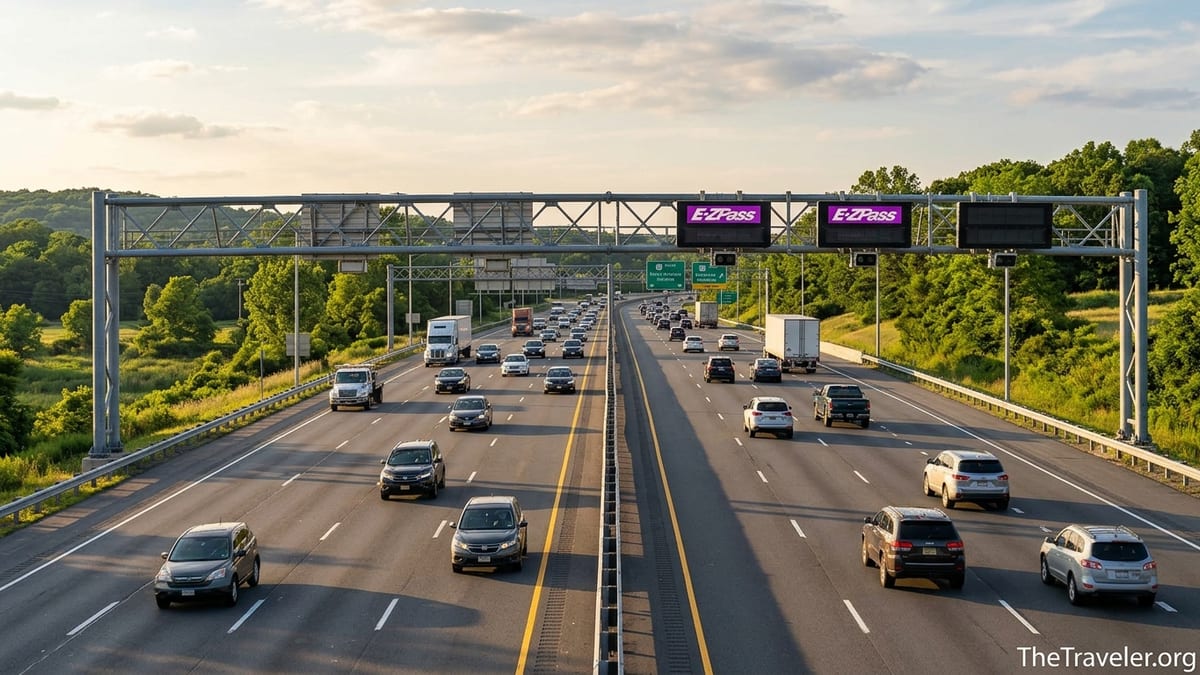
What E‑ZPass Is and Where You Can Use It
E‑ZPass is an electronic toll collection system used widely across the eastern United States. Instead of stopping to pay cash or waiting for a mailed bill, you mount a small transponder in your vehicle that links to a prepaid account. When you pass under a toll gantry or through a toll plaza, sensors read the tag and deduct the toll from your balance in a fraction of a second.
As of mid‑2026, E‑ZPass is accepted on toll facilities in roughly 17 states, forming an almost continuous corridor of coverage from Maine to Florida and as far west as Illinois. In practice, this means you can drive with a single transponder on the Massachusetts Turnpike, New York State Thruway, New Jersey Turnpike, Pennsylvania Turnpike, Ohio Turnpike, and down I‑95 through Maryland and Virginia, then continue on to certain SunPass‑compatible roads in Florida without changing devices.
For a frequent traveler, that interoperability is a major advantage. A Boston‑based consultant driving weekly to New York and New Jersey, or a family that tows a camper from Ohio to the Outer Banks every summer, can rely on one account and one windshield tag throughout the journey. Even occasional flyers who rent cars in E‑ZPass states will recognize the system, though rental‑car toll programs bring their own fee structure and complications.
It is worth noting that E‑ZPass is not truly nationwide. If your road trips regularly take you into non‑E‑ZPass regions such as much of the Midwest, the Deep South away from the coasts, or the Mountain West, you may still encounter separate local toll systems or long stretches of toll‑free highway where a transponder offers no benefit at all.
What It Really Costs to Get and Keep an E‑ZPass
Costs to open and maintain an E‑ZPass account vary by state, which can surprise new users who assume the program is fully standardized. Some agencies charge for the transponder hardware, others offer it free but require a higher starting balance, and some add small monthly or annual account fees. Because you can generally choose which state to open your account in, those details matter if you are price‑sensitive.
Massachusetts, for example, currently offers its E‑ZPass MA transponders at no upfront cost when you open an account directly with the state. Drivers typically fund the account with an initial balance of around 20 dollars per vehicle, loaded via credit card, and refill automatically as they use the system. In contrast, Virginia’s E‑ZPass kits sold at DMV offices and retailers are commonly priced in the mid‑30‑dollar range, which includes an initial prepaid toll balance loaded to the tag.
Other states follow slightly different models. Some New York and New Jersey plans have historically provided the transponder at little or no charge but ask for an initial prepayment that might range from 25 to 40 dollars, depending on how many vehicles and tags you register. A few agencies add a modest monthly service fee, often well under a dollar per tag, which is easy to overlook but should be counted as part of the ongoing cost of ownership.
For a frequent highway user, these upfront and maintenance costs tend to be minor compared with the toll savings and time savings the system can provide. However, for a driver who rarely encounters toll roads, even a low recurring fee or a 25‑ or 35‑dollar tied‑up balance can feel like dead money. Understanding how much you are likely to spend on tolls each month is the critical first step before you sign up.
How E‑ZPass Discounts Work in the Real World
In many E‑ZPass states, the most powerful argument in favor of getting a transponder is not convenience but direct price discounts compared with paying cash or by mail. These discounts can be small on a single trip but add up significantly over a year of commuting or frequent travel.
On the Garden State Parkway in New Jersey, for instance, as of early 2026 a typical passenger car toll at most plazas is about 2 dollars and 40 cents for cash users versus roughly 2 dollars and 25 cents for E‑ZPass users. That 15‑cent difference may sound minor, but a commuter who hits four toll plazas each workday could save more than 15 dollars per month simply by using a transponder instead of cash.
Other facilities offer even more dramatic differentials. The Pennsylvania Turnpike, which now operates with all‑electronic tolling, charges noticeably higher rates for drivers billed via license‑plate image than for those with E‑ZPass. A passenger vehicle traveling the length of the mainline turnpike between the Warrendale and Neshaminy Falls interchanges in 2026 pays well over 100 dollars using toll‑by‑plate but roughly half that amount with E‑ZPass. For a contractor or sales representative who makes that full‑length run several times a month, the savings could reach hundreds or even thousands of dollars annually.
New Jersey and other states also layer on targeted discounts for specific patterns of use. Commuter plans may provide extra reductions on weekday peak‑hour trips between a chosen pair of exits. Senior discounts, green‑vehicle rates, and off‑peak discounts for business accounts with high monthly toll volumes are also common. The catch is that many of these incentives are reserved for transponders issued by that particular state’s E‑ZPass program. A driver with a New York E‑ZPass may pay the standard E‑ZPass rate on the New Jersey Turnpike but miss out on special New Jersey commuter or senior‑citizen plans that require a New Jersey‑issued tag.
Time Savings, Convenience and Hidden Headaches
Even when toll discounts are modest, many drivers value E‑ZPass for the time and stress it can save. On busy urban corridors like the New Jersey Turnpike, New York’s Hudson River crossings, or the Baltimore Harbor tunnels, E‑ZPass users often pass through dedicated express lanes while cash traffic crawls through a handful of staffed booths. Shaving a few minutes off each crossing can translate into many hours reclaimed over the course of a year.
Modern cashless toll roads make that effect less dramatic, because all drivers pass under gantries at highway speed. Still, even under cashless systems there is a convenience difference. With E‑ZPass, your tolls are automatically deducted in the background, itemized on your online account statement. Without a tag, you may receive a stack of paper bills weeks later, sometimes with separate administrative fees added by the tolling authority or, in the case of rental cars, by the rental company.
The convenience gains are especially noticeable on longer road trips that cross several states. A family driving from Boston to Washington, DC with E‑ZPass can move through the Massachusetts Turnpike, New York Thruway, George Washington Bridge, New Jersey Turnpike, and Delaware toll plazas without searching for cash, dealing with change, or worrying about whether an out‑of‑state license plate bill will track them down. For a small business owner keeping records, having a downloadable statement that lists dates, locations, and exact toll amounts also simplifies expense tracking and tax documentation.
That said, E‑ZPass is not free of headaches. Mis‑mounted tags can fail to read, leading to license‑plate bills at higher rates. Overlapping accounts can cause confusion when a driver carries both an older out‑of‑state transponder and a new local one, or when a rental car’s built‑in tag competes with a personal tag on the windshield. In some states, if your credit card expires or your balance falls below the minimum and you keep driving through tolls, you can accumulate violations that include additional administrative fees. Frequent travelers who rely on E‑ZPass should treat account maintenance as seriously as they would keeping their vehicle registration updated.
Crossing State Lines: Choosing Which E‑ZPass to Get
Because E‑ZPass works across multiple states, you do not have to sign up in the state where you live. A driver who resides in Connecticut but often commutes into New York City can choose either a New York E‑ZPass, which may offer deep discounts on certain Hudson River bridges and tunnels, or a Massachusetts E‑ZPass MA account if they value the free hardware and simple sign‑up process there. Both tags will function throughout the E‑ZPass system, but each state’s plan may unlock different special discounts and fee structures.
For most drivers, the best choice is to open an account in the state where they will incur the most tolls. A Wilmington, Delaware resident who spends many hours each month on the New Jersey Turnpike and Garden State Parkway is often better served by a New Jersey E‑ZPass account, because New Jersey’s commuter and senior‑citizen discount plans typically apply only to New Jersey‑issued tags. Meanwhile, a Buffalo‑area commuter who rarely leaves New York is likely to benefit most from a New York E‑ZPass, which is tuned to local bridges, tunnels, and the Thruway system.
There are also specialty devices such as the E‑ZPass Flex transponder, widely used in Virginia and neighboring states, that include a physical switch to mark a vehicle as a high‑occupancy vehicle for HOV or express‑lane discounts. A commuter who regularly uses reversible express lanes around Washington, DC, for example, may specifically want a Flex tag because it allows them to ride free or at reduced cost when they meet the occupancy requirement.
Before committing to a specific state’s program, frequent travelers should review three key elements: any sign‑up or tag fees, ongoing account fees, and the list of special discounts by facility. In practice, a difference of a few cents per toll or the availability of a local commuter plan can quickly outweigh a 20‑ or 30‑dollar difference in upfront cost.
Is E‑ZPass Worth It for Your Kind of Driving?
Whether E‑ZPass is worth getting comes down to your personal driving pattern. If you live in a largely toll‑free region and encounter a toll road only a few times a year, especially if those trips are in rental cars, the math might not justify the hassle of managing a separate account. In that case, paying the occasional toll bill by mail could be simpler, even if you pay a modest premium per trip.
If, on the other hand, you commute daily on a toll facility, drive frequently up and down the Eastern Seaboard, or regularly tow a trailer or motorhome along long‑distance turnpikes, E‑ZPass is more likely to be a clear win. A New Jersey commuter making a 30‑mile round trip on the Turnpike five days a week will typically save money through the E‑ZPass rate alone, and may be able to save more through a targeted commuter plan. A Pennsylvania family that visits relatives several times a year on the opposite side of the state could cut their turnpike tolls nearly in half with a transponder compared to toll‑by‑plate charges.
Even drivers who are only moderate toll users may decide that the time savings and predictability are worthwhile benefits. Knowing that every toll will be paid automatically, recorded in one place, and billed at the lowest available E‑ZPass rate eliminates a form of travel friction that, for many people, is worth more than a few dollars a month.
To decide for yourself, add up your likely toll usage over the next year. Look at your common routes, estimate how many toll gantries or plazas you pass each month, and check the posted E‑ZPass versus cash or pay‑by‑plate rates on the websites of the turnpikes or toll agencies you use most. If the annual savings and convenience clearly outweigh any upfront tag cost or monthly fees, E‑ZPass is probably a sound investment.
The Takeaway
E‑ZPass has evolved from a nice‑to‑have perk into a practical necessity for many regular users of toll roads in the eastern United States. The system’s main strengths are its broad geographic coverage, the consistent availability of discounted rates compared with cash or toll‑by‑plate billing, and the convenience of sailing through toll points at speed without fumbling for change or worrying about future invoices.
At the same time, E‑ZPass is not a one‑size‑fits‑all solution. Costs, discounts, and even the physical transponders themselves vary by state agency, and some of the most attractive commuter or senior plans are tied to specific state‑issued tags. Occasional toll road users may not see enough trips in a year to make the math compelling, especially if their home region has few toll facilities.
If you are a frequent highway traveler who regularly crosses tolled bridges, tunnels, or long‑distance turnpikes, the balance of evidence tilts strongly in favor of getting an E‑ZPass. With a little upfront research into which state’s program best matches your routes, you can minimize fees, maximize discounts, and turn a once‑annoying part of road travel into a nearly invisible background detail.
FAQ
Q1. Do I need to live in an E‑ZPass state to get an account?
No. Most E‑ZPass agencies allow drivers from any state to open an account, as long as you provide valid contact, vehicle, and payment information.
Q2. Will one E‑ZPass transponder work in every E‑ZPass state?
Yes. A properly mounted, active E‑ZPass transponder from any member agency will generally work on toll roads, bridges, and tunnels throughout the E‑ZPass network.
Q3. How much money do I need to load when I first sign up?
It depends on the state. Many programs require an initial prepaid balance in the 20 to 40 dollar range per transponder, sometimes bundled into the tag purchase price.
Q4. Can I move my E‑ZPass between different vehicles?
Usually yes, as long as all vehicles are correctly listed on your account and of a similar class. Some states issue sticker‑style tags that are meant to stay with a single vehicle.
Q5. What happens if my E‑ZPass account balance runs low?
Most accounts are set to auto‑replenish from a credit or debit card when your balance falls below a threshold. If replenishment fails and you keep driving through tolls, you can receive violation notices and added fees.
Q6. Is E‑ZPass cheaper than paying toll bills by mail?
In most E‑ZPass states, yes. Toll‑by‑plate or pay‑by‑mail rates are often significantly higher than E‑ZPass transponder rates, and may include extra administrative fees.
Q7. Can I use E‑ZPass in rental cars?
You can usually bring your own transponder and use it in a rental, but you should turn off the rental company’s built‑in toll device and make sure your personal tag is correctly mounted and active.
Q8. Does E‑ZPass work with HOV or express lanes?
On some highways, yes. Certain regions use special E‑ZPass Flex or similar tags with a switch that lets qualifying high‑occupancy vehicles receive reduced or free express‑lane tolls.
Q9. How do I track tolls for business or tax purposes?
E‑ZPass agencies provide online account statements that list each toll transaction by date, time, facility, and amount, which is useful for expense reports and record‑keeping.
Q10. What if my transponder is lost, stolen, or stops working?
Contact your E‑ZPass agency immediately to deactivate the device and request a replacement. Depending on the program, there may be a small replacement fee or deposit.