


More news on this day
A cascading air traffic disruption on the East Coast led to dozens of delayed flights and several cancellations at St. Louis Lambert International Airport on Monday, stranding passengers and complicating travel plans across multiple airlines.
Get the latest news straight to your inbox!
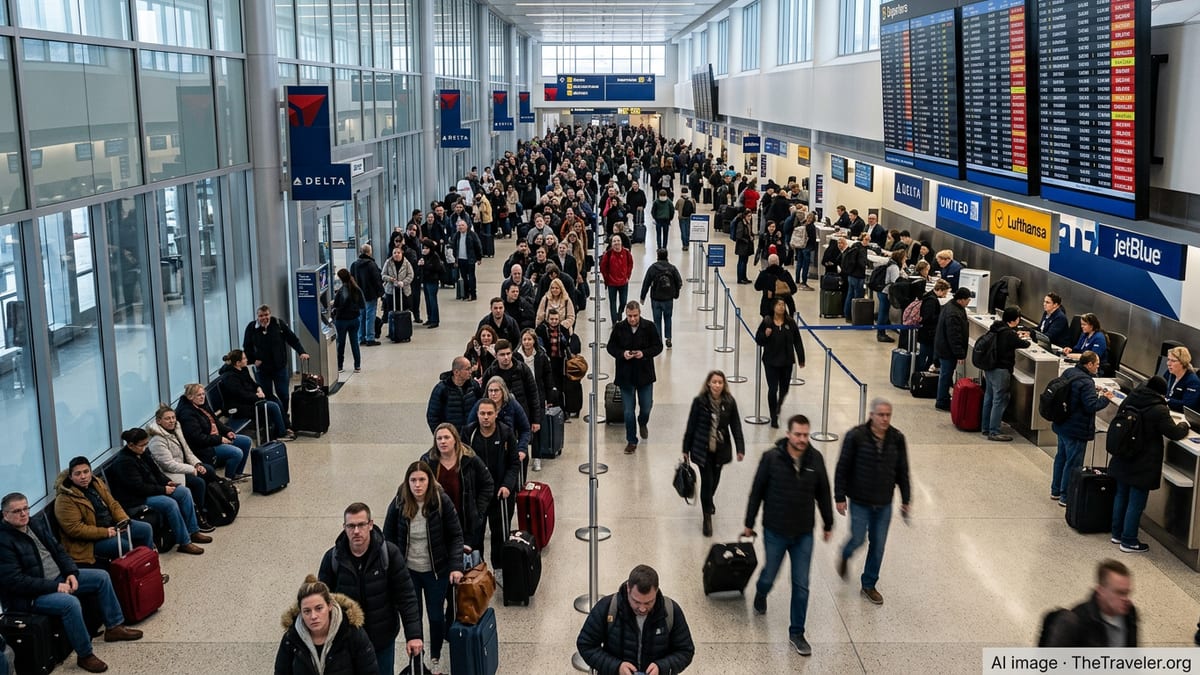
Technical breakdown triggers widespread East Coast disruptions
Published coverage indicates that the interruption began with a technical failure at an air traffic facility serving the Philadelphia area, where a blown circuit affected communications and a backup system was reportedly damaged during nearby construction work. The issue affected radio and data links used to manage aircraft movements in one of the nation’s busiest corridors, prompting a series of ground stops at major East Coast airports.
Reports from national outlets describe significant effects at airports serving the New York region, including Newark Liberty International, LaGuardia, John F. Kennedy International and Philadelphia International, where flights were temporarily halted while technicians worked to restore service. The outages rippled quickly through airline schedules, with aircraft and crews out of position and departure queues growing throughout the day.
Federal aviation data and daily air traffic summaries show that once the underlying problem was identified, priority was placed on restoring communications and gradually lifting the ground stops. However, publicly available updates also indicate that normal operations were not immediately restored; residual delays persisted into the evening as airlines attempted to re-sequence flights and clear accumulated backlogs.
According to national aviation reporting, transportation officials have stated that telecom lines serving the affected facility have since been repaired and that East Coast airport operations have largely resumed. Even with systems back online, the same reporting notes that it can take many hours for aircraft rotations to normalize when such a large region experiences simultaneous ground restrictions.
Delayed departures and cancellations at St. Louis Lambert
Local coverage from St. Louis indicates that the East Coast disruption was felt clearly at St. Louis Lambert International Airport, where aircraft bound for or arriving from the affected region faced knock-on delays. Flight-tracking data cited in that coverage show that about ten dozen flights were delayed and at least five were canceled at the airport on Monday once the ground stop took effect at multiple East Coast hubs.
Publicly available information from flight-status services suggests that the most affected routes were those connecting St. Louis to large Northeast and Mid-Atlantic hubs, including Newark, Philadelphia and New York-area airports. Some flights originating in the region arrived hours behind schedule into St. Louis, while departures from Lambert to the East Coast were held at gates or rescheduled as traffic management initiatives were put in place.
The official website for St. Louis Lambert International Airport highlights a mix of major carriers serving the field, including American Airlines, Southwest Airlines, United Airlines and others. Because several of these airlines operate large connecting operations at East Coast hubs, the disruption in that region quickly cascaded into Lambert’s schedule, affecting travelers whose flights neither began nor ended in the Northeast but relied on those airports for connections.
Airport operations planning documents for St. Louis describe how carriers, rather than the airport operator, are primarily responsible for handling irregular operations such as extended tarmac delays and large-scale schedule disruptions. The events on Monday activated many of those contingency processes, as airlines adjusted gate assignments, rebooked travelers and repositioned aircraft throughout the day.
Passenger impacts stretch across airlines and itineraries
Accounts compiled in local news reports describe a challenging day for passengers at Lambert, with travelers arriving from Newark and other East Coast airports landing many hours later than expected. In at least one widely circulated account, a traveler scheduled on a roughly two-hour flight from Newark to St. Louis arrived in Missouri after an all-day delay, illustrating how a relatively short route can turn into a daylong journey when ground stops and congestion collide.
Other passengers departing from St. Louis reported shorter but still disruptive delays, with departure times pushed back by 30 minutes or more and continued uncertainty about whether additional holds might be imposed. Some travelers bound for business trips or academic commitments indicated that the timing of the delays forced them to rearrange meetings, miss planned events or revise overnight plans at their destinations.
Local reporting notes that baggage handling became another point of frustration for some travelers. When flights are delayed for long periods or aircraft are reassigned, checked luggage can become separated from passengers, arriving on later services once space and scheduling permit. Flight-tracking and baggage-handling systems are designed to eventually reunite passengers with their bags, but during widespread disruptions, those systems can take longer than usual to catch up.
Airline schedule data and historical performance statistics for carriers operating at Lambert suggest that even in normal conditions, a share of daily flights experience minor delays. On days with system-wide irregular operations driven by external infrastructure failures, those ordinary fluctuations are amplified, as spare aircraft and crew capacity that might otherwise absorb routine issues are already committed to handling the broader disruption.
How airlines and the airport manage irregular operations
Publicly available contingency plans for St. Louis Lambert International Airport, including an irregular-operations and tarmac-delay document, outline how airlines and the airport coordinate when flights are significantly disrupted. These materials state that carriers have primary responsibility for caring for passengers during extended delays, including managing onboard conditions, making decisions about returning to gates and communicating schedule changes.
The same planning documents describe how the airport’s operations center works with air traffic control and airlines to stage aircraft, allocate gates and manage the flow of arrivals and departures when bad weather, equipment failures or other events reduce capacity. During a regional ground stop affecting multiple hubs, those responsibilities can include holding aircraft on the ground in St. Louis until receiving airports are able to accept inbound flights.
Federal aviation resources, such as the daily air traffic report, provide an overview of conditions at major U.S. airports, including ground stops, ground delay programs and significant arrival or departure constraints. Travelers reviewing these public tools can see when a particular hub is experiencing systemic issues, although airlines continue to advise that passengers check directly with their carriers for flight-specific information.
While Monday’s disruptions were triggered by a technical failure far from Missouri, the response mechanisms activated in St. Louis were similar to those used during severe weather or other operational constraints. Airline network control centers evaluate where to hold flights, which routes to prioritize and how to position crews, while Lambert’s local operations staff coordinate gate usage and airfield movements to minimize additional delays.
What travelers through St. Louis should know going forward
Travel advisors quoted in local coverage emphasize that when disruptions originate from broad infrastructure issues, such as an air traffic facility failure, travelers are often better served by working directly with their airline rather than making unilateral changes. Rebooking tools offered by carriers, including same-day flight changes and waivers on certain fees, are generally adjusted to reflect the nature and scale of the disruption.
Public information from St. Louis Lambert International Airport underscores the importance of using official channels to monitor flight status, including the airport’s own flight information displays and airline-specific mobile apps. These tools typically provide more current information than third-party sites or social media posts, especially when gate changes or aircraft substitutions occur close to departure time.
Federal aviation data and independent delay-tracking services also indicate that the aftereffects of a major ground stop can continue into the following day, as aircraft and crews gradually return to their assigned rotations. Travelers connecting through Lambert on routes that pass through the Northeast may experience residual delays even after formal ground restrictions have been lifted at East Coast airports.
For now, reports indicate that the technical issues at the Philadelphia-area facility have been resolved and that normal air traffic flows are resuming across the affected corridor. St. Louis Lambert International Airport’s published resources show regular operations continuing, but the events of the week highlight how interconnected the U.S. aviation network remains, with a single point of failure capable of affecting travelers hundreds of miles away in the Midwest.