


More news on this day
Europe’s new biometric Entry/Exit System is straining airport border checkpoints at the height of the summer travel season, with long queues, missed flights and mounting pressure from airlines and airports for the European Union to allow wider suspension of biometric checks when congestion surges.
Get the latest news straight to your inbox!
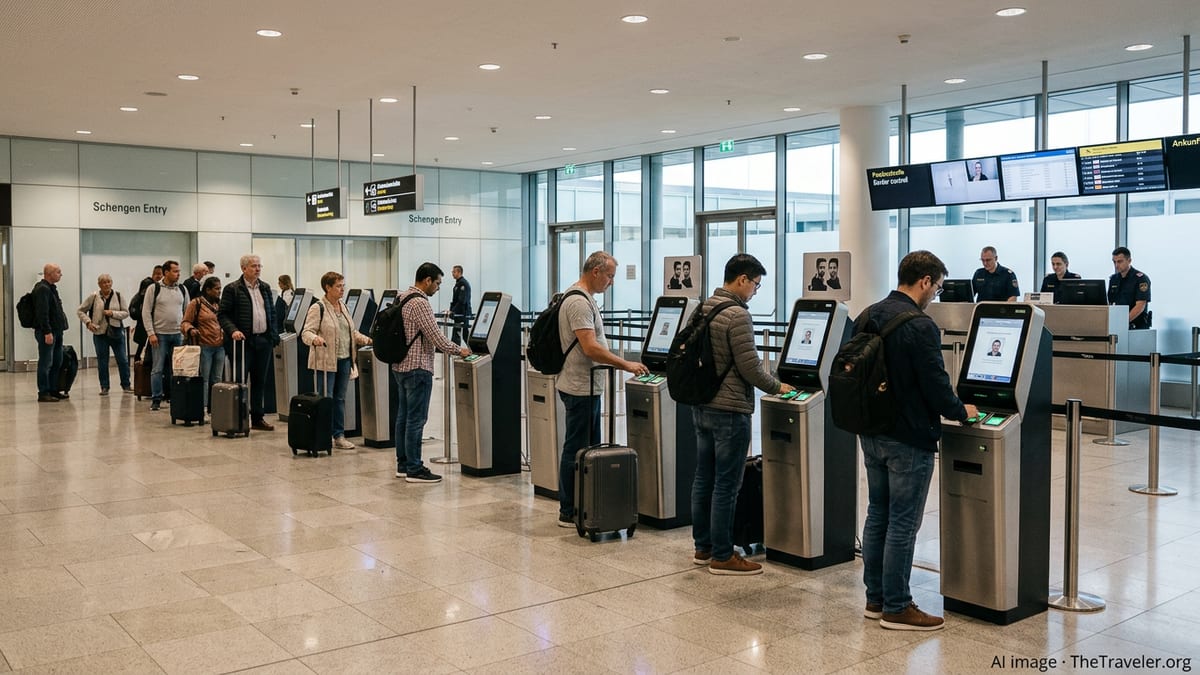
Summer queues expose weak points in new border regime
Reports from major European hubs indicate that the rollout of the Entry/Exit System, known as EES, has pushed up processing times for non-EU travellers as border officers capture fingerprints and facial images at dedicated kiosks and counters. Industry analyses cited by European media describe waiting times that can stretch beyond two hours at peak periods, with some airports recording even longer queues when systems slow down or staffing is thin.
Publicly available information from airport groups notes that the progressive introduction of biometric registration has increased the time required for each passenger, particularly for first-time registrants who must provide both biometric and passport data. Once enrolled, future crossings should be faster, but the initial surge of new profiles coincides with the summer high season, when leisure traffic from North America and other long haul markets spikes.
Travel coverage across Europe points to delays at key Schengen entry points where large numbers of visa exempt visitors arrive, including hubs that handle high volumes of UK, US and Canadian passengers. In some cases, airlines have reportedly had to hold departures or rebook travellers who were still caught in border queues at boarding time, putting additional pressure on schedules already constrained by tight turnaround times.
Airport operators have warned in recent weeks that, without additional flexibility, the combination of higher processing times, occasional technical glitches and seasonal surges could lead to a pattern of rolling disruption through July and August.
Airlines and airports push for emergency suspension powers
The growing operational strain has triggered a coordinated response from airport and airline associations, which argue that existing EU rules on the Entry/Exit System do not offer enough practical flexibility for real world peak conditions. In open letters and fact sheets circulated in recent weeks, organizations representing airports and European carriers have urged EU institutions to explicitly permit border authorities to suspend or scale back biometric collection whenever queues risk becoming unmanageable.
Published material from Airports Council International Europe, Airlines for Europe and the International Air Transport Association describes EES as a structural challenge that cannot be solved solely by local staffing adjustments. These groups maintain that border police should be able to switch temporarily to manual passport checks, or limit biometric capture to targeted cohorts, when waiting times exceed predefined thresholds.
A recent letter reported by European media calls for a temporary framework that would allow member states to suspend EES entirely at some border crossing points during the busiest summer weeks, rather than rely only on restricted exemptions. The associations argue that such a step would provide a safety valve to prevent “systemic disruptions” across airport operations, from check in and security to departure punctuality.
Industry commentary stresses that, while long term digitalisation of borders remains a shared goal, preserving the reliability of air travel during the transition is essential for both passenger confidence and the competitiveness of European hubs.
Existing legal flexibilities tested as pressure builds
EU regulations governing the Entry/Exit System already permit limited suspension of biometric collection in exceptional circumstances when waiting times become excessive. According to information published by the European Commission and the European Parliament’s research service, national authorities can temporarily halt the capture of fingerprints and facial data at specific border points for a restricted period if queues reach critical levels.
In practice, reports indicate that some airports have already resorted to these provisions. Media coverage from Portugal, for example, has described instances where EES kiosks at Lisbon Airport were taken out of service for extended periods in order to ease long lines at border control. Similar accounts from other Schengen gateways suggest that local border agencies have intermittently relaxed biometric checks during peak surges.
The latest wave of appeals from airports and airlines, however, suggests that sector stakeholders view the current legal tools as insufficiently predictable or broad for the pressures of the summer season. Calls reported in European press coverage seek clearer guidance and a more systematic approach, including agreed thresholds for queue lengths and transparent criteria for when EES can be paused or reduced.
The European Commission has publicly underlined the security rationale of the new system, which is designed to record entries, exits and refusals for non EU travellers in order to strengthen enforcement of short stay rules. Balancing that objective with the need to keep passengers moving smoothly through airports has become one of the most sensitive issues in the early months of EES operation.
Operational challenges: staffing, technology and passenger readiness
Behind the headline delays, industry documentation points to a mix of structural and practical challenges. Analyses shared by airport and airline bodies highlight chronic staffing constraints at passport control, where recruitment and training have struggled to keep pace with rising traffic levels and the additional workload created by biometric capture.
Technical issues add another layer of complexity. Various reports mention intermittent faults at self service kiosks and automated gates, software slowdowns and difficulties integrating new EES components with legacy border systems. Even short interruptions can quickly create backlogs when arrival flows are heavy, especially at airports with limited physical space to expand border control areas.
Passenger preparedness is also emerging as a factor. Travel advisories note that many visitors still arrive without a clear understanding of how EES works, which documents to have ready, or how to use the kiosks. When large numbers of first time users attempt registration at once, border officers often need to provide hands on guidance, reducing throughput per lane.
Industry recommendations circulated in recent weeks call for a combination of measures, including more frontline staff at passport control, wider deployment of automated gates that are fully EES enabled, and robust public information campaigns targeted at travellers from key origin markets such as the United Kingdom, the United States and Canada.
Impact on tourism and traveller confidence
The timing of the current bottlenecks is particularly sensitive for European tourism. Travel industry coverage notes that the first full summer with EES in wide operation coincides with strong demand for European city breaks and beach holidays from long haul markets. Concerns are growing that images of crowded border halls and stories of missed connections could deter some visitors or nudge them toward alternative destinations.
Commentary from tourism observers suggests that even a minority of severely affected airports can have an outsized impact on perception, especially when disruptions occur at major hubs that serve as gateways to multiple countries within the Schengen area. Airlines are also wary of the operational costs associated with repeated departure delays, missed connections and rebooking obligations.
Several travel risk advisories now encourage passengers to allow extra time at departure and arrival airports in the Schengen zone, particularly if they are making tight connections or crossing borders for the first time under the new system. Some carriers have adjusted recommended check in times or are warning customers that boarding gates will close at the published time even if EES queues are still long.
How EU institutions and national authorities respond over the coming weeks is likely to shape both the near term travel experience and the longer term reputation of the Entry/Exit System. For now, the central question for the industry is how far and how fast Brussels will go in allowing broader suspension of biometric checks to keep Europe’s summer traffic moving.