


More news on this day
Egypt is accelerating a far-reaching expansion of its airport network, signaling a new phase of aviation-driven growth that aims to position the country as a leading hub for Africa, Europe and the Middle East, while reshaping regional travel flows for tourism, business and cargo.
Get the latest news straight to your inbox!
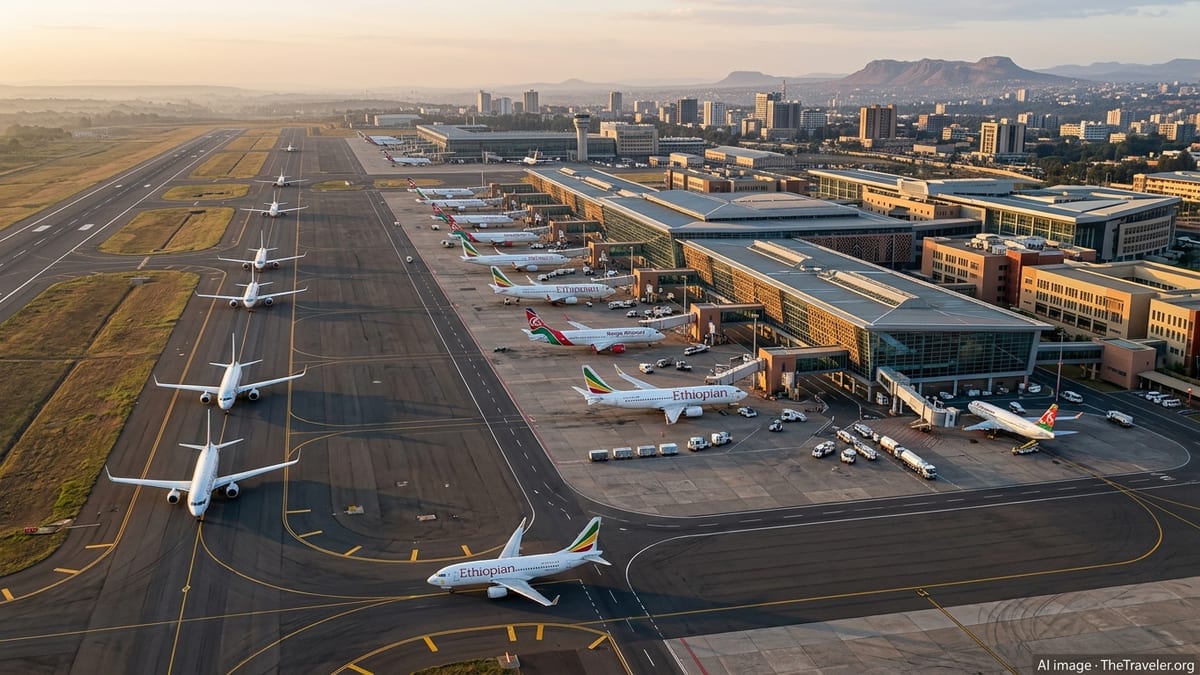
Cairo’s New Terminal 4 Anchors an Emerging Super-Hub
Expansion at Cairo International Airport sits at the core of Egypt’s aviation strategy, with the planned Terminal 4 project designed to roughly double the airport’s capacity and cement its status as a primary gateway between Africa, Europe and Asia. Recent government briefings describe the new facility, often referred to as the “New Republic Air Gate,” as a next-generation passenger terminal built to handle at least 30 million travelers per year, lifting Cairo’s overall capacity to more than 60 million annually and potentially toward 70 million as supporting infrastructure is completed.
According to publicly available information, the Terminal 4 program is tied closely to Egypt Vision 2030, which emphasizes turning the country into a regional transport and logistics hub and raising annual tourist arrivals to around 30 million. Reports indicate that the expanded complex is being planned with a focus on transit efficiency, modern security systems and improved passenger services, which together are expected to attract more international airlines and strengthen Cairo’s role as a connecting point for long-haul itineraries across Africa and beyond.
Traffic volumes through Cairo have already been rebounding. A recent base prospectus covering Egypt’s aviation sector notes that approximately 28.8 million passengers used Cairo International Airport in 2024, up from 26.2 million in 2023, underscoring the urgency of new capacity and more efficient terminal design. With the upcoming expansion, aviation analysts expect Cairo to absorb a rising share of connecting flows between sub-Saharan Africa, the Gulf, Europe and North America, especially as airlines look for competitive alternatives to saturated hubs in the region.
Sphinx and Capital Airports Ease Pressure and Unlock New Tourism Corridors
Beyond Cairo’s main gateway, secondary airports in Greater Cairo are being upgraded to disperse demand and open new travel patterns across Egypt. Sphinx International Airport, situated near the Giza pyramids and the Grand Egyptian Museum, has undergone a major expansion that increased its terminal area to around 24,000 square meters from 3,600 square meters. Official strategy documents indicate that its capacity has risen from about 300 to 900 passengers per hour, or roughly 1.2 million travelers a year, with improved baggage systems, security technology and energy efficient lighting.
The Sphinx project is intended to reduce congestion at Cairo International, while enabling short-stay and “one day” tourism tied to the museum and heritage sites clustered on the city’s western edge. Domestic services began ramping up from late 2022, followed by international flights, positioning Sphinx as a gateway for leisure itineraries that combine Cairo with Red Sea resorts and Nile Valley destinations without passing through the crowded main terminals.
To the east of Cairo, Capital International Airport, which serves the New Administrative Capital, has also been brought into the network as part of a wider strategy to redistribute air traffic across the fast-growing metropolitan area. The airport, which opened commercially in 2020, includes a passenger terminal, control tower and runway capable of handling large aircraft, and is expected to ease pressure on both Cairo International and Sphinx as government institutions and businesses migrate to the new capital zone.
Alexandria’s Borg El Arab Becomes Africa’s First “Green” Airport Terminal
On Egypt’s Mediterranean coast, the modernization of Borg El Arab International Airport near Alexandria highlights how sustainability is being incorporated into the country’s aviation expansion. Public information from Egypt’s State Information Service and project partners describes a new passenger terminal designed as the first environmentally friendly airport terminal in Africa, with features such as energy efficient systems and provisions for renewable power, alongside upgraded safety and operational technology.
The modernization and extension program includes construction of a new terminal building, additional aprons, taxiways and related facilities to support rising passenger and cargo volumes. Development agencies involved in feasibility and implementation have framed the project as a response to sharply increasing demand for air transport in Alexandria and along the North Coast, as well as a step toward shifting more international traffic from older facilities to a modern, scalable platform.
Engineering firms active on the project report that construction of the expanded Borg El Arab facilities was completed in late 2024, with a subsequent period allocated to operation and maintenance under contract. The airport’s upgraded capacity, combined with its role as a low cost and regional hub, is expected to enhance connectivity between Egypt and neighboring markets in North Africa, the Eastern Mediterranean and the Gulf, strengthening the country’s position in intra-African travel and trade flows.
Public Private Partnerships and Regional Connectivity Across Africa
Airport expansion in Egypt is increasingly tied to new financing and operating models that aim to draw in global expertise and capital. A notable step in this direction was an agreement with the International Finance Corporation to introduce public private partnerships across 11 airports, with Hurghada International Airport selected as a pilot. According to the Ministry of International Cooperation, the initiative is part of an asset monetization program designed to attract world class investors, improve performance and support the wider goal of transforming Egypt into a competitive travel and trade hub.
Alongside large scale projects in Cairo, Giza and Alexandria, Egypt is also modernizing airports in key tourism centers and peripheral regions, including Sharm El Sheikh, Marsa Alam, St Catherine and El Arish, as well as enhancing air navigation systems and airspace management. Regional aviation organizations report that Egypt’s civil aviation sector is working within broader African initiatives to liberalize air services and expand route rights, which could make the additional capacity at Egyptian airports a significant asset for pan African carriers and cross border operators.
For African travelers and airlines, the effect of this airport buildout is likely to be felt through more frequent services, new point to point routes and expanded code sharing options connecting secondary African cities through Egyptian hubs. The combination of upgraded terminals, expanded runways and modern logistics areas opens the door for Egypt to capture more cargo and express traffic linking Europe and Asia with African markets, reinforcing the country’s role as a bridge within the continent’s emerging aviation network.
Implications for Tourism, Investment and Intra-African Travel
The scale and timing of Egypt’s airport investments align with a broader push across Africa to expand passenger and freight capacity in anticipation of long term demand growth. With tourism central to Egypt’s economy and new cultural assets such as the Grand Egyptian Museum attracting global attention, improved airport infrastructure near key heritage clusters is expected to support higher value, higher volume visitor flows, including short breaks and multi destination itineraries that combine city, desert and seaside experiences.
At the same time, expanded and more efficient airports create opportunities for logistics, aircraft maintenance, retail and hospitality businesses clustered around major terminals. Development plans referenced in government and partner documentation highlight a focus on improving the areas surrounding airports as investment zones, which could help anchor new jobs and services that extend well beyond the boundaries of the aviation sector itself.
For Africa more broadly, Egypt’s airport expansion demonstrates how targeted infrastructure upgrades, coupled with regional traffic rights and modern financing tools, can reshape connectivity patterns. As new terminals come online and capacity constraints ease, airlines within and beyond the continent are likely to reassess their networks, with Egypt’s emerging constellation of hubs offering additional options for routing passengers and cargo in and out of African markets.
Cairo Airport Terminal 4 capacity and hub plans
Egypt civil aviation sector strategy and Sphinx Airport expansion
Egypt partnership with IFC on airport public private partnerships