


More news on this day
Morning rail travel between Essex and London was thrown into disarray today as all mainline services into the capital were suspended following a trackside fire, according to early disruption reports from UK rail operators and National Rail information feeds.
Get the latest news straight to your inbox!
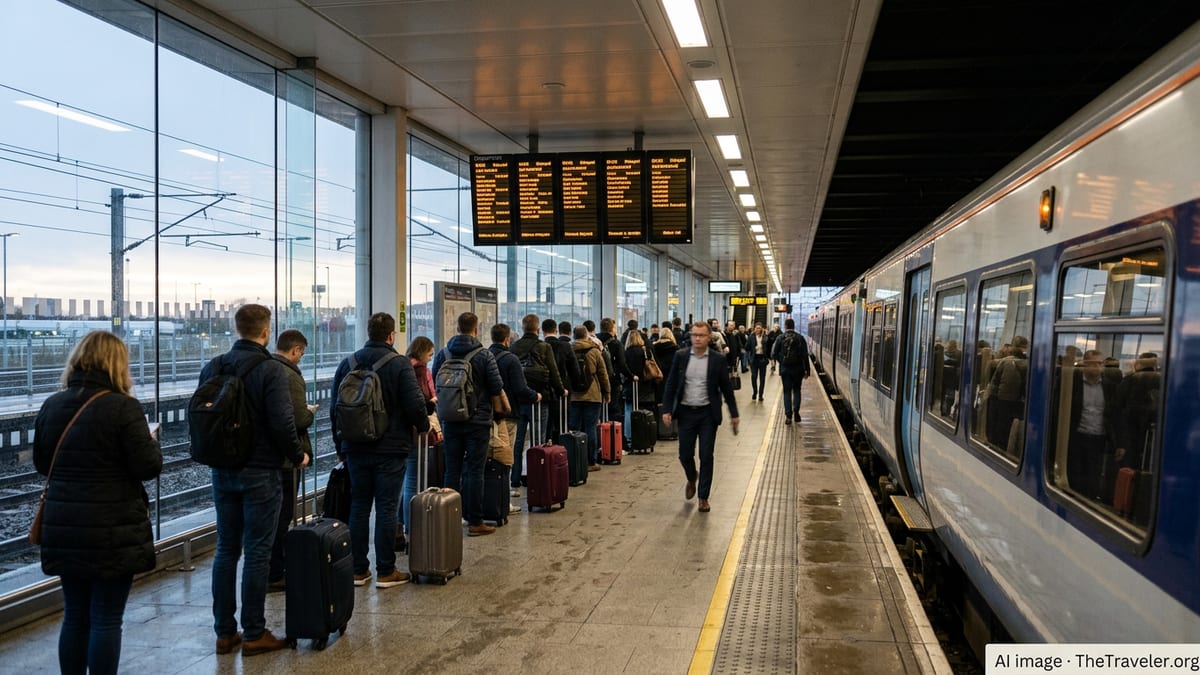
Services halted across Essex commuter routes
Published disruption summaries indicate that trains from key Essex towns into London were brought to an abrupt stop shortly after the start of the morning peak, with operators suspending services in both directions while the fire was dealt with. Routes normally carrying thousands of commuters into London termini were affected, including services used daily by workers, students and leisure travellers.
Information shared through live departure boards and official status pages shows that inbound trains from Essex to London were either cancelled outright or terminated short of the capital, with no estimate initially available for when full services might resume. Some trains already en route were reported as being held at intermediate stations while the incident was assessed.
Rail monitoring platforms noted a sharp increase in cancellations and severe delays across the affected corridor, a pattern consistent with previous incidents in which fires near the track or at lineside equipment have forced operators to halt traffic for safety checks and emergency access.
Passengers checking journey planners throughout the early morning peak were met with repeated cancellation notices and advice to delay travel where possible, as the suspension of Essex to London trains removed one of the principal commuter arteries into the city.
Fire near the railway triggers safety shutdown
Early indications from operational updates suggest the disruption was caused by a fire in the vicinity of the railway, prompting a precautionary shutdown of services into London. Although detailed technical information about the exact location was not immediately available, recent incidents on the UK rail network show that fires affecting power cables, signalling cabinets or other trackside equipment can quickly lead to widespread suspensions.
Standard operating practice in such situations is to halt trains while fire and rail engineers confirm that it is safe to move traffic through the affected section. In past cases, including cable-duct and tunnel fires on other parts of the network, operators have only gradually reintroduced trains after inspections, temporary repairs and reduced-speed restrictions were put in place.
Reports from rail users on social platforms described trains standing outside stations for extended periods and platforms filling as repeated announcement boards switched from delayed to cancelled. While precise timings for today’s incident are still emerging, the pattern reflects the cautious approach taken when any fire is reported close to high-voltage railway infrastructure.
Disruption summaries issued this morning emphasised that safety checks had to be completed before services could restart, signalling that cancellations were likely to continue beyond the initial response period even after the fire itself was brought under control.
Severe impact on commuters and regional travel
The suspension of all Essex to London trains during the morning peak created significant knock-on effects for passengers along the route. Many regular commuters were left seeking alternative ways into the capital, including driving to London, diverting to other rail lines where possible or turning to coach services and local buses.
Stations across Essex saw queues build as travellers attempted to rebook or seek advice on alternative connections. In some locations, departure boards showed entire columns of cancelled services into London, reflecting the breadth of the shutdown rather than isolated train faults or routine delays.
The impact extended beyond daily commuters. People heading to scheduled medical appointments, business meetings, exams and events in London also faced last-minute disruption. Social media posts from affected passengers highlighted concerns about missed commitments and the difficulty of re-planning journeys at short notice when multiple consecutive trains were removed from the timetable.
Rail information pages for the region indicated that delays would remain likely even once trains began moving again, with displaced rolling stock and crew out of position. Recent examples from other UK incidents involving fires have demonstrated that it can take much of the day for normal service levels to be restored, particularly on busy commuter routes.
Replacement road transport and alternative routes
Publicly available travel updates show that operators requested rail replacement buses on key stretches of the line to bridge gaps created by the suspension of Essex to London trains. However, the capacity of road transport to absorb demand on a weekday morning is limited compared with a full rail timetable, meaning many passengers still faced extended waiting times.
National journey-planning tools advised passengers to consider alternative rail routes where available, including diverting via different London terminals or using intersecting lines that remained open. In practice, options for many Essex commuters were constrained, as the primary mainline corridor into the capital was the one directly affected by the fire-related shutdown.
Travel advice issued via rail information channels encouraged anyone without an essential need to complete their journey this morning to postpone travel until later in the day. Where tickets were bought in advance, existing industry arrangements typically allow passengers to use their tickets on later services once the route reopens, or to seek refunds if they choose not to travel because of significant disruption.
Experience from previous large-scale incidents suggests that congestion can quickly spread to nearby routes when a major commuter artery is closed, as passengers seek any available alternative into London. Early reports from today’s disruption indicated that some connecting services were already seeing heavier-than-normal crowding.
Ongoing disruption and what passengers should watch for
As the morning progressed, live rail feeds indicated that disruption was expected to continue for several hours, even after the immediate fire hazard was addressed. Trains and crews were left out of place, timetables needed to be re-sequenced and infrastructure checks had to be completed before full line speed could be restored.
Passengers planning to travel later today were advised through official status pages and journey planners to keep checking for updates, as operators worked to introduce a limited service and then increase frequency as conditions allowed. Experience from prior trackside fire incidents elsewhere on the network suggests that residual delays and short-notice cancellations can persist well into the day.
Information shared by rail companies pointed to the usual range of assistance for disrupted passengers, including guidance on claiming compensation where entitlements apply under existing delay and cancellation schemes. Travellers affected by the suspension of Essex to London services are generally advised to retain their tickets and any receipts for additional reasonable expenses incurred while completing essential journeys.
While the precise timeline for a full return to normal service remained unclear this morning, the incident once again underscored the vulnerability of heavily used commuter corridors to infrastructure problems, and the scale of disruption that a single trackside fire can cause for thousands of people attempting to reach London.