


More news on this day
Rail passengers in east London faced severe disruption after a fire near Stratford station led to a full closure of the busy interchange, halting services and triggering widespread delays across multiple routes.
Get the latest news straight to your inbox!
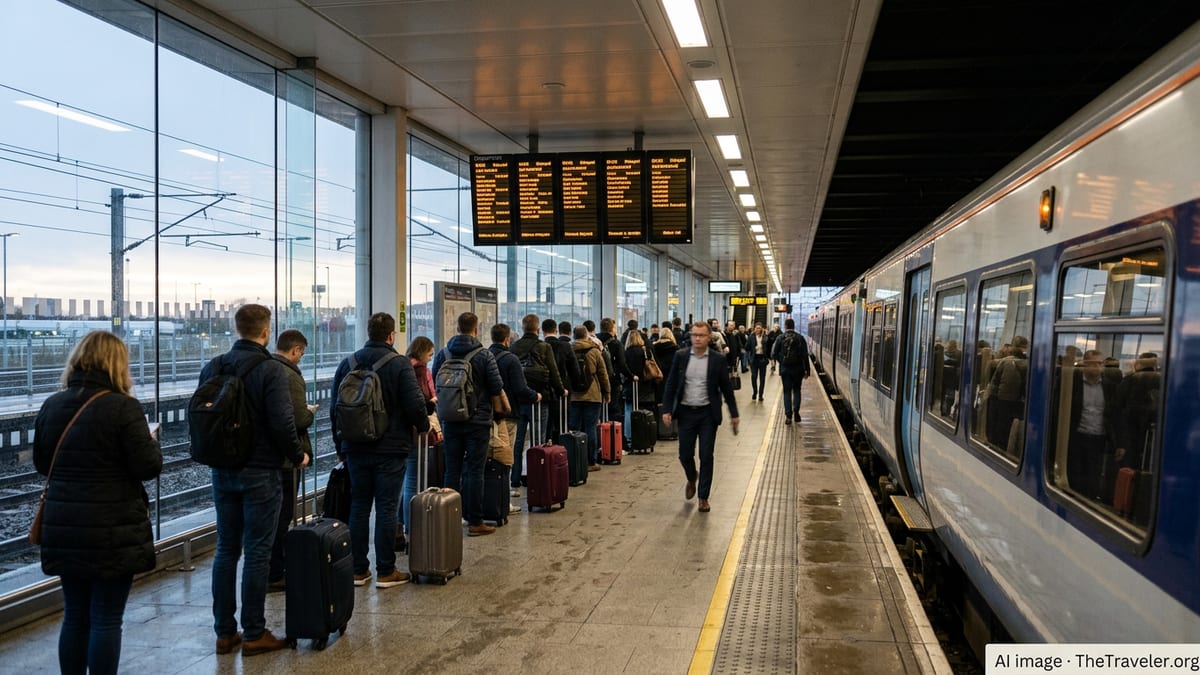
Major east London hub brought to a standstill
Stratford station, one of London’s key rail and Underground interchanges, remained closed for several hours after the incident, with reports indicating that trains were prevented from calling at the station while emergency services worked in the area. The shutdown affected mainline, Underground and Docklands Light Railway connections at the height of the evening travel period.
According to published coverage and live travel feeds, services were held outside the station or diverted away, creating bottlenecks along the wider network. Passengers reported trains being terminated short of Stratford and platforms becoming increasingly congested at nearby stops as travellers tried to reroute.
No serious injuries had been reported in the immediate aftermath, but operators advised customers to avoid non-essential journeys through east London. Network updates described a fluid situation, with the duration of the closure initially unclear and disruption expected to continue even after services began to resume.
Commuters face missed connections and long delays
The closure quickly rippled across morning and evening peak periods, leaving commuters struggling to reach workplaces, appointments and events around Stratford, the Queen Elizabeth Olympic Park and nearby residential districts. Social media posts described packed replacement routes, queues spilling out of neighbouring stations and bus stops, and journeys that took two or three times longer than usual.
Many long-distance passengers attempting to change at Stratford for services into central London or towards Essex and East Anglia were forced to improvise, diverting via alternative hubs such as Liverpool Street, Hackney and Canary Wharf. Rail users reported confusion as real-time information screens updated frequently, with some services reinstated only to be delayed again as congestion built up along the approaches.
Published rail and Underground advisories warned that even once the fire area was declared safe, trains and platforms would remain busy while the backlog cleared. Timetables were expected to be disrupted well beyond the initial incident window, with knock-on delays likely into the late evening.
Cause under investigation as safety checks carried out
Early reports suggested the fire started close to the railway, prompting a cautious response that required stopping movements through the affected section. Technical teams were dispatched to inspect infrastructure including cabling, trackside equipment and signalling systems before any trains were allowed to run again.
Publicly available information indicated that operators were treating the episode as a significant safety event, with checks extending beyond the immediate fire location to ensure that smoke, heat or firefighting activity had not compromised nearby assets. This contributed to the length of the closure, but operators maintained that clearing services too quickly could risk further disruption later if additional faults emerged.
Investigations into the precise cause are expected to focus on electrical equipment and vegetation close to the line, in line with recent incidents elsewhere on the network where small fires have nevertheless had a major operational impact. Detailed findings typically follow in the days after such events, once engineers and incident investigators have reviewed site evidence and system data.
Stratford’s role as a critical interchange magnifies impact
Stratford’s importance within London’s transport system magnified the disruption. The station links multiple Underground lines, the Elizabeth line, London Overground, regional rail and the Docklands Light Railway, serving commuters, stadium visitors and shoppers heading to Stratford City and Westfield. Previous planning documents and transport studies have highlighted the hub as one of the capital’s busiest and most complex interchanges.
On a normal weekday, this mix of local, regional and international-bound passengers means any interruption can quickly cascade across lines. With services halted or heavily reduced, trains on approaching routes became crowded while passengers sought alternative paths via Canning Town, West Ham, Mile End and other nodes on the network.
Observers noted that the incident again underlined the vulnerability of large urban hubs when a single point on the network is taken out of action. Even a relatively contained fire near the tracks can force the closure of a high-capacity station, with consequences stretching many miles beyond the immediate scene.
Travel advice and expectations for the coming days
In the hours after the fire, operators urged passengers to check live journey planners before setting out and to allow extra time for travel through east London. Replacement bus services and alternative rail routes were recommended where available, though demand quickly outstripped capacity on some corridors.
Transport commentators suggested that residual delays and short-notice cancellations around Stratford could persist into following days as timetables and train crew diagrams are reset. Some late-night and early-morning services may also be adjusted to reposition rolling stock and recover the network to its normal pattern.
Regular users of Stratford station are being encouraged to build more contingency into their journeys while the aftermath of the closure is managed. For visitors heading to events at the London Stadium or nearby venues, planning alternative routes in advance, avoiding tight connections and travelling outside the busiest peak periods are being highlighted as practical ways to reduce the risk of further disruption.