


More news on this day
Ethiopian Airlines is accelerating its ambition to become a global super‑connector, finalizing a wave of record-breaking jet purchases that analysts say will redefine air travel, tourism and connectivity across Africa through the next decade.
Get the latest news straight to your inbox!
A Landmark Fleet Expansion on an African Scale
The latest agreements build on a historic series of deals that began at the Dubai Airshow in November 2023, when publicly available information shows Ethiopian Airlines committed to purchase 11 Boeing 787 Dreamliners and 20 Boeing 737 MAX aircraft, with options that could lift the total to 67 jets. Aviation industry coverage describes the package as the largest single Boeing order by an African carrier and a watershed moment for the continent’s commercial aviation sector.
The momentum continued in March 2024 with an agreement for up to 20 Boeing 777X widebodies, positioning Ethiopian as the launch operator of the next‑generation long‑haul jet in Africa. Fleet records indicate that firm orders for eight 777‑9s, plus additional purchase rights, will significantly upgrade the airline’s ability to serve high‑density intercontinental routes.
On the Airbus side, the carrier has cemented its status as Africa’s largest A350 operator. In parallel with the Boeing commitments, Ethiopian has ordered additional A350‑900s and has already taken delivery of Africa’s first A350‑1000, according to manufacturer statements. A more recent order for six further A350‑900s, disclosed in late 2025 press material, extends that growth trajectory well into the 2030s.
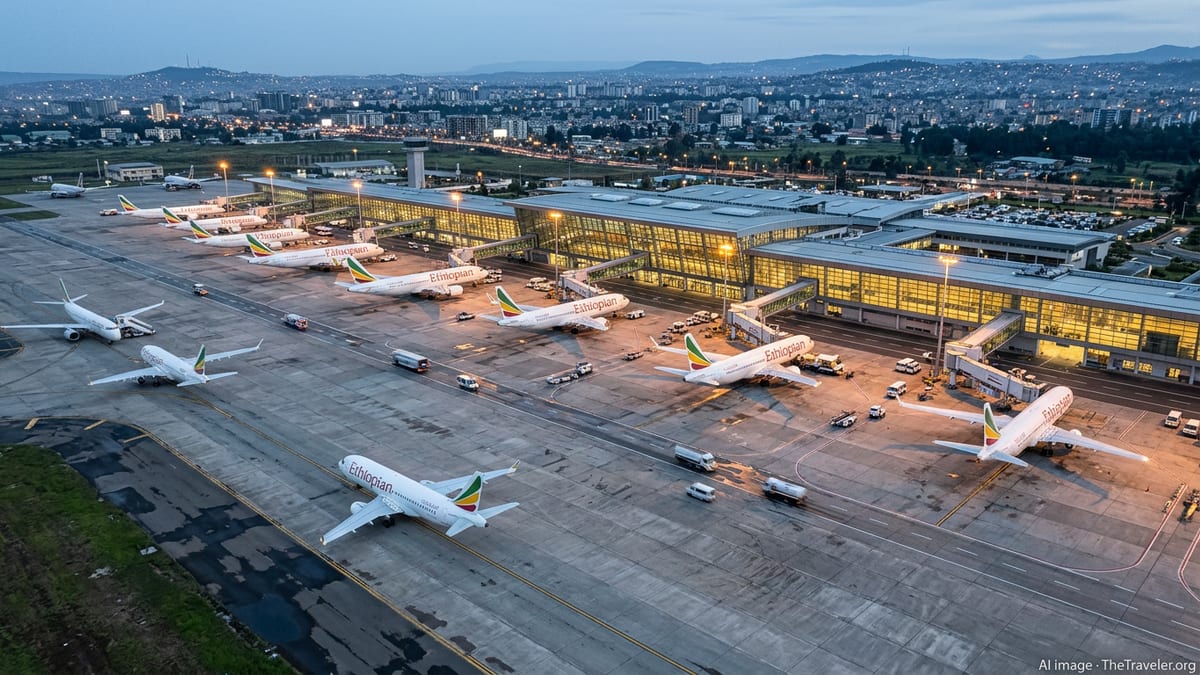
Fact sheets released by the airline indicate that as of late 2025 Ethiopian operates a fleet of well over 140 aircraft with more than 60 new jets still on order. This combined pipeline from Boeing and Airbus represents one of the most aggressive fleet expansion plans on the continent and underpins the carrier’s long‑term growth strategy.
Supercharging Tourism and Global Route Networks
Industry analysts expect the enlarged fleet to ripple far beyond airline balance sheets, ushering in a new phase of tourism growth for key African destinations. The mix of fuel‑efficient Boeing 787s, high‑capacity 777Xs and Airbus A350s is designed to open new long‑haul markets while boosting frequencies on existing routes linking Addis Ababa with Europe, North America, Asia and the Middle East.
According to coverage of Ethiopian’s network plans, the carrier is steadily adding secondary cities in India, China and Europe to complement its established gateway destinations. More long‑range aircraft provide the flexibility to connect these cities nonstop to Addis Ababa or via multi‑stop itineraries that route traffic through African tourism hotspots in East and Southern Africa.
Tourism boards across the region are watching closely. Additional widebody capacity is expected to lower average fares on some competitive long‑haul corridors, widen seat availability in peak seasons and enable more tailored schedules for leisure travelers. Analysts suggest this may particularly benefit safari, heritage and conference tourism, where group travel depends on reliable seat blocks at predictable prices.
Smaller African destinations could also gain. With more single‑aisle Boeing 737 MAX aircraft coming into service, Ethiopian is positioned to add feeder flights from secondary and tertiary cities into its Addis Ababa hub, where travelers can connect onward to long‑haul services. That combination of regional feed and intercontinental reach is regarded as a foundation for sustained tourism growth.
Boosting Intra‑African Connectivity and Trade
Beyond tourism, Ethiopian’s order book is widely viewed as a catalyst for intra‑African connectivity. Reports drawing on manufacturer forecasts note that air traffic in Africa is projected to grow faster than the global average over the next two decades, but limited direct links between African cities have long constrained trade and mobility.
The expansion of a mixed fleet of narrowbody and widebody jets allows Ethiopian to thicken frequencies on trunk routes within Africa, while opening new point‑to‑point connections between emerging economic centers. By adding more 737 MAX aircraft, the airline gains the range and efficiency to serve medium‑distance routes across the continent with lower operating costs than older models.
Improved connectivity is likely to benefit sectors such as agribusiness, pharmaceuticals, mining and technology, where timely air transport is essential. Cargo capacity on 787s, 777Xs and A350s can support high‑value exports and imports, while more frequent passenger services facilitate business travel and regional integration initiatives under frameworks such as the African Continental Free Trade Area.
Some aviation observers argue that Ethiopian’s strategy could encourage competitive responses from other African carriers, accelerating a broader modernization of fleets and route networks. If that materializes, travelers could see a denser web of intra‑African flights, shorter total travel times and fewer enforced connections through non‑African hubs.
Modern Aircraft, Sustainability Goals and Passenger Experience
A key element of the jet order is its focus on new‑generation aircraft that are marketed as more fuel‑efficient and quieter than the models they replace. Boeing highlights double‑digit fuel‑burn reductions for the 787 and 737 MAX compared with earlier designs, while Airbus promotes similar gains for the A350 family. For Ethiopian, this aligns with a stated objective to operate one of the youngest fleets in Africa, with an average age of under seven years.
Lower fuel consumption can help reduce operating costs and carbon emissions per seat, which is increasingly important as regulators and corporate customers scrutinize the environmental footprint of air travel. Although overall emissions will depend on the total number of flights operated, a shift to more efficient jets places Ethiopian closer to industry benchmarks on sustainability.
Passenger comfort is another selling point. The 787, 777X and A350 families are equipped with larger windows, higher cabin humidity and improved air‑pressure settings compared with many older aircraft. Cabin layouts on Ethiopian’s new jets are expected to feature lie‑flat business class seats on long‑haul routes and upgraded in‑flight entertainment and connectivity, including satellite‑based broadband on the newest Airbus deliveries.
For travelers using Addis Ababa as a transfer point, these enhancements could help the airline compete more directly with established global hub carriers in the Gulf and Europe. Travel specialists suggest that a modern onboard experience, combined with competitive fares and growing network breadth, is central to Ethiopian’s ambition to attract more sixth‑freedom traffic that neither originates nor ends in Ethiopia.
Vision 2035 and the Race to Dominate African Skies
The jet order spree is tightly linked to Ethiopian Airlines’ long‑term business roadmap, often referred to in company literature as Vision 2035. Having reported that it met its previous strategic plan years ahead of schedule, the carrier is now targeting substantial growth in fleet size, passenger numbers and cargo volumes over the next decade.
Published data from recent annual reports show that the airline has already passed milestones such as operating more than 145 aircraft and carrying tens of millions of passengers annually. The pipeline of more than 60 additional jets suggests that management expects continued demand growth in both intercontinental and regional markets, even as competition intensifies.
Geography remains a structural advantage. Addis Ababa sits at a crossroads between Africa, Europe, the Middle East and Asia, enabling efficient one‑stop connections on many long‑haul itineraries. With more long‑range aircraft available, Ethiopian can fine‑tune departure banks at its hub to minimize transfer times and capture time‑sensitive business and premium leisure traffic.
Whether this amounts to a full‑scale revolution in African air travel will depend on execution, regulatory support and broader economic conditions. Yet industry observers broadly agree that Ethiopian’s sweeping orders from Boeing and Airbus have raised the stakes. As the new jets arrive through the late 2020s and into the 2030s, Africa’s skies are likely to be busier, better connected and more central to global aviation than at any point in the region’s history.