


More news on this day
Air France has joined Lufthansa, British Airways and KLM in tightening restrictions on flights touching the Gulf and wider Middle East, after the European Union Aviation Safety Agency expanded its conflict-zone advisory across Bahrain, the United Arab Emirates, Saudi Arabia, Oman and several neighboring states, triggering renewed rerouting, delays and suspensions on routes used by millions of travelers worldwide.
Get the latest news straight to your inbox!
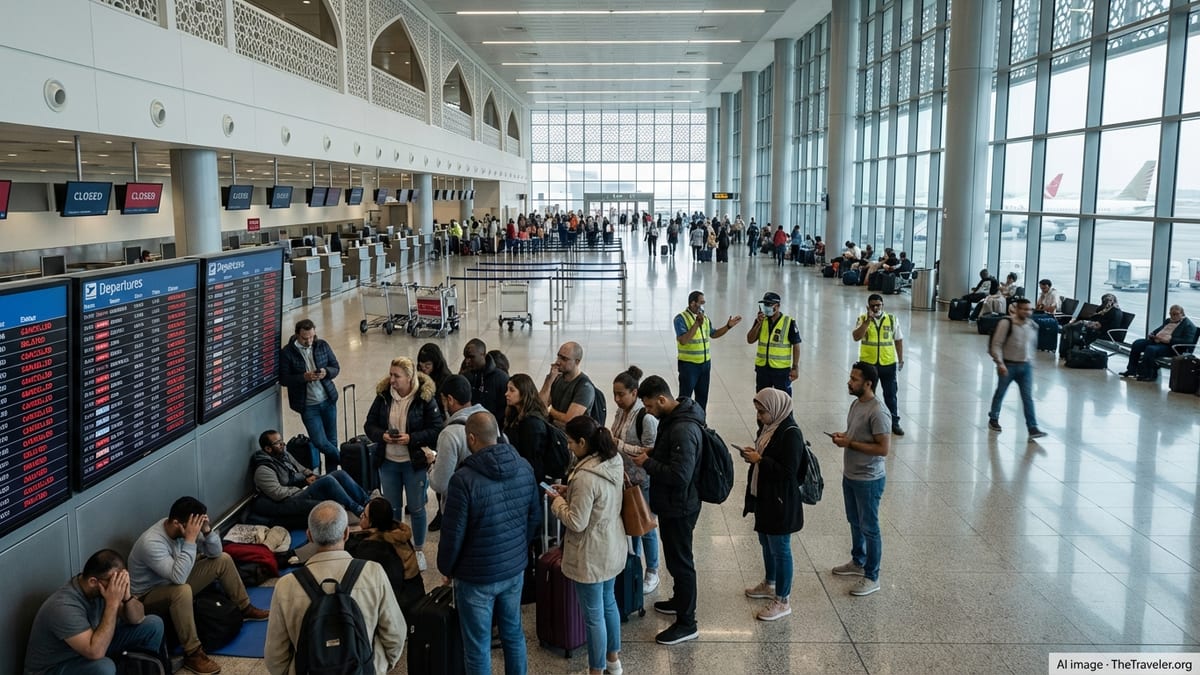
EU Extends Conflict-Zone Guidance Across Key Gulf Airspaces
According to publicly available information from European aviation bodies and specialist airspace trackers, the European Union Aviation Safety Agency (EASA) updated its Conflict Zone Information Bulletin in early April, advising operators to avoid or severely limit operations in the airspace of Bahrain, the UAE, Saudi Arabia, Oman and multiple other Middle Eastern states due to elevated missile and drone risks. The notice, which runs at least through late April unless revised, builds on a series of advisories issued since late February as regional tensions escalated.
Reports indicate that the latest bulletin now effectively covers much of the airspace linking Europe with the Gulf and wider Middle East, including routes that traditionally overfly Iran, Iraq, Syria, Israel, Jordan, Kuwait, Lebanon and Qatar. Aviation risk databases describe a patchwork of outright closures, flight level bans and tightly controlled corridors, leaving airlines with limited options to plan safe and economically viable routings between Europe, Asia and Africa.
Industry-focused coverage notes that while some Gulf airspaces have partially reopened under defined “safe corridor” concepts, the EU advisory continues to urge extreme caution and avoidance of the region’s busiest flight information regions wherever possible. For European carriers, the practical effect has been to move large portions of long-haul traffic away from the traditional Middle East overflight belt and onto longer, more circuitous paths.
Travel-industry analyses suggest that this represents the most extensive European conflict-zone guidance affecting the Middle East since the early 1990s, with implications rippling far beyond the region itself into global network planning, crew rostering and aircraft utilization.
Air France Aligns With Lufthansa, British Airways and KLM
Against this backdrop, Air France has shifted its operational stance in line with other major European groups. Travel trade reports describe the French flag carrier curbing use of affected Gulf airspace, cancelling or temporarily suspending select services into the region, and rerouting flights to Asia and the Indian subcontinent away from high-risk corridors identified in the EU advisory.
Lufthansa, British Airways and KLM had already moved in a similar direction in March, progressively suspending direct links to certain Gulf gateways, trimming frequencies, or rerouting flights around the Arabian Peninsula. Recent schedules published by airline-data providers show reduced or altered operations on key city pairs connecting European hubs such as Paris, London, Frankfurt and Amsterdam with Dubai, Abu Dhabi, Jeddah, Muscat and other major transit points.
Publicly available timetables and booking engines indicate that many Europe to Asia and Europe to East Africa flights that previously crossed Iranian and Iraqi airspace are now looping north via the Caucasus and Central Asia or south over Egypt and the Red Sea, in some cases avoiding much of the Gulf region altogether. This strategy reduces exposure to potential conflict activity but often comes at the cost of higher fuel burn, longer block times and tighter crew scheduling.
Analysts note that the decisions by Air France and its European peers are shaped not only by regulatory expectations under the EU safety framework, but also by corporate risk thresholds, war-risk insurance conditions and the availability of viable alternate routings. With EASA maintaining its robust advisory posture, carriers face limited room to restore suspended links in the short term.
Rerouting, Longer Flight Times and Patchwork Suspensions
For passengers, the most visible impact is a mix of extended journey times, short-notice reroutes and outright cancellations. Flight-tracking snapshots compiled by independent aviation platforms show thinned-out traffic across Bahrain and segments of Gulf airspace, while traditional high-density Europe–Gulf–Asia corridors have broken into scattered flows moving either north through the Caucasus or south via Egypt and the Arabian Sea.
Route analyses published by specialist flight-planning services illustrate that some Europe–India and Europe–Southeast Asia services are adding 30 to 90 minutes to scheduled flight times, depending on the need to detour around multiple restricted flight information regions. The resulting knock-on effects include later arrivals, missed onward connections and the need for additional aircraft rotations to maintain previously announced timetables.
In parallel, travel-management advisories circulated to corporate clients highlight a growing list of routes that remain fully or partially suspended, particularly non-stop links to Bahrain, parts of Saudi Arabia and selected airports in the UAE and Oman. Some carriers have switched to triangular patterns or consolidated services through a single Gulf hub, while others have halted operations entirely until the advisory landscape stabilizes.
Observers point out that this fragmented operational picture can change quickly as states adjust their own national airspace restrictions and as insurers reassess perceived risks. Travelers planning itineraries through the Gulf in April and potentially into May are being urged by airlines and agencies to monitor bookings frequently and allow additional connection time at major hubs.
Knock-On Effects Across Global Hubs and Alliances
The disruption is not confined to Europe and the Middle East. Travel-industry reporting from hubs in Asia, Africa and North America describes a cascading effect on global connectivity, as aircraft that would normally cycle efficiently through Gulf stopovers are instead repositioned or grounded. Airports such as Singapore, Kuala Lumpur and Bangkok have reported waves of cancellations or aircraft downgrades on services that previously relied on Middle Eastern feed.
Alliance and codeshare structures are adding another layer of complexity. With Air France, Lufthansa, British Airways and KLM all deeply embedded in global partnerships, changes to a single Gulf rotation can reverberate across dozens of onward connections sold under joint flight numbers. Publicly available booking data shows some itineraries being automatically re-ticketed through alternative hubs in Istanbul, Cairo or Addis Ababa, while others display “sold out” or “not available” status even when underlying point-to-point segments continue to operate.
Operational briefings shared by travel-management firms suggest that alliance partners are attempting to plug gaps by upgauging aircraft on remaining corridors, adding temporary frequencies where airspace remains more permissive, and leaning more heavily on secondary hubs in Central Asia and southern Europe. However, constrained aircraft availability and crew duty limits mean that many of the lost Gulf connections cannot be fully replaced.
For leisure travelers, the disruption is translating into fewer routing choices and, in many cases, higher fares, especially on short-notice bookings to South and Southeast Asia. Corporate travel buyers report that premium-cabin availability has tightened as displaced passengers compete for seats on a reduced number of safe routings.
What Travelers Should Expect in the Coming Weeks
Looking ahead, aviation risk consultancies and airline schedule data both suggest that the current pattern of rerouting and selective suspension is likely to continue at least until the present round of EASA guidance expires or is substantially revised. Even if a more durable regional ceasefire takes hold, industry commentary indicates that regulators and carriers are unlikely to relax their posture immediately after several high-profile incidents underscored the vulnerability of civil aviation in active conflict zones.
Travelers transiting Europe to reach destinations in the Gulf, South Asia or East Africa should be prepared for dynamic schedules, including last-minute equipment changes, modified routings and shifting connection times. Many airlines are offering limited-fee or fee-free changes for tickets issued before the latest escalation, but conditions vary significantly by carrier and fare class.
Consumer advocates and travel advisors are urging passengers to pay close attention to notifications from airlines and booking platforms, keep contact details updated, and consider longer connection windows when itineraries involve hubs in or near the affected region. Travel insurance policies also merit close review, as standard coverage often excludes disruption linked to conflict and airspace closures.
For now, the alignment of major European carriers with the extended EU conflict-zone advisory underscores the depth of concern over Middle East airspace safety. Until risk assessments shift materially, Air France, Lufthansa, British Airways, KLM and their peers appear set to prioritize conservative routings over convenience, reshaping global flight patterns and adding new layers of uncertainty to long-haul travel plans.