


More news on this day
European skies remained busy but increasingly congested in Week 29 of 2026, as EUROCONTROL data shows average daily flights edging down by 0.5% while network delays surged by around 80% compared with the previous week.
Get the latest news straight to your inbox!
Summer traffic plateaus after record-setting June
According to EUROCONTROL’s European Aviation Overview for Week 29 of 2026, the network handled an average of 36,201 flights per day. That is marginally lower than in Week 28, reflecting a 0.5% dip following several weeks of steady growth and new traffic records earlier in July.
Despite the week-on-week softening, activity remained higher than a year ago. EUROCONTROL figures indicate that Week 29 traffic was around 1.9% above the same week in 2025, confirming that the continent’s summer season is running ahead of last year in terms of volume.
The slight pullback comes after a strong June and early July, when the network first exceeded an average of 36,000 daily flights and individual days set new post‑pandemic records. Publicly available briefings for Weeks 26 and 27 highlighted day peaks above 37,000 flights and delay levels that, while rising, were still tracking well below 2025.
For airlines and airports, the Week 29 numbers suggest demand has not collapsed but is no longer climbing at the same pace. That shift places more attention on how efficiently the system can process existing volumes rather than on accommodating further sharp increases in traffic.
ATFM delays jump 80% despite near-flat traffic
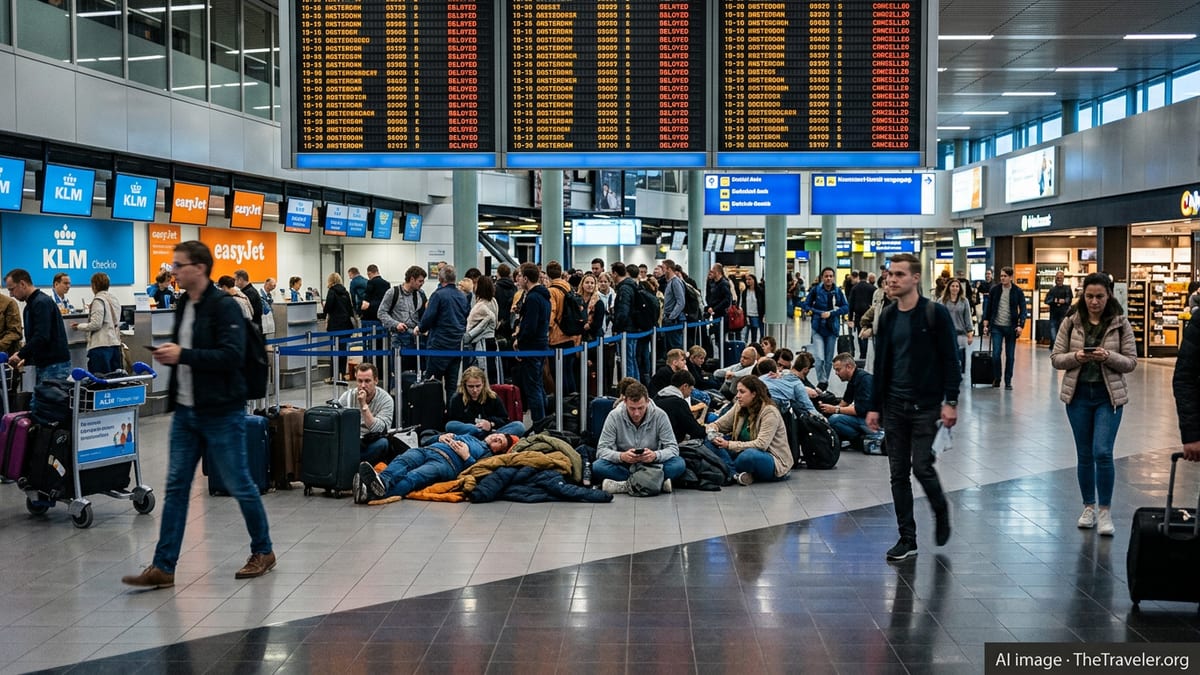
The most striking development in Week 29 was on punctuality. EUROCONTROL reports that total air traffic flow management delay across the network increased by about 80% compared with Week 28, even though the number of flights fell slightly over the same period.
On average, the system generated roughly 137,000 minutes of ATFM delay per day, with 3.8 minutes per flight attributed to en‑route constraints and 0.6 minutes to airport-related restrictions. That brought total flow-management delay to around 4.4 minutes per flight, noticeably above the levels recorded earlier in the summer.
Compared with 2025, Week 29 delay minutes were also elevated. EUROCONTROL’s overview indicates that total ATFM delay was about 11% higher than in the equivalent week last year, underscoring how quickly pressure can build once the summer peak is underway.
The combination of near‑stable traffic and sharply higher delay suggests that structural and operational bottlenecks, rather than demand alone, are driving the deterioration in on‑time performance. For passengers, the impact is felt in longer ground waits, missed connections and increased schedule uncertainty even on routes where flight frequencies have not changed significantly week on week.
Where the bottlenecks are emerging across the network
EUROCONTROL’s recent summer briefings for June and early July point to a set of recurring hotspots that help explain the Week 29 delay spike. Earlier weeks highlighted parts of France, Spain and Greece as major contributors to en‑route delays, with capacity limitations, staffing constraints and the bedding‑in of new air traffic systems among the main drivers.
In France, area control centres such as Reims, Marseille and Brest have been cited in previous reports as responsible for a sizeable share of en‑route delay minutes, particularly during peak hours. Capacity restrictions and staffing pressures have periodically reduced the flow of traffic, leading to airborne holding and departure regulations for overflights.
Southern Europe has also been under strain. Published EUROCONTROL analyses for mid‑June identified Spanish centres including Barcelona, Madrid and Sevilla, and Greek centres around Athens and Makedonia, as handling rapidly growing traffic with limited additional capacity. The combination of busy holiday routes, weather‑related constraints and staffing challenges has tended to magnify even minor disruptions.
While the Week 29 overview focuses on network‑level statistics rather than specific facilities, the pattern is consistent with earlier weeks. Once traffic reaches peak summer levels, local issues in a handful of control centres or airports can reverberate across the wider network, generating knock‑on delays far from the original source.
Impact on passengers and airlines across Europe
For travelers, the Week 29 figures translate into a greater risk that flights will depart or arrive later than scheduled, even if overall capacity and connectivity remain broadly similar to the previous week. High-frequency leisure routes, especially those linking northern Europe with Mediterranean destinations, are particularly exposed as they route through some of the busiest and most delay‑prone sectors.
Airlines face mounting operational complexity as they try to keep aircraft and crews in position. When ATFM regulations force slower flows through constrained airspace, carriers must juggle rotations, extend block times and add buffers where possible. These measures can limit the number of additional flights that can be scheduled and may reduce aircraft utilisation during the height of the season.
Airports at key hubs and holiday gateways are also affected as arrival waves bunch and departure banks compress. Ground handling teams and border control services must cope with more variable surges of passengers, which in turn can lengthen queues and boarding times even when headline passenger numbers are broadly unchanged from the previous week.
Travelers connecting between flights are likely to feel the effect most acutely. With more services arriving off‑schedule, minimal connection windows become harder to guarantee, leading to a rise in missed onward flights and rebookings, particularly on tightly timed evening banks.
What Week 29 signals for the rest of the summer
Week 29 covers the period just as European school holidays are ramping up across several major outbound markets. Historically, this part of July has tended to produce some of the most congested days of the year for EUROCONTROL’s network, and early data from 2026 appears to follow that pattern.
The latest overview suggests that, while traffic volumes are slightly below the early July peak, any further weather disruption, labour action or technical constraint could have an outsized effect on punctuality. With average delays already 80% higher than a week earlier, the margin for absorbing additional shocks appears limited.
At the same time, comparisons with earlier weeks in 2026 show that lower delay levels are possible when capacity and staffing align more closely with demand. In late spring and the first half of June, total ATFM delay per flight regularly hovered around or below two minutes, even as daily flights climbed toward current levels.
For the remainder of the summer period, the key question for travelers and the industry alike is whether the network can return closer to those earlier performance benchmarks while sustaining roughly 36,000 flights per day. EUROCONTROL’s subsequent weekly briefings will provide a clearer indication of whether Week 29 was a temporary spike or a warning sign of a more prolonged period of disruption.